
 Worksheets
Cash Flow Understanding Quiz
Total questions: 102
Worksheet time: 51mins
What is the role of understanding cash flow in a business?
It helps in the decision-making process.
It increases the company's profits.
It reduces the need for financial advisors.
It eliminates all financial risks.
What is a cash flow forecast?
A document that estimates future profits.
A document that helps estimate the amount of money moving in and out of a business.
A report on past financial performance.
A strategy for reducing expenses.
What does a healthy cash flow enable a business to do?
Increase its market share.
Meet its short-term outflows when needed.
Expand into new markets.
Hire more employees.
What is a cash flow forecast?
A historical record of past cash flows
An educated prediction of future cash flow
A detailed list of expenses
A summary of annual profits
How can a business use a cash flow forecast when there is a surplus?
Increase production
Save money for future shortages
Hire more employees
Expand to new markets
What might a business do if revenue is predicted to be low?
Increase salaries
Launch a promotion
Open new branches
Hire more staff
What is the main benefit of a cash flow forecast for a business?
It guarantees profit
It helps make decisions before issues arise
It eliminates all financial risks
It ensures constant revenue
What is a cash flow forecast used to investigate?
The future inflows and outflows of a business
The past profits of a business
The employee satisfaction levels
The market competition
Which of the following is considered a common inflow in a cash flow forecast?
Cash sales
Employee salaries
Office supplies
Marketing expenses
What indicates a healthy cash flow in a business?
Greater inflows than outflows
More expenses than income
Equal inflows and outflows
Greater outflows than inflows
Which of the following is NOT a common inflow mentioned in the document?
Loans
Credit sales
Office rent
Capital introduced
What are outflows in a business context?
Money entering a business
Money leaving a business
Money saved by a business
Money invested in a business
When is a business considered unhealthy in terms of cash flow?
When cash inflow is greater than cash outflow
When cash outflow is greater than cash inflow
When cash inflow equals cash outflow
When there is no cash flow
Which of the following is NOT a common outflow for a business?
Cash purchases
Credit purchases
Investments
Utilities
What is the main difference between cash purchases and credit purchases?
Cash purchases are paid immediately, while credit purchases are paid later.
Cash purchases are cheaper than credit purchases.
Credit purchases are always more expensive.
Cash purchases require a credit card.
Which of the following is typically a fixed regular payment made to an employee?
Wages
Rent
Salaries
Utilities
What is a regular payment made to a landlord usually in exchange for the use of a premises?
Utilities
Rent
Wages
Salaries
Which of the following is NOT considered a utility bill?
Electricity
Gas
Cable TV
Water
How are wages typically determined?
By a fixed annual rate
Based on hours worked
As a monthly sum
By the landlord
What can a business do with the VAT paid on goods and services?
Ignore it
Reclaim it
Double it
Transfer it
What is the formula for calculating net cash flow?
Cash inflows + cash outflows
Cash inflows - cash outflows
Cash outflows - cash inflows
Cash inflows x cash outflows
What does the opening balance represent in a business?
The total sales at the end of the month
The amount of cash inflow during the month
How much the business has at the start of each month
The profit made during the month
How is the closing balance calculated?
Opening balance - net cash flow
Opening balance + net cash flow
Net cash flow - opening balance
Cash inflows + cash outflows
What is the purpose of analyzing a cash flow forecast once it is completed?
To finalize the cash flow
To predict future sales
To make informed decisions
To increase employee salaries
How can a cash flow forecast help a business?
By predicting stock market trends
By predicting consequences of certain actions
By determining employee productivity
By setting product prices
What might be a consequence of hiring more employees according to a cash flow forecast?
Increased cash inflow
Decreased cash outflow
Detrimental impact on cash flow
Improved customer satisfaction
Why is it important to know the consequences predicted by a cash flow forecast?
To increase product prices
To put solutions in place before issues arise
To reduce marketing expenses
To hire more employees
How can a cash flow forecast be utilized when cash flow is negative?
To increase employee salaries
To manage months where cash flow is negative
To expand business operations
To reduce product prices
What does a cash flow forecast help identify?
The best marketing strategies
Where most of your inflows and outflows are coming from
The most profitable products
The most efficient employees
What can a business do when areas of concern occur in cash flow?
Increase inflows or decrease outflows
Hire more employees
Launch new products
Open new branches
How does a business decide what targets to set based on cash flow?
By analyzing competitor strategies
By identifying issues in its cash flow
By reviewing past sales data
By consulting with customers
Why might a business not make enough sales in certain months?
Due to poor marketing
Because of a seasonal business nature
Due to high employee turnover
Because of increased competition
What strategy can a business use to achieve greater sales in months with low sales?
Increase advertising budget
Diversify their product portfolio
Hire more staff
Lower product prices
What is a break-even chart used for?
To determine the point at which a business will begin to make a profit.
To calculate the total revenue of a business.
To find the maximum production capacity.
To assess employee performance.
What does a break-even chart typically show?
Fixed costs, variable costs, and revenue.
Employee salaries and benefits.
Market trends and forecasts.
Customer satisfaction levels.
What is the break-even point (BEP)?
The point at which a business's revenues equal its costs.
The point at which a business's costs exceed its revenues.
The point at which a business's revenues are double its costs.
The point at which a business's profits are maximized.
Why is a break-even chart particularly useful for a business?
It helps understand the relationship between unit price and sales volume.
It predicts future market trends.
It determines employee productivity.
It calculates tax liabilities.
What can a break-even chart help a business identify?
Ways to increase unit price or reduce costs.
New product development strategies.
Employee training needs.
Competitor weaknesses.
What does it mean for a company to break even?
The company makes a profit.
The company incurs a loss.
The company's income equals its expenditure.
The company's revenue is less than its costs.
What is the profit and loss when a company breaks even?
Profit = 0, Loss = 0
Profit = 100, Loss = 100
Profit = 50, Loss = 50
Profit = 10, Loss = 10
What must be true for a company to make a profit?
Revenue must be less than expenditure.
Revenue must be equal to expenditure.
Revenue must be greater than expenditure.
Revenue must be zero.
What information is needed to create an accurate break-even chart?
Total revenue and total costs
Total profit and total loss
Total assets and total liabilities
Total sales and total inventory
What is labeled on the vertical axis when creating a break-even chart?
Output
Costs/Sales
Revenue
Profit
In a break-even chart, what type of line represents fixed costs?
Vertical line
Diagonal line
Horizontal line
Curved line
At what point do the total revenue line and total costs line intersect in a break-even chart?
Maximum profit point
Break-even point
Loss point
Revenue peak
What does the grey shaded area above the break-even point on a break-even graph represent?
Loss
Fixed Costs
Profit
Total Costs
What does the purple shaded area below the break-even point on a break-even graph indicate?
Profit
Loss
Total Revenue
Break-even Point
In a break-even graph, what does it mean when total costs are higher than total revenue?
The business is making a profit
The business is at the break-even point
The business is making a loss
The business has no fixed costs
What is the purpose of analyzing a break-even chart?
To create a new business plan
To identify key points and inform business decisions
To increase the number of products sold
To reduce employee salaries
What does a statement of comprehensive income provide to a business?
An estimate of future profits
An accurate account of profit and loss
A list of all assets
A summary of employee performance
What is deducted from sales revenue in a statement of comprehensive income?
Assets
Liabilities
Expenses
Investments
Over what period of time does a statement of comprehensive income usually record financial information?
1 month
6 months
1 year
5 years
Why is a statement of comprehensive income important for a business?
It helps in understanding the business's financial position.
It is used to calculate taxes.
It determines employee salaries.
It predicts future market trends.
What should a business do if it identifies a loss?
Ignore the loss and continue operations.
Assess the profit & loss account to find the cause.
Immediately shut down the business.
Increase product prices without analysis.
What is another name for a Statement of Financial Position?
Income Statement
Cash Flow Statement
Balance Sheet
Profit and Loss Statement
When is a Statement of Financial Position usually produced?
At the beginning of the financial year
At the end of the financial year
Every month
Every quarter
What does a Statement of Financial Position show?
Only the assets of a business
Only the liabilities of a business
The net worth of a business at a particular point in time
The revenue of a business
What are the two main components shown in a Statement of Financial Position?
Revenue and Expenses
Assets and Liabilities
Profits and Losses
Cash and Investments
How is sales revenue calculated?
Opening inventory + Purchases - Closing inventory
Quantity sold x Selling price
Sales - Cost of goods sold
Opening inventory - Purchases + Closing inventory
What is the formula for calculating the cost of goods sold?
Sales - Gross profit
Quantity sold x Selling price
Opening inventories + Purchases - Closing inventories
Sales + Purchases - Closing inventories
If a business sells 1000 jackets at £100 each, what is the total sales revenue?
£10,000
£100,000
£1,000,000
£50,000
What is the gross profit if the sales are £100,000 and the cost of goods sold is £25,000?
£50,000
£75,000
£25,000
£100,000
What is gross profit?
The total sales revenue
The amount of money left after deducting the cost of goods sold from sales revenue
The total cost of goods sold
The opening inventory value
How is gross profit calculated?
Sales turnover + cost of goods sold
Sales turnover - cost of goods sold
Opening inventory - closing inventory
Purchases + closing inventory
How is net profit calculated according to the statement of comprehensive income?
Gross profit + expenses + other revenue income
Gross profit - expenses + other revenue income
Gross profit - expenses - other revenue income
Gross profit + expenses - other revenue income
What is considered revenue income in the context of the statement?
Sales from core business activities
Interest from the bank
Cost of goods sold
Depreciation
What are current assets expected to be used for within a company?
Long-term investments
Standard business operations within the current year
Employee salaries
Marketing campaigns
Which of the following is NOT considered a current asset?
Cash in Hand
Cash in the Bank
Premises
Inventories
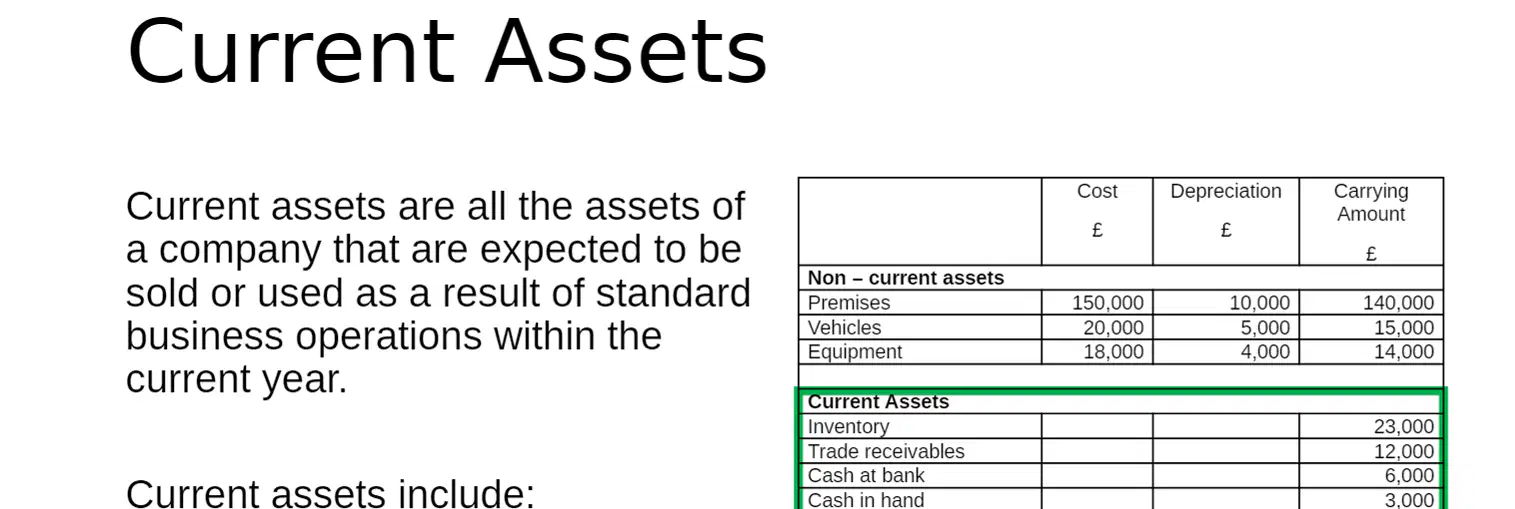
What is the total value of current assets listed in the table?
£23,000
£44,000
£15,000
£29,000
Which of the following is an example of trade receivables?
Cash in Hand
People that owe the business money
Inventory
Equipment
What are current liabilities?
Debts that the business owes that need repaying in under one year.
Long-term debts that the business owes.
Assets that the business owns.
Income generated by the business.
Which of the following is an example of a current liability?
Overdrafts
Premises
Vehicles
Equipment
How is working capital calculated?
Current assets minus current liabilities
Total assets minus total liabilities
Current liabilities minus current assets
Total liabilities minus total assets
What could indicate cash flow problems in a business?
Current liabilities greater than current assets
Current assets greater than current liabilities
High retained profit
Low depreciation
What are non-current liabilities?
Short-term debts that need to be paid within a year
Long-term debts that need to be paid back in more than one year's time
Assets that can be quickly converted to cash
Expenses that occur regularly
Which of the following is an example of a non-current liability?
Inventory
Trade payables
Bank loan
Cash at bank
How are net assets calculated?
Non-current assets + current liabilities - current assets
Current assets + current liabilities - non-current liabilities
Non-current assets + current assets - (current liabilities + non-current liabilities)
Non-current liabilities + current liabilities - current assets
What does "Capital Employed" refer to in a business context?
The total amount of money borrowed by a business
The capital put into the business plus retained profits
The total sales revenue of a business
The total expenses of a business
What are retained profits?
Profits distributed to shareholders
Profits reinvested back into the business
Profits used to pay off debts
Profits used for employee bonuses
Which of the following is a non-current asset?
Inventory
Trade receivables
Premises
Cash at bank
How is sales revenue calculated?
Opening inventory + Purchases - Closing inventory
Quantity sold x Selling price
Sales - Cost of goods sold
Opening inventory - Purchases + Closing inventory
What is the formula for calculating the cost of goods sold?
Sales - Gross profit
Quantity sold x Selling price
Opening inventories + Purchases - Closing inventories
Sales + Purchases - Closing inventories
If a business sells 1000 jackets at £100 each, what is the total sales revenue?
£10,000
£100,000
£1,000,000
£50,000
What is the gross profit if the sales are £100,000 and the cost of goods sold is £25,000?
£50,000
£75,000
£25,000
£100,000
What is gross profit?
The total sales revenue
The amount of money left after deducting the cost of goods sold from sales revenue
The total cost of goods sold
The opening inventory value
How is gross profit calculated?
Sales turnover + cost of goods sold
Sales turnover - cost of goods sold
Opening inventory - closing inventory
Purchases + closing inventory
How is net profit calculated according to the statement of comprehensive income?
Gross profit + expenses + other revenue income
Gross profit - expenses + other revenue income
Gross profit - expenses - other revenue income
Gross profit + expenses - other revenue income
What is considered revenue income in the context of the statement?
Sales from core business activities
Interest from the bank
Cost of goods sold
Depreciation
What are current assets expected to be used for within a company?
Long-term investments
Standard business operations within the current year
Employee salaries
Marketing campaigns
Which of the following is NOT considered a current asset?
Cash in Hand
Cash in the Bank
Premises
Inventories
What is the total value of current assets listed in the table?
£23,000
£44,000
£15,000
£29,000
Which of the following is an example of trade receivables?
Cash in Hand
People that owe the business money
Inventory
Equipment
What are current liabilities?
Debts that the business owes that need repaying in under one year.
Long-term debts that the business owes.
Assets that the business owns.
Income generated by the business.
Which of the following is an example of a current liability?
Overdrafts
Premises
Vehicles
Equipment
How is working capital calculated?
Current assets minus current liabilities
Total assets minus total liabilities
Current liabilities minus current assets
Total liabilities minus total assets
What could indicate cash flow problems in a business?
Current liabilities greater than current assets
Current assets greater than current liabilities
High retained profit
Low depreciation
What are non-current liabilities?
Short-term debts that need to be paid within a year
Long-term debts that need to be paid back in more than one year's time
Assets that can be quickly converted to cash
Expenses that occur regularly
Which of the following is an example of a non-current liability?
Inventory
Trade payables
Bank loan
Cash at bank
How are net assets calculated?
Non-current assets + current liabilities - current assets
Current assets + current liabilities - non-current liabilities
Non-current assets + current assets - (current liabilities + non-current liabilities)
Non-current liabilities + current liabilities - current assets
What does "Capital Employed" refer to in a business context?
The total amount of money borrowed by a business
The capital put into the business plus retained profits
The total sales revenue of a business
The total expenses of a business
What are retained profits?
Profits distributed to shareholders
Profits reinvested back into the business
Profits used to pay off debts
Profits used for employee bonuses
Which of the following is a non-current asset?
Inventory
Trade receivables
Premises
Cash at bank

