
Font size
 Worksheets
7.7A , 7.7C , 6.8A 6.8B - 8th Grade Review
Total questions: 55
Worksheet time: 28mins
In an outdoor plant, the process of photosynthesis converts carbon dioxide and water to glucose and oxygen. How is energy conserved within this system during this process?
Thermal energy from the Sun transforms into light energy that is given off by the plant.
Light is transformed into chemical and heat energy as the plant gets warmer in the sunlight.
Chemical energy is transformed into mechanical energy as the plant grows.
Radiant or light energy is transformed into chemical energy.
Which of these statements correctly describes energy transformation when a wooden log burns in a fireplace?
A. Chemical energy is transformed into potential energy.
B. Chemical energy is transformed into thermal energy and light energy.
C. Thermal energy and light energy are transformed into potential energy.
D. Thermal energy and light energy are transformed into chemical energy.

Which of these descriptions of how the basketball behaves correctly explains the kinetic energy of the basketball?
The kinetic energy is not transformed into any other energy forms.
The kinetic energy is conserved after each bounce, so it remains the same.
The kinetic energy decreases after each bounce because some of it is transformed to other forms of energy.
The kinetic energy increases after each bounce because other forms of energy are transformed to kinetic energy.
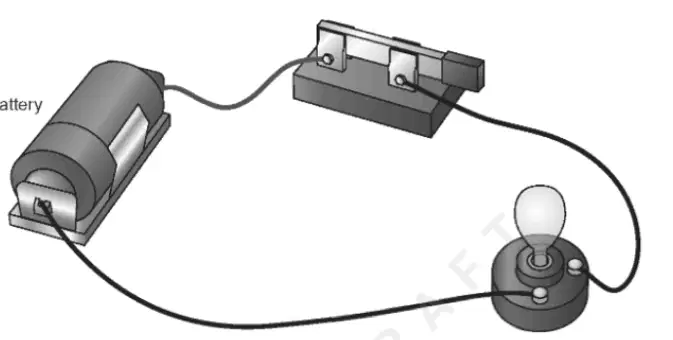
Over time, the battery loses power and the bulb dims. Finally, it goes out. What happened to the energy?
The battery creates new energy.
There is no energy being transformed by the system.
Energy is being destroyed by the system.
Energy is leaving the system in the form of light and heat.
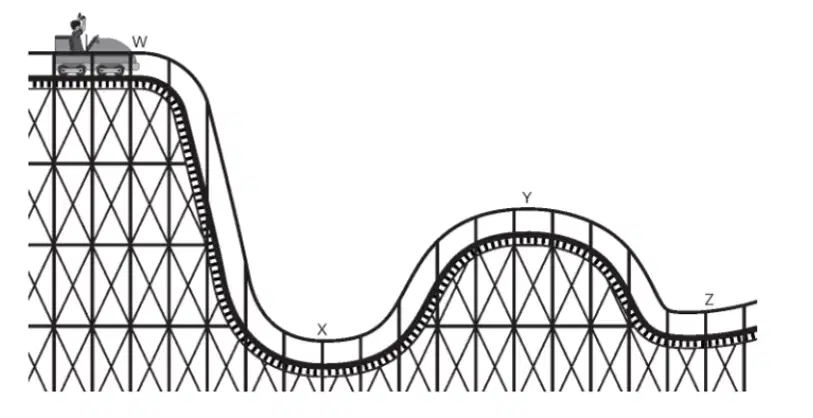
At what point will the roller coaster car have transformed the greatest amount of gravitational potential energy into kinetic energy? Pick the ONE correct answer.
W
X
Y
Z
As the car moves down the slope, the amount of ___ energy decreases while the amount of ___ energy increases.
kinetic; potential
potential; kinetic
mechanical; kinetic
thermal; potential
Choose the correct path by which energy is transferred through the roller coaster. Between Point W and Point Z, the total amount of energy in the car –
stayed the same; it gained gravitational potential energy but lost kinetic energy.
stayed the same; it lost gravitational potential energy but gained kinetic energy.
changed; it gained gravitational potential energy and gained kinetic energy.
changed; it lost gravitational potential energy and lost kinetic energy.
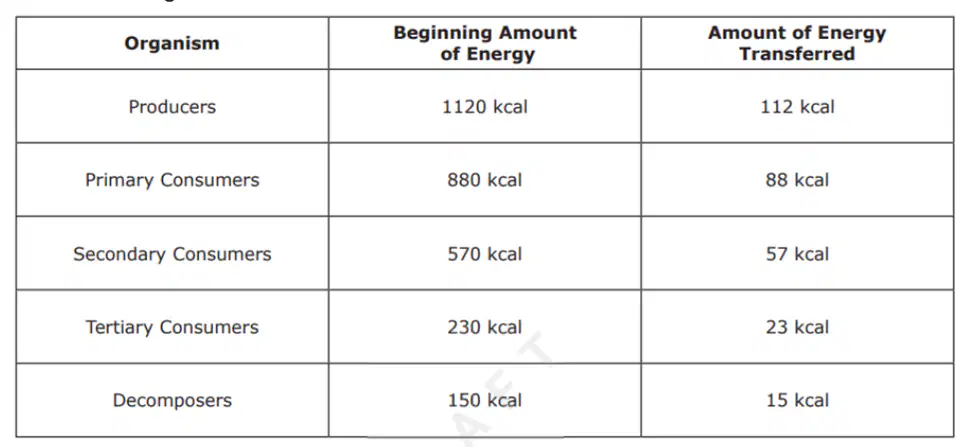
Which of the following are true statements?
Some energy is lost as heat into the environment.
The difference in the beginning amount of energy between producers and decomposers is 970 kcal.
Energy is destroyed when the producers are eaten.
Energy is conserved because of the law of conservation of energy.
Decomposers consume the highest amount of energy.
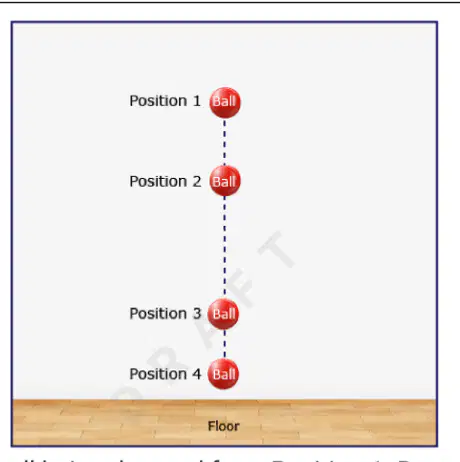
Based on the path traveled, at which position would the ball have the greatest kinetic energy and least potential energy?
Position 1
Position 2
Position 3
Position 4
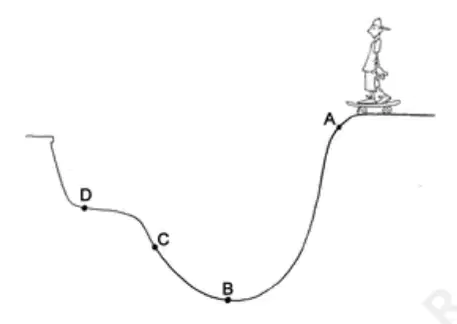
At which point is Marshall's greatest gravitational potential energy the greatest?
Point A
Point B
Point C
Point D
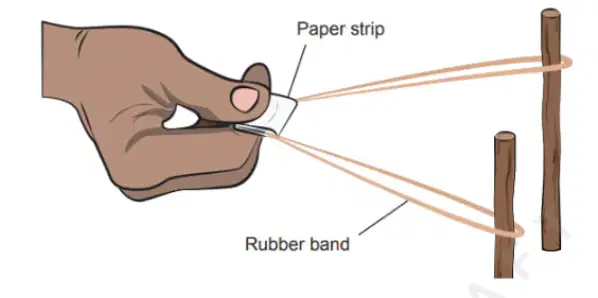
In what parts of the model can elastic potential energy and kinetic energy be observed?
Elastic potential energy is observed when the rubber band has been pulled all the way back. Kinetic energy is observed when you release the rubber band.
Elastic potential energy is observed when you release the rubber band. Kinetic energy is observed as you are pulling the rubber band back.
Elastic potential energy is built up in the paper strip. Kinetic energy is built up in the sticks.
Elastic potential energy is built up in the sticks. Kinetic energy is observed any time the rubber band is moving.
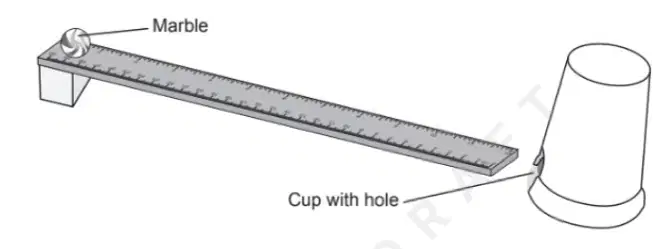
Which of the following will change the gravitational potential energy the marble starts with?
Switching the plastic ruler for a wooden one
Replacing the marble with a rock
Applying more force to the marble down the ramp
Increasing the height of the book under the ruler
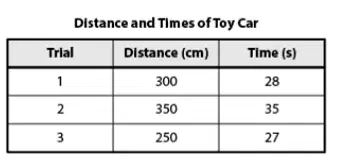
A student is investigating motion by rolling a toy car down a ramp. The distance and time over three trials are shown in the table. What is the average speed of the car?
10 cm/s
12 cm/s
15 cm/s
9 cm/s
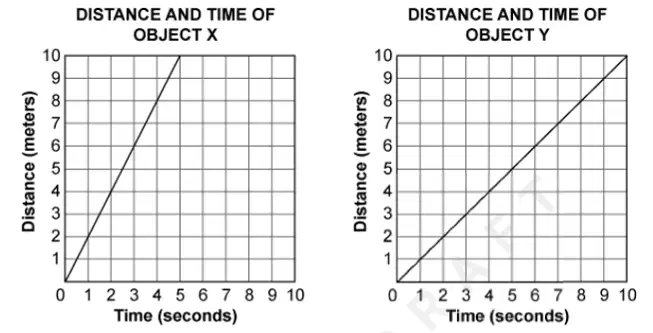
Two objects, X and Y, each started at the same origin. The graphs show how far each object traveled over a period of time. What was the average speed of each object?
Object X: 2 m/s; Object Y: 1 m/s
Object X: 1 m/s; Object Y: 2 m/s
Object X: 1/2 m/s; Object Y: 1 m/s
Object X: 1 m/s; Object Y: 1/2 m/s
An old trick to determine an approximate distance to a storm is to count the number of seconds it takes to hear a peal of thunder after seeing a lightning bolt and divide that number by 5 to get the number of miles to the storm. If it takes 15 seconds for thunder to reach an observer 3 miles away, about how fast is the sound of the thunder traveling in miles per second to the nearest tenth?
0.2
0.5
2.0
5.0
Gregory is visiting his grandmother, who lives 200 km from his house. While traveling there, Gregory had an average speed of 100 km/h. Which of the following is true about Gregory's trip?
Gregory must have maintained a constant velocity of 100 km/h.
Gregory must have maintained a constant speed of 100 km/h.
Gregory must have stopped sometime during his trip.
Gregory must have completed the trip in 2 hours.
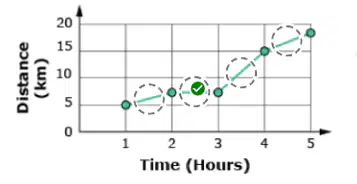
The motion graph shows a bike trip that Kara took last Saturday. Which part of her trip shows that she stopped to rest?
Between 0 and 1 hour
Between 1 and 2 hours
Between 2 and 3 hours
Between 3 and 4 hours
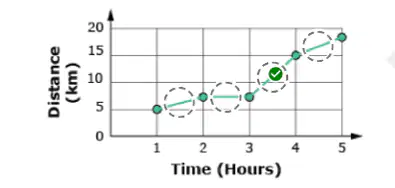
Based on the motion graph, during which section of Kara's trip was she traveling the fastest?
Between 0 and 1 hour
Between 1 and 2 hours
Between 2 and 3 hours
Between 4 and 5 hours
Between 3 and 4 hours
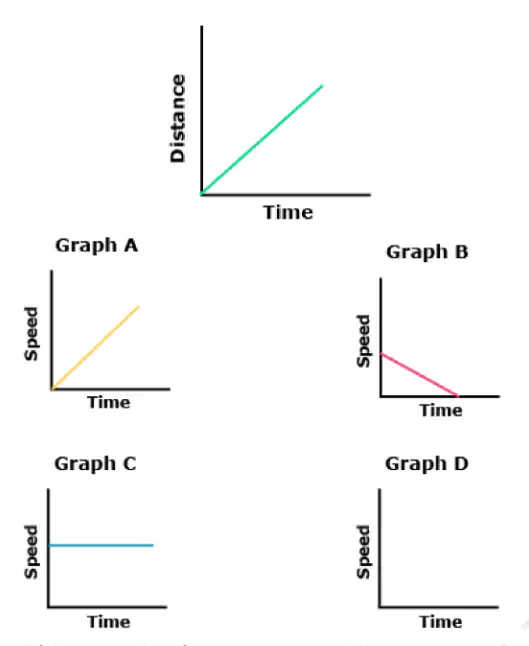
A distance-time graph displaying an object's motion is shown. Below the distance-time graph are four different speed-time graphs. Which of the speed-time graphs matches the motion displayed on the distance-time graph?
A
B
C
D
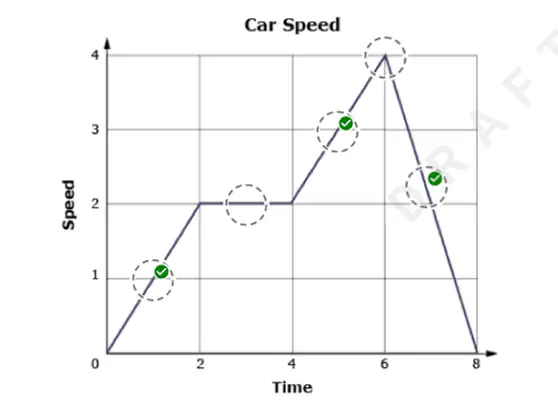
The graph represents the speed of an object over time. At which sections of the graph is the object accelerating? Select THREE correct answers.
Between 0 and 2 seconds
Between 2 and 4 seconds
Between 4 and 6 seconds
Between 6 and 8 seconds
Photosynthesis goes through two energy transformations. What are the transformations?
radiant
chemical
chemical
radiant
electrical
nuclear
radiant
sound
Compare and contrast gravitational potential energy and kinetic energy. Which of the following statements is true?
Gravitational potential energy is stored energy due to an object's position, while kinetic energy is the energy of motion.
Both gravitational potential energy and kinetic energy depend on the speed of an object.
Kinetic energy is stored energy, while gravitational potential energy is the energy of motion.
Gravitational potential energy and kinetic energy are the same and can be used interchangeably.
Which of the following scenarios best illustrates the conservation of energy in an amusement park ride?
A roller coaster at the top of a hill has maximum kinetic energy.
A roller coaster descending a hill converts potential energy into kinetic energy.
A roller coaster at the bottom of a hill has maximum potential energy.
A roller coaster moving on a flat track has no energy transformation.
Calculate the average speed of a car that travels 150 kilometers in 3 hours.
45 km/h
50 km/h
55 km/h
60 km/h
Which of the following best distinguishes between speed and velocity?
Speed includes direction, while velocity does not.
Velocity includes direction, while speed does not.
Speed and velocity are the same and can be used interchangeably.
Speed is a vector quantity, while velocity is a scalar quantity.
A spring is compressed and then released. Which type of energy transformation occurs?
Chemical potential energy to kinetic energy
Elastic potential energy to kinetic energy
Gravitational potential energy to kinetic energy
Kinetic energy to chemical potential energy
Describe how energy is conserved in a food web.
Energy is created at each trophic level.
Energy is destroyed as it moves through the food web.
Energy is transferred and transformed from one organism to another.
Energy remains constant and does not change form.
A cyclist travels 30 kilometers in 2 hours. What is the cyclist's average speed?
10 km/h
15 km/h
20 km/h
25 km/h
A car travels 100 meters north in 10 seconds. What is the car's velocity?
10 m/s
10 m/s north
10 m/s south
100 m/s north
Plan an investigation to compare the kinetic energy of two objects with different masses but the same speed. What factors should be considered?
Only the speed of the objects
Only the mass of the objects
Both the mass and speed of the objects
Neither mass nor speed, only the type of objects
Design an experiment to demonstrate energy conservation in an electrical circuit. What is a key component to include?
A single light bulb with no power source
A power source, such as a battery, and a resistor
Only wires with no connections
A switch that is always off
A runner completes a 400-meter track in 50 seconds. Calculate the runner's average speed.
6 m/s
7 m/s
8 m/s
9 m/s
A car travels 60 meters east in 5 seconds. What is the car's velocity?
12 m/s
12 m/s east
12 m/s west
60 m/s east
Analyze the motion of an object using a distance-time graph. What does a horizontal line on the graph indicate?
The object is moving at a constant speed.
The object is accelerating.
The object is decelerating.
The object is at rest.
Evaluate the energy transformations in photosynthesis. Which of the following best describes the process?
Chemical energy is converted into light energy.
Light energy is converted into chemical energy.
Mechanical energy is converted into thermal energy.
Thermal energy is converted into mechanical energy.
A toy car moves 20 meters in 4 seconds. What is the toy car's average speed?
4 m/s
5 m/s
6 m/s
7 m/s
A train travels 200 meters west in 20 seconds. What is the train's velocity?
10 m/s
10 m/s west
10 m/s east
200 m/s west
Compare and contrast gravitational potential energy and kinetic energy. Which of the following statements is true?
Gravitational potential energy is stored energy due to an object's position, while kinetic energy is the energy of motion.
Both gravitational potential energy and kinetic energy depend on the speed of an object.
Kinetic energy is stored energy, while gravitational potential energy is the energy of motion.
Gravitational potential energy and kinetic energy are the same and can be used interchangeably.
Which of the following scenarios best illustrates the conservation of energy in an amusement park ride?
A roller coaster at the top of a hill has maximum kinetic energy.
A roller coaster descending a hill converts potential energy into kinetic energy.
A roller coaster at the bottom of a hill has maximum potential energy.
A roller coaster moving on a flat track has no energy transformation.
Calculate the average speed of a car that travels 150 kilometers in 3 hours.
45 km/h
50 km/h
55 km/h
60 km/h
Which of the following best distinguishes between speed and velocity?
Speed includes direction, while velocity does not.
Velocity includes direction, while speed does not.
Speed and velocity are the same and can be used interchangeably.
Speed is a vector quantity, while velocity is a scalar quantity.
A spring is compressed and then released. Which type of energy transformation occurs?
Chemical potential energy to kinetic energy
Elastic potential energy to kinetic energy
Gravitational potential energy to kinetic energy
Kinetic energy to chemical potential energy
Describe how energy is conserved in a food web.
Energy is created at each trophic level.
Energy is destroyed as it moves through the food web.
Energy is transferred and transformed from one organism to another.
Energy remains constant and does not change form.
A cyclist travels 30 kilometers in 2 hours. What is the cyclist's average speed?
10 km/h
15 km/h
20 km/h
25 km/h
A car travels 100 meters north in 10 seconds. What is the car's velocity?
10 m/s
10 m/s north
10 m/s south
100 m/s north
Plan an investigation to compare the kinetic energy of two objects with different masses but the same speed. What factors should be considered?
Only the speed of the objects
Only the mass of the objects
Both the mass and speed of the objects
Neither mass nor speed, only the type of objects
Design an experiment to demonstrate energy conservation in an electrical circuit. What is a key component to include?
A single light bulb with no power source
A power source, such as a battery, and a resistor
Only wires with no connections
A switch that is always off
A runner completes a 400-meter track in 50 seconds. Calculate the runner's average speed.
6 m/s
7 m/s
8 m/s
9 m/s
A car travels 60 meters east in 5 seconds. What is the car's velocity?
12 m/s
12 m/s east
12 m/s west
60 m/s east
Analyze the motion of an object using a distance-time graph. What does a horizontal line on the graph indicate?
The object is moving at a constant speed.
The object is accelerating.
The object is decelerating.
The object is at rest.
Evaluate the energy transformations in photosynthesis. Which of the following best describes the process?
Chemical energy is converted into light energy.
Light energy is converted into chemical energy.
Mechanical energy is converted into thermal energy.
Thermal energy is converted into mechanical energy.
A toy car moves 20 meters in 4 seconds. What is the toy car's average speed?
4 m/s
5 m/s
6 m/s
7 m/s
A train travels 200 meters west in 20 seconds. What is the train's velocity?
10 m/s
10 m/s west
10 m/s east
200 m/s west
Energy conversion in which sunlight, water and carbon dioxide is converted into oxygen and glucose.
photosynthesis
cellular respiration
DNA replication
Biomolecules

