
 Worksheets
Nervous System Review
Total questions: 60
Worksheet time: 1hrs 3mins

1 ?
Cell body
Nucleus
Axon
Dendrite
Schwann cell
2 ?
Cell body
Nucleus
Axon
Dendrite
Schwann cell
3 ?
Cell body
Nucleus
Axon
Dendrite
Schwann cell
4 ?
Axon hillock
Nucleus
Axon
Dendrite
Schwann cell
5 ?
Axon hillock
Node of Ranvier
Axon
Dendrite
Schwann cell
6 ?
Axon hillock
Node of Ranvier
Axon
Myelin Sheath
Schwann cell
7 ?
Myelin sheath
Node of Ranvier
Axon
Dendrite
Schwann cell
8 ?
Myelin sheath
Node of Ranvier
Axon terminal
Dendrite
Schwann cell
What are cells that transmit impulses?
Neurons
Neuroglia
Glia cells
Schwann Cells
What part of the neuron transmits impulses towards the cell body?
Nodes of Ranvier
Axon
Axon terminal
Dendrites
What part of the neuron transmits impulses away from the cell body?
Nodes of Ranvier
Axon
Axon terminal
Dendrites
What connects the cell body to the axon in a neuron?
Axon hillock
Dendrites
Schwann Cells
Myelin sheath
Which structure of a neuron is responsible for releasing neurotransmitters?
Axon terminal
Dendrites
Schwann Cells
Myelin sheath
What are the gaps between Schwann cells that help transmit impulses?
Axon terminal
Synaptic cleft
Myelin sheath
Nodes of Ranvier
Myelinated neurons in the brain make up
White matter
Grey matter
What is the type of conduction that occurs when the impulse jumps along the nodes of Ranvier in myelinated neurons?
Saltatory
Excretory
Excitatory
Sweetatory

posterior median sulcus
A
B
C
D
E
posterior funiculus
A
B
C
D
E

What is 2
(a)
What is 7
(a)
What is 8
(a)
What is 9
(a)
What is 11
(a)
What is 12
(a)

What is #1?
Frontal Lobe
Parietal Lobe
Cerebellum
Occipital Lobe
What is #2?
Frontal Lobe
Temporal Lobe
Medulla Oblongata
Occipital Lobe
What is #3?
Frontal Lobe
Parietal Lobe
Temporal Lobe
Occipital Lobe
What is #6?
Occipital Lobe
Corpus Callosum
Medulla Oblongata
Cerebellum

What is #2?
Cerebellum
Pons
Corpus Callosum
Thalamus
What is #5?
Cerebellum
Medulla Oblongata
Midbrain
Thalamus
What is #9?
Thalamus
Pons
Midbrain
Cerebellum
What is #13?
Hypothalamus
Pons
Midbrain
Thalamus
Functions include initiating voluntary movement, personality, and higher cognitive functions such as decision-making and judgment.
Frontal lobe
Parietal lobe
Occipital lobe
Temporal lobe
What is the largest area of the brain that controls everything conscious (the 4 lobes of the brain)?
The temporal lobe controls
learning, memory, thinking
speech, memory, smell and hearing
Speech, feelings and hearing
learning, behavior, and feelings
The cerebellum controls
breathing, coordination and balance
balance, coordination and temperature
coordination, balance and muscle control
heart rate and coordination
Which part of the brain processes visual information?
Temporal lobe
Occipital lobe
Frontal lobe
Parietal lobe

This is a picture of the brain and spinal cord make up what?
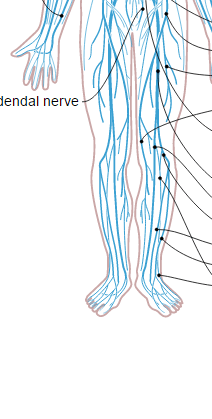
This is a picture of all the nerves coming off the spinal cord make up what?
Which brain part helps regulate body temp., controls water balance, and regulates metabolism?
Cerebellum
Thalamus
Occipital Lobe
Hypothalamus
Cranial Nerve 5
Abducens
Glossopharyngeal
Trigeminal
Trochelar
Which cranial nerves test touch sensation on the forehead, cheek, and jaw?
vagus
trigeminal
acoustic
Facial
Which cranial nerve is tested by a shoulder shrug?
vagus
accessory
acoustic
abucens
Which cranial nerve controls involuntary function of vital organs?
vagus
accessory
glossopharyngeal
abucens
Cranial Nerve 9
Accessory
Glossopharyngeal
Olfactory
Hypoglossal
Trochlear
Sensory
Motor
Both
What reflex instructs the eyes to have a hard blink movement?
Pupillary Reflex
Consensual Reflex
Corneal Reflex
Accommodation Reflex
Which reflex has the eyes become un-yoked (crossed)?
Accommodation Reflex
Corneal Reflex
Convergence Reflex
Pupillary Reflex
Which reflex has the feet go into plantar flexion?
Plantar Reflex
Biceps Reflex
Stretch Reflex
Achilles Reflex
A clinical evaluation for areflexia
0
1
2
3
Clinical evaluation for hyporeflexia
0
1
2
3
What test is evaluating the Babinski Reflex?
plantar reflex
ankle reflex
stretch reflex
biceps reflex
Somatic nerves innervate
skeletal muscle
cardiac muscle
nervous muscle
smooth muscle
Sensory neurons are also called ____________ neurons
Afferent
Efferent

