Wayground logo

Free Printable Worksheets

Font size

S
M
L
XL
Worksheets

Unit 06: Bonding Intro

Total questions: 59

Worksheet time: 1hrs 24mins
Name
Class
Date
1.
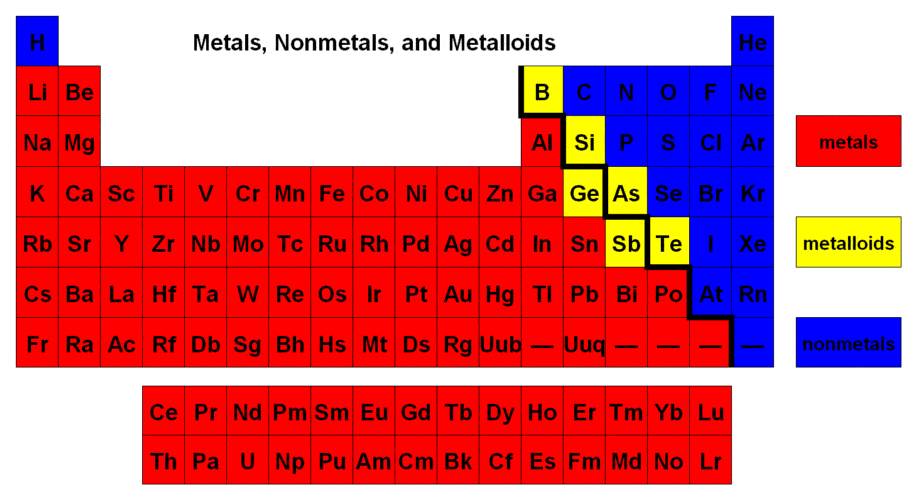
What elements generally make an ionic bond?
a)
metal and nonmetal
b)
2 or more nonmetals
c)
metal
d)
none of the above
2.

When forming a covalent bond, a non-metal atom:
a)
Gains electrons to form a cation
b)
Loses electrons to form a cation
c)
Gains electrons to form an anion
d)
Loses electrons to form an anion
3.
What elements generally make a covalent bond?
a)
metal and nonmetal
b)
2 or more nonmetals
c)
metal
d)
none of the above
4.
In chemical compounds, covalent bonds form when
a)
the electronegativity difference between two atoms is very large.
b)
electrons are completely transferred between two metals.
c)
pairs of electrons are shared between two nonmetal atoms.
d)
two nonmetal atoms are attracted to each other by opposite charges.
5.
An ionic bond forms when 
a)
Valence electrons are shared
b)
a sea of mobile electrons surround the cations
c)
valence electrons are transferred between atoms
d)
none of the above
6.
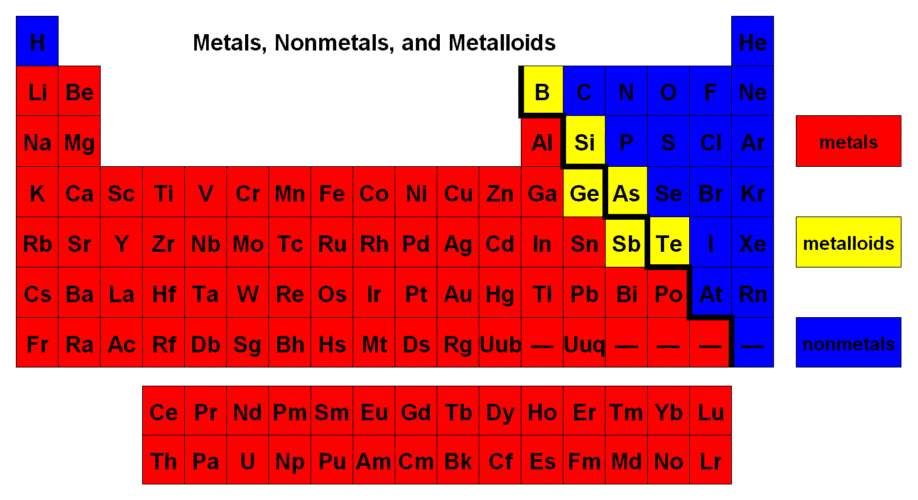
Predict the bond that will form between Be and F.
a)
Ionic
b)
Covalent
7.
Predict the bond that will form between Se and Cl.
a)
Ionic
b)
Covalent
8.
A chemical bond between oppositely charged ions.
a)
compound
b)
ion
c)
covalent bond
d)
ionic bond
9.
A chemical bond formed between shared atoms.
a)
chemical bond
b)
covalent bond
c)
oxidation #
d)
ionic bond
10.
Substance made from two or more combined atoms. 
a)
ion
b)
covalent bond
c)
ionic bond
d)
compound
11.
Force that holds together atoms in a substance.
a)
compound
b)
ion
c)
chemical bond
d)
ionic bond
12.

What type of energy is stored in a bond?

a)

potential energy

b)

kinetic energy

c)

thermal energy

13.

Why do atoms bond?

a)

to become more stable

b)

to get 8 valence electrons

c)

to gain more neurons

d)

to gain more protons

14.

when a bond is formed?

a)

energy is released

b)

energy is absorbed

c)

exothermic

d)

stability increases

15.

When a bond is BROKEN

a)

energy is absorbed

b)

energy is released

c)

endothermic

d)

stability decreases

16.

Why is there a transfer of electrons in ionic compounds?

a)

because the electronegativity difference is greater than 1.7

b)

because the electronegativity difference is greater than 1.0

c)

because the electronegativity difference is between 0.0 - 0.4

d)

because the electronegativity difference is between 0.5 - 1.7

17.

H2

a)

ionic

b)

covalent

18.

CH4

a)

ionic

b)

covalent

19.

CaCl2

a)

ionic

b)

covalent

20.

What type of energy is stored in a bond?

a)

chemical

b)

potential

c)

kinetic

d)

thermal

21.

C2O5

a)

Covalent

b)

Ionic

22.

CCl4

a)

Covalent

b)

Ionic

23.

PI3

a)

Covalent

b)

Ionic

24.

PI5

a)

Covalent

b)

Ionic

25.

S2Cl2

a)

Covalent

b)

Ionic

26.

S2F10

a)

Covalent

b)

Ionic

27.

CO

a)

Covalent

b)

Ionic

28.

F10O9

a)

Covalent

b)

Ionic

29.

FN

a)

Covalent

b)

Ionic

30.

I2Cl

a)

Covalent

b)

Ionic

31.

NaBr

a)

Covalent

b)

Ionic

32.

MgCl2

a)

Covalent

b)

Ionic

33.

K2Te

a)

Covalent

b)

Ionic

34.

Na3N

a)

Covalent

b)

Ionic

35.

Li2S

a)

Covalent

b)

Ionic

36.

MnS2

a)

Covalent

b)

Ionic

37.

Mg3P2

a)

Covalent

b)

Ionic

38.

CaCN

a)

Covalent

b)

Ionic

39.

RbOH

a)

Covalent

b)

Ionic

40.

AlPO4

a)

Covalent

b)

Ionic

41.

This could be the dot diagram of

a)

Mg

b)

Cl

c)

C

d)

O

42.

What is the goal of the Lewis Dot Structure?

a)

To determine the electron position.

b)

To show the element's valence electrons & bonding capabilities.

c)

To find the atomic mass of an element.

d)

To search for the number of electrons in an individual atom.

43.

How many valence electrons should Lithium have in its Lewis dot model?

a)

1

b)

2

c)

3

d)

4

44.

How many valence electrons should Oxygen have in its Lewis dot model?

a)

5

b)

6

c)

7

d)

8

45.

How many valence electrons should Magnesium have in its Lewis dot model?

a)

1

b)

2

c)

3

d)

4

46.

This is a correct dot diagram for nitrogen (N)

a)

true

b)

false

47.

This is a correct dot diagram for carbon (C)

a)

true

b)

false

48.

This is a correct dot diagram for neon (Ne)

a)

true

b)

false

49.

Which of these is incorrect?

a)
b)
50.

How many electrons should Boron have around its Lewis dot model?

a)

1

b)

2

c)

3

d)

4

51.
How many valence electrons does chlorine (Cl) have?
a)
2
b)
5
c)
6
d)
7
52.
How many valence electrons does carbon (C) have?
a)
3
b)
4
c)
5
d)
6
53.
Which of these elements has 8 valence electrons?
a)
P
b)
Be
c)
O
d)
Ar
54.
This is a correct dot diagram for oxygen (O)
a)
true
b)
false
55.
According to the octet rule most elements need _______ valence electrons.
a)
2
b)
8
c)
6
d)
18
56.
Which type of bonding leads to brittle substances?
a)
Metallic
b)
Ionic
c)
Network Covalent
d)
Molecular Covalent
57.
A mystery substance has a low melting point, does not dissolve in water, does not conduct electricity, and is made of nonmetals. This substance is soft. Which type of substance is it most likely to be?
a)
Metal
b)
Ionic
c)
Network Covalent
d)
Molecular Covalent
58.
A mystery substance has a high melting point, dissolves in water, does not conduct electricity when it is solid, and is made of metals and nonmetals. Which type of substance is it most likely to be?
a)
Metal
b)
Ionic
c)
Network Covalent
d)
Molecular Covalent
59.

a substance in an excellent conductor of electricity in a solution. The chemical bonds in this substance are most likely?

a)

ionic, because the valence electrons are mobile

b)

ionic, because the valence electrons are stationary

c)

covalent, because the valence electrons are stationary

d)

metallic, because the valence electrons are stationary