
 Worksheets
Types of Chemical Reactions and Balancing Practice
Total questions: 70
Worksheet time: 1hrs 6mins
(a) H2 + (b) Cl2 → (c) HCl
What is the right part of a chemical equation called?
2H2 + O2 ---> 2H2O
Reactants
Yields
Products
Chemical Equation
In a balanced equation, the total number of atoms of each element on the left side (reactants) is _____ the total number of atoms on the right side (products).
equal to
greater than
less than
unequal to
The Law of Conservation of Mass states that mass is ______ during a chemical reaction.
created
destroyed
converted into energy
neither created nor destroyed
What is the number before a chemical formula called?
Example: 2H2 + O2 ---> 2H2O
Coefficient
Atom
Subscript
Equation
(a) Al + (b) O2 → (c) Al2O3
(a) Fe + (b) O2 → (c) Fe2O3
What is the left part of a chemical equation called?
2H2 + O2 ---> 2H2O
Reactants
Yields
Products
Chemical equation
(a) ZnS + (b) O2 → (c) ZnO + (d) SO2
(a) Sb + (b) O2 → (c) Sb4O6
(a) AgNO3 + (b) Ni → (c) Ni(NO3)2 + (d) Ag
(a) Zn + (b) AgCl → (c) ZnCl2 + (d) Ag
(a) KI + (b) Pb(NO3)2 → (c) KNO3 + (d) PbI2
(a) Ca + (b) H2O → (c) Ca(OH)2 + (d) H2
(a) Li + (b) H2SO4 → (c) Li2SO4 + (d) H2
(a) S8 + (b) O2 → (c) SO2
(a) C2H2 + (b) O2 → (c) CO2 + (d) H2O
(a) H2SO4 + (b) NaCN → (c) HCN + (d) Na2SO4
(a) NH3→ (b) N2 + (c) H2
(a) Cu + (b) H2SO4 → (c) CuSO4 + (d) H2O + (e) SO2
(a) AgNO3 + (b) NaCl → (c) AgCl + (d) NaNO3
(a) FeCl3 + (b) NaOH → (c) Fe(OH)3 + (d) NaCl
(a) Mg(OH)2 + (b) H2SO4 → (c) MgSO4 + (d) H2O
(a) AgNO3 + (b) CuCl2 → (c) AgCl + (d) Cu(NO3)2
(a) C3H8 + (b) O2 → (c) CO2 + (d) H2O
(a) NaOH + (b) H3PO4 → (c) H2O + (d) Na3PO4
(a) MgCl2 + (b) NaOH → (c) Mg(OH)2 + (d) NaCl
(a) Fe + (b) CuSO4 → (c) Cu + (d) Fe2(SO4)3
(a) H2S → (b) H2 + (c) S8
(a) Na2SO4 + (b) CaF2 → NaF + (c) CaSO4
(a) Mg + (b) CuSO4 → (c) Cu + (d) MgSO4
(a) AgNO3 + (b) Cu → (c) Ag + (d) Cu(NO3)2
What is the little number after an element in a chemical equation called? Example:Cl2
(a)

When the chemical equation is balanced, what is the SUM of all of the coefficients?
(a)
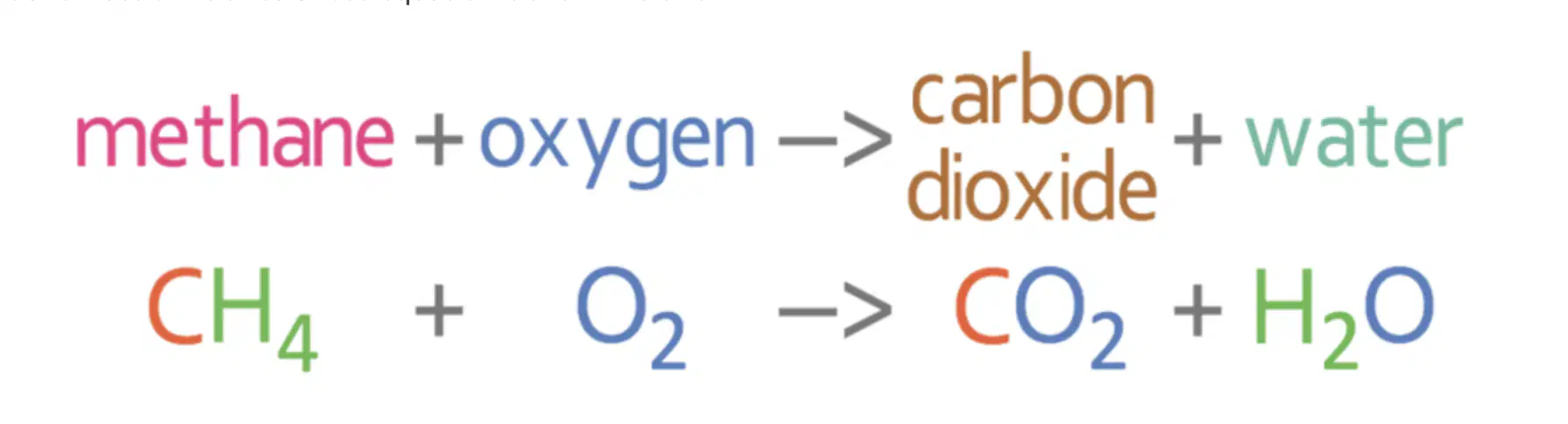
When the equation is balanced, what is the SUM of the coefficients?
(a)

When the equation is balanced, what is the SUM of the coefficients?
(a)

When the equation is balanced, the SUM of the coefficients is
(a)
What reaction has the following general formula:
AB --> A + B
Combination
Decomposition
Single Replacement
Double Replacement
Combustion
What reaction has the following general formula:
A + CD --> C + AD
Combination
Decomposition
Single Replacement
Double Replacement
Combustion
What reaction has the following general formula:
AB + CD --> CB + AD
Combination
Decomposition
Single Replacement
Double Replacement
Combustion
What reaction has the following general formula:
A + B --> AB
Combination
Decomposition
Single Replacement
Double Replacement
Combustion
What reaction has the following general formula:
CxHy + O2 −>CO2 + H2O
Combination
Decomposition
Single Replacement
Double Replacement
Combustion
What is the general reaction scheme for a single replacement reaction?
A + B --> AB
AB --> A + B
A + CD --> C + AD
AB + CD --> CB + AD
CxHy+O2 −> CO2+H2O
What is the general reaction scheme for a combustion reaction?
A + B --> AB
AB --> A + B
A + CD --> C + AD
AB + CD --> CB + AD
CxHy+O2 −> CO2+H2O
What is the general reaction scheme for a combination reaction?
A + B --> AB
AB --> A + B
A + CD --> C + AD
AB + CD --> CB + AD
CxHy+O2 −> CO2+H2O
What is the general reaction scheme for a double replacement reaction?
A + B --> AB
AB --> A + B
A + CD --> C + AD
AB + CD --> CB + AD
CxHy+O2 −> CO2+H2O
What is the general reaction scheme for a decomposition reaction?
A + B --> AB
AB --> A + B
A + CD --> C + AD
AB + CD --> CB + AD
CxHy+O2 −> CO2+H2O
What type of reaction is the following:
2H2+O2−>2H2O
Combination
Decomposition
Single Replacement
Double Replacement
Combustion
What type of reaction is the following:
BaCl2+2KI −> 2KCl + BaI2
Combination
Decomposition
Single Replacement
Double Replacement
Combustion
What type of reaction is the following:
C11H24+17O2−> 11CO2 + 12H2O
Combination
Decomposition
Single Replacement
Double Replacement
Combustion
What type of reaction is the following:
2KI −> 2K + I2
Combination
Decomposition
Single Replacement
Double Replacement
Combustion
What type of reaction is the following:
2NaHCO3−> Na2CO3+CO2+H2O
Combination
Decomposition
Single Replacement
Double Replacement
Combustion
What type of reaction is the following:
Zn + 2HCl −> ZnCl2+H2
Combination
Decomposition
Single Replacement
Double Replacement
Combustion
What type of reaction is the following:
3CuS +2Al −> Al2S3+3Cu
Combination
Decomposition
Single Replacement
Double Replacement
Combustion
What type of reaction is the following:
2C4H10 +13O2 −> 8CO2+10H2O
Combination
Decomposition
Single Replacement
Double Replacement
Combustion
What type of reaction is the following:
Na2S +2HCl −> H2S+2NaCl
Combination
Decomposition
Single Replacement
Double Replacement
Combustion
What type of reaction is the following:
Ag3N + 3HBr−>3AgBr+H3N
Combination
Decomposition
Single Replacement
Double Replacement
Combustion
What are the products of the reaction: MgO ->?
Mg + O2
Mg + O
2MgO
CO2 + H2O
What are the products of this reaction:
C2H4 + O2 -->
C2O2 + H4
CO2 + H2 + O2
CO + H
CO2 + H2O
No Reaction
What are the products for octane (C8H18) combusting?
CO2 + H2O
C + H2 + O2
C + H + O
C8 + H18
Which of these is a product for H2O -->
H2
OH
H
O
H2O2
Predict the products for the reaction of Aluminum and Oxygen
(a)
Which of these is a product for the decomposition of Carbon tetrachloride (CCl4)
CCl2
Cl2
Cl
C4
C2
Which of these is a product for the decomposition of ammonia (NH3)
H2
N2H2
N
H
H3
What is the product when Calcium reacts with chlorine?
CaCl2
CaCl
Ca2Cl
Ca + Cl2
Ca + Cl
What are the products of the reaction:
K + O2 -->
KO2
KO
K2O
OK2
O2K
What is the term for the number written below and to the right of a chemical symbol in a formula?
Example: H2O
Coefficient
Subscript
Superscript
Exponent
Which of the following is a characteristic of a balanced chemical equation?
Different number of atoms on each side
Equal number of atoms of each element on both sides
More products than reactants
More reactants than products

