wayground logo

Free Printable Worksheets

Font size

S
M
L
XL
Worksheets

Unit 2 Cells Test

Total questions: 48

Worksheet time: 1hrs 3mins

Name
Class
Date
1.
A single-celled organism that lacks a membrane-bound nucleus, mitochondria, or any other membrane -bound organelle .
a)
Prokaryote
b)
Eukaryote
c)
Nucleus
d)
Single-celled organism
2.
Which type of cell?
a)
Prokaryote
b)
Eukaryote
3.
Which type of cell?
a)
Prokaryote
b)
Eukaryote
4.
According to cell theory, where did this cell come from?
a)
another living cell
b)
energy from sun
c)
a multicellular organism
d)
the nonliving environment
5.

What is the gel-like substance inside of cells that provides a medium for metabolism?

a)
photoplasm
b)
photosynthesis
c)
cytoskeleton
d)
cytoplasm
6.

Which of the following is directly involved in the transportation of proteins and other materials within the cell?

a)
Endoplasmic Reticulum
b)
Vacuole
c)
Lysosome
d)
Mitochondria
7.
Directs all cell activities through the DNA located there.
a)
Lysosomes
b)
Nucleus
c)
ribosomes
d)
Mitochondria
8.
Chloroplasts in plant cells allow the plant to perform a function that animal cells cannot do.  What is the main function of the chloroplasts found in plant cells?
a)

to absorb light energy and manufacture food (glucose)

b)
to remove waste materials by active transport
c)

to manufacture chemical energy from food and store as ATP

d)
to control the shape of the cell
9.
All cells need energy to function.  Which cell organelle is responsible for producing energy in the cell?
a)
chloroplasts
b)
mitochondria
c)
nucleus
d)
vacuoles
10.
What is the function of a cell wall?
a)
to protect and support the cell
b)
to perform different functions in each cell
c)
to prevent water from passing through it
d)
to prevent oxygen from entering the cell
11.

What is one basic function of the vacuoles?

a)
circulating oxygen
b)
producing food
c)
controlling cell processes
d)
storing water
12.
Cell organelles that are responsible for digesting food, worn out organelles and other cellular wastes are called ___________________.
a)
Mitochondria
b)
Vacuoles
c)
Lysosomes
d)
Chlororplasts
13.

Which cell structure controls what can come into or leave a cell?

a)
cell membrane
b)
cytoplasm
c)
nucleus
d)
vacuole
14.

Cell that contains a true nucleus and membrane bound organelles

a)

Mitochondria

b)

Eukaryote

c)

Prokaryote

d)

Bacteria

15.

Which organelle receives proteins and materials from the ER, packages them and distributes them

a)

Vacuoles

b)

Golgi Bodies

c)

Nucleus

d)

Chromatin

16.

what is the function of ribosomes

a)

to assemble amino acids to create proteins

b)

to pack proteins

c)

to clean proteins

17.

IDENTIFY the form of transport is being shown in the diagram.

a)
diffusion
b)
osmosis
c)
facilitated diffusion
d)
active transport
18.
If the sodium concentration inside a cell is greater than outside the cell, how can a cell take in more sodium?
a)
osmosis
b)
diffusion
c)
active transport
d)
passive transport
19.

When a cell forms a vesicle around unwanted particles and expels it OUT of the cell.

a)

Pinocytosis

b)

Endocytosis

c)

Receptor-mediated

d)

Exocytosis

20.
A type of active transport that brings particles into a cell when the cell membrane encloses a particle to make a vesicle
a)
Diffusion
b)
Passive Transport
c)
Active Transport
d)
Endocytosis
21.
In this image, the cell is using which type of molecular transport?
a)
Osmosis
b)
Diffusion 
c)
Endocytosis
d)
Exocytosis 
22.
Facilitated diffusion is the movement of materials into and out of the cell
a)
with the use of energy
b)
with the use of proteins but no energy
c)
by moving water
d)
by using ATP
23.
The  movement of water from a high concentration to a low concentration is called
a)
diffusion
b)
osmosis
c)
facilitated diffusion
d)
active transport
24.
Semi-permeable mean to allow
a)
all materials across the membrane
b)
only some materials across the membrane
c)
no material to cross the membrane
d)
to allow only water across the membrane
25.
Passive transport is called "passive" because it occurs WITHOUT
a)
cause.
b)
energy.
c)
a concentration gradient.
d)
a cell wall.
26.
Active transport allows a cell to move molecules from an area of low concentration to an area of high concentration.
a)
True
b)
False
27.
Which of the following is NOT a type of passive transport?
a)
Osmosis
b)
Diffusion
c)
Endocytosis
28.

When the concentration of solutes on both sides of a membrane is the SAME, the solution is

a)
isotonic
b)
hypertonic
c)
hypotonic
29.
Facilitated diffusion involves movement of molecules across a membrane when they bond to 
a)
channel proteins
b)
lipid proteins
c)
a protein pump (carrier protein)
d)
sticky proteins
30.

Match the following

a)

Simple Diffusion

1.

When molecules passively cross the plasma membrane through the phospholipid bilayer

b)

Facilitated Diffusion

2.

When molecules passively cross the plasma membrane through a channel protein

c)

Osmosis

3.

The movement of water across the cell membrane

d)

Endocytosis

4.

Bringing in large materials through the cell membrane into a vacuole.

e)

Exocytosis

5.

Moving larger amounts or large quantities of materials through the cell membrane

31.

This a picture of an animal and plant cell placed in a solution. Describe the solution?

a)

Isotonic

b)

Hypotonic

c)

Hypertonic

32.
The maintenance of an organism’s internal environment is called:
a)
compensating
b)
homeostasis
c)
balancing
d)
routine
33.
The "effect" of a given stimulus is the...
a)
response
b)
stimulus
c)
cause
d)
result
34.
The "cause" for something to happen is the
a)
response
b)
effect
c)
stimulus
d)
homeostasis
35.
The process of childbirth is an example of:
a)
negative feedback loop
b)
positive feedback loop
36.
Maintaining body temperature is an example of a:
a)
negative feedback loop
b)
positive feedback loop
37.

A is pointing to: 

a)
chromosome
b)

Sister chromatid

c)
centromere
d)

Telomere

38.
B is pointing to: 
a)
chromosome
b)

Sister chromatid

c)
centromere
d)

Telomere

39.

C is pointing to: 

a)
chromosome
b)

Sister chromatid

c)
centromere
d)

Telomere

40.
Question Image

Match the following

a)

Interphase

1.

The longest stage of a cell's life

b)

G1

2.

part of interphase where the cell is growing

c)

S phase

3.

DNA Synthesis

When the cell is making more DNA

d)

G2

4.

part of interphase where the cell prepares to divide

e)

Cell Division

5.

A small stage in the cell's life where the cell splits to make more cells

41.
What is the purpose of mitosis?
a)
To increase the surface area of a cell
b)
To allow cells to divide for growth, repair, and renewal
c)
For increasing genetic variation within a species
d)
To allow for DNA replication and protein synthesis
42.

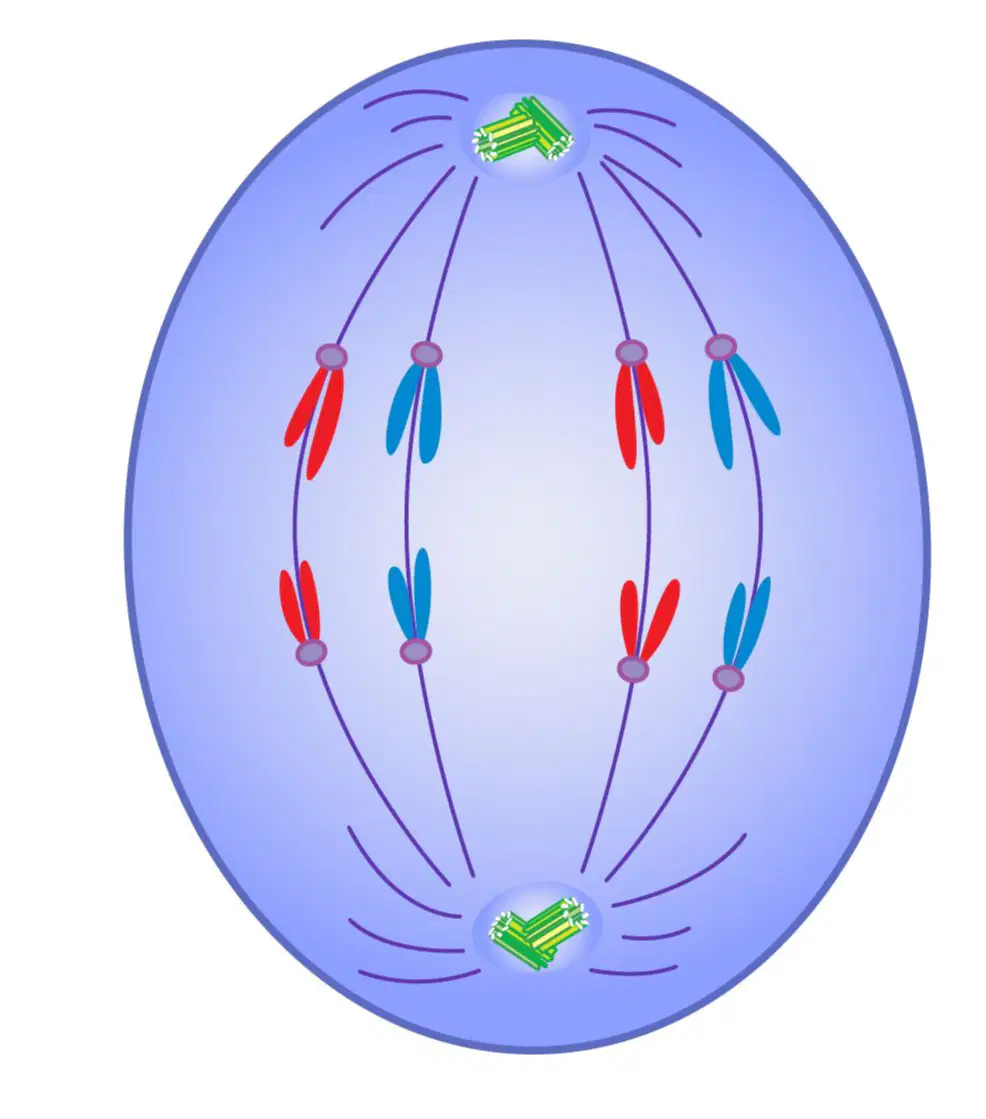
Match the following images to the correct Phase of Mitosis

a)

1.

Prophase

b)

2.

Metaphase

c)

3.

Anaphase

d)

4.

Telophase

e)

5.

Cytokinesis

43.

What is happening during prophase?

a)

chromosomes condense, nucleus disappears

b)

chromosomes appears, nucleus condenses

c)

chromosomes condense, nucleus condenses

d)

chromosomes disappears, nucleus disappears

44.

What is happening during metaphase?

a)

DNA lines up in the middle of the cell and DNA attaches to spindle fibers

b)

centrioles and spindle fibers appear

c)

2 new identical cells are created

d)

DNA gets copied

45.

What is happening during anaphase?

a)

DNA lines up in the middle of the cell and DNA attaches to spindle fibers

b)

centrioles and spindle fibers appear

c)

Each DNA gets pull to the opposite sides of the cell

d)

DNA gets copied

46.

What is happening during telophase?

a)

DNA lines up in the middle of the cell and DNA attaches to spindle fibers

b)

centrioles and spindle fibers appear

c)

Each DNA gets pull to the opposite sides of the cell

d)

2 new nuclei form

47.

What is happening during cytokinesis?

a)

DNA lines up in the middle of the cell and DNA attaches to spindle fibers

b)

Cell membrane pinches to make 2 new identical daughter cells

c)

Each DNA gets pull to the opposite sides of the cell

d)

2 new nuclei form

48.
Mitosis results in the formation of...
a)
Two identical cells with all of the original chromosomes
b)
Two different cells with half of the original chromosomes
c)
Four identical cells with all of the original chromosomes
d)
Four different cells with half of the original chromosomes