
 Worksheets
HS20 - Muscular System Review
Total questions: 65
Worksheet time: 33mins
What is the primary function of the muscular system?
To produce heat
To provide stability
To enable movement
To store energy
What is the term for the "hinge" of motion?
Tendon
Ligament
Fulcrum
Joint
Which muscles are responsible for moving internal organs?
Skeletal
Cardiac
Smooth
Voluntary
Which type of muscle has the most oxygen supply?
Smooth
Skeletal
Cardiac
Voluntary
Which type of movement involves moving on an axis, such as the neck turning?
Flexion
Extension
Rotation
Adduction
What causes a muscle contraction?
Myosin breaking down
Actin pulling itself along myosin
Collagen stretching
Elastin contracting
What type of movement is involved in pulling actions?
Abduction
Adduction
Flexion
Extension
Which movement is described as moving away from the body?
Adduction
Abduction
Flexion
Rotation
What is muscular dystrophy?
An inherited disease causing progressive weakness
A bacterial infection
An autoimmune disorder
A chronic pain condition
What does botulism cause?
Paralysis
Muscle atrophy
Joint dislocation
Chronic pain
What is used to treat torn muscles?
Surgery
RICE
Antibiotics
Chemotherapy
What is used to treat certain degenerative diseases?
Physiotherapy
Surgery
Antibiotics
Chemotherapy
Which doctor specializes in the study of nerves and how signals are sent throughout the body?
Orthopedist
Neurologist
Podiatrist
Chiropractor
What is the role of a Chiropractor?
Study of nerves
Treatment of the spine
Muscles and how they work
Feet or ankles
What does an Athletic trainer help with?
Study of nerves
Movement and health related to movement
Diseases of the spine
Feet or ankles
Which type of muscle is responsible for voluntary movements?
Smooth
Cardiac
Skeletal
Involuntary
What is the primary role of ligaments in the body?
Connect muscles to bones
Connect bones to bones
Provide muscle contraction
Store calcium
Which condition is characterized by inflammation of the joints?
Osteoporosis
Arthritis
Muscular dystrophy
Fibromyalgia
What is the primary function of tendons in the body?
Connect muscles to bones
Connect bones to bones
Provide muscle contraction
Store calcium
Which condition is characterized by a decrease in bone density?
Arthritis
Osteoporosis
Muscular dystrophy
Fibromyalgia
What type of muscle is responsible for involuntary movements?
Smooth
Cardilacisomethingthatisthewronganswer
Skeletal
Voluntary
What is the primary function of cartilage in the joints?
Connect muscles to bones
Provide cushioning and reduce friction
Store calcium
Facilitate blood flow
Which type of joint allows for the greatest range of motion?
Hinge joint
Ball and socket joint
Pivot joint
Gliding joint
What is the role of synovial fluid in the body?
Lubricate joints
Connect bones to muscles
Store energy
Transmit nerve signals
Which type of joint is found in the elbow?
Ball and socket joint
Hinge joint
Pivot joint
Gliding joint
What is the function of red bone marrow?
Store minerals
Produce blood cells
Provide energy
Facilitate movement
What is the primary function of synovial fluid in joints?
To provide nutrients to bones
To lubricate and reduce friction
To connect muscles to bones
To store calcium
Which condition is characterized by a progressive weakening of muscles?
Osteoporosis
Arthritis
Muscular dystrophy
Fibromyalgia
What is the role of a Podiatrist?
Study of nerves
Treatment of the spine
Muscles and how they work
Doctor for Feet or ankles
What is one of the functions of the muscular system?
Producing heat
Digesting food
Regulating body temperature
Filtering blood
Which type of muscle is voluntarily controlled?
Skeletal muscle
Cardiac muscle
Smooth muscle
All of the above
Which type of muscle is found in the walls of internal organs?
None of the above
Smooth muscle
Cardiac muscle
Skeletal muscle
What is the role of ATP in muscle contractions?
Regulates body temperature
Transmits nerve impulses to muscle fibers
Allows muscles to slide and prevent bursting
Provides energy for muscle contractions
How many skeletal muscles are there in the body?
Over 300
Over 500
Over 100
Over 650
Which type of muscle is involuntary and makes up many of your internal organs?
skeletal
smooth
cardiac
gastrointestinal
The _________ separate one sarcomere from another?
synapses
m-lines
z-lines (z-discs)
active sites
Which type or types of muscle fibers is/are non-striated?
skeletal
cardiac
smooth
fasicular
Which muscle group is primarily responsible for the flexion of the forearm?
The deltoids
The biceps brachii
The triceps brachii
The quadriceps
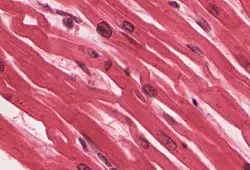
Look at the image of cardiac muscle. Which of the following best describes what you see?
All the muscle fibers are shaped like eyes.
The muscle fibers are branching and connected to each other.
All the muscle fibers are oval and purple.
All the muscle fibers are running parallel to each other.
What type of muscle provides slower motion?
Skeletal muscle
Cardiac and smooth muscle
Fast-twitch muscle
None of the above
What is the function of tropomyosin?
It binds calcium ions.
It blocks myosin binding sites on actin.
It hydrolyzes ATP.
It releases ADP.
What does the myosin filament pull on to shorten a sarcomere?
Actin filament
Calcium ions
ATP molecules
Muscle fiber
What is the result of the sliding filament theory?
Muscle contraction
Muscle relaxation
Muscle elongation
Muscle fatigue
Which of the following Muscles is a SMOOTH Muscle?
The Heart
The Stomach
The Bicep
The Pectoral
This muscle is the hardest-working muscle in the body.
The Heart
The Lungs
The Legs
The Brain

Which Muscles are highlighted in Blue in the Photo?
The Quadriceps (Quads)
The Hamstrings
The Gluteus Maximus
The Gastrocnemius (Calves)

Which Muscles are highlighted in Blue in the Photo?
The Obliques
Latissimus Dorsi (Lats)
The Abdominals (Abs)
The Pectorals (Pecs)

Which Muscles are highlighted in the Photo?
The Quadriceps (Quads)
The Hamstrings
The Gluteus Maximus
The gastrocnemius (Calves)

Which Muscles are highlighted in the Photo?
The Biceps
The Triceps
The Pectorals (Pecs)
The Hamstrings

Which Muscles are highlighted in the Photo?
The Deltoids (Delts)
The Trapezius (Traps)
The Pectorals (Pecs)
The Gluteus Maximus (Glutes)

Which Muscles are highlighted in the Photo?
The Deltoids (Delts)
The Pectorals (Pecs)
The Abdominals (Abs)
The Triceps

Which Muscles are highlighted in the Photo?
The Quadriceps (Quads)
The Hamstrings
The Gastrocnemius (Calves)
The Gluteus Maximus (Glutes)

Abdominals
Obliques
Pectorals
Trapezius

What group of muscles are located in the upper front part of the leg?
quadriceps
gastrocnemius
hamstrings
abdominals

What muscle can you see in the image?
Hamstrings
Quadriceps
Gluteus Maximus
Gastrocnemius

What is this muscle?
Chest
Pectorals
Deltoids
Trapezius

