Worksheets
MANAGERIAL ECONOMICS
Total questions: 50
Worksheet time: 13hrs 30mins
(a) is a time period where all factors can be changed.
If the marginal is less than the average, then the average declines.
TRUE
FALSE
When the marginal product is greater than the average product, average product decreases.
TRUE
FALSE
A firm should hire more workers, if the value of the marginal product of that worker exceeds the cost of hiring or the wage.
TRUE
FALSE
Marginal product cannot be negative.
TRUE
FALSE
When there is increasing marginal returns, total product increases at an increasing rate so marginal product increases.
TRUE
FALSE
When there is diminishing marginal returns, both the total product and marginal product are decreasing.
TRUE
FALSE
With fixed production level, the average product will decline as more workers are employed in the production.
TRUE
FALSE
The law of diminishing returns will not take effect if no input is fixed.
TRUE
FALSE
When total product declines, marginal product becomes negative and diminishing returns set in.
TRUE
FALSE
A (a) shows the relationship between the level of output that can be produced with a given set of inputs.
It refers to the additional output produced when an additional unit of a variable input is added in the production process.
(a)
_ refers to the output produced by each unit of a variable input used in production.
(a)
Negative marginal returns occurs when total product starts to decline as more of the variable input are used in production holding other inputs fixed.
TRUE
FALSE
When the marginal product is negative, total product is decreasing.
TRUE
FALSE
Short-run is a time period where some factors are fixed and some are variable.
TRUE
FALSE
When there is diminishing marginal returns, as more of a variable input are added to a fixed input, the variable input becomes less productive.
TRUE
FALSE
When the marginal and average products are equal, the marginal product is at the maximum.
TRUE
FALSE
Variable inputs are those that can easily be increased or decreased in a short period of time.
TRUE
FALSE
It is easier to measure the marginal product of labor if the output is countable, unlike in services.
TRUE
FALSE
When output is zero, fixed cost is also zero.
TRUE
FALSE
Explicit costs include the salary you could have earned if you were an employee rather than if you were running your own business.
TRUE
FALSE
The marginal cost will always come from the change in the variable cost, not from the fixed cost.
TRUE
FALSE
When output is zero, fixed cost is also zero.
TRUE
FALSE
The ___________ cost does not exist in the long run.
average cost
variable cost
marginal cost
fixed cost
The ___________ cost does not exist in the long run.
total cost
variable cost
none of the above
fixed cost
Which of the following is true?
When MR=MC, output is optimal.
When MR=MC, output should be reduced.
When MR>MC, output should be decreased.
When MR < MC, output should be increased.
It changes accordingly with the quantity produced.
average fixed cost
fixed cost
variable cost
all of the above
The goal of the firm is to __.
be the most in demand
minimize the number of workers
maximize the profit
produce the highest possible output
Suppose the oligopoly firm's product price is P 50. The average total cost per unit is P 30, marginal revenue and marginal costs are equal at P 20, and the quantity being sold in the market is 1,000 units. How much is the firm's profit?
(a)
Which of the following can be a source of product differentiation?
all of the above
physical attributes of the product
branding and packaging
geographic location
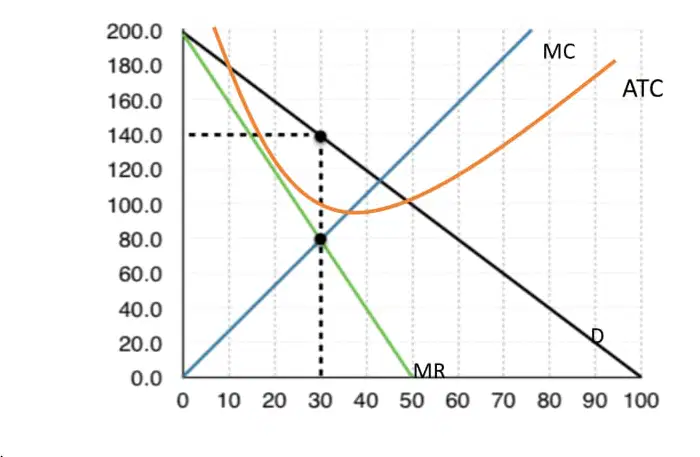
Consider this graph of a firm under monopolistic competition. How much is the firm's profit, if the firm will try to maximize its profits?

Under a perfectly competitive market, the firm's demand curve is also the marginal revenue curve.
True
False
Which of the following conditions is not true if a firm under monopolistic competition is incurring losses?
P > ATC
P > MC
P > MR
MR = MC
Which of the following is not a source of market power?
presence of many substitute goods
exclusive right over an essential resource
economies of scale
high cost of entry
Which of the following is not a characteristic of a perfectly competitive firm?
The demand curve is perfectly elastic.
The seller has a slight influence on the market price.
there is perfect information.
The products sold in the market are homogeneous.
Examples of industries under this type of market structure are airline, telecommunication, and banking industries.
oligopoly
monopolistic competition
monopoly
perfect competition
Advertisements and promotions are needed to communicate the differentiation of the seller's products from its competitors.
oligopoly
monopolistic competition
monopoly
perfect competition
The product sold in the market is unique.
oligopoly
monopolistic competition
monopoly
perfect competition
The seller is a price taker.
oligopoly
monopolistic competition
monopoly
perfect competition
The firm has market power being the sole provider of the product in the market.
oligopoly
monopolistic competition
monopoly
perfect competition
Many sellers selling differentiated product
oligopoly
monopolistic competition
monopoly
perfect competition
few sellers in the market where each seller serves a large portion/share of the market.
oligopoly
monopolistic competition
monopoly
perfect competition
Many sellers selling homogeneous products.
oligopoly
monopolistic competition
monopoly
perfect competition
Suppose the monopoly firm's product price is P 100 and the total cost of producing 100 units of the firm's product is P 4,500. The firm's marginal revenue and marginal costs are equal at this level of output with a value of P30. How much is the firm's profit?
(a)
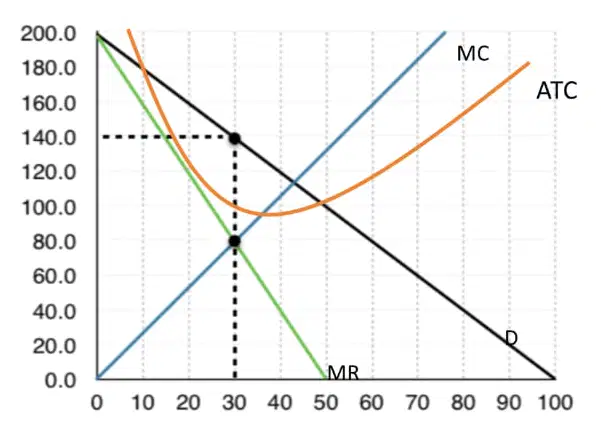
Consider this graph of a firm under monopolistic competition. How much is the firm's profit, if the firm will try to maximize its profits?
Suppose the oligopoly firm's product price is P 50. The average total cost per unit is P 30, marginal revenue and marginal costs are equal at P 20, and the quantity being sold in the market is 1,000 units. How much is the firm's profit?
(a)
As long as the MR of the firm is greater than the MC, then the firm should increase output to raise profits.
True
False
Which of the following conditions is not true in the long-run for a firm under monopolistic competition?
P = ATC
P < MC
MR = MC
P > MR
Consider this graph of a firm under monopolistic competition. How much is the firm's price mark-up over its marginal cost?