
 Worksheets
Chapter 9 - DNA Replication and Protein Synthesis
Total questions: 53
Worksheet time: 27mins
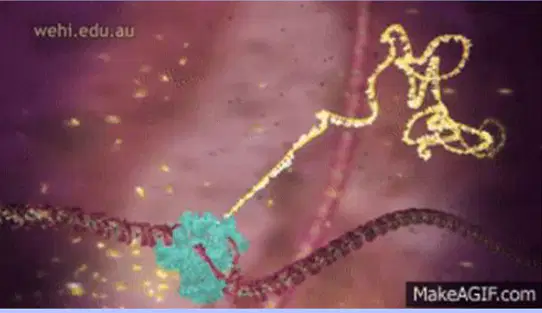
What is the main topic of Chapter 9 in the provided learning material?
DNA Replication
Protein Synthesis
Cell Division
Photosynthesis
Which concept is associated with the central dogma of genetics?
Photosynthesis
Protein Synthesis
Cellular Respiration
Mitosis
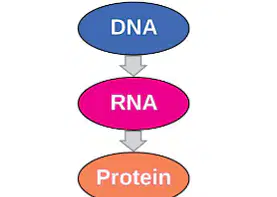
What is the correct sequence of the central dogma of genetics?
RNA > DNA > Protein
DNA > Protein > RNA
DNA > RNA > Protein
Protein > RNA > DNA
What process converts DNA into mRNA?
Translation
Replication
Transcription
Mutation
What does translation use to build proteins?
DNA
mRNA
tRNA
rRNA
What does the central dogma describe?
Protein synthesis
Genetic information flow
Cell division
DNA replication
What is the process of using a segment of DNA to construct an mRNA called?
Translation
Replication
Transcription
Transformation
Where does eukaryotic transcription occur?
Cytoplasm
Ribosome
Nucleus
Mitochondria
In prokaryotes, where does transcription take place?
Nucleus
Cytoplasm
Ribosome
Endoplasmic reticulum
What are the three stages of transcription?
Initiation, replication, termination
Initiation, elongation, termination
Elongation, translation, replication
Replication, translation, termination
What is the flow of genetic information from DNA to protein?
The structure of DNA
The flow of genetic information from DNA to RNA to protein
The process of cellular respiration
The role of ribosomes in protein synthesis
What begins the initiation phase of transcription?
DNA replication
DNA unwinding at the transcription bubble
RNA splicing
Protein synthesis
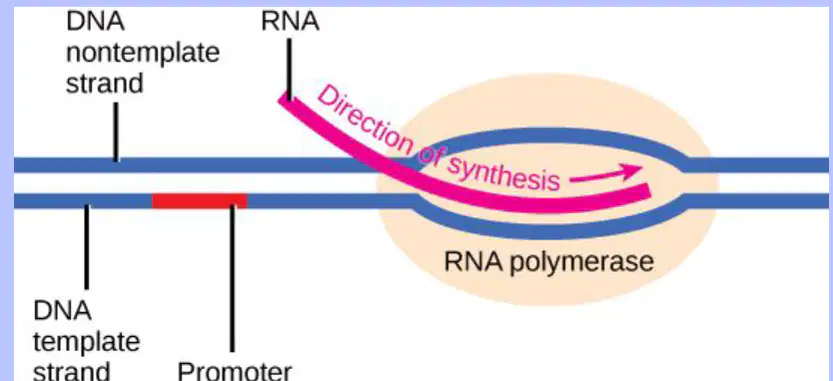
Where are promoters located in relation to the gene they regulate?
Downstream
Within the gene
Upstream
On a different chromosome

During the elongation phase of transcription, what does RNA polymerase do?
Adds nucleotides via base pairing
Removes nucleotides from the DNA strand
Synthesizes proteins directly
Converts RNA into DNA
What base does RNA contain instead of thymine (T) found in DNA?
Uracil (U)
Adenine (A)
Cytosine (C)
Guanine (G)
What happens to DNA during the elongation phase of transcription?
DNA unwinds ahead of RNA polymerase and rewinds behind it
DNA is completely broken down
DNA is converted into RNA
DNA remains unchanged
Termination signals instruct RNA polymerase to (a)
In which type of cells can transcription and translation occur simultaneously?
Eukaryotic cells
Prokaryotic cells
Both eukaryotic and prokaryotic cells
Neither eukaryotic nor prokaryotic cells
What is required for eukaryotic mRNAs before they leave the nucleus for translation?
Processing
Replication
Transcription
Translation
How do eukaryotic mRNAs compare in stability to prokaryotic mRNAs?
Less stable, lasting seconds
More stable, lasting hours
Equally stable
Unstable, lasting minutes
The function of RNA-stabilizing proteins in mRNA processing is to (a) .
What is added to mRNA to initiate translation and protect it?
Poly-A tail
3' cap
5' cap
Exon
What signals the export and protection of mRNA?
5' cap
Poly-A tail of 200 adenine residues
Exon
Intron
Eukaryotic genes consist of (a)
What happens to introns during splicing?
They are translated
They are replicated
They are removed
They are expressed
What is the role of RNA polymerase during transcription?
It binds to a promoter region on DNA
It synthesizes proteins
It translates mRNA into amino acids
It degrades mRNA
Which strands are formed when RNA polymerase unwinds DNA?
Coding and non-coding strands
Template and nontemplate strands
Leading and lagging strands
Sense and antisense strands
The bonding rules for constructing mRNA from DNA are (a)
What happens to introns during mRNA processing?
They are translated into proteins
They are spliced together with exons
They are removed
They are converted into exons
What modifications are made to mRNA before it leaves the nucleus?
A 3' cap and a poly-G tail are added
A 5' cap and a poly-A tail are added
A 5' cap and a poly-G tail are added
A 3' cap and a poly-A tail are added
What is protein synthesis described as in cells?
A simple process
An energy-intensive metabolic process
A non-essential process
A passive process
What are the most abundant components in organisms, excluding water?
Carbohydrates
Lipids
Proteins
Nucleic acids
What does translation decode mRNA into?
Lipids
Carbohydrates
Polypeptides
Nucleotides
Match the following components with the process they are involved in:
mRNA, ribosomes, tRNAs, and enzymatic factors
Translation
DNA, ribosomes, lipids, and carbohydrates
Cellular structure formation
mRNA, DNA, lipids, and carbohydrates
Genetic information storage
tRNAs, lipids, carbohydrates, and DNA
Energy storage and genetic information
Approximately how many ribosomes do E. coli cells contain?
100,000
200,000
300,000
400,000
Where are eukaryotic ribosomes found?
Nucleus and mitochondria
Cytoplasm and endoplasmic reticulum
Golgi apparatus and lysosomes
Cell membrane and chloroplasts
Match the following ranges with the number of tRNA types that exist for binding to mRNA sequences.
10 to 20
Number of tRNA types for rare amino acids
20 to 30
Number of tRNA types for common amino acids
30 to 40
Number of tRNA types for moderately common amino acids
40 to 60
Total number of tRNA types in most organisms
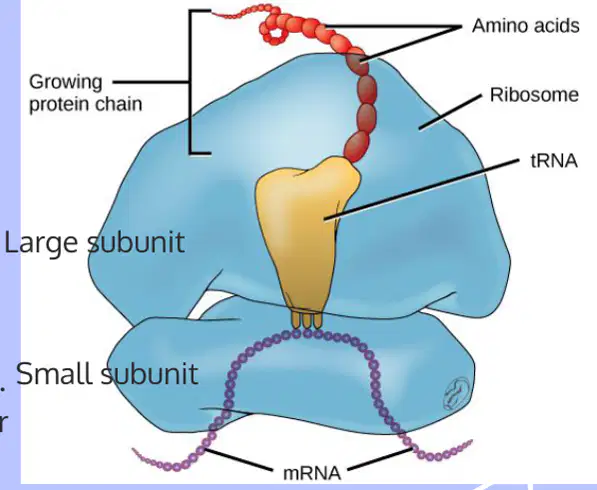
What is the function of the small subunit of a ribosome?
Binds tRNAs with amino acids
Binds mRNA
Synthesizes lipids
Transports proteins
What does transcription generate from genes?
Protein products
DNA strands
Messenger RNA (mRNA)
Amino acids
Which nucleotides are found in mRNA?
A, T, C, G
A, C, G, U
A, T, G, U
A, C, T, U
How many common amino acids are proteins made of?
16
18
20
22
What is the role of the AUG codon in translation?
Stops translation
Specifies leucine
Starts translation and specifies methionine
Specifies tryptophan
How many possible codon combinations are there?
32
48
64
80
What is the function of stop codons?
Initiate protein synthesis
Terminate protein synthesis
Specify amino acids
Replicate DNA
How is the genetic code described in terms of its universality?
Unique to each species
Universal across most species
Only found in humans
Different for plants and animals
Match the following components with their role in the initiation complex of protein synthesis.
Ribosome, mRNA, initiation factors, initiator tRNA
Components involved in the initiation of protein synthesis
Ribosome, DNA, elongation factors, initiator tRNA
Components involved in DNA replication
Ribosome, mRNA, termination factors, initiator tRNA
Components involved in the termination of protein synthesis
Ribosome, DNA, initiation factors, elongation tRNA
Components involved in DNA transcription
What is the role of the A site in the E. coli ribosome during protein synthesis?
Binds incoming charged tRNAs with specific amino acids
Holds tRNAs with amino acids bonded to polypeptide chain
Releases dissociated tRNAs for recharging
Signals termination of translation
What happens to mRNA after translation is complete?
It is reused for another round of translation
It is degraded for nucleotide reuse
It is stored for future use
It is converted back to DNA
Which statement about the genetic code is correct?
It is unique to humans
It consists of 20 codons
It is universal across most species
It includes only start codons
What is the role of mRNA in translation?
It attaches to the ribosome and is read 3 nucleotides at a time.
It forms peptide bonds between amino acids.
It carries amino acids to the ribosome.
It repeats the cycle until the polypeptide is complete.
Match the following tRNA functions with their descriptions in protein synthesis.
It forms a peptide bond with the previous amino acid.
Function of tRNA in forming peptide bonds.
It arrives at the ribosome using an anticodon to match the corresponding codon.
Function of tRNA in matching codons with anticodons.
It reads the mRNA three nucleotides at a time.
Function of tRNA in reading mRNA sequences.
It completes the polypeptide and leaves the ribosome.
Function of tRNA in completing polypeptides.
Match the following events with their corresponding actions at the ribosome.
The mRNA is read again.
When the ribosome needs to re-initiate translation.
The cycle repeats until the polypeptide is complete.
When the translation process continues until termination.
The amino acid forms a peptide bond with the previous one.
When a second tRNA arrives at the ribosome.
The tRNA leaves the ribosome.
When the tRNA has delivered its amino acid.
The translation cycle repeats (a)

