
 Worksheets
untitled
Total questions: 61
Worksheet time: 1hrs 3mins


What type of heat transfer takes place in liquids and gasses?
Conduction
Convection
Radiation
Thermal Equilibrium
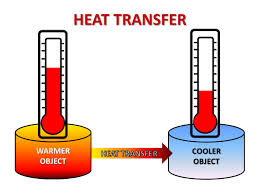
_________________ is the transfer of energy through or by electromagnetic waves.
Conduction
Convection
Radiation
What is the formula to calculate mechanical advantage for a pulley system?
MA = Fout * Fin
MA = Fout/Fin
MA = Fout + Fin
MA = Fin/Fout
In an inclined plane, if the input force is 100 N and the output force is 500 N, what is the mechanical advantage?
5
20
10
2
When does a yo-you have the most potential energy?
at its highest point
at its lowest point
when its at its top speed
when it is moving between the highest and lowest point
When is potential energy transformed into kinetic energy?
when it is put into motion
when it stops
when it is at rest
when it is in a higher spot
Which has the MOST potential energy?
a ball on the ground
a ball resting resting on the edge of a cliff
a ball on top of the refridgerator
a ball being thrown at 100 miles per hour
Energy can be ______________ and stored, but cannot be created or destroyed.
gainned
lost
saved
transformed
If two objects have the same ______ the one moving faster will have more kinetic energy.
mass
height
color
position
What is energy?
moving energy
stored energy
renewable energy
The ability to do work.
What is potential energy?
moving energy
stored energy
renewable energy
non renewable energy
What is kinetic energy?
moving energy
potential energy
stored energy
renewable energy


What is kinetic energy?
The energy an object has due to its motion.
The energy an object has due its chemical composition.
The energy an object has due to its atomic structure.
When does an object have NO kinetic energy?
When it's at rest.
When it's moving very slowly.
When it has no electrical charge.
What type of energy is food energy stored in your muscles?
mechanical
nuclear
thermal
chemical
Which type of energy propels a baseball after it has been struck by a bat?
chemical
thermal
mechanical
nuclear
What is the correct energy chain from the sun to grass to cow?
light and thermal => chemical => chemical
light => heat => mechanical => chemical
light => thermal => mechanical
nuclear => chemical => potential
The sun gives of large amounts of light and ___________ energies?
nuclear
mechanical
chemical
thermal
Which type of potential energy is stored in a gasoline?
nuclear
mechanical
chemical
thermal
Any form of energy can be converted to any other form of energy.
True
False


Which of following are types of kinetic energy? Check all that apply.
sound energy
light energy
thermal energy
mechanical energy
potential
Which of the following is an example of kinetic energy?
A rock at the top of a hill.
Water falling down a waterfall.
A pencil sitting on a desk.
A backpack on the ground.

Energy stored because of gravity is called:
Gravitational Potential Energy
Kinetic Energy
Mechanical Advantage
Chemical Energy

What is the unit for mass?
kilogram (kg)
meter (m)
Newton (N)
Joule (J)

What is the unit for distance?
kilogram (kg)
meter (m)
Newton (N)
Joule (J)

What is the unit for force?
kilogram (kg)
meter (m)
Newton (N)
Joule (J)

What is the unit for energy?
kilogram (kg)
meter (m)
Newton (N)
Joule (J)

A softball is thrown with 150 joules of energy. If the ball is moving at 30.0 m/s, what is the mass of the ball in kg?
0.33 kg
0.50 kg
5.0 kg
10.0 kg

What is the Kinetic Energy of an 8.00 kg bowling ball rolling at 2.20 m/s?
5.8 Joules
8.8 Joules
10.2 Joules
19.36 Joules

A 12.0 kg rock is sitting on a cliff. If the rock has 2500 joules of Potential Energy, what is the height of the cliff in m?
2.08 m
16.67 m
20.80 m
21.26 m

What happens to the Kinetic Energy and Gravitational Potential Energy of a ball in a free fall?
a) Kinetic Energy and Gravitational Potential Energy both increase.
b) Kinetic Energy and Gravitational Potential Energy both decrease.
c) Kinetic Energy increases and Gravitational Potential Energy decreases.
d) Kinetic Energy decreases and Gravitational Potential Energy increases.

A moving van burns gasoline in its engine. During this process it converts –
a) chemical energy into mechanical energy
b) kinetic energy into potential energy
c) thermal energy into electrical energy
d) mechanical energy into kinetic energy
Kinetic Energy (KE) is changed to Potential Energy (PE) when ____.
a) a skier skis down a slope, arriving at a lower elevation
b) a car speeds up along a flat highway
c) a roller coaster slows down as it climbs up a hill
d) a ball rolls to the bottom of as inclined plane

A teacher asks the students to decrease their Kinetic Energy. What could the students do to decrease their Kinetic Energy the most?
a) Run to the front of the room.
b) Sit down and stop moving.
c) Jump up and down.
d) Stand up and move their arms.
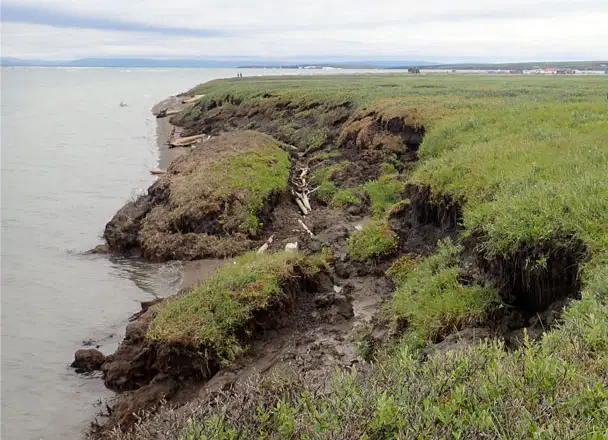
Erosion is a process that moves pieces of rock or soil from one place to another. This process most often takes place by water, wind, or ice. Rushing water can change the shape of a coastline or carve deep canyons and valleys. Which of the following best describes the process of erosion?
a) Potential Energy
b) Chemical Energy
c) Kinetic Energy
d) Elastic Energy

