wayground logo

Free Printable Worksheets

Font size

S
M
L
XL
Worksheets

untitled

Total questions: 49

Worksheet time: 32mins

Name
Class
Date
1.
With what 3 letters do enzymes typically end?
a)
-ose
b)
-ase
c)
-ese
d)
-tic
2.
Enzymes are...
a)
nucleic acids
b)
proteins
c)
lipids
d)
carbohydrates
3.
What happens when enzymes are heated to a high temperature?
a)
The enzymes die.
b)
The shapes of the enzyme are altered denature
c)
The enzymes' amino acid sequence changes.
d)
The enzymes remain the same
4.
Which of these is most likely an enzyme?  
a)
Sucrose
b)
Galactose
c)
Fructose
d)
Amylase
5.
What is a substance called if it speeds up a chemical reaction?
a)
reusable
b)
catalyst
c)
specific
d)
fragile
6.

Can a change in pH alter the active site of an enzyme

a)

yes

b)

no

7.
Enzymes are composed of which of the following monomers? 
a)
amino acids
b)
carbohydrates
c)
nucleotides
d)
monosaccharides
8.
What is another name for enzymes?
a)
chemical catalysts
b)
microorganisms
c)
biological catalysts
d)
inorganic catalysts
9.
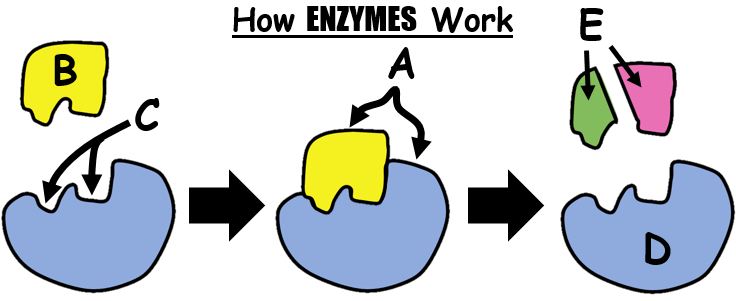
What is indicated by letter A?
a)
enzyme
b)
product
c)
substrate
d)
active site
10.

What is indicated by letter C?

a)

enzyme

b)

product

c)

substrate

d)

active site

11.

What is indicated by letter B?

a)

enzyme

b)

product

c)

substrate

d)

active site

12.
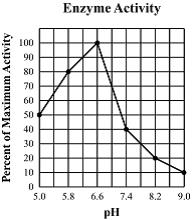
Which of the following conclusions can be drawn from this graph?
a)
The optimum pH of the enzyme is 6.6.
b)
The optimum pH of the enzyme is 5.8
c)
The enzyme’s activity increases as pH increases 5.0 to 9.0
d)
The enzyme’s activity is greater around pH of 8.0 .
13.
What makes an enzyme substrate specific?
a)
Size
b)
Shape
c)
Name
d)
Location it is found in
14.
Each enzyme only has 1 substrate that will fit its active site.  What is this called?
a)
reusablility
b)
denaturation
c)
specificity
d)
fragility
15.
In the diagram, what is letter A? 
a)
product
b)
substrate
c)
enzyme-substrate complex
d)
active site
16.
An enzyme speeds up a chemical reaction in the cell but can only be used once.  True or False? 
a)
true
b)
false
17.
At 40 degrees Celsius, your biological enzymes will...
a)
Functional optimally
b)
Denature
c)
Wait until the temp. increases
d)
Wait until the temp. decreases
18.

The enzyme and substrates have

a)

adverse shapes

b)

complementary shapes

c)

contrary shapes

d)

similar shapes

19.
What is the function of an enzyme?
a)
enzymes break themselves into small pieces
b)
enzymes slow down chemical reactions
c)
enzymes speed up chemical reactions
d)
enzymes combine products to form reactants 
20.
Which enzyme is most efficient in a basic solution?
a)
A
b)
B
21.
Every enzyme has a optimal temperature and pH. True or False?
a)
True 
b)
False
22.
Enzymes are composed of which of the following monomers? 
a)
amino acids
b)
carbohydrates
c)
nucleotides
d)
monosaccharides
23.
Enzymes will make a reaction go _______ and use ______ energy.
a)
faster, less
b)
faster, more
c)
slower, less
d)
slower, more
24.

Name the glands associated with the Human Digestive System?

a)

Only salivary glands and pancreas

b)

Only salivary glands and liver

c)

Only liver and pancreas

d)

Salivary Glands, Liver and Pancreas

25.

The correct sequence of the steps involved in the process of Human Digestive System

a)

Digestion, Ingestion, Assimilation, Egestion and Absorption

b)

Ingestion, Digestion, Absorption, Assimilation and Egestion

c)

Egestion, Absorption, Digestion, Assimilation and Ingestion

d)

Ingestion, Absorption, Digestion, Assimilation and Egestion

26.

In which part of the alimentary canal does digestion of protein begin?

a)

Small intestine

b)

Buccal cavity

c)

Stomach

d)

Oesophagus

27.

What is the function of Bile Juice secreted by Liver?

a)

It makes the food alkaline.

b)

It makes the food acidic.

c)

It breaks down the big fat globules for effective enzyme action

d)

It converts fat to fatty acid and glycerol

28.

Where does most of the digestive process take place?

a)

Small intestine

b)

Stomach

c)

Large intestine

29.

The correct order of parts labelled 2,3,7,8

a)

Oesophagus,stomach,pancreas,liver

b)

Oesophagus,stomach,liver,pancreas

c)

Oesophagus,pancreas,stomach,liver

d)

Oesophagus,pancreas,liver,stomach

30.

How is the small intestine adapted to perform its function ?

a)

Being long and coiled

b)

Lined with villi

c)

Richly supplied with blood vessels

d)

All the above

31.

The part that stores liver’s digestive juice until they are needed by the intestines.

a)

Pancreas

b)

Gall bladder

c)

Duodenum

d)

Spleen

32.

The mode of nutrition in which organisms depend on other for food is

a)

Autotrophic nutrition

b)

Heterotrophic nutrition

c)

Both

d)

None

33.

During digestion the carbohydrates breaks down to

a)

Fats and fatty acids

b)

Glucose

c)

Aminoacids

d)

All

34.

During digestion the proteins breaks down to

a)

Fats and fatty acids

b)

Glucose

c)

Aminoacids

d)

All

35.

During digestion the fats breaks down to

a)

Fats and fatty acids

b)

Glucose

c)

Aminoacids

d)

All

36.

Which of the following are the raw materials needed for the photosynthesis process?

a)

Carbondioxide

b)

Water

c)

Glucose

d)

Both a and b

37.

Complete digestion of food happens in

a)

Stomach

b)

Small intestine

c)

Large intestine

d)

None

38.

Living beings and non living beings can be differentiated by

a)

Life processess

b)

Organized structure

c)

Both a and b

d)

None

39.
Which mineral is important for the production of hemoglobin?
a)
Vitamin D
b)
Iron
c)
Vitamin E
d)
Calcium
40.
Which vitamin is important for good vision and healthy skin and hair?
a)
Vitamin D
b)
Vitamin A
c)
Vitamin C
d)
Vitamin E
41.
Which of the following is NOT a source of vitamin A?
a)
Leafy vegetables
b)
Oranges
c)
Liver
d)
Eggs
42.
Which of the following is NOT a source of protein?
a)
Legumes
b)
Nuts and seeds
c)
Meat and fish
d)
Fruits and vegetables
43.
What is the main role of lipids in our body?
a)
To help us absorb calcium
b)
To provide energy
c)
To prevent scurvy
d)
To keep us warm
44.
What is the main purpose of carbohydrates in our diet?
a)
To help us absorb calcium
b)
To keep us warm
c)
To provide energy
d)
To prevent scurvy
45.
Which mineral is important for strong bones?
a)
Iron
b)
Calcium
c)
Vitamin D
d)
Vitamin E
46.
Which nutrient is found in foods like oily fish and nuts and seeds and is important for providing energy and keeping us warm?
a)
Lipids
b)
Protein
c)
Vitamin C
d)
Iron
47.
Which of the following is NOT a source of iron?
a)
Spinach
b)
Red meat
c)
Oily fish
d)
Beans
48.
Which of the following is an example of a mineral?
a)
Vitamin C
b)
Vitamin A
c)
Calcium
d)
Vitamin D
49.
Which nutrient is found in starchy foods like bread, pasta, and potatoes?
a)
Vitamin C
b)
Protein
c)
Carbohydrates
d)
Iron