
NEW
Font size
 Worksheets
Shaping Earth's Surface Review
Total questions: 24
Worksheet time: 18mins
While hiking in the mountains, Tanya observed a narrow and steep valley with running water at the bottom of it. What most likely caused the valley to first form?
Wind
River
It was man-made
Volcanic eruption
Jane was looking at a cliff made up of several layers of different kinds of rock. Near the top of the
cliff, she found a fossilized bone. Near the middle, she found the fossil of a fern. At the bottom, she
found a fossilized shell. What process was critical in the formation and preservation of the fossils?
Plate tectonics
Chemical weathering
Deposition
Abrasion
Water is found in many places on Earth, like rivers, streams, and oceans. What landform will be
created when sediments carried by the river are deposited near the river’s mouth?
A sinkhole
A sea cliff
A cavern
A delta
4. Through freezing and thawing, a boulder is broken into smaller pieces. What is this an example of?
Chemical weathering
Physical weathering
Abrasion
Deposition
Hurricanes and tropical storms are strong storms that often move along the eastern coast of
Florida and the southeastern United States. People who live in these areas try to protect their
homes and businesses by using sandbags. Many even build their homes above ground. There is
also a natural means of flood and storm surge protection for the coastlines and inland areas. Which
statement correctly identifies the landform which provides the most protection for the coast?
Dunes provide protection from erosion caused by water.
Deltas create a natural barrier to prevent erosion by wind.
Rivers prevent flooding by preventing ocean water from moving inland.
Sinkholes decrease the chance for flooding by providing a place for excess water to go.
Many thousands of years ago, glaciers covered large areas of Earth’s surface. Glaciers are large
blocks of ice that flow slowly over the land. Portions of the ice melted and were refrozen many
times over the years. Which explanation best describes how glaciers contributed to the formation
of coastlines along Florida and other states?
Water, from the melting ice, elevated the shoreline to form plateaus.
Water, from the melting ice, flooded the plains causing plants to die.
Water, from the melting ice, changed the shape of the coastline.
Water, from the melting ice, deposited sand on the ocean floor.
Rivers played a huge part in shaping the Earth through erosion and weathering. The St. John’s
River is the largest river in Florida and flows along the northeastern part of the state. How do the
rivers in Florida differ from those in other areas?
Florida’s rivers are shallower than those in mountainous regions.
Florida’s rivers move much faster than those which end at the ocean.
Florida’s rivers are much deeper than those located in states further north.
Florida’s rivers carry more sediment from erosion than those that flow faster.
Some landforms in Florida have different characteristics than the same type of landform in other
states. Which of the following statements correctly differentiates one type of Florida landform from
those in other states?
Florida’s rivers do not flow into the oceans, as do other U. S. rivers.
Mountain ranges in Florida are long in comparison to the mountain ranges in other states.
Dunes in Florida are larger than dunes which form in the deserts of the western United States.
Lakes in Florida may be shallow as compared to other areas or are formed as the result of
sinkholes.
Which of the following best describes the many rivers that flow through the state of
Florida?
Florida’s rivers are very deep as a result of the force of the water rushing down mountains.
Florida’s rivers are very slow due to the flatness of the terrain.
Florida’s rivers are very swift and cause much erosion.
Florida’s rivers always begin at the coastline.
Naomi watches birds at a bird feeder for one week and records the number of birds seen there
each day. Javier places three different types of food in separate bird feeders and records the
number of birds seen at each feeder every day for one week. Which student is conducting an
experiment?
Naomi is conducting an experiment because she is recording data.
Naomi is conducting an experiment because her investigation has controlled variables.
Javier is conducting an experiment because his investigation has controlled variables.
Javier is conducting an experiment because he is recording data.
Carol wants to determine how a fertilizer will affect the growth of marigolds. Which best explains
why Carol would choose to investigate this topic using an experiment rather than an observation?
Her research question requires changing one variable to see how it affects others.
Her research question involves studying a system that is too large or dangerous to study directly.
Her research question should be answered using samples that are in identical circumstances.
Her research question requires comparison, not notation and measurements.
What is the process of transporting sediments from location to another?
weathering
erosion
deposition
compaction
The process of breaking up Earth's surface into sediment is called...
weathering
erosion
depostion
compaction
Which of these is an example of erosion?
Light Shinning onto a mountain
Wind blowing away sediment
Rain breaking down rock
All of the above
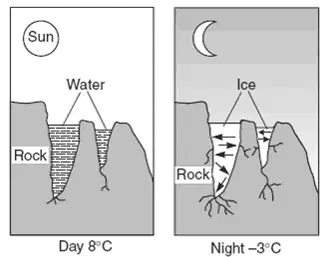
The diagrams shows a natural process that weathers rock.
Which statement best explains why this process results in weathering?
frozen water acts as a solute
the mass of water increases when it freezes
water expands when it freezes
frozen water dissolves most types of rock
How do plants weather rocks?
during photosynthesis
when the plant moves water from the roots to the leaves
when roots grow into cracks of rocks and expand the rock
Plants don't weather rocks
How does vegetation in the soil affect the rate of erosion?
It doesn't affect erosion.
It increases erosion.
It decreases erosion.
soil erosion doesn't exist.
Deltas are mainly created by the process of ___
weathering
erosion
deposition
waves
Rain washing away soil from a hillside is an example of _________
weathering
erosion
deposition
compaction

What is the main cause of weathering and erosion to make a canyons?
wind
glaciers
ice
moving water
Weathering involves the movement of rocks and minerals by agents such as water, wind and gravity.
TRUE
FALSE
Oxidation and Acid Rain are examples of ____.
physical weathering
chemical weathering
erosion
deposition
How do weathering and erosion differ?
Weathering acts quickly; erosion acts slowly
Weathering acts underground; erosion acts above ground
Weathering breaks down materials; erosion moves materials
Weathering is caused by wind; erosion is caused by water
Which process causes sinkholes to
form?
Fast-moving water causes rocks to crumble.
Surface water dissolves and weakens rocks.
Oxygen reacts with rocks and causes them to rust.
Ocean waves move rocks from one place to another.

