
 Worksheets
Unit 5 ACC TEKS Check Review
Total questions: 109
Worksheet time: 2hrs 46mins
What 2 things are measured on the HR Diagram?
temperature only
dim and temperature
brightness and temperature
mass and temperature
When the most massive stars die they may become what?
black hole
nothing
nebula
supernova

What star do we compare all other stars to?
white dwarf
sun
protostar
nebula

This is a picture of dust and gas that is getting compressed by gravity, which stage of the life cycle of a star is this?
Black Hole
Main Sequence
Nebula
Protostar
The sun is classified as what stage in the Life Cycle of a star?
Nebula
Protostar
Main Sequence
Red Giant
White Dwarf stars are considered?
Bright, but Hot
Hot, but Dim
Small, but Bright
Large, but dim

Two stars are identified on the Hertzsprung-Russell diagram. Based on this diagram, how do the characteristics of Star 1 and Star 2 compare?
Star 1 is cooler and less bright than Star 2
Star 1 is hotter and brighter than Star 2
Star 1 is cooler and brighter than Star 2
Star 1 is hotter and less bright than Star 2

All stars begin their life as a
Main Sequence
Nebula
Protostar
Black Dwarf

The stage after the main sequence star:
red giant
nebula
white dwarf
black dwarf


sort of cool, dim (not too much light), and red?


In the life cycle of a massive star, it will become a...
white dwarf
red supergiant
black dwarf
red giant

What factor determines whether a star will eventually become planetary nebula or a supernova?
amount of mass
amount of luminosity
amount of temperature
amount of oxygen


Where are the coolest stars on an HR Diagram found?
top
bottom
left
right

What two words could go in the blanks to describe star B?
Bright, Hot
Bright, Cool
Dim, Hot
Dim, Cool
What two words could go in the blanks to describe star C?
Bright, Hot
Bright, Cool
Dim, Hot
Dim, Cool
What two words could go in the blanks to describe star D?
Bright, Hot
Bright, Cool
Dim, Hot
Dim, Cool
What two words could go in the blanks to describe star A?
Bright, Hot
Bright, Cool
Dim, Hot
Dim, Cool
What happens to the gases in the planetary nebula?
They become regions where galaxies form.
They release carbon that eventually is recycled in other stars.
They eventually form stars made mainly of hydrogen and helium.
They release enormous amounts of energy and explode.
What happens in a star’s life cycle when it moves off the main sequence?
The star contracts until the core is hot and dense enough for nuclear fusion to begin.
The star collapses inward and releases energy.
The star begins to fuse hydrogen into helium in the core.
The star forms iron in its core, the core collapses quickly, and the star explodes.
How does the Cosmic Microwave Background provide evidence of the Big Bang?
As predicted, light released shortly after the Big Bang was red shifted as the universe warmed up.
As predicted, light released shortly before the Big Bang was blue shifted as the universe filled with dark matter.
As predicted, light released shortly after the Big Bang was blue shifted as the universe expanded and cooled.
As predicted, light released shortly after the Big Bang was red shifted as the universe expanded and cooled.
The current theory of the universe’s origin is most supported by which of the following evidence?
the increase in temperature in space over time
the formation of stars in the Milky Way galaxy
observations of supernova explosions
the amount of hydrogen and helium present in the universe

A student sketches the following galaxies in a notebook. How should the student label each of the galaxies?
A-Irregular, B-Spiral, C-Elliptical
A-Elliptical, B-Circular, C-Irregular
A-Spiral, B-Irregular, C-Elliptical
A-Spiral, B-Elliptical, C-Irregular

What type of stars would be found along line A?
White dwarfs
Main sequence
Supergiants
Red giants

Which location on the Hertzsprung-Russell diagram contains the hottest and brightest stars in the universe?
Location A
Location B
Location C
Location E

What can scientists predict based on the color of a star?
Brightness
Luminosity
Temperature
Size

Based on the Hertzsprung-Russell diagram, which list accurately places various stars in order from highest to lowest average surface temperature?
C, B, E, A, D
C, D, A, B, E
D, A , E, B, C
E, B, D, A, C
A huge system of millions or billions of stars, together with gas and dust, held together by gravity.
galaxy
solar system
nebula
asteroid
A random scattered type of galaxy that does not form a distinct shape or pattern.
irregular galaxy
spiral galaxy
elliptical galaxy
random galaxy
A flat, disk-shaped galaxy with a central bulge and winding "arms" that extend outward.
irregular galaxy
spiral galaxy
elliptical galaxy
random galaxy

Identify the galaxy in the image.
irregular
spiral
elliptical
none listed

Identify the galaxy in the image.
irregular
spiral
elliptical
none listed

Identify the galaxy in the image.
irregular
spiral
elliptical
none listed

Identify the galaxy in the image.
irregular
spiral
elliptical
none listed

Identify the galaxy in the image.
irregular
spiral
elliptical
none listed

Identify the galaxy in the image.
irregular
spiral
elliptical
none listed

Identify the galaxy in the image.
irregular
spiral
elliptical
none listed

This is the name of the galaxy Earth is in.
Andromeda
Milky Way
Solar System

What type of galaxy is this?
Irregular
Spiral
Elliptical

A _____ is a sphere of matter, body made of gas, held together by gravity and with a temperature great enough to generate light by a nuclear reaction.
star
galaxy
nebula
black hole

What keeps planets in the solar system from moving in straight lines through the galaxy?
A. Light energy
B. Gravity
C. Inertia
D. Potential energy

"Made mostly of ice", fits best under which heading in the Venn diagram below?
A. Asteroid
B. Meteor
C. Comet
D. Section X
Objects made of ice, gas and dust and orbit our sun are called:
A. Asteroids
B. Meteors
C. Comets
D. Planets
Why does it take Neptune so long to revolve around the Sun?
A. The Sun is applying large amounts of gravity on the planet, slowing it down.
B.
Neptune has a large diameter causing the planet to be less aerodynamic, slowing it
down.
C. Neptune is such a long distance away that it has a large orbital path.
D.
Neptune is rotating fast for its size, and the energy of its orbit is being transferred into
rotational speed.
Which of the following is the biggest and most complex system?
Galaxy cluster
Galaxy
Solar system
Universe
Which of the following has the hierarchy of the universe listed, in order, from least complex to most complex.
moon, planet, star, black hole
Universe, galaxy, galaxy cluster, solar system, planet, moon
moon, planet, solar system, galaxy, galaxy cluster, universe
moon, planet, solar system, galaxy cluster, galaxy, universe

The Sun is at the center of our solar system. All the planets in the solar system orbit around the Sun. Neptune has the longest period of revolution because...?
It is closest to the Sun
It is the furthest from the sun
It is the largest planet
It is the smallest planet
What is the correct order of the planets in the Solar System, starting closest to the Sun?
Mars, Mercury, Earth, Venus, Jupiter, Saturn, Uranus, Neptune,
Mercury, Venus, Earth, Mars, Jupiter, Saturn, Uranus, Neptune
Mercury, Mars, Venus, Earth, Jupiter, Saturn, Uranus, Neptune,
Mercury, Venus, Earth, Mars, Jupiter, Neptune, Uranus, Saturn
What do Mercury, Venus, Earth, and Mars all have in common?
They are all very cold planets.
They are considered terrestrial planets, that are small, rocky, or have metals with hard surface.
They are about the same size.
They are considered gas giants
The inner planets are also called a
Gas giants
Terrestrial planets
Large planets
Asteroid
As the distance from the sun increases for a planet, the time it takes to revolve (or orbit) around the sun will ________________?
Stay the same
decrease (take shorter
increase (take longer)
Reverses
What is the main reason Earth is the only planet in our solar system capable of sustaining life as we know it?
Earth has a liquid core.
Earth has 4 layers
Earth has magnetic poles.
Earth has the atmosphere to support life
The inner planets share 2 qualities or characteristics
Humans can live on them, they all have water
They are rocky, and humans can find food on them
They are rocky and close to the Sun
They are close to the Sun, and humans can live on them
When we see streaks of light falling in the sky, we call them falling stars but these objects are actually ________________
meteors
comets
meteorites
asterites
Which of the following answers describes a comet?
Has a coma and a tail made of ice and rock.
Made of small rocks and dust
Made of helium and hydrogen
Made of space dust
An attractive force that exists between all objects that have mass
Gravity
Eccentricity
Inertia
Momentum
A measure of how hard it is to stop a moving object
Momentum
Inertia
Gravity
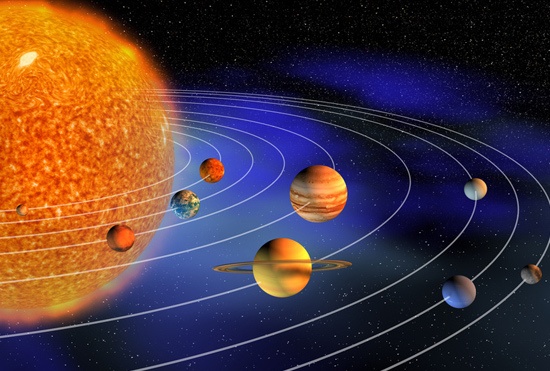
Why do all of the planets orbit the sun rather than Earth?
the sun has more mass
the sun is a star
the Earth is heavier
the sun is in the middle of the milky way
Why do all of the planets orbit the sun rather than Earth?
the sun has more mass
the sun is a star
the Earth is heavier
the sun is in the middle of the milky way
As distance increases, gravitational forces:
Decrease
increase
Disappear
Stay the same
As mass increases, gravitational forces:
Increase
decrease
stay the same
disappear
Earth's _____ helps protect life from ultraviolet radiation.
water
oxygen
ozone layer
ice
Earth's atmosphere is mostly made up of the gases _____ and _____.
water and ice
atmosphere and ozone layer
oxygen and nitrogen
oxygen and water

Which planet would be the most likely place to observe for life?
A
B
C
D

14) The diagram below represents the Sun and planets of our solar system. Which planet on the above diagram represents Earth?
G
H
K
M
Which choice best depicts the shape of the Milky way?


Our solar system is part of the Milky Way galaxy. The sun is at the center of our solar system. All of the following are possible locations of the sun in the Milky Way galaxy EXCEPT
Postion A
Postion B
Postion C
Postion D
I am made of lots of gas and dust.
Usually Forming many new stars, but with no structure.
Might be the result of galaxies colliding
What am I?
Irregular
Spiral
Elliptical
Star formation is no longer occurring
I lack dust and gas
What am I?
Spiral
Irregular
Elliptical
What are the TWO things that affect the force of gravity between objects?
The mass of the objects
The chemical composition of the objects
The net force between the objects
The distance between the objects
Type of galaxy that do not have a definable regular shape and they contain mostly YOUNG stars, dust and gas.
Elliptical Galaxies
Regular Galaxies
Irregular Galaxies
Spiral Galaxies
Type of galaxy that do not have a definable regular shape and they contain mostly YOUNG stars, dust and gas.
Elliptical Galaxies
Regular Galaxies
Irregular Galaxies
Spiral Galaxies
Type of galaxy that looks like a flattened ball and contain billions of OLD stars and has little dust and gas. Because of minimal gas and dust, new stars cannot form in this galaxy.
Elliptical Galaxies
Regular Galaxies
Irregular Galaxies
Spiral Galaxies
Type of galaxy that looks like a flattened ball and contain billions of OLD stars and has little dust and gas. Because of minimal gas and dust, new stars cannot form in this galaxy.
Elliptical Galaxies
Regular Galaxies
Irregular Galaxies
Spiral Galaxies


What type of galaxy is this?
Irregular
Elliptical
Spiral
It isn't a galaxy

What type of galaxy is this?
Irregular
Elliptical
Spiral
It isn't a galaxy
Identify the galaxy in the image.
irregular
spiral
elliptical
none listed
Ever since the universe began, the universe has been
expanding
contracting
stays the same size

