

wayground logo

Free Printable Worksheets

Font size

S
M
L
XL
Worksheets

PHS - Semester 1 Exam (Ch. 1-6) 2025

Total questions: 64

Worksheet time: 41mins

Name
Class
Date
1.
groups of similar occupations and industries that share a core set of basic knowledge and skills for all workers
a)
career pathways
b)
career clusters
2.
the most common form of medical care in the United States, which uses medication and surgery to treat the signs and symptoms of illness
a)
holistic medicine
b)
regenerative medicine
c)
western medicine
d)
genomic medicine
3.
healthcare practices and treatments that minimize or avoid the use of surgery and drugs
a)
western medicine
b)
genomic medicine
c)
alternative, complementary, or integrative therapies
d)
nanotechnology
4.
smaller groups of specialized occupations within a career cluster that require more specific sets of knowledge, skills, and training
a)
career clusters
b)
career pathways
5.

_________________advances continue to change the methods and outcomes of medical treatment.

a)
technological
b)
medical procedures
c)
medical billing
d)
insurance payments
6.
Ultrasounds, computed tomography (CT), and magnetic resonance imaging (MRI) are all examples of ____.
a)
integrative therapy
b)
medical imaging
c)
genomic medicine
d)
complementary advancements
7.
Patients are looking for medical care that is more ____ and pays attention not only to their physical requirements, but also to their emotional, social, and even spiritual needs.
a)
naturalistic
b)
advanced
c)
holistic
d)
technological
8.
skills related to choosing a career, acquiring and keeping a job, changing jobs, and advancing in a career
a)
technical training
b)
medical coding
c)
employability skills
d)
confidentiality
9.
the legally protected right of patients to have their personal and medical information kept private
a)
tact
b)
confidentiality
c)
employability skills
d)
technical skills
10.
a career and technical student organization for future healthcare workers
a)
OSHA - occupation safety and health administration
b)
HOSA - Future Health Professionals
c)
therapeutic services department
d)
Skills USA
11.
a group of professionals from different health science training backgrounds working in coordination toward a common goal for the patient
a)
secondary care team
b)
interdisciplinary healthcare team
c)
primary care team
d)
holistic care team
12.
Which of the following elements should be included in a medical record? (Select all that apply)
a)
complete medical and treatment history
b)
family medical history
c)
personal hobbies
d)
personal identifiable information
13.
A clinic or hospital’s interdisciplinary healthcare team may include ____. (Select all that apply)
a)
doctors, nurses, and therapists
b)
insurance representatives
c)
custodians/housekeepers
d)
medical assistants
14.
A(n) ______________________________ is a short, one-page document that contains your accomplishments and experiences as they relate to the job you are seeking.
a)
career portfolio
b)
job application
c)
certification
d)
résumé
15.

A(n) (a)   form contains clinical information such as a patient’s past diagnoses and treatments.

16.

Match:

a)

a detailed account of each claim processed by an insurance plan, which is sent to the patient as notification of claim payment or denial

1.

Explanation of benefits (EOB)

b)

an out-of-pocket fee paid by a person with health insurance at the time a covered service, such as an office visit or a prescription, is received

2.

copay

c)

the procedure for submitting costs for medical services so that payment can be collected or denial can be determined

3.

claims process

17.
an evaluation process in which a group of patients is sorted according to the urgency of their need for care
a)
triage
b)
claims process
c)
statistics
d)
explanation of benefits (EOB)
18.
the act of sharing a message, thought, or idea so that it is accurately received and understood
a)
health literacy
b)
communication
c)
body language
19.
term for a code of polite behavior among members of a profession or group
a)
body language
b)
etiquette
c)
communication
20.
The most vital skill for understanding a message is _____________
a)
feedback
b)
listening
c)
input
d)
observation
21.
Which of the following is a good way to improve listening skills and understand a message?
a)
facing the sender
b)
avoiding eye contact
c)
interrupting the speaker
d)
all of the above
22.
Through the use of ____, healthcare workers are alert to situations in which a patient’s verbal and nonverbal messages don’t match.
a)
observation
b)
communication
c)
protocols
d)
listening
23.
The ____ record has the potential to speed up the documentation process, improve the accuracy of patient records, and expand access to complete medical records for all providers.
a)
electronic health
b)
virtual medical
c)
documented medical
d)
telecommunication
24.
the branch of law that establishes rules for business relationships between people or between individuals and businesses
a)
criminal law
b)
HIPAA
c)
tort
d)
civil law
25.
a condition that results in a person being unable to enter a contract, such as being under the age of consent, being ruled mentally incompetent, or having an altered mental state due to drugs or semi-consciousness
a)
tort
b)
managed care
c)
legal disability
d)
ethical
26.
a legal document prepared by a patient before a health crisis occurs to guide healthcare decisions in situations when the patient is unable to speak for himself or herself
a)
advance directive
b)
managed care
c)
contract
d)
registration
27.
a term used to describe an action that fits with someone’s personal morals or professional rules of conduct
a)
tort
b)
system
c)
etiquette
d)
ethical
28.
the branch of law that aims to protect individuals and society by defining certain actions as crimes, or offenses against society
a)
civil law
b)
legal disability
c)
criminal law
d)
tort
29.
a federal law that makes it easier to obtain healthcare coverage and protects personal health information
a)
advance directive
b)
criminal law
c)
civil law
d)
HIPAA
30.
a legally binding agreement between two or more people or agencies
a)
registration
b)
contract
c)
documentation
d)
system
31.
______________________________ includes a patient’s name, medical record number, birth date, Social Security number, address, telephone number, e-mail address, employer, and so on.
a)
patient privacy
b)
protected health information (PHI)
c)
medical health information (MHI)
d)
advanced directive
32.
____ care facilities provide skilled nursing care and rehabilitation services for residents who will live in the facility for many months or years.
a)
Ambulatory
b)
Long-Term
c)
Outpatient
d)
Hospice
33.
____ care is available for clients who have been diagnosed with a terminal disease and generally have less than six months to live.
a)
Ambulatory
b)
Long-term
c)
Outpatient
d)
Hospice
34.
A(n) ____ is a harmful action that causes injury, restricts someone’s freedom, or damages property.
a)
civil offense
b)
criminal clause
c)
tort
d)
medical malpractice offers
35.

Match:

a)
anatomy
1.

the physical structures or parts of the

b)

the functions or inner workings of the body

2.

physiology

c)

refers to the front of the body

3.

anterior

36.

Match

a)

a hollow space within the body that is lined by a membrane and contains bodily organs

1.

body cavity

b)

a flat or level surface seen by cutting away part of the body through surgery or medical imaging to serve as a point of reference when discussing anatomy

2.

body plane

c)

the agreed-upon reference for body position when studying anatomy; standing erect on two legs, facing frontward, with the arms at the sides and palms facing forward

3.

standard anatomical position (SAP)

d)

An area of the body with a specific name, which s used as a reference point when discussing anatomy

4.

body region

37.
All healthcare workers must be able to read, write, and understand ______________________________ so they can communicate clearly with other professionals about their patients.
a)
mnemonic device
b)
greek and latin
c)
medical documents
d)
medical terminology
38.

The term __________________ refers to a point closer to the center/middle of the body

a)

medial

b)

anterior

c)

lateral

d)

dorsal

39.

The term __________________ describes a near or toward the side of the body

a)

medial

b)

anterior

c)

lateral

d)

dorsal

40.

superior is toward the _____________

a)

head

b)

feet

c)

back of the body

d)

middle of the body

41.

Inferior is toward the __________

a)

feet

b)

head

c)

front of the body

d)

side of the body

42.

Match:

a)

The term ____________ refers to a part that is farther away from the attachment site.

1.

distal

b)

When describing appendages (arms and legs), the term ______________ indicates that the part is closer to the point of attachment

2.

proximal

c)

refers to the back of the body

3.

posterior

43.
Which of the following tissues is important for providing support, absorbing shock, and storing and transporting nutrients?
a)
connective tissue
b)
nervous tissue
c)
muscular tissue
d)
epithelial tissue
44.
Which of the following tissues conducts impulses to and from body organs?
a)
connective tissue
b)
nervous tissue
c)
muscular tissue
d)
epithelial tissue
45.
____ tissue is important for movement.
a)
Connective
b)
Nervous
c)
Muscular
d)
Epithelial
46.
The ____ system is made up of bones and ligaments and its key purpose is to provide support and protection.
a)
lymphatic
b)
respiratory
c)
excretory
d)
skeletal
47.
The ____ system is made up of the heart and blood vessels and its key purpose is to transport blood throughout the body.
a)
cardiovascular
b)
excretory
c)
nervous
d)
muscular
48.

Match the five health science career paths:

a)

occupations that change the health status of a patient over time

1.

therapeutic services

b)

occupations focused on documenting patient care

2.

health informatics

c)

occupations that create a therapeutic environment for providing patient care

3.

support services

d)

occupations that create a picture of a patients health status at a single point in time

4.

diagnostic services

e)

occupations involved in biotechnology research and development that applies to human health

5.

biotechnology research and development

49.
Question Image

Match the body directions:

a)

A

1.

superior

b)

B

2.

inferior

c)

E

3.

anterior

d)

F

4.

posterior

50.
Question Image

Match the body directions:

a)

C

1.

medial

b)

D

2.

lateral

c)

A

3.

superior

d)

B

4.

inferior

51.

The ____ system is responsible for gas exchange and includes the trachea, bronchus, and lungs

a)
digestive
b)
nervous
c)
respiratory
d)
circulatory
52.

The ------ system consists of the esophagus, stomach, intestines, liver, etc.
a)
respiratory
b)
circulatory
c)
nervous
d)
digestive
53.
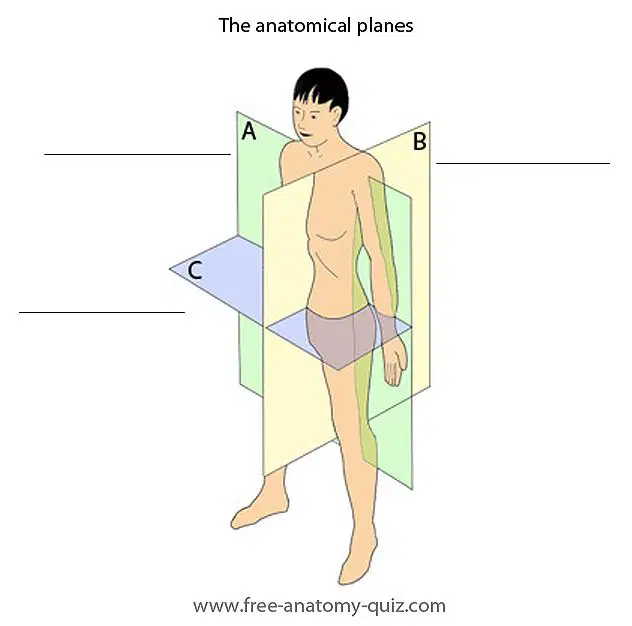
Question Image

Match the body planes:

a)

A

1.

frontal(coronal)

b)

B

2.

midsagittal

c)

C

3.

transverse

54.

steps that a healthcare worker takes with all patients to prevent the spread of infection

a)
Use gloves only when necessary.
b)
Isolate patients with known infections.
c)
Avoid handwashing between patients.
d)

standard precautions

55.

the full extent of movement for a joint

a)
Joint flexibility
b)
Movement capacity
c)
Articular mobility
d)
Range of motion
56.

the ability to identify with another person’s feelings and thoughts

a)
apathy
b)
sympathy
c)
empathy
d)
compassion
57.

(1) individuals living in long-term care facilities; (2) medical school graduates who are completing the last portion of their medical training before becoming licensed physicians

a)

residents

b)

fellows

c)

doctors

d)

patients

58.

the ability to communicate difficult or embarrassing information without giving offense

a)
brutality
b)
candor
c)
diplomacy
d)
tact
59.

Medical Specialties Matching:

a)

focuses on disorders of the heart and blood vessels

1.

cardiology

b)

focuses on the diagnosis of brain and nervous system disorders

2.

neurology

c)

focuses on disorders of muscles and bones

3.

orthopedics

d)

focuses on diseases and disorders of the mind

4.

psychiatry

e)

focuses on the diagnosis and treatment for diseases of the digestive organs

5.

gastroenterology

60.

_______________ teams include surgeons, surgical technicians, nurse anesthetists, and operating room nurses.

a)
Medical teams
b)
Emergency teams
c)

primary care

d)

secondary care

61.

_______________ teams include the primary care physician, physician assistants, and nurse practitioners who see the patient in a clinic setting.

a)
primary care teams
b)
specialist care teams
c)
emergency response teams
d)

secondarycare teams

62.

Ch. 6: An extremely important part of reducing the spread of infection, ________________ should be practiced before and after care is given in healthcare settings.

a)
surface cleaning
b)
personal protective gear
c)
patient isolation
d)
hand hygiene
63.

Ch. 6: Certified nurse aides (CNA) provide _________ nursing care to patients and residents.

a)
minimal and occasional
b)

basic

c)

advanced

d)
complex and intensive
64.

Ch. 6: Gowns, gloves, face shield, mask, and goggles are all considered ____.

a)
medical attire
b)
safety gear
c)
protective clothing
d)
personal protective equipment (PPE)