
Font size
 Worksheets
MBD FINAL EXAM - AU MANILA
Total questions: 100
Worksheet time: 2hrs 42mins

How many Bp is the band is sample A?
1200bp
1000bp
500bp
2--bp

What are the bands in Sample C?
1000bp, 600bp, and 100bp
50bp, 200bp and 400 bp
1200bp, 500bp, and 100bp
600bp, 300bp, and 100bp
A. Stain the gel
B. PCR
C. Load the DNA
D. Analyze
E. Add restriction enzymes
F. Electrophorese
a technique used to separate nucleic acids or proteins according to size and charge in an agarose or acrylamide gel
genetic engineering
vector
gel electrophoresis
two-dimensional gel electrophoresis
This is a molecule that cuts DNA at a specific sequence.
restriction enzyme
DNA probe
gene
electrophoresis

DNA has a ___________ charge and will migrate through a gel towards the ___________ electrode.
positive, negative
positive, positive
negative, positive
negative, negative

Larger DNA fragments move through a gel _____________ smaller DNA fragments.
faster than
at the same rate as
slower than
Place the steps of DNA Sequencing below into their correct order.
A. Detection of fluorescence w/ lasers & sensors
B. PCR w/ fluorescent dideoxynucleotides
C. Separate DNA by size w/ gel electrophoresis
D. Match DNA sequence using BLAST database
A, B, C, D
B, C, A, D
B, A, C, D
D, B, C, A
which strand in the Gel Electrophoresis will be faster
short strand
tall strand
i don't know:)
The combined mixture of all labeled DNA fragments is electrophoresed to _____ the fragments by______ and the ladder of fragments is scanned for the presence of each of the four labels.
separate, size
separate, pH
assimilate, pH
assimilate, size

DNA has a _________ charge.
positive
opposite
negative
attractive

What is the primary purpose of electrophoresis?
To amplify DNA
To separate molecules based on size and charge
To visualize nucleic acids
To synthesize proteins
Which gel type is derived from seaweed?
Agarose Gel
Capillary Gel
Silica Gel
Polyacrylamide Gel
What is the role of buffer systems in electrophoresis?
To enhance the visibility of the samples
To increase the temperature of the gel
To carry the current and protect samples
To provide nutrients to the samples
Which dye is most widely used for DNA analysis?
Ethidium Bromide
Fluorescein
Silver Stain
SyBr Green
What is the typical concentration range for low-concentration agarose gels?
2000-50,000 bp
1-10%
50-500 bp
10-20%
What is the purpose of using pulsed field gel electrophoresis?
To synthesize nucleic acids
To visualize proteins
To enhance migration of very large DNA pieces
To separate small DNA fragments
Which of the following is a common buffer used in electrophoresis?
Acetic acid
Tris borate EDTA (TBE)
Hydrochloric acid
Sodium chloride
What is the main advantage of polyacrylamide gels?
Higher resolution for small fragments
Lower cost
More durable
Easier to prepare
What does a pure preparation of DNA typically have as an OD260/OD280 ratio?
1.0-1.5
2.5-3.0
1.8-2.0
0.5-1.0
What is the function of the comb in electrophoresis equipment?
To heat the gel
To stir the buffer solution
To create wells for sample loading
To measure DNA concentration
Which of the following is a characteristic of capillary electrophoresis?
Requires high temperatures
Only for protein analysis
Separates based on size and charge
Uses large gel slabs
What is the purpose of using additives like formamide in electrophoresis?
To enhance gel strength
To modify sample molecules for migration
To increase the pH
To reduce sample size
What is the primary use of a UV-VIS spectrophotometer in nucleic acid analysis?
To amplify DNA
To separate DNA fragments
To measure absorbance at specific wavelengths
To visualize proteins
What happens to negatively charged molecules in high pH buffers during capillary electrophoresis?
They become protonated
They migrate slower
They are completely ionized
They precipitate out
What is the primary function of restriction enzymes?
To synthesize DNA
To cleave DNA at specific sites
To transfer RNA
To amplify DNA
What type of sequences do restriction enzymes recognize?
Linear sequences
Palindromic sequences
Circular sequences
Random sequences
What is the purpose of hybridization in nucleic acid analysis?
To separate DNA fragments
To bond complementary DNA or RNA molecules
To amplify DNA sequences
To visualize proteins
Which technique is used to evaluate specific DNA sequences?
Northern blotting
PCR
Western blotting
Southern blotting
What is the first step in the Southern blot technique?
Hybridization
Gel electrophoresis
DNA digestion
Probe labeling
What is the main purpose of Southern blotting?
To amplify RNA
To identify proteins
To detect specific DNA sequences
To analyze RNA sequences
What is the role of a probe in hybridization techniques?
To identify complementary sequences
To digest DNA
To amplify DNA
To separate RNA
Which of the following is a characteristic of Northern blotting?
It analyzes RNA sequences
It is used for DNA amplification
It is used for protein detection
It focuses on DNA sequences
What is the purpose of the blocking step in blotting techniques?
To enhance signal detection
To amplify DNA
To prevent nonspecific binding
To digest RNA
What is the main application of Western blotting?
To amplify nucleic acids
To analyze DNA sequences
To visualize RNA
To detect specific proteins
What is the significance of using a radioactive probe?
To enhance DNA synthesis
To amplify RNA
To visualize protein bands
To detect specific nucleic acid sequences
What is the purpose of gel electrophoresis in nucleic acid analysis?
To amplify DNA
To separate nucleic acid fragments by size
To label probes
To digest RNA
Which of the following is NOT a step in the Western blot technique?
Gel electrophoresis
Probe labeling
Protein denaturation
DNA digestion
What is the role of dithiothreitol in Western blotting?
To denature proteins
To label probes
To separate RNA
To digest DNA
Check the purity of the DNA.
OD260 - 0.456
OD280 -0.245
Pure
Protein contamination
Chloroform contamination
Compute the DNA Concentration.
How much DNA is present in a diluted sample (1uL of sample in 50 ul diluting fluid) and the at ab260 is 1.98?
(a)
Compute the DNA Yields.
A DNA extraction resulted in 100 uL total volume. The sample was diluted 1:10 and gave an OD260 of 0.291.
(a)

If the target sequence or restriction site is 5'GCTTCG3', what is the complementary sequence read in the 3'-5' direction?
CGAAGC
GCTTCG
CGUUCG
GCUUCG

The unpaired nucleotides produced by the action of restriction enzymes are referred to as.....
sticky end.
base sequence.
single strands.
restriction fragments.

What kind of cuts were made in the scenario above?
Blunt
Sticky
No cuts were made
Palindrome


1. If the recognition sequence of the restriction enzyme HindIII is AAGCTT, then how many covalent bonds will be broken by the enzyme in the following DNA molecule?
1
2
3
4
Which mutation is most commonly associated with cystic fibrosis?
ΔF508
K-RAS
TP53
RB1
What type of lung cancer accounts for over 80% of cases?
Non-small cell lung cancer
Small cell lung cancer
Lung carcinoid tumor
Mesothelioma
Which gene is often mutated in small cell lung cancer?
EGFR
RB1
K-RAS
TP53
What molecular biology technique is used to amplify specific DNA sequences?
Immunohistochemistry
Fluorescence In Situ Hybridization
Polymerase Chain Reaction
Next-Generation Sequencing
What is a major cause of hospital-acquired infections caused by Pseudomonas aeruginosa?
Cystic fibrosis lung infections
Burn infections
Eye infections
Urinary tract infections
Which gene is linked to insulin resistance in Type 2 diabetes?
MYC
INS
TCF7L2
PTEN
What does the blaKPC gene in Klebsiella pneumoniae confer resistance to?
Tetracycline
Carbapenem antibiotics
Colistin
Penicillin
Which gene mutation is commonly associated with aggressive prostate cancer?
HLA-DQ
FTO
TP53
BRCA1
Which molecular technique is used to detect chromosomal rearrangements in prostate cancer?
Western Blotting
Fluorescence In Situ Hybridization (FISH)
PCR
RNA Sequencing
Which technique is used to amplify specific genes related to diabetes?
CRISPR-Cas9
Mass Spectrometry
Polymerase Chain Reaction (PCR)
Next-Generation Sequencing
Which gene is primarily associated with quinolone resistance in Acinetobacter baumannii?
oxa23
qnrA
armA
aadB
What is a significant virulence factor produced by Acinetobacter baumannii?
Dystrophin
Phospholipase D
BRCA1
TP53
What is the primary cause of Duchenne Muscular Dystrophy?
Mutations in the TP53 gene
Mutations in the DMD gene
Mutations in the BRCA1 gene
Mutations in the PTEN gene
Which molecular technique is used to amplify specific regions of the DMD gene?
Sanger Sequencing
Western Blot
PCR
NGS
Which gene is frequently mutated in high-grade serous ovarian carcinoma?
BRCA1
TP53
PALB2
PTEN
What is the primary function of the armA gene in Acinetobacter baumannii?
Encodes a 16S rRNA methylase
Encodes a protein that enhances biofilm formation
Encodes a phospholipase
Encodes a protein that facilitates DNA repair
What is the function of the TP53 gene in colon cancer?
Enhances DNA repair
Increases cholesterol levels
Promotes cell division
Regulates apoptosis
Which gene is commonly mutated in the early stages of colon cancer?
BRCA1
APC
TP53
KRAS
What is Familial Hypercholesterolemia primarily caused by?
Viral infections
Sedentary lifestyle
Genetic mutations
High sugar intake
What is the role of the APC gene in colon cancer?
Regulates cell growth
Inhibits apoptosis
Promotes tumor growth
Enhances DNA replication
What is the primary mechanism of the vanB gene?
Alters peptidoglycan synthesis
Increases antibiotic absorption
Enhances metabolic pathways
Promotes cell adhesion
What is the main risk factor for developing colon cancer?
Regular exercise
Low cholesterol levels
Genetic predisposition
High fiber diet
Which gene is involved in binding LDL particles to the LDL receptor?
LDLR
APOB
TP53
KRAS
What is the significance of mutations in the LDLR gene?
Increase blood pressure
Lead to high cholesterol levels
Enhance immune response
Reduce inflammation
Which organ is NOT typically affected by Gaucher cells?
Bone marrow
Heart
Liver
Spleen
What accumulates in lysosomes due to GCase deficiency?
Glucocerebroside
Sphingomyelin
Cholesterol
Galactocerebroside
What genetic mutation is associated with Gaucher disease?
Mutation in the GBA2 gene
Mutation in the GBA4 gene
Mutation in the GBA1 gene
Mutation in the GBA3 gene
What type of genetic disorder is Lesch-Nyhan Syndrome?
X-linked recessive
Mitochondrial
Autosomal recessive
Autosomal dominant
On which chromosome is the HPRT1 gene located?
Chromosome 2
Y chromosome
X chromosome
Chromosome 1
What is the effect of the mutation in the HPRT1 gene?
Increased HPRT enzyme activity
No effect on HPRT enzyme
Severely reduced HPRT enzyme
Complete absence of HPRT enzyme
Which gene is associated with bone cancer?
LDLR
TP53
APOB
PCSK9
Which of the following is NOT a type of bone cancer?
Osteosarcoma
Chondrosarcoma
Melanoma
Ewing sarcoma
What is the most well-known gene associated with an increased risk of breast cancer?
TP53
BRCA1
HER2
EGFR
What is a common method used to detect MRSA?
Sanger Sequencing
Real-Time PCR
Microsatellite Instability Testing
Immunohistochemistry
Which type of diabetes is characterized by mutations in the HNF1A gene?
Gestational diabetes
Maturity-Onset Diabetes of the Young (MODY)
Type 2 diabetes
Type 1 diabetes
What does the mecA gene encode?
Penicillin-binding protein 2a
Mismatch repair protein
Insulin receptor
Tumor suppressor protein
The haptens that can be used in non-radioactive labelling of probes are
Biotin
Digoxigenin
Fluorescein
All of the above
DNA on agarose gel can be stained with
Ethidium bromide
Gram Stain
Eosin Stain
All of the above
Another name for complementary DNA is:
cDNA
miDNA
ncDNA
snRNP
RFLP
In Southern blotting _________ type of gel is used for the separation of molecular band
Polyacrylamide
Agarose
Starch
None
In Southern blotting, ___________ type paper is used for blot transfer
Nitrocellulose membrane or Nylon membrane filter
Whatman filter paper
Paper towel filter paper
None
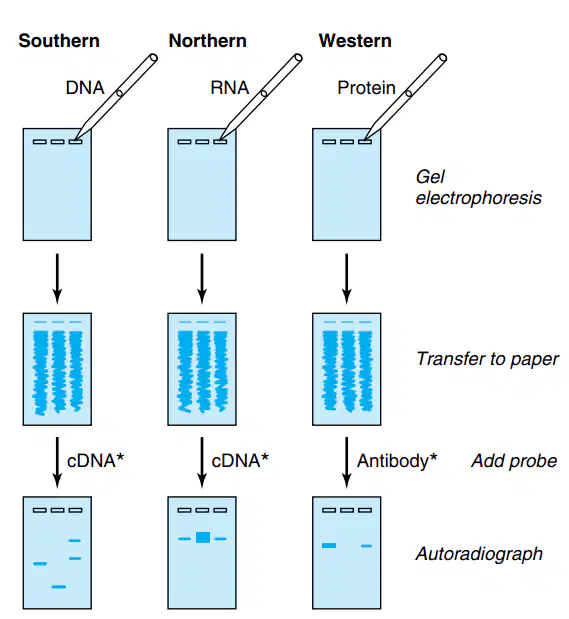
A student researcher overexpresses an exogenous protein in cell culture and wants to determine if that protein, is in fact, overexpressed. What technique would best demonstrate that this protein is expressed in these cells?
NORTHERN BLOT
SOUTHERN BLOT
WESTERN BLOT
EASTERN BLOT
Which of the following probes are most commonly used in Western blotting?
NUCLEIC ACIDS
ANTIBODIES
BOVINE SERUM ALBUMIN
ALL OF THE ABOVE
What is the purpose of washing in every step in western blotting?
to ensure a stable pH environment in the tank
to remove any unbound antibodies
to remove any contaminating residues
to avoid protein degradation
to moisten the transfer membrane
What is the first step in blotting technique?
Detection and analysis of molecules of interest
Separation of molecules based on size and charge
Transfer of separated molecules from a gel to a membrane
Labeling of probes or antibodies

A student performed a gel electrophoresis experiment. Compared to the fragments at the top of the gel, the fragments at the lower end are?
larger, and move slower
smaller, and move faster
larger, and move faster
smaller, and move slower
Why do the fragments of DNA in gel electrophoresis travel away from the negative electrode?
DNA is negatively charged so attracted to the positive end of the unit
the agarose gel in negatively charged
DNA is positively charged to attracted to the negative end of the unit
the agarose gel is positively charged

