
 Worksheets
Chem and Phys changes ++
Total questions: 70
Worksheet time: 44mins
Mark is observing a burning candle. He notices that the candle wax makes a pool and dribbles down the side of the candle, where it hardens again. The wax has undergone:
a physical change
a chemical change
a physical and chemical change
the formation of a new substance
A different chemical substance is formed when
a cloth is cut
a cup breaks
a candle burns
a piece of chalk falls apart
Which object would be most likely to rust?
an iron nail
a plastic comb
a glass marble
a paper cup
David added a little baking soda to a beaker that contained vinegar. Bubbles started coming from the mixture and a gas was released. The gas was evidence that:
the mixture was starting to boil.
the air in the flask contracted.
the vinegar and baking soda expanded.
a chemical reaction took place.
An example of a liquid turning into a gas is:
a chocolate bar melting
steam escaping from a cup of hot chocolate
an ice cream cone dripping
a stick of butter getting warm
If you dissolved a lot of salt in some water in a large, flat dish and put the dish in bright sunlight on a hot day, what would be left in the dish after a long time?
dry salt
water with no salt
the same salty water as before
nothing

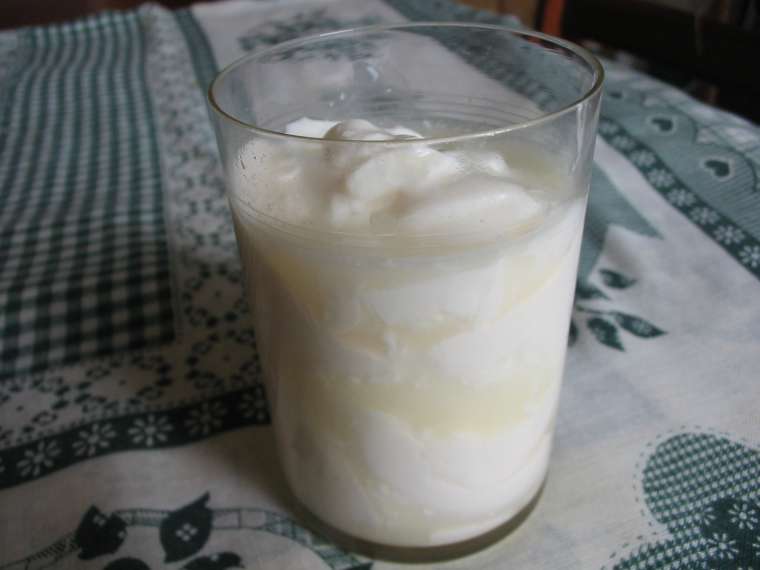


Scrambling eggs is an example of
A physical change
A chemical change
Solution
Tearing paper into small pieces is an example of a
Mixture
Physical change
Chemical change
Heating a solid until it changes color and produces an odor, and noting the solid cannot be changed back is an example of
Physical Change
Chemical Change
When two or more substances are combined to create a new substance, this is an example of a ______________ change.
physical
chemical
heated
particle
When matter changes shape, this is an example of a _____________ change.
physcial
chemical
particle
permanent
_____________ of matter can be measured without changing the matter.
Properties
Particles
Substances
Solutions

True or false: The picture below shows a physical change.
True
False

What type of change is represented by the image below? Select all that apply:
physical
chemical
soluble
permanent
A student boils a mixture of water and salt until the salt dissolves into the water. How could he prove that the salt did not disappear but is still present in the water?
Pour the mixture through a sieve to filter out the salt.
Wait until the mixture cools and then boil it again.
Add vinegar to the water and salt.
Let the water evaporate until only the salt is left.
Which of the following is a physical change?
Iron is oxidized to iron oxide
Aluminum metal is pounded into thin sheets
Copper reacts with a strong acid
Sodium metal explodes on contact with water
Which of the following is an example of a chemical change?
melting solid gold
burning hydrogen gas
dissolving sugar in water
breaking a sheet of glass
Which of the following is a common sign that a chemical change has occurred?
A chemical has changed size.
A chemical has changed to a different state (solid, liquid or gas)
A chemical has become a different shape.
A chemical has turned a different color.
Jolene wants to experiment with sugar cubes. Which of the following causes a sugar cube to only change physically, not chemically?
burning the sugar cube with a match
crushing the sugar cube and dissolving it in water
dehydrating the sugar cube with sulfuric acid
chewing the sugar cube and digesting it
Properties that describe how a substance looks, feels, state of matter, etc., are?
Chemical Properties
Physical Properties
Which type of change is most often easily reversed?
Chemical
Physical
Both

Drying wet hair is an example of a ___________ change
Chemical
Physical

Josh decided to mix some vinegar with baking soda. He knew that a reaction occurred because he made careful observations. He noted that the mixture started to foam up and bubble, and it was white in color. How did Josh know that a chemical reaction occurred?
He was sure a reaction occurred because of
the color of the mixture
the smell of the vinegar
the volume of the mixture
the formation of a gas
Which of the following examples represents a physical change?


Cooking an egg
Chemical
Physical
Melting Chocolate
Chemical
Physical
Evaporating Water
Chemical
Physical
Bike rusting
Chemical
Physical
Crushing a can
Chemical
Physical
Digesting food
Chemical
Physical
Melting Wax
Chemical
Physical
A student mixes yellow powder with water. Which observation would prove a CHEMICAL change occurred?
The powder DISSOLVED in the water
The water turned the COLOR yellow
The water's TEMPERATURE changed
The STATE OF MATTER changed
Which of the following examples provides evidence of a PHYSICAL change?
Wood is burned and releases ash and smoke
Iron rusts over time
When mixed, baking soda and vinegar form gas bubbles
Boiling water bubbles when heated
You mix a yellow powder and a clear liquid. The liquid turns light yellow and the powder seems to disappear. This is a...
Endothermic Chemical Change
Exothermic Chemical Change
Physical Change

A white tablet is dropped into water. The water becomes cloudy and bubbles are produced. What type of change has occurred?
Physical change
Chemical change
No change
Which observations prove a chemical change occurred
Dissolving and expected color change
Mixing and dissolving
State of matter change and boiling water bubbles
Unexpected color change and temperature change
What is true of ALL Chemical reactions?
Produce gas
Change color
Form new substances
Create a precipitate
Julie measured out 10.5 ounces of water. Then she measured 3.5 ounces of lemon juice. She added the lemon juice to the water and stirred until they were completely mixed.
What was the weight of the final mixture?
3.5 ounces
14.0 ounces
7.0 ounces
10.5 ounces
Lyle stirs 5 grams of salt into a beaker of water. He then adds 15 grams of pure iodine to the mixture.
If the total weight of the new mixture is 225 grams, what is the weight of the water?
200 grams
20 grams
100 grams
205 grams

Shannon broke her pencil into 4 pieces and found the mass of each piece.
Using the picture, what is the mass of the whole pencil before Shannon broke it?
20 g
18 g
23 g
The mass cannot be determined.
Which sentence about physical and chemical changes is true?
Both create a new substance.
Neither creates a new substance.
A physical change creates a new substance, but a chemical change does not.
A chemical change creates a new substance, but a physical change does not.

What kind of change is a rotting banana?
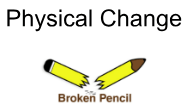
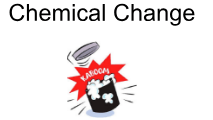

What kind of change is crushing a soda can?

When a new substance is formed with different properties than the original substance it is called a
chemical change
physical change
freezing
boiling

