
 Worksheets
Physiological Adaptations to Exercise
Total questions: 72
Worksheet time: 38mins
What is a common physiological adaptation to exercising in hot environments?
Increased sweat production
Decreased heart rate
Reduced blood flow to the skin
Lower core body temperature
Which of the following is a typical adaptation to exercising in cold environments?
Increased blood flow to extremities
Enhanced shivering response
Decreased metabolic rate
Reduced insulation from body fat
What is a primary adaptation to exercising at high altitude?
Decreased red blood cell count
Increased lung capacity
Enhanced oxygen-carrying capacity of blood
Reduced breathing rate
Which metabolic adaptation occurs as a result of regular exercise?
Decreased mitochondrial density
Increased reliance on carbohydrates for energy
Enhanced fat oxidation
Reduced enzyme activity
What is a common musculoskeletal adaptation to regular exercise?
Decreased bone density
Increased muscle fibre size
Reduced joint flexibility
Lower tendon strength
Which of the following is a neural adaptation to exercise?
Decreased motor unit recruitment
Improved neuromuscular coordination
Reduced nerve conduction velocity
Lower synaptic efficiency
What is a cardiovascular adaptation to regular aerobic exercise?
Decreased stroke volume
Increased resting heart rate
Enhanced capillary density
Reduced cardiac output
Which respiratory adaptation is commonly seen with regular exercise?
Decreased tidal volume
Increased respiratory rate at rest
Enhanced lung diffusion capacity
Reduced alveolar surface area
What is an endocrine adaptation to regular exercise?
Decreased insulin sensitivity
Increased cortisol levels at rest
Enhanced hormone receptor sensitivity
Reduced growth hormone production
Which of the following is a symptom of overtraining?
Increased energy levels
Improved sleep quality
Persistent fatigue
Enhanced immune function
What happens to the muscles during hypertrophy?
The muscle fibers decrease in size
The muscle fibers increase in size
The number of muscle fibers decreases
The number of muscle fibers increases
What causes microtears
muscles being too strong
stress on the bone
overload of the muscle
tendons

Why are microtears a good thing
increased protein synthesis
helps them become shorter
decreased blood flow
increased fat absorbtion
Why are microtears beneficial
bones become stronger
joints get more tendons
helps muscle grow stronger / hypertrophy
reduction in muscle mass
What is hyperplasia
The reduction in number of muscle fibres.
The increase in number of muscle
fibres.
The increase in size of muscle fibres.
The reduction in size of muscle fibres.
Aerobic exercise will affect the muscle cells by:
Decreasing myoglobin concentration
Increasing myoglobin concentration
Increasing the number of red blood cells
Reducing the number of mitochondria
Heart rate increasing just before exercise to prepare the body for the demands about to be placed on it is called...
Vascular Shunting
Hypertrophy
Rise in Blood Pressure
Anticipatory Rise
The technical term for the redirection of blood flow is...
Vascular Shunting
Vena Cava
Capillarisation
Sudden Arrhythmic death Syndrome
What is the Adaptation called when your heart gets bigger?
Vasoconstriction
Hypertension
Capillarisation
Cardiac Hypertrophy
Cardiac output is:
Tidal volume x stroke volume
Stroke volume x heart rate
Heart rate x ventilation
Stroke volume x venous return
Cardiac output is:
Tidal volume x stroke volume
Stroke volume x heart rate
Heart rate x ventilation
Stroke volume x venous return
Myoglobin is responsible for:
Transferring oxygen from capillaries into the muscle cell
Respiration and the aerobic production of energy / ATP
Breaking down glycogen
Transferring CO2 back into alveoli from the blood
Which option is an ADAPTATION to exercise?
Increased Blood Pressure
Decreased Heart Rate Recovery Time
Vascular Shunting
increased Heart rate
Which one of the following is a short-term effect of exercise on the Muscular system?
Decrease in stroke volume
Increase in the temperature
Decrease in blood flow from the heart
Increase in muscle mass
Which one of the following is a short-term effect of exercise on the Muscular system?
Decrease in stroke volume
Build up of Lactic Acid
Decrease in blood flow from the heart
Increase rate of recovery
Starling's Law relates to what response?
The return of Blood to the Right Atria Through the Veins
Increased Venous Return leaved to Increased SV, due to an increased stretch of ventricular walls and therefore force of contraction.
Narrowing of the Arteries. arterioles and pre-capillary Sphincters.
what is the effect of Starling's Law on stroke volume (pick 2)
venous return (blood back to heart) increases
cardiac output lowers with less blood
stroke volume will increase as more blood fills the heart
stroke volume will decrease
what is the effect of capillarisation on diffusion rate in the working muscles
more capillaries decreases the exchange of gases in the muscle
less capillaries will help diffusion
more capillaries will increase gas exchange and diffusion in the muscle
more capillaries will have no effect in the diffusion rate
What is Arteriovenous oxygen difference (a-VO2 diff)
difference of blood flow in the muscle
difference of blood O2 in the arterial blood compared to the venous blood
difference of CO2 entering and leaving the lungs
difference of lactic acid in the muscle before and after
why does blood flow change during exercise (pick 2)
increase delivery of O2 to working muscles
decrease stroke volume
removal of CO2/waste from the muscles
decrease breathing rate
Long-term physiological changes that occur as a result of participating in a training program are referred to as..
Chronic adaptations
Acute responses
The minimum period for adaptations to occur with Aerobic (endurance) training is..
4 weeks
6 - 8 weeks
10 weeks
6 weeks, although they are more evident after 12 weeks
Which of the following is a chronic adaptation of the cardiovascular system due to aerobic training?
Decreased capillarisation
Increased capillarisation
Decreased muscle mass
Increased muscle mass
Cardia Output =
Blood Pressure x HR
Blood Pressure / HR
HR + Stroke Volume
HR x Stroke Volume
What is the effect of a higher stroke volume in trained aerobic athletes?
More blood is pumped with each heartbeat
Less blood is pumped with each heartbeat
Heart needs to work harder
Decreased blood flow and oxygen supply
What is one of the benefits of the heart working more efficiently in trained aerobic athletes?
Higher HR during
sub-maximal exercise
Lower HR during
sub-maximal exercise
Increased blood pressure
Decreased oxygen supply
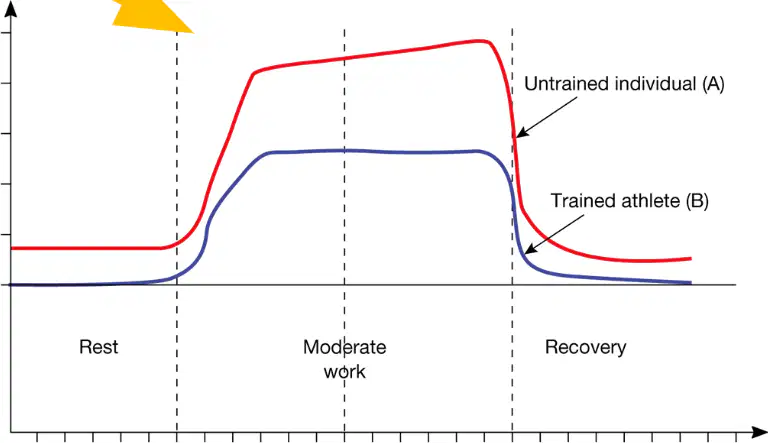
During which of the following times does the heart rate of trained athletes remain lower compared to untrained individuals according to the graph?
Rest
Moderate work
Recovery
All of the above
What does a faster HR recovery in trained athletes indicate?
lower fitness levels
higher aerobic fitness
higher blood pressure
lower muscle mass
Which of the following is a cardiovascular adaptation to aerobic training?
Decreased cardiac output during maximal exercise
Increased cardiac output during maximal exercise
Increased heart rate during rest
Decreased stroke volume during exercise
A benefit of enlargement of the heart muscle (cardiac hypertrophy) as a result of Aerobic training is..
Higher blood pressure and vasoconstriction of the blood vessels
Greater volume of blood ejected from the heart and more oxygen to the muscles
Greater recruitment of motor units (muscle fibres) and therefore greater strength
Greater stroke volume and reduced cardiac output
What is the name of the receptors that detect change in blood pH?
Baroreceptors
Chemoreceptors
pH receptors
chemicalreceptors
What part of the brain receives signals regarding changing breathing rate?
Cardiac control centre
Respiratory control centre
Breathing control centre
Hypothalamus
Name the missing part in the travel of air into the lungs:
pharynx, larynx, trachea, bronchi, _________ alveoli
Epiglottis
Diaphragm
Thoracic Cavity
Bronchioles
Select the 3 characteristics of the membranes that increase efficiency of gaseous exchange.
one cell thick
large surface area
layer of moisture
lots of holes
Definition: "The volume of air
breathed in and out
with each breath"
Breathing rate
Tidal Volume
Inspiratory Reserve Volume
Vital Capacity
Definition: "The amount of air that can be forced out of the lungs after maximal inspiration."
Tidal Volume
Breathing Rate
Vital Capacity
Inspiratory Reserve Volume
Select the acute adaptations of the respiratory system
Increased breathing rate
Increased strength of respiratory muscles
Increased size of thoracic cavity
Increased tidal volume
Select the chronic adaptations of the respiratory system.
Increased breathing rate
Increased strength of respiratory muscles
Increased Tidal Volume
Increased Vital Capacity
Name the nerve that stimulates an increase in the contraction rate and force of respiratory muscles
Breathing nerve
Phrenic Nerve
Siatic Nerve
Trochlear nerve
What are the possible negative effects of training at altitude?
Home sickness
Altitude sickness
Clouds
Lack of motivation
Poor coaching
What is different about training at altitude and sea level that causes adaptation to occur?
The amount of food to eat
The partial pressure of O2
The partial pressure of CO2
The partial pressure of nitrogen
Which respiratory muscles work during inspiration?
Diaphragm
Internal intercostals
External Intercostals
Which respiratory muscles work during expiration?
Diaphragm
Internal intercostals
External intercostals
What are the short-term effects of exercise on the cardiovascular system?
Decreased heart rate, decreased blood flow, and decreased oxygen delivery to the muscles.
No effect on heart rate, blood flow, or oxygen delivery to the muscles.
Increased heart rate, decreased blood flow, and decreased oxygen delivery to the muscles.
Increased heart rate, increased blood flow, and increased oxygen delivery to the muscles.
How does exercise affect the respiratory system in the long term?
Exercise damages the respiratory system and reduces lung capacity.
Exercise improves lung capacity, strengthens respiratory muscles, and improves oxygen exchange efficiency.
Exercise weakens lung capacity, weakens respiratory muscles, and decreases oxygen exchange efficiency.
Exercise has no effect on the respiratory system in the long term.
What are the benefits of exercise on the muscular system?
Exercise on the muscular system can cause muscle damage.
Exercise on the muscular system helps to increase muscle strength, improve muscle tone, enhance muscle endurance, and promote overall muscle health.
Exercise on the muscular system can lead to muscle weakness.
Exercise on the muscular system has no benefits.
How does exercise impact the skeletal system?
Exercise impacts the skeletal system by increasing bone density, strengthening muscles and improving joint flexibility.
Exercise only impacts the muscles, not the skeletal system.
Exercise weakens the bones and joints.
Exercise has no impact on the skeletal system.
What are the different energy systems used during exercise?
phosphagen system, glycolytic system, aerobic system
endocrine system, immune system, digestive system
muscular system, cardiovascular system, nervous system
anaerobic system, aerobic system, respiratory system
How does exercise improve cardiovascular endurance?
Exercise improves cardiovascular endurance by increasing the risk of heart disease.
Exercise improves cardiovascular endurance by decreasing the efficiency of oxygen delivery to the muscles.
Exercise improves cardiovascular endurance by reducing the body's ability to use oxygen during physical activity.
Exercise improves cardiovascular endurance by strengthening the heart muscle, increasing the efficiency of oxygen delivery to the muscles, and improving the body's ability to use oxygen during physical activity.
What happens to the respiratory rate during exercise?
Fluctuates
Stays the same
Increases
Decreases
How does exercise strengthen muscles?
Exercise causes microscopic damage to muscle fibers, which are then repaired and strengthened.
Exercise has no effect on muscle strength.
Exercise reduces the number of muscle fibers.
Exercise increases the size of muscle fibers.
What are the long-term effects of exercise on bone density?
Exercise increases bone density and reduces the risk of osteoporosis.
Exercise only increases bone density temporarily and does not have long-term effects.
Exercise decreases bone density and increases the risk of osteoporosis.
Exercise has no effect on bone density.
How do the energy systems contribute to exercise performance?
The energy systems have no impact on exercise performance.
The energy systems only provide energy for short bursts of exercise.
The energy systems are responsible for muscle growth during exercise.
The energy systems provide fuel and sustain energy levels during exercise.
What are the benefits of regular exercise?
Regular exercise improves cardiovascular health and reduces the risk of chronic diseases.
Regular exercise has no benefits.
Regular exercise leads to muscle weakness and joint problems.
Regular exercise only helps in weight loss.
How does exercise affect mental health?
Exercise has no impact on mental health.
Exercise improves mental health by reducing stress and anxiety.
Exercise only worsens mental health conditions.
Exercise leads to memory loss and cognitive decline.
What are the short-term effects of exercise on the muscular system?
Decreased muscle strength and endurance.
No effect on the muscular system.
Increased muscle strength and endurance.
Increased muscle soreness and fatigue.
What are the long-term effects of exercise on mental health?
Exercise has no impact on mental health.
Exercise improves mental health by reducing stress and anxiety.
Exercise only worsens mental health conditions.
Exercise leads to memory loss and cognitive decline.
How do the energy systems contribute to muscle growth during exercise?
The energy systems have no impact on muscle growth during exercise.
The energy systems only provide energy for short bursts of exercise.
The energy systems are responsible for muscle growth during exercise.
The energy systems provide fuel and sustain energy levels during exercise.
What happens to the heart rate during exercise?
Fluctuates
Stays the same
Increases
Decreases
What are the benefits of regular physical activity?
Regular physical activity improves cardiovascular health and reduces the risk of chronic diseases.
Regular physical activity has no benefits.
Regular physical activity leads to muscle weakness and joint problems.
Regular physical activity only helps in weight loss.
How does exercise impact the cardiovascular system?
Exercise has no impact on the cardiovascular system.
Exercise decreases heart rate, blood flow, and oxygen delivery to the muscles.
Exercise increases heart rate, blood flow, and oxygen delivery to the muscles.
Exercise only affects the muscles, not the cardiovascular system.
What are the long-term effects of regular exercise on mental health?
Regular exercise has no impact on mental health.
Regular exercise improves mental health by reducing stress and anxiety.
Regular exercise only worsens mental health conditions.
Regular exercise leads to memory loss and cognitive decline.

