
Font size
 Worksheets
Chemistry Final Sem1
Total questions: 124
Worksheet time: 1hrs 2mins
Which is the best word that describes a quantum?
wave
energy
orbital
frequency
What is the model of the atom that says that the electron cloud has probable places to find electrons?
Quantum reality model
Bohr model
Rutherford model
Quantum mechanical model
Which is the correct description for the highest sublevel for energy level 3?!
Energy level 3 has 3 sublevels; the highest energy sublevel is d, with 5 orbitals.
Energy level 3 has 2 sublevels; the highest energy sublevel is d, with 5 orbitals.
Energy level 3 has 3 sublevels; the highest energy sublevel is f, with 7 orbitals.
Energy level 3 has 2 sublevels; the highest energy sublevel is p, with 3 orbitals.
What is the shape for the p subshell orbitals?
dumbbell
spherical
ring
clover
What determines the shape of the periodic table?
quantum structures of the nucleus
nuclear fission
electron configurations
Plank’s constant
Which is the short-hand electron configuration for potassium?
[Ar]4s2
1s22s22p64s1
1s22s22p63s23p64s1
[Ar]4s1
Which element is this electron configuration best representing?
1s22s22p63s23p64s23d7
Y
O
Co
Fe
Which element or ion could NOT have this electron configuration?
1s22s22p63s23p6
Br-
Ar
Cl-
S2-
What is the electron configuration for a neutral atom of silver?
[Kr]5s24d9
[Ar]5s24d9
[Kr]5s14d10
[Ar]5s14d10
Which statement best describes the Aufbau principle?
Protons will fill the lowest energy orbitals in the electron cloud first.
Electrons will fill the lowest energy orbitals in the electron cloud first.
Protons will fill the highest energy orbitals in the electron cloud first.
Electrons will fill the highest energy orbitals in the electron cloud first.
Which statement best describes Hund’s rule?
Electrons prefer unstable orbital energies.
Electrons fill orbitals to maximize the opposite spin before the same spin is filled.
Electrons fill orbitals to maximize the same spin before the opposite spin is filled.
All elements with valence electrons in the d block will steal one electron from the previous s block.

Which rule regarding electrons is being described by this image?
Aufbau principle
Pauli exclusion principle
Hund’s rule
Heisenberg uncertainty principle
Which two quantum laws rely on the spin of an electron?
Heisenberg uncertainty principle and Aufbau principle
Pauli exclusion principle and Heisenberg uncertainty principle
Aufbau principle and Hund’s rule
Hund’s rule and Pauli exclusion principle
A hydrogen lamp emits several lines in the visible region of the spectrum. One of these lines has a wavelength of 6.56 x 10 -5 cm. What is the frequency of this radiation in nm?
4.57 x 10¹²/s
4.6 x 10¹²
1.97 x 10⁴/s
2.19 x 10⁻¹³/s
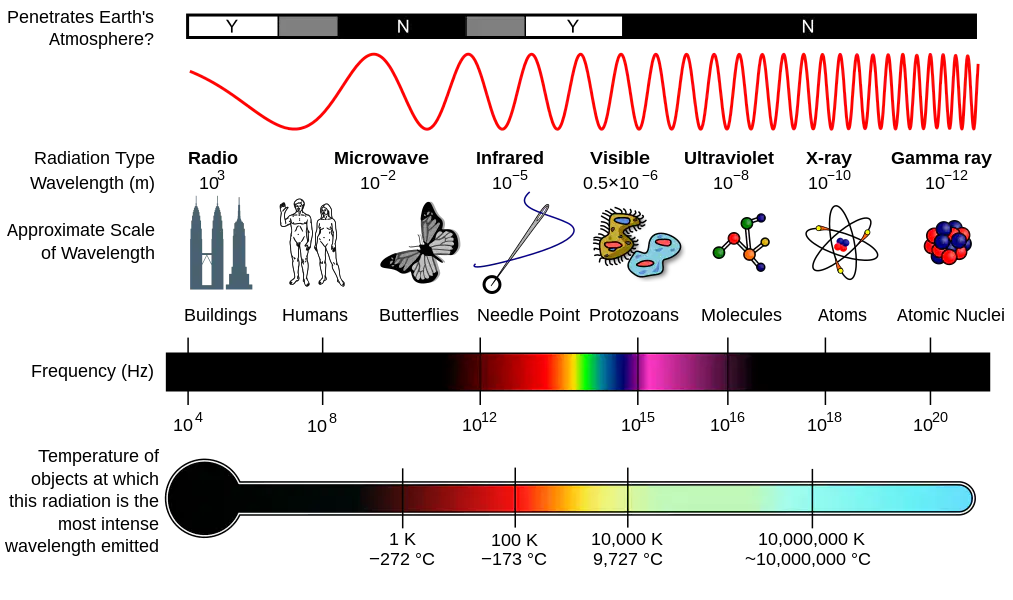
What is the frequency of radiation with a wavelength of 5.00 x 10⁻⁸ m? In which region of the electromagnetic spectrum is this radiation?
v = 6.0 x 10¹⁵ /s, visible light
v = 1.5 x 10⁻¹²/s, radio light
v = 1.5 x 101 /s, ultraviolet light
v = 6.0 x 10¹⁵ /s, radio light
What mistake(s) was made in this problem? The question is: What is the frequency of radiation with a wavelength of 2.70 x 10⁻⁸ m? Here is the student’s work using the GUESS method. Helpful information: c = v. c = 3 x 10⁸ m/s.
w = 2.7 x 10⁻⁸ m
c = 3 x 10⁸ m/s
v=v
v = c/w
v = 3x10⁸m/s / (2.7 x 10⁻⁸ m)
v = 1.1 x 10¹⁶ /s
They used the wrong symbol for the speed of light.
They used the wrong symbol for wavelength.
They rounded their answer to too many significant figures.
They got the wrong answer.
What is the origin of the atomic emission spectrum of an element?
How electrons are ejected from metals when a high enough wavelength of light shines on them.
How electrons always go to the most unstable energy level to fill their sublevels.
How electrons release energy when they go to a more stable energy level.
How the electron cloud is denoted by energy level, sublevel, and orbitals by their quantum number.

Put the following forms of radiation in order based on the longest to the smallest wavelength.
Microwave, Ultraviolet, Visible
ultraviolet, microwave, visible
ultraviolet, visible, microwave
microwave, visible, ultraviolet
visible, ultraviolet, microwave
Which of the following household structures could easily be used to demonstrate the absorption and release of energy by electrons?
piece of paper
toothbrush
pile of dirt
ladder
Why would an atom that has a very high atomic number also probably be expected to have a very high number of lines on its emission spectrum?
It has many electrons.
It has many protons.
It has few energy levels due to quantum compression.
It would have the same number of lines on an emission spectrum as a small atom.
Which equation best incorporates the ideas of quantum mechanics, as we learned in this lesson?
μ= λv
E = hv
E= λv
c= λv
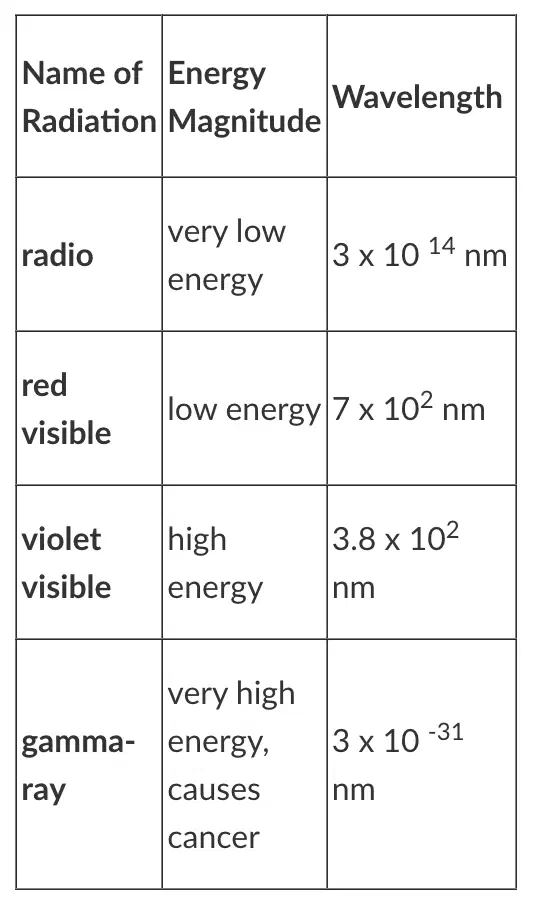
What is the wavelength of radiation with a frequency of 1.5 x 10¹³ Hz? Does this radiation have a longer or shorter wavelength than red light?
Helpful information:
c =λv
E= hv
2.0 x 10⁴nm, which is longer than red light
1.0 x 10¹⁶nm, which is longer than red light
4.5 x 10²¹nm, which is longer than red light
2.0 x 10⁻⁵nm, which is shorter than red light
What is the name for the physical process of shining high-frequency light on metal to eject electrons?
quantum mechanical law
The photoelectric effect
The Heisenberg uncertainty principle
electron configurations
Which best describes the dual nature of light?
Light can behave as neither a particle nor a wave depending on how it is observed.
Light can behave as a particle and an energy source depending on how it is observed.
Light is both a distance and a volume.
Light can behave as both a particle and a wave depending on how it is observed.

Use the helpful information to solve this problem. What is the frequency of visible light?
It is impossible to determine because some information is missing.
v = 6 x 10¹⁴/s
v = 6 x 1027
v = 6 x 10²³/s
Which statement is false?
Chemistry can only use empirical data observed through the senses or sensors.
Chemistry is a human endeavor, with arguments and mistakes made all the time.
Elements are only named for scientists who are no longer living.
The periodic table is probably unfinished; super-heavy elements might still be discovered.
Meyer and Mendeleev squabbled about who got the credit for the periodic table because they both published at similar times without helping each other. Which statement is false?
Meyer rearranged the periodic table to ensure that element properties matched, even though it got their masses out of order.
It is normal for scientists to squabble about discoveries and evidence.
Mendeleev and Meyer both organized their periodic tables based on relative atomic mass.
Mendeleev left room on his periodic table for undiscovered elements; Meyer did not.
What states that periodic properties will emerge by organizing elements by increasing atomic number?
law of standard periods
atomic law
law of conservation of matter
periodic law
Which organization is responsible for standard naming conventions for elements on the periodic table?
Metric System
Mendeleev Group
IUPAC
PhET
What discovery fixed the mistakes and questions that existed after Mendeleev’s periodic table?
atomic number
neutrons
isotopes
relative atomic mass
Who made the modern periodic table that we now use?
Mendeleev
Milikin
Moseley
Meyer
Use your periodic table to determine which of the following is NOT a metal.
Bk
Bh
Ba
Br
Use your periodic table to determine which of the following is NOT a lanthanide.
Cn
Pr
Ho
Gd
Use your periodic table to determine which of the following is NOT a property of an alkali metal.
most reactive
1 valence electron
likes to accept valence electrons
found in group 2
Use your periodic table to determine which of the following is NOT a property of a noble gas.
has a very low ionization energy
8 valence electrons
least reactive elements
gas phase
Use your periodic table to determine which of the following is a transition metal.
Sb
Sr
Pt
Rb
Which lists only nonmetals?
Ki, Li, Po, Ru
Br, Ne, Xe, Rn
Si, As, Sb, Te
C, N, I,
Which image best describes the trend of metallic properties and the trend of atomic size?
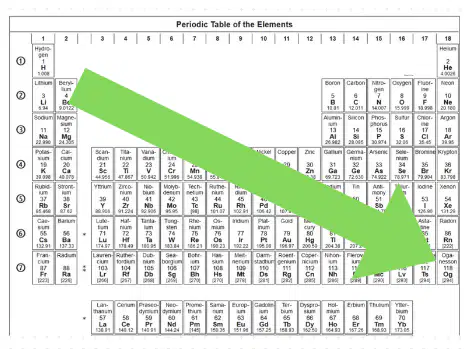
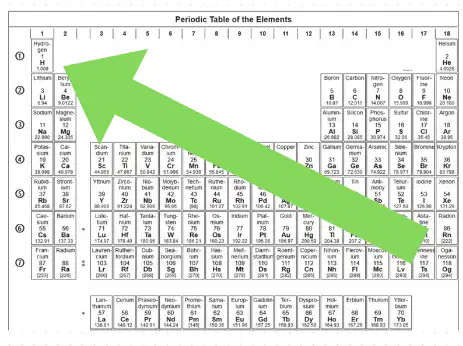
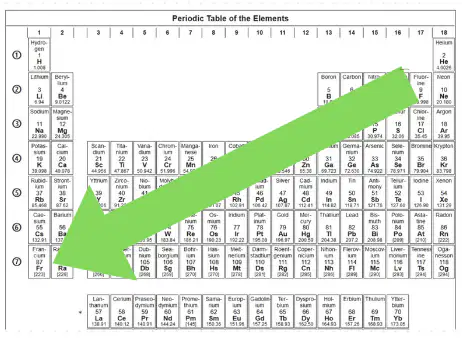
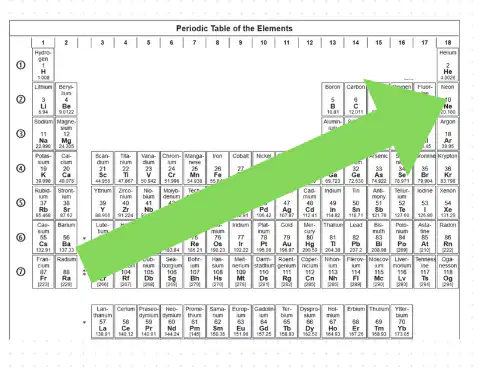
Use your periodic table to help answer this question.
Which image best describes the trend of electronegativity?
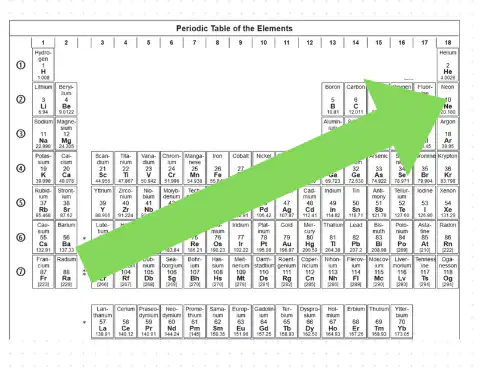
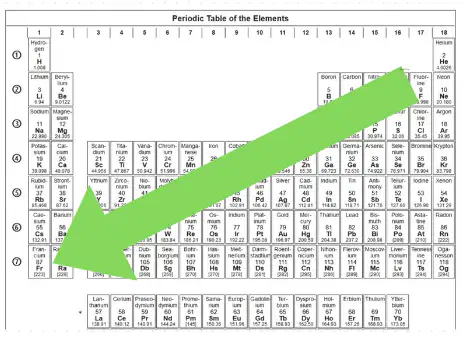
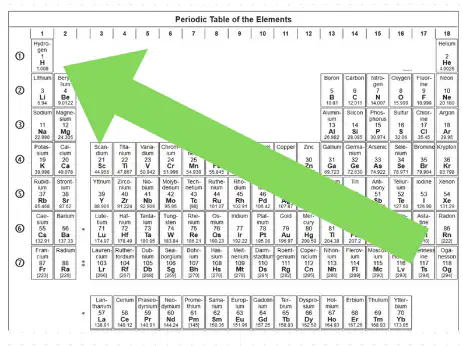
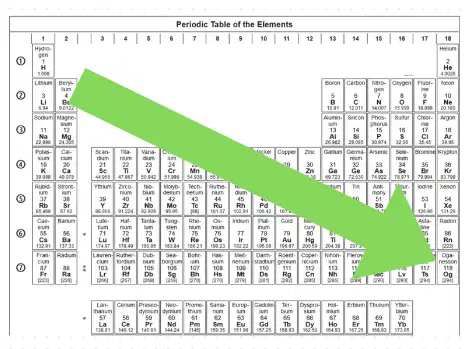
How do valence electron and electron configurations explain why atoms are the biggest and most happy to give up valence electrons by using very little ionization energy in the bottom left, such as Fr, Cs, Ra, and Ba?
Their valence electrons are in subshells 6 and 7, very far from the nucleus, and only have 1 or 2 valence electrons, so they are more stable if they give up those weakly held, far away electrons.
This statement is incorrect. Fr, Cs, Ra, and Ba’s properties do not depend on their electron configuration.
Electron configurations are always the biggest for those elements and are also the most metallic.
They only use condensed electron configurations.
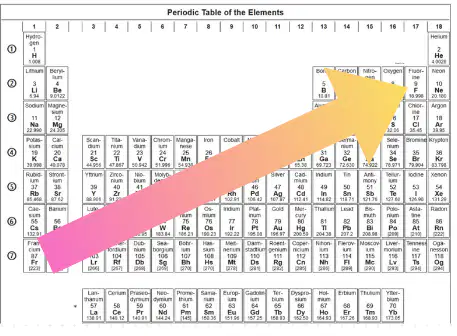
Which patterns on the periodic table are being illustrated by this diagram?
Atomic radius and metallic properties
Ionization energy and electronegativity
Ionization energy and atomic radius
Metallic properties and electronegativity

What does this electron dot diagram indicate about where this atom fits in a periodic table trend?
It has a high metallic property because it has to get rid of 6 valence electrons.
It has a high electronegativity because it only needs 2 more valence electrons to fill the valence shell.
There is no relationship between an electron dot diagram and the periodic table.
It has 6 valence electrons, so it fits all the highest trends.
Why does F have a higher electronegativity than Ti?
It has 7 valence electrons and is more stable with 8.
It is a nonmetal, so it is more likely to let go of electrons.
It has 7 valence electrons and is more stable if it loses them.
It is a bigger atom than Ti, so it wants electrons more.
Use your periodic table to answer this question. Which atom in this list has a bigger neutral radius?
He
Ru
S
Cs
What happens to the size of atomic radii for atoms that become positive by losing valence shells?
They are half their size.
They get smaller.
They get bigger.
They stay the same size.
Use your periodic table to answer this question. Put the following atoms in order from smallest to largest, as predicted by periodic table trends.
Zn, Mn, Cr, Ni, Sc
They cannot be estimated for comparative size.
Zn, Cr, Mn, Ni, Sc
Cr, Mn, Sc, Ni, Zn
Zn, Ni, Mn, Cr, Sc
What kind of atom gains electrons to become more stable, which increases the size of its electron cloud, making the radius larger?
neutron
crouton
anion
cation
Which of the following measurements is a possible size for an atomic radius?
1.50 x 10²³ m
150 m
150 pm
1.50 x 10¹⁰ km
Use your periodic table to answer this question. Which lists atoms in order from smallest to largest?
Hf, Zr, Ti
F, Cl, I
As, P, N
Au, Cu, Ag
Which lists the common charges for these elements in the same order as the element name?
hydrogen, aluminum, iodine
1+, 2+, 1-
1+, 3+, 1-
Write the formula for these cations: iron (II), iron (III) and tin (IV)
Fe 2+, Fe1+, Sn9+
Ir2+, Ir3+, Ti4+
Ir(II), Fe(III), Ti(IV)
Fe2+, Fe3+ and Sn4+
Which is true for the hydrogen ion?
The hydrogen ion is a metallic cation with a positive 1 charge.
The hydrogen ion is a nonmetallic cation with a positive 1 charge.
The hydrogen ion is a nonmetallic cation with a negative 1 charge.
The hydrogen ion is a nonmetallic anion with a positive 1 charge.
What charge do anions always get?
positive
both positive and negative simultaneously
neutral
negative
Which statement is FALSE?
Ions are most stable with 8 valence electrons.
The octet rule predicts stability with a filled valence shell.
Ionic stability happens when like charges attract.
Isoelectric species result from the formation of most ions.
Which statement is true?
Chemical bonds are forces of attraction that hold atoms together, often by similar electromagnetic charges.
Chemical bonds are forces of attraction that hold atoms together, often by opposite electromagnetic charges.
Isoelectric bonds are forces of attraction that hold atoms together, often by opposite electromagnetic charges.
Chemical bonds are forces of repulsion that hold atoms together, often by similar electromagnetic charges.
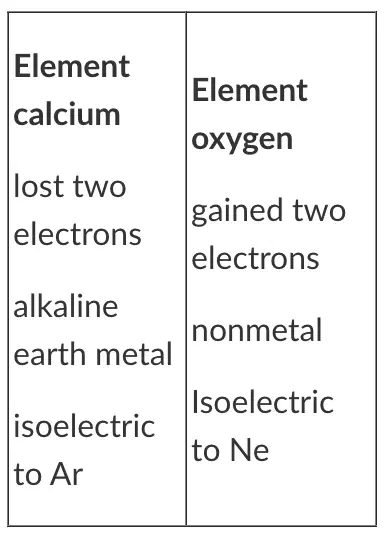
Explain the electromagnetic relationship (if any) between these two ions.
These will form a heterogeneous mixture without bonding.
Calcium will be 2+, and oxygen will be 2-, providing a force of repulsion.
These have no relationship.
They will probably be attracted to each other and form an ionic bond.
If an electron is lost from a metal's valence shell and transferred to a nonmetal's valence shell, what probably happened?
Ionic bonding
isotopes
Repulsion
nothing happened
Name this ionic compound using IUPAC rules.
NaCl
sodium monochloride
sea salt
sodium chloride
monosodium chlorine
Write the names for these two compounds, using IUPAC rules.
FeO, Fe2O3
iron (I) oxide, iron (II) oxide
iron oxide for both
iron (II) oxide, iron (III) oxide
iron (I) oxide, iron (II) oxide (III)
Why is MgO the correct formula for the ionic compound magnesium oxide?
It is not the correct formula, it should be Mg2O2.
Mg is 2+ and O is 2- and since all charges are multiplied by 2, they equal zero.
Mg is always a subscript of 1, and likewise for O
Mg is 2+ and O is 2- and they cancel each other out. Crisscross requires empirical formulas.
What are the charges on each ion in this formula:
SnS2
Sn 1+, S 2-
Sn 2+, S 2-
Sn 2+, S 1-
Sn 4+, S 2-
How many dots are drawn for all monatomic cations in electron dot diagrams?
zero
two
eight
one
How many dots will a neutral hydrogen atom have in an electron dot diagram, and then how many dots will it have when it becomes the hydrogen ion?
0, 2
0, 1
1, 0
2, 2
When drawing electron dot diagrams, which of the following is NOT required for drawing an ion?
number of valence electrons when neutral
charge outside the brackets
brackets around the symbol and valence electron dots
Chemical symbol
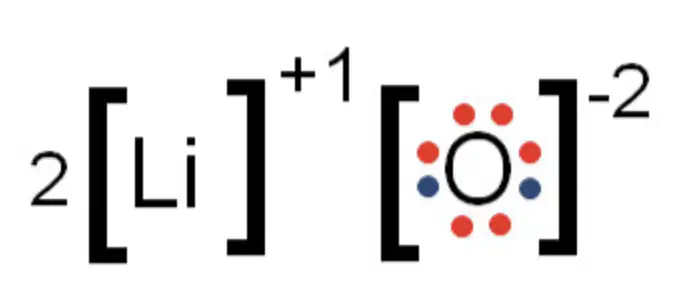
What is the chemical formula for the compound whose electron dot diagram is drawn below?
Li2O2
2LiO
LiO2
Li2O
Why do ionic compounds always bond metals to nonmetals?
Metals lose electrons, and nonmetals gain them, producing similar charges which attract.
Ions are atoms that have lost their charges, and therefore they form compound crystals.
Metals lose electrons, and nonmetals gain them, producing more stable charges if they balance out.
Metals gain electrons, and nonmetals lose them, producing opposite charges more stable if they balance out.
Why are metals such good conductors of heat and electricity?
Protons are loosely held in metals and will transfer electricity and heat easily.
They are not good conductors; they form brittle crystals.
Their sea of electrons allows for easy movement of these entities.
Their double bonds allow for easy movement of these entities.
What do you know about the valence electrons for metals and for elements that become cations?
They usually only need to accept 1 or 2 of them.
They don’t have valence electrons.
Cations are also metals.
They usually only have 1 or 2 of them.
Which is NOT a property of an ionic compound?
It is a salt.
Forms flexible crystal.
Conducts electricity in liquid and aqueous phases.
Forms brittle crystals.
Breaking bonds is ____. (Fill in the blank.)
exothermic
endothermic
neither endothermic nor exothermic
both endothermic and exothermic
Forming bonds is ____. (Fill in the blank.)
endothermic
exothermic
neither exothermic nor endothermic
both endothermic and exothermic
An ice cube melts in the hand. The chemist studies the flow of energy into or out of the ice cube molecules. Which statement below is true?
Melting is a chemical change.
The thermometer used to measure the temperature is the system.
The ice cube is the system.
The ice cube is the surroundings.
Does the graph for energy go up or down AFTER an endothermic reaction? Energy is graphed on the Y axis.
stays the same
down
up
unable to tell without more information
What is the name for the amount of energy stored in the chemical bonds of a substance? And what if it is an ionic substance? (Give two answers.)
bond energy, lattice energy
valence energy, ionic energy
valence energy, lattice energy
bond energy, ionic energy
Which of the following choices lists a similarity, and a difference, between ionic, polar covalent, and nonpolar covalent bonds?
These are all forces of attraction that cause bonds to break. Ionic bonds are low in electronegativity differences, while polar and nonpolar covalent bonds are very high.
Most tend to achieve a stable octet when bonding. Ionic transfers electrons, nonpolar covalent shares electrons unequally, and polar covalent shares electrons equally.
These are all forces of attraction that hold atoms together. Ionic transfers electrons, nonpolar covalent shares electrons unequally, and polar covalent shares electrons equally.
Most tend to achieve a stable octet when bonding. Ionic transfers electrons, nonpolar covalent shares electrons equally, and polar covalent shares electrons unequally.
Which is NOT true for all bonds, generally: ionic bonding, polar covalent bonding, and nonpolar covalent bonding?
They are all forces of attraction that hold atoms together.
They all tend to find stability by completing octets in the valence shell.
Electrons are shared unequally in all types of bonds.
They all tend to give off energy when forming bonds and require energy to break them.
Which major chemistry theme most closely relates to predicting the formation of ionic lattices and molecules when studying the bonding and formation of individual molecules?
Making sure significant figures are correct.
The particulate view in chemical reactions.
Matter behaves in a way that provides stability for atoms.
Keeping track of units.
Which is NOT a characteristic of a covalent bond?
salts
very strong bond energy
between two nonmetals
Electron is shared
When someone says that a pair of electrons are shared to form a covalent, single bond, what do they mean?
The two electrons are first used by ONE atom in the bond; then shared by the other.
The two electrons are available to BOTH atoms in the bond.
The two electrons are destroyed in a quantum vortex to keep the atoms bonded.
The two electrons are split when shared so that EACH atom in the bond can access one.
The name for the polyatomic anion is sulfate. What is the name of the acid it forms?
It is impossible to name this from the information provided.
hydrosulfuric acid
sulfurous acid
sulfuric acid
The polyatomic ion is nitrite. What is the name of the acid it forms?
nitric acid
nitrous acid
hydronitric acid
hydronitrous acid
Which fact makes acids special from many other compounds?
They are molecular compounds and do not dissolve in water.
While they are ionic compounds, they unexpectedly dissolve in water.
While they are molecular compounds, they ionize in water.
While they are ionic compounds, they expectedly dissolve in water.
Name this hydrate:
CuSO4. 5H2O
monocopper (II) tetrasulfate pentahydrate
copper sulfate pentahydrate
copper (II) sulfate pentahydrate
monocopper (II) sulfate hydrate
Which is NOT a property of an acid?
Acids generally taste sour.
Acids never break down into ions in water.
Acids are molecular compounds.
Acids almost always have H at the beginning of the formula.
It is time to draw the electron dot diagram for N2. Draw your electron dot diagram on paper by hand, then answer the following question.
Which statement is accurate for finding the number of dots to draw?
There are two N atoms, and each contributes 5 valence electrons for a total of 10.
There are two N atoms, and each needs 8 valence electrons, for a total of 8.
There is one N2 atom, each contributing 5 valence electrons for 8.
There are two N atoms, and each needs 8 valence electrons, for a total of 16.
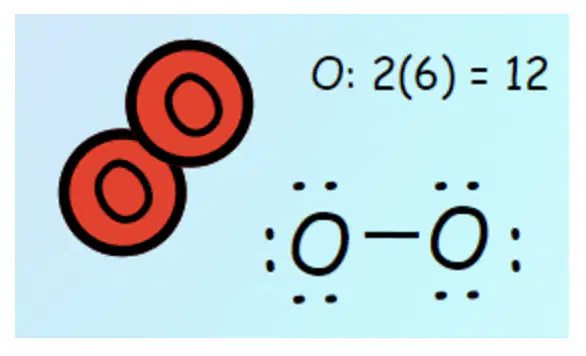
A student made an electron dot diagram for elemental oxygen. What mistake, if any, did they make?
The electron dot diagram should have brackets.
The student should have put in a triple bond when they realized they didn’t have enough valence electrons.
The student did not make a mistake.
The student filled all octets, creating too many valence electrons.
Which statement is true about triple bonds?
They are the strongest type of covalent bond.
They are usually found in bonds between H and other atoms.
They are the longest type of covalent bond.
They should be drawn when there are too many valence electrons in the electron dot diagram.
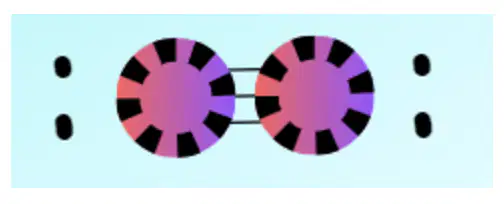
Draw your own electron dot diagram for elemental nitrogen. Use it to answer this question. Which statement about the electron dot diagram for elemental nitrogen is NOT true?
These are two metals bonded together, forming a covalent bond.
There are a total of 10 valence electrons.
The element is very stable this way; it is hard to break a triple bond.
There are two lone pairs and three bonded pairs.
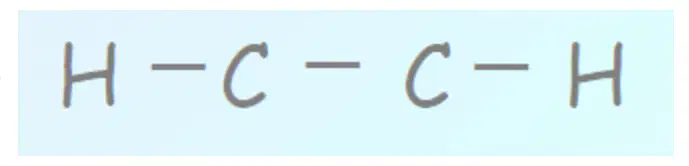
Draw an electron dot diagram for C2H2
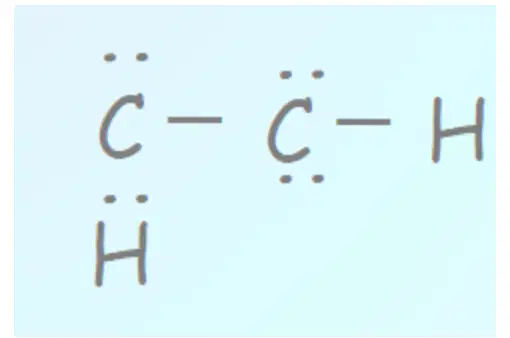
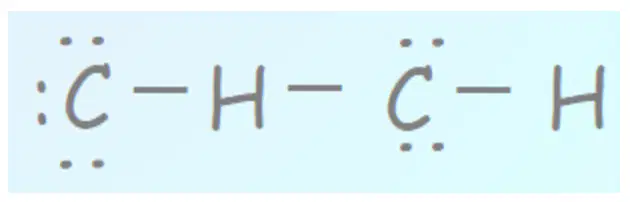
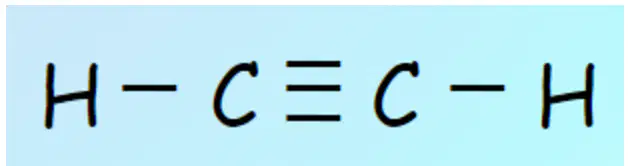
What is the formula for ammonium oxide?
AmO
none of these
NH4O
(NH4)2O
What is a particle that is held together with covalent bonds and contains a charge. It acts as a single particle in chemical reactions.
polyatomic ion
hydrate
acid
multiple-charged ion
Draw an electron dot diagram for the nitrate ion. Which statement is true?
There are a total of 18 valence electrons.
A double bond can be drawn on any N-O bond.
There are no brackets in this molecule.
There is only one way to draw the nitrate ion.
What is the name for Al2(SO4)3
dialuminum trisulfate
Aluminum sulfate
dialuminum monosulfide tetroxide
dialuminum trisulfate dodecoxide
What is wrong with this formula? Na3(PO4)
There is no problem with this formula.
There should not be parentheses around the phosphate ion.
There should also be parentheses around the sodium ion.
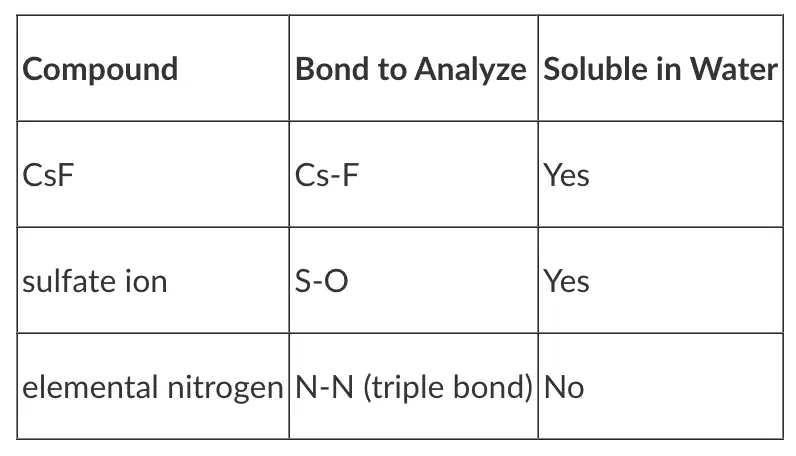
Which of the following has an electronegativity difference that would make it have a polar bond for the bond to analyze?
Impossible to determine
Cs-F
N-N
S-O
The formula is HClO3. What type of matter is it based on the formula?
Hydrate
Nonpolar
Acid
Ionic
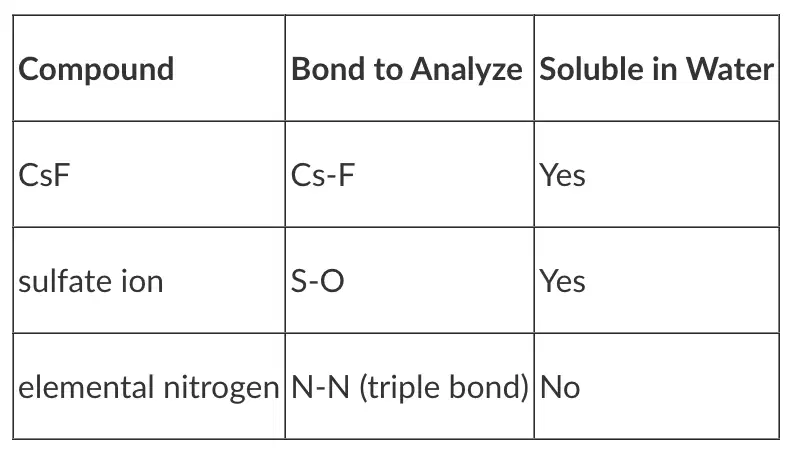
Which list below orders the bonds from highest electronegativity difference to lowest?
S-O, F-Cs, N-N
N-N, S-O, Cs-F
Cs-F, S-O, N-N
S-O, Cs-F, N-N
What might be true if the electronegativity difference in a bond is 1.8, but the bond is classified as polar instead of ionic?
It was classified as nonpolar instead.
The two elements in the bond might both be metals.
The two elements in the bond might both be nonmetals.
The two elements in the bond might be a metal and a nonmetal.
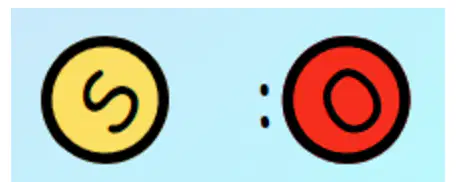
What type of matter might be represented by this diagram of a bond?
Ionic bond because the electrons are transferred from the metallic sulfur to the nonmetallic oxygen.
Polar bond because the shared electrons are much closer to oxygen.
Polar bonds because the shared electrons are much closer to sulfur, which has a higher electronegativity than oxygen.
Nonpolar covalent because they are both nonmetals, and the electrons are shared equally down the middle.
What term is used in chemistry to describe a convenient amount of atoms?
molecule
gram
mole
formula unit
What element is the concept of the mole based upon?
Hydrogen
Uranium
Carbon-12
Carbon-13
Why is a mole such a weird number? Why did they pick something so hard to remember? Where did that number come from?
It’s the number of atoms that line up around the equator.
Finding the number of atoms that fit inside a golf ball.
Calculating the percent composition of the empirical formula of carbon-12.
Just measure the periodic table mass, then count how many atoms are there.
Which of the following is a very rough example of a mole of a substance?
The tiny amount that can fit on your pinky finger.
About as much as will fill up an entire bus.
About a handful.
The amount of all mass in the universe.
Which of the following is NOT important when measuring out a mole of a gas?
It must be at standard temperature, 0oC (273 K).
It must be at standard pressure, 1 atmosphere (101.3 kPa).
It must be 6.02x10²³ molecules.
It must be at standard mass, 1 kg.
What standard device can calculate how much to measure out when you need a mole of matter?
the molar mass table of Avogadro
periodic table
none of these
activity series of the metals
Find the molar mass of C20H42
282 g/mol
74 g/mol
62 g/mol.
56 g/mol
Which is NOT a useful hint for calculating molar mass in this level of a chemistry class?
Round average atomic mass to the nearest tenth.
Use your calculator.
Always use electronic apps as shortcuts and trust they are always right.
Use your periodic table.
Which of the following formulas does NOT have a molar mass?
Ionic compounds
hydrates
acids
molecular compounds
Acids
Hydrates
Bases
They all have molar masses.
What is the mass in grams of one mole of a pure substance?
molar mass
average atomic mass
molecules (mc)
mole
Which of the following tools does NOT help calculate molar mass?
Scientific Calculator.
Periodic Table of the Elements.
Percent Composition
Compound Help Sheet.
What is the molar mass of aluminum sulfate Al2(SO4)2?
It is impossible to determine.
59.1 g/mol
150.3 g/mol
214.2 g/mol
Avogadro’s number will be in the conversion factor when converting between which two units?
grams and liters
moles and liters
moles and grams
moles and molecules
Which of the following conversion factors will NOT use Avogadro’s number?
moles to molecules
molecules to moles
liters of gas at standard conditions to moles
liters of gas at standard condition to molecules

A student wanted to know how many liters of gas are in 3.20 x 10 -3 mol CO2. They did the math. Why should 1 mole of CO2 be on the bottom of the conversion factor?
So the unit mol CO2 cancels out.
Whether the unit is on the top or the bottom of the conversion factor doesn't matter.
It shouldn’t; it should be on the top only so that it cancels out.
So the unit L CO2 cancels out.

A student wanted to know how many liters of gas are in 3.20 x 10 -3 mol CO2. They did the math. What mistake did they make?
They used the molar mass for the moles of carbon dioxide.
They rounded to too many significant digits.
They did not make a mistake.
They used the molar mass of carbon for the volume of gas.
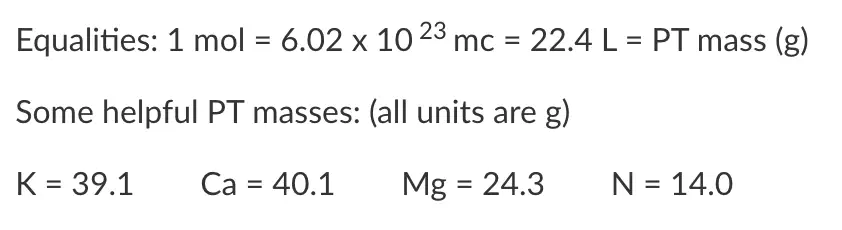
5.60 g of K is how many moles when a chemical reaction occurs and all of it is being measured?
0.14
8.6 x 10²³ mol K
0.14 mol K
2.2 x 10²
Which of the following cannot use 22.4L as a conversion unit when doing mole math at standard conditions?
oxygen in pure form
nitrogen in pure form
carbon dioxide
sodium chloride in pure form

Which of the following questions is being answered by the following line of chemistry math worked out by a student?
What is the molar mass of nitrogen?
How many grams of nitrogen are in 125 grams of sodium bicarbonate?
How many grams of nitrogen are in 125 grams of ammonia?
How many moles of nitrogen are in 125 g of ammonia?
What is the empirical formula of a compound if its molecular formula is N12O15?
NO3
N2O
N4O5
N3O2
What is the empirical formula of a compound that is 84% carbon and 16% oxygen?
C3O
C84O16
C7O
C21 O3
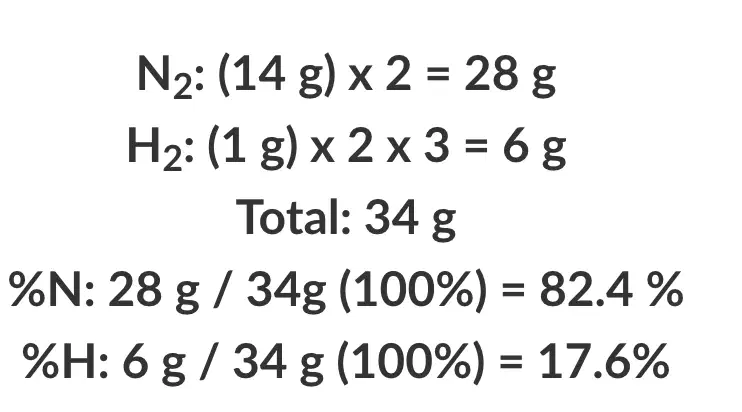
A student does the following work to calculate the percent composition of ammonia (NH3).
What mistake(s) if any, did they make?
They calculated the wrong molar mass for nitrogen.
They forgot to find their mole ratios.
They forgot that while N and H are diatomic, they are not diatomic in this molecule
They made no mistakes.
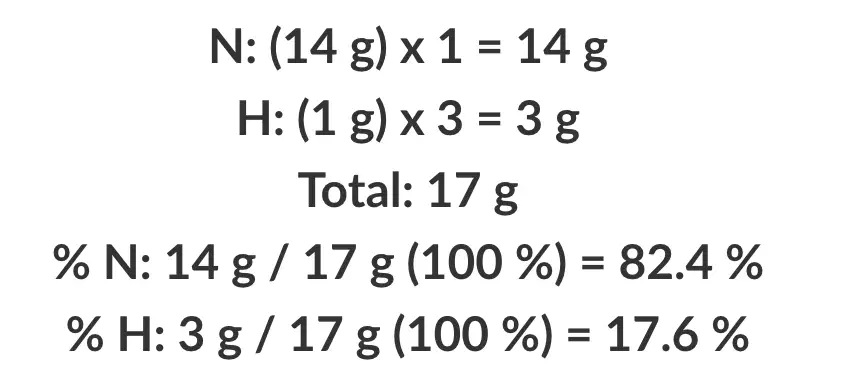
A student does the following work to calculate the percent composition of ammonia (NH3).
What mistake(s) if any, did they make?
They calculated the wrong molar mass for nitrogen.
They made no mistakes.
They forgot to find their mole ratios.
They forgot that nitrogen is a diatomic element.
The empirical formula for a compound is CH3O.
The molecular formula molar mass is 62.0 g/mol.
The empirical formula for molar mass is 31 g/mol.
What is the molecular formula for this compound?
C3H6O3
C2H2O2
C2H6O2
CH3O
What do the percentages of elements in a percent composition problem always total?
The molar mass
110%
A mole
100%

