wayground logo

Free Printable Worksheets

Font size

S
M
L
XL
Worksheets

PHYSICS FUCN

Total questions: 147

Worksheet time: 52mins

Name
Class
Date
1.
An object at rest will _______ if no outside forces are applied.
a)
Stay at rest
b)
Increase Velocity
c)
Decrease Mass
2.
A greater applied force is required to move an object with a greater mass than one with a smaller mass.
a)
True
b)
False
3.
The SI units for force are...
a)
Kilograms
b)
Newtons
c)
Meters per second
d)
Pounds
4.
If a baseball and a cannonball are dropped from the same height at the same time, which ball will hit the ground first?
a)
the cannonball
b)
the baseball
c)
The balls land at the same time.
d)
the ball with the larger volume
5.
A crumpled piece of paper hits the ground before a flat sheet of paper because
a)
the acceleration of gravity is greater on the  crumpled paper.
b)
there is more air resistance against the flat paper.
c)
the crumpled paper is more massive
d)
the crumpled paper is less massive.
6.
According to Newton’s first law of motion, a moving object that is not acted on by an unbalanced force will
a)
remain in motion.
b)
eventually come to a stop.
c)
change its momentum.
d)
accelerate.
7.
If a force of 26 N is exerted on two balls, one with a mass of 0.52 kg and the other with a mass of 0.78 kg, which ball will have the greater acceleration?  (F=ma)
a)
The one with a mass of .78 kg will have the greatest acceleration.
b)
The one with a mass of .52 kg will have the greatest acceleration.
c)
They will both accelerate at the same rate.
8.

Who is the scientist who came up with the Laws of Motion?

a)

Sir Isaac Newton

b)

The Greeks

c)

John Dalton

d)

Sir John Newt

9.
What law states an object at rest stays at rest unless acted upon by a net force or a moving object at a contant speed will continue to move in a straight at a constant speed?
a)
First
b)
Second
c)
Third
d)
Fourth
10.
What law describes how acceleration, mass and net force are related?
a)
First
b)
Second
c)
Third
d)
Fourth
11.

Which resistor is in series with resistor R?

a)

R1

b)

R2

c)

R3

d)

R4

12.

The two ends of a 3.0-ohm resistor are connected to a 9.0-V battery. What is the current through the resistor?

a)

27 A

b)

6.3 A

c)

3.0 A

d)

0.33 A

13.

The two ends of a 3.0-ohm resistor are connected to a 9.0-V battery. What is the total power delivered by the battery to the circuit?

a)

3.0 W

b)

27 W

c)

0.33 W

d)

0.11 W

14.

Three resistors connected in parallel have individual values of 4.0, 6.0 and 10.0 ohm, respectively. If this combination is connected in series with a 12-V battery and a 2.0-ohm resistor, what is the current in the 10-ohm resistor?

a)

0.59 A

b)

1.0 A

c)

11 A

d)

16 A

15.
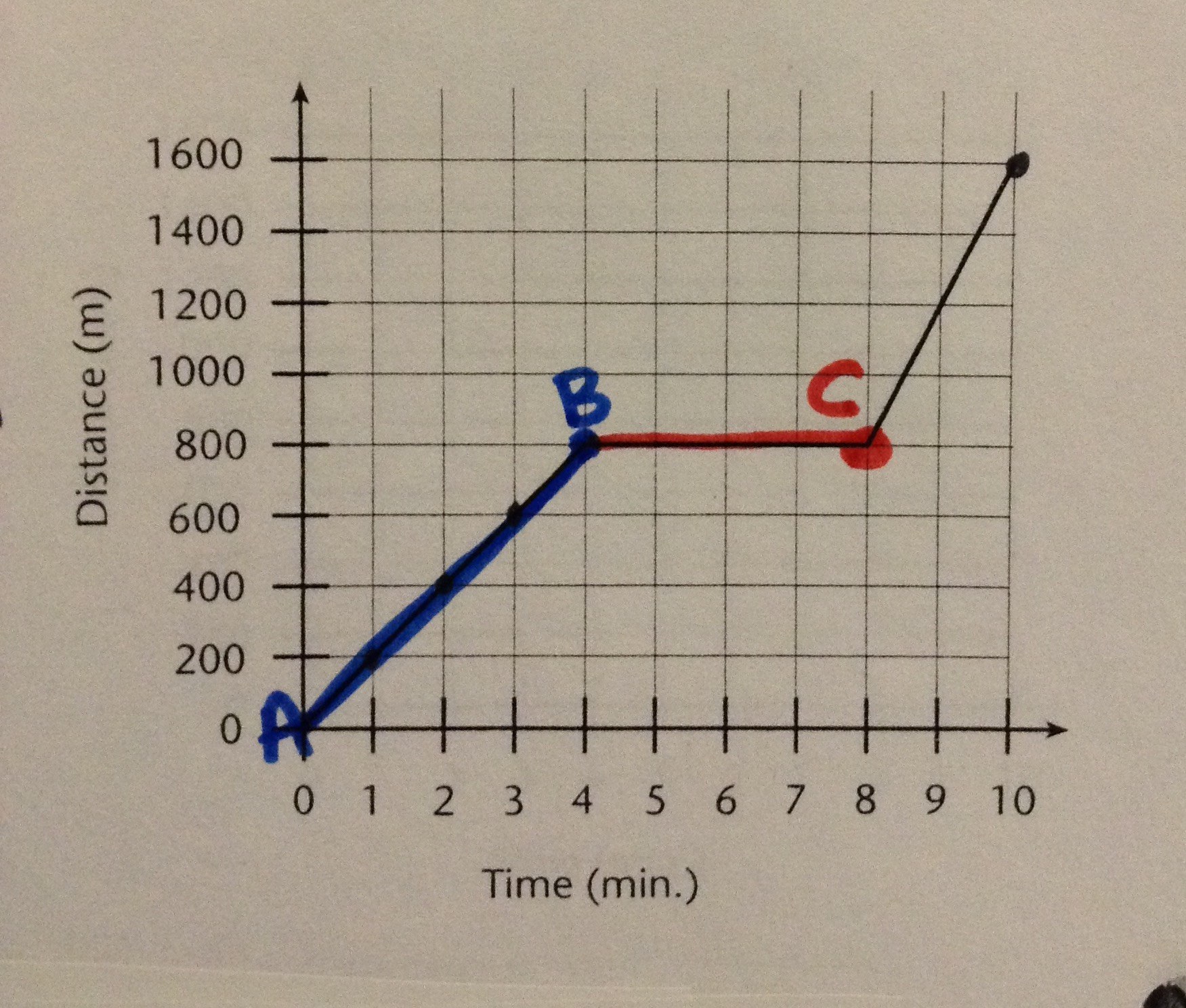
 The graph shows Ashley riding her bike to Maria's house. 
What is occurring from point A to point B?
a)
they are traveling at a constant speed
b)
they are decreasing in speed
c)
they stopped to take a break
16.
The rate at which velocity CHANGES is: 
a)
acceleration
b)
speed
c)
direction
d)
physics
17.
An object is _____ if its position changes relative to another object.
a)
in motion
b)
at reset
c)
a frame of refence
d)
magical
18.
A place or object used for comparison to determine if another object is in motion is called a
a)
comparison point
b)
reference point
c)
point of view
d)
motion detector
19.
Speed =
a)
distance / time
b)
time / distance
c)
distance * time
20.
Which runner won the race?
a)
A
b)
B
c)
C
21.
True or false. Energy can be created and destroyed.
a)
True
b)
False
22.

A car at the top of the drop on a roller coaster has ________ energy.

a)

potential

b)

kinetic

c)

chemical

d)

sound

23.

A car rolling down the drop of a roller coaster has ________ energy.

a)

potential

b)

kinetic

c)

chemical

d)

sound

24.

We receive ________ and heat energy from the Sun.

a)

sound

b)

mechanical

c)

light

d)

kinetic

25.

A hot drink has...

a)

Kinetic Energy

b)

Heat Energy

c)

Thermal Energy

d)

Nuclear Energy

26.
What type of energy is stored in food and fuel?
a)
Chemical
b)
Thermal
c)
Potential
d)
Calories
27.

Coal and oil are?

a)

Non-Renewable energy resources

b)

Renewable energy resources

c)

None of the above

28.

___________ energy comes directly from the sun.

a)

Warm

b)

Solar

c)

Hydro

d)

Bio-fuels

29.

Bio-fuel and geothermal energy are examples of?

a)

Non-renewable energy resources

b)

Hydro energy

c)

Renewable energy resources

d)

None of the above

30.

In this force diagram, which arrow is representing Friction?

a)

A

b)

B

c)

C

d)

D

31.
What is the force that causes objects to fall to Earth?
a)
Air resistance
b)
Gravity
c)
Water resistance
d)
Pressure
32.
What is the name of the units that we measure force in?
a)
Einsteins 
b)
Newtons
c)
Kg
d)
Metres
33.
When two objects rub together, what force do they produce
a)
Gravity
b)
Air resistance
c)
Friction
d)
Water resistance
34.

___________ forces always cause an object's motion to change.

a)

balanced

b)

unbalanced

c)

contact

d)

non-contact

35.

______________ is a force that always acts in the direction opposite of motion.

a)

applied

b)

friction

c)

gravity

d)

normal

36.
What is the equation to calculate speed?
a)
speed = distance/time
b)
speed = time/distance
c)
speed = time x distance 
d)
speed = speed/time 
37.

Which of the following is a unit of speed ?

a)

 J/s

b)

kg/m

c)

m/s

d)

kg/s

38.
If a student ran 300 m in 30 seconds, what was her average speed?
a)
0.10 m/s
b)
10 m/s
c)
270 m/s
d)
100 m/s
39.

Dave runs a 400 m race with a speed of 4 m/s. How long will it take him to finish the race?

a)

400 seconds

b)

100 minutes

c)

100 seconds

d)

1600 seconds

40.

Anna rides her bike to school every day. Today she rode her bike for 20 minutes, then stopped at the store for 5 minutes for a snack. She continued to ride her bike to school afterwards. Select the graph that accurately shows her movement.

a)
b)
c)
41.

How many colors are there in the spectrum when white light is separated?

a)

6

b)

7

c)

8

d)

9

42.

A Newton is equal to which of the following?

a)

kilogram-meter per second

b)

meter per second squared

c)

kilogram-meter per second squared

d)

kilogram per meter-second

43.

The work done by a friction force is:

a)

always positive

b)

always negative

c)

always zero

d)

either positive or negative depending upon the situation

44.

It is more difficult to walk on a sandy road than on a concrete road because ____________.

a)

Sand is soft and concreter is hard

b)

The friction between sand and feet is more than that between concrete and feet

c)

The friction between sand and feet is less than that between concrete and feet

d)

The sand is grainy but concrete is smooth

45.

Which among the following is an accurate depiction for the deceleration when a car is travelling in a north direction and produces a deceleration of 80 m/s2 to stop?

a)

Westwards, 80 m/s2

b)

Southwards, 80 m/s2

c)

Eastwards, 80 m/s2

d)

Northwards, 80 m/s2

46.

Which among the following activities is not an example of the third law of motion?

a)

Running

b)

Cycling

c)

Skiing

d)

Walking on a boat

47.

Which among the following is a vector quantity?

a)

Mass

b)

Displacement

c)

Temperature

d)

Density

48.

A body is said to have the power of 1 Watt if it does work at the rate of ______.

a)

1 joule

b)

1 joule in 1 second

c)

1 second

d)

1 radian / second

49.

Why can lights travel in a vacuum but not sound?

a)

Light waves are dual in nature

b)

Due to the electromagnetic nature of light waves.

c)

Due to the electromagnetic nature of sound waves.

d)

Speed of sound is very slow than light

50.

A candela is an SI unit for what?

a)

Radioactivity

b)

Luminous intensity

c)

Amount of substance

d)

Inductance

51.

What is the net force of an object when you combine a force of 10 N north with a force of 5 N south?

(a)  

52.

Which type of electromagnetic radiation has the shortest wavelength?

a)

Gamma ray

b)

Radio wave

c)

X-ray

d)

Microwave

53.

What is the rate of acceleration of gravity at the Earth's surface?

a)

6.7 m/s2

b)

7.8 m/s2

c)

9.8 m/s2

d)

11.2 m/s2

54.

Ohm's law describes the relationship between what?

a)

Current and velocity

b)

Current, voltage, and resistance

c)

Frequency, wavelength, and velocity

d)

Kinetic energy and momentum

55.

The first law of thermodynamics is also known as (a)   .

56.

Who discovered that a moving magnet generates electric current known as electromagnetic induction?

a)

Benjamin Franklin

b)

Nikola Tesla

c)

Michael Faraday

d)

Wilhelm Rontgen

57.

Who's third law states that every action has an equal and opposite reaction?

(a)  

58.

Which has the lower temperature: 0 degrees Celsius or 32 degrees Fahrenheit?

(a)  

59.

How many significant figures are in the number 0.00150?

a)

2

b)

3

c)

5

d)

6

60.

How can we calculate the velocity of a vehicle?

a)

Divide the travelled distance by the taken time

b)

Divide the taken time by the travelled distance

c)

Multiply the travelled distance with the taken time

d)

Multiply the taken time by the travelled distance

61.
Which of the following is a derived SI unit?
Yang manakah berikut adalah unit SI terbitan?
a)
Celcius
b)
Newton
c)
kilogram
d)
second
62.
Which of the following is a vector quantity?
Antara berikut yang manakah kuantiti vektor?
a)
Energy  
(Tenaga) 
b)
Electric current  
(arus elektrik)
c)
Momentum
d)
Volume of gas
(isipadu gas)
63.
Which of the following is not an experimental procedure?
Manakah di antara berikut bukan prosedur eksperimen?
a)
Make a hypothesis
(Membuat suatu hipotesis) 
b)
Control manipulated variable
(Mengawal pembolehubah dimanipulasi)
c)
Measure responding varible
(Mengukur pembolehubah) bergerakbalas
d)
Repeat the experiment with different values of manipulated variable
(Ulangi ekperimen dengan nilai pembolehubah dimanipulasi yang berbeza)
64.
The diagram shows the marks made by five shots on a target board.
 Rajah  menunjukkan tanda yang dibuat oleh lima tembakan pada sebuah papan sasar
a)
accurate but inconsistent
(Jitu tapi tidak persis)
b)
consistent but not accurate
(Persis tapi tidak jitu)
c)
Accurate and consistent
(jitu dan persis)
d)
Inaccurate and inconsistent
(Tidak jitu dan tidak persis)
65.
When one object is traveling with a constant velocity, its acceleration, will be...  
 Satu objek bergerak dengan halaju seragam, pecutannya akan ...
a)
Decreasing
(Berkurang)
b)
Constant
(Seragam)
c)
Increasing
(Bertambah)
d)
Zero
(sifar)
66.
A fully loaded train in motion is difficult to stop because .. Keretapi yang penuh dengan muatan dan sedang bergerak, sukar untuk berhenti kerana. 
a)
it's travelling with high speed
(ia bergerak dengan laju yang tinggi)
b)
it has a big mass
(ia mempunyai jisim yang besar)
c)
it has a large inertia
(ia mempunyai inersia yang besar)
67.
Which of the following is not the effect of the force ?
Antara berikut, yang manakah bukan kesan daya ke atas suatu jasad ?
a)
change it's mass
(mengubah jisimnya)
b)
change it's shape
(mengubah bentuknya)
c)
change it's size
(mengubah saiznya)
d)
change it's motion direction
(Mengubah arah gerakannya)
68.
Which comparison is correct about the extension of P, Q and R?
Antara perbandingan berikut, manakah yang benar tentang pemanjangan P, Q dan R? 
a)
P<Q<R
b)
Q<R<P
c)
R<Q<P
d)
Q<P<R
69.
The vertical height of the mercury column is h cm. What is the pressure at S?
 Tinggi turus tegak merkuri itu ialah h cm. Apakah tekanan pada S?
a)
h cm Hg
b)
approximately zero
(menghampiri sifar)
c)
atmospheric pressure + h cm Hg
(tekanan atmosfera + h cm Hg)
70.
Diagram shows an observer sees his image behind a plane mirror. Which of the following about the image is true ?
Rajah menunjukkan seorang pemerhati memerhatikan imejnya di belakang cermin satah. Yang manakah di antara berikut yang benar mengenai imej ?
a)
The image is blurr
(Imej adalah kabur)
b)
The image is laterally inverted
(Imej adalah songsang sisi)
c)
The image appears to be larger
(Imej kelihatan lebih besar)
d)
The image is real and has the same size as the object
(Imej adalah nyata dan sama saiz dengan objek)
71.
Diagram shows an object O in front of a convex mirror. T is the centre of curvature of the mirror. The image is formed at ....
Rajah menunjukkan suatu objek O di hadapan sebuah cermin cembung. T ialah pusat kelengkungan cermin itu. 
Imej terbentuk di  ... 
a)
A
b)
B
c)
C
d)
D
72.
Which of the optical instrument uses the principle of the total internal reflection of light?
Yang manakah alat – alat optik berikut menggunakan prinsip pantulan dalam penuh?
a)
plane mirror (cermin satah)
b)
Projector (projektor)
c)
Astronomical telescope (teleskop astronomi)
d)
Binoculars (binokular)
73.
When  a ray of light travel from  water to  the air, its speed will...
 Apabila sinar cahaya merambat dari air ke udara, halajunya akan... 
a)
Increase
(bertambah)
b)
decrease
(berkurang)
c)
Same
(sama)
74.
What is the name of the heat absorbed during the process?
Apakah nama haba yang diserap semasa proses ini? 
a)
Specific heat capacity  (muatan haba tentu)
b)
Latent heat of fusion
(haba pendam pelakuran)
c)
Latent heat of vaporisation
(Haba pendam pengewapan)
d)
Latent heat of condensation
(Haba pendam kondensasi)
75.
What is the light phenomenon involve? Apakah fenomenon cahaya  yang terlibat? 
a)
Reflection
(pantulan)
b)
Diffraction
(pembelauan)
c)
Refraction
(pembiasan)
d)
Total Internal; Reflection
(Pantulan dalam penuh)
76.
Diagram  shows  three  states  of  a  sealed  plastic  bottle  placed  at  three  different  places, A,  B  and  C.  Which  of  the  following  comparisons  about  the  atmospheric  pressure  is  true?
               Rajah  menunjukkan  tiga  keadaan  botol  plastik  yang  tertutup  diletakkan  pada  tiga  tempat  yang  berbeza,  A,  B  dan  C.  Yang  manakah  antara  perbandingan mengenai  tekanan  atmosfera  berikut  adalah  benar?  
a)
PA< PB < PC
b)
PA < PC < PB 
c)
PC < PB < PA
d)
PB < PC < PA
77.
Speed is equal to 
a)
Distance/Time
b)
Time/Distance
c)
Time x Distance
d)
Acceleration
78.
If a man runs at a speed of 70 m/s, and has a time of 30 s. What is the distance he ran?
a)
2100 m
b)
0.233 m
c)
2.33 m
d)
300m
79.
What equation do I use to calculate time?
a)
S = D/T
b)
T = D/S
c)
D=TS
80.
What equation do I use to calculate distance?
a)
S = D/T
b)
T = D/S
c)
D=TS
81.
What equation do I use to calculate speed?
a)
S = D/T
b)
T = D/S
c)
D=TS
82.

If a puppy runs across a park at a speed of 15 m/s. The puppy has a time of 5 seconds. How far did the puppy run?

a)

75 m

b)

30 m

c)

45 m

d)

105 m

83.
Alan travels 100 km in 5hrs. Find his average speed in km/h
a)
5km/hr
b)
10km/hr
c)
50km/hr
d)
20km/hr
84.
What is the speed of a cheetah that travels 112.0 m in 4.0 s?
a)
0.0357 m/s
b)
28 m/s
c)
0.036 m/s
d)
28.0 m/s
85.
You walk 10 meters to math class in 20 seconds. Your average speed is
a)
2 m/s
b)
0.5 m/s
c)
200 m/s
d)
5 m/s
86.
What is need to determine the speed of an object?
a)
distance and time
b)
distance and mass
c)
time and friction
d)
time and gravity
87.

SI unit for distance

a)

miles

b)

centimeters

c)

meters

d)

inches

88.

SI unit for time

a)

seconds

b)

minutes

c)

hours

d)

days

89.

Formula for velocity

a)

v = d*t

b)

v = d/t

c)

v = m*t

d)

v = m/t

90.

Formula for acceleration

a)

a = (vf-vo)/t

b)

a = t/(vf-vo)

c)

a = t*(vf-vo)

d)

a = t*d

91.

SI unit for mass

a)

kilograms

b)

grams

c)

pounds

d)

ounces

92.

SI unit for force

a)

Joules

b)

Watts

c)

Newtons

d)

meters

93.

Formula for force

a)

F = m*a

b)

F = m/a

c)

F = d*a

d)

F = d/a

94.

SI unit for energy

a)

Joules

b)

Watts

c)

Newtons

d)

meters

95.

Formula for work

a)

W = F*d

b)

W = F/d

c)

W = F*m

d)

w = F/m

96.

Formula for kinetic energy

a)

KE = m*g*y

b)

KE = 12\frac{1}{2} m*v^2

c)

KE = F*d

d)

KE = W/t

97.

Formula for potential energy

a)

U = m*g*y

b)

U = 12\frac{1}{2} m*v^2

c)

U = F*d

d)

U = W/t

98.

Formula for spring constant

a)

k = -F/d

b)

k = F/d

c)

k = -F*d

d)

k = F*d

99.

Formula for elastic potential energy

a)

Us = m*g*y

b)

Us = 12\frac{1}{2} k*x^2

c)

Us = F*d

d)

Us = W/t

100.

Formula for total mechanical energy

a)

TME = Ki-Kf+Ugi-Ugf+Usi-Usf+W

b)

TME = W

c)

TME = Ki+Kf+Ugi+Ugf+Usi+Usf+W

d)

TME = Ki-Kf-Ugi-Ugf-Usi-Usf-W

101.

SI unit for power

a)

Watts

b)

Joules

c)

Newtons

d)

Meters

102.

Formula for power

a)

P = W/t

b)

P = E/t

c)

P = W*t

d)

P = E*t

103.

Definition of work

a)

The amount of energy transferred when an object is moved over a distance by an external force in regards to the direction of the displacement.

b)

The rate of energy transferred per second

c)

The amount of energy transferred in motion

d)

The amount of energy an object has at rest / before motion

104.

Definition of power

a)

The amount of energy transferred when an object is moved over a distance by an external force in regards to the direction of the displacement.

b)

The rate of energy transferred per second

c)

The amount of energy transferred in motion

d)

The amount of energy an object has at rest / before motion

105.

Definition of kinetic energy

a)

The amount of energy transferred when an object is moved over a distance by an external force in regards to the direction of the displacement.

b)

The rate of energy transferred per second

c)

The amount of energy transferred in motion

d)

The amount of energy an object has at rest / before motion

106.

Definition of potential energy

a)

The amount of energy transferred when an object is moved over a distance by an external force in regards to the direction of the displacement.

b)

The rate of energy transferred per second

c)

The amount of energy transferred in motion

d)

The amount of energy an object has at rest / before motion

107.

Units of Force (F)

a)

s

b)

kg

c)

m

d)

N

108.

Units of mass (m)

a)

s

b)

N

c)

kg

d)

kg m/s

109.

Units of momentum (p)

a)

kg m/s

b)

kg

c)

m/s

d)

Ns

110.

Units of velocity (v)

a)

m/s2

b)

m/s

c)

N

d)

kg m/s

111.

Units of acceleration (a)

a)

m/s

b)

kg

c)

m/s2

d)

N

112.

Units of impulse (J or sometimes I)

a)

kg

b)

s

c)

Ns

d)

N

113.

Units of energy (KE, PE, EE)

a)

kg

b)

J

c)

kg m/s

d)

m/s2

114.

Units of work (W)

a)

J

b)

W

c)

kg m/s

d)

m

115.

Unit of displacement (x or d)

a)

m/s2

b)

kg

c)

m

d)

m/s

116.

Units of power (P)

a)

kg

b)

N

c)

m

d)

W

117.
If two balloons have the same charge, what will happen if you place them close to each other?
a)
Nothing
b)
They will be attracted
c)
They will pop
d)
They will push each other away.
118.
The charge of an electron is 
a)
positive. 
b)
negative. 
c)
Electrons have no charge
119.
An atom loses an electron.  What type of charge does it have now?
a)
positive
b)
negative
120.
Charged objects are not attracted to neutral objects
a)
True
b)
False
121.
When a balloon is rubbed on clothes it acquires a charge by ___________
a)
Induction
b)
reduction
c)
friction 
d)
concuction
122.
When a glass rod is rubbed with silk and the glass rod becomes positively charged, what happens to the electrons?
a)
they are removed from the rod
b)
they are added to the rod
123.
What do you call the process of charging a conductor by bringing it near another charged object?
a)
induction
b)
polarization
c)
neutralization
d)
conduction
124.
Which of the following is not a good conductor of electricity?
a)
copper
b)
silver
c)
Glass
d)
aluminum
125.
Which of the following is not a good insulator?
a)
Copper
b)
Glass
c)
rubber
d)
wool
126.
The law of conservation of charge states that...
a)
all atoms have more protons than electrons
b)
only protons can be rubbed off of an atom
c)
charge cannot be created or destroyed
d)
charge cannot be transferred 
127.
Insulators are different than conductors in that insulators ____.
a)
do not contain electrons or protons 
b)
 do not contain any charge
c)
have a weaker affinity for electrons 
d)
do not allow charge to freely move 
128.
Two electrically charged identical-sized metal spheres, A (charge of -4) and B (charge of +8). If the spheres are brought into contact, which sphere will have a net gain of electrons?
a)
both A and B
b)
neither
c)
only A
d)
only B
129.
Two electrically neutral metal spheres, A and B, on insulating stands are placed in contact with each other. A negatively charged rod is brought near, but does not touch the spheres, as shown in the diagram below. How are the spheres now charged?
a)
A is positive and B is positive.
b)
A is negative and B is positive.
c)
A is positive and B is negative.
d)
A is negative and B is negative.
130.

Electrostatic force F exists between two point charges. If both charges are doubled, the force between the charges will be

a)

F

b)

4F

c)

2F

d)

F/4

131.
Which of the following is a false statement about electrostatic force.
a)
Bringing charges closer together strengthen the force.
b)
The electrostatic constant remains the same.
c)
The values of the two charges is always the same.
d)
Electrostatic force can be attractive or repulsive
132.
Two similar metal spheres, A and B, have charges of +2.0 x 10⁻⁶ coulomb and +1.0 x 10⁻⁶ coulomb, respectively. The magnitude of the electrostatic force on A due to B is 4.0N newtons. What is the magnitude of the electrostatic force on B due to A?
a)
2.0N
b)
4.0N
c)
8.0N
d)
1.0N
133.

An atom of oxygen has 8 protons and 10 electrons, this means the atom is ____________

a)

positively charged because it has excess electrons

b)

negatively charged because it has excess electrons

c)

positively charged because it has a deficiency of electrons

d)

negatively charged because it has a deficiency of electrons

134.

After a balloon is rubbed against wool, the two objects will ________ each other because they have ___________ charges

a)

attract; like

b)

attract, opposite

c)

repel; like

d)

repel; opposite

135.
Electric charges that are alike _______ each other.
a)
Attract
b)
Repel
136.
The SI unit of charge is
a)
the ampere
b)
the newton
c)
the coulomb
d)
the joule
137.

What is the rate of flow of electric charges called?

a)

Electric potential

b)

electric conductance

c)

Electric current

d)

none of these

138.

Which instrument is used for measuring electric potential?

a)

Ammeter

b)

galvanometer

c)

voltmeter

d)

potentiometer

139.

The hindrance presented by material of conductor to the smooth passing of electric current is known as:

a)

Resistance

b)

Conductance

c)

Inductance

d)

None of these

140.

The resistance of a conductor is directly proportional to:

a)

Its area of cross-section

b)

density

c)

melting point

d)

length

141.

Point to be kept in mind for verification of Ohm’s Law is:

a)

Ammeter and voltmeter should be connected in series

b)

Ammeter should be connected in series and voltmeter in parallel

c)

Ammeter should be connected in parallel and voltmeter in series

d)

Ammeter and voltmeter should be connected in parallel

142.

Define One Ohm

4 lines
143.

Can current flow in a circuit without potential difference?

4 lines
144.

What happens to the intensity or the brightness of the lamps connected in series as more and more lamps are added?

a)

Increases

b)

decreases

c)

remains the same

d)

cannot be predicted

145.

When we double the voltage in a simple electric circuit, we doubt the

a)

current

b)

power

c)

resistance

d)

both a & b

146.

When we double both the voltage and current in a simple electric circuit keeping its resistance constant, the power will be

a)

remain unchanged

b)

halves

c)

doubles

d)

quadruples