
NEW
Font size
 Worksheets
Unit 2 Force and Motion
Total questions: 43
Worksheet time: 54mins

Rebecca is practicing her aim by throwing a ball at a target.
The ball exerts a force on the target, causing the target to fall over. But when this happens, the ball bounces backward. Why does the ball bounce backward?
The ball exerts a larger force on the target, causing the target to have a larger change of motion than the ball.
The target exerts the same size force on the ball, so when the target moves in one direction, the ball moves in the opposite direction.
The ball exerts a smaller force on the target because the ball is smaller than the target, so the target causes the ball to bounce backward.
The target exerts a larger force on the ball because the ball is very bouncy.

A box has two forces acting on it. One force is 100 N upward. Another force is 50 N downward. What is the net force on the box?
100 N upward
50 N upward
50 N downward
100 N downward

Why is friction force considered to be a contact force?
Friction affects only solid objects.
Friction always acts in the same direction.
Friction is produced when objects slide past one another.
Friction acts in a direction opposite to the direction of an object’s motion.

Michael watched the path a baseball followed after a pitcher threw it. He noticed that the ball traveled horizontally away from the pitcher as well as downward toward the ground. What force caused the ball to accelerate in the downward direction when it was thrown?
electrical force
air resistance
gravitational force
applied force

A bird flies at 12.5 meters/second. The wind speed is 4.5 m/s.
What is the speed of the bird when it flies with the wind?
12.5 m/s
4.5 m/s
17 m/s
8 m/s

A bird flies at 12.5 meters per second. The wind speed is 4.5 meters per second.
What is the speed of the bird when it against the wind?
17 m/s
8 m/s
12.5 m/s
4.5 m/s

In which situation is it better to have low friction?
a student walks down a hallway
a hockey puck slides toward the goal
a ladder leans against the wall
a skydiver uses a parachute

Two basketballs are sitting 1 m apart and are not moving. Which best explains why the gravitational force does not cause them to move?
No gravitational force exists between the two objects because they are not touching.
No gravitational force exists between the two objects because their masses are small.
The gravitational force between the two objects is weak because they are 1 m apart.
The gravitational force between the two objects is weak because their masses
are small.

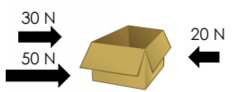
This diagram shows forces acting on a box. Predict how the box will move (in which direction and with what amount of net force)
the box will move up with 25 N force
the box will move left with 100 N force
the box will move right with 100 N force
the box will move right with 50 N force

An airplane is traveling at a speed of 200 m/s relative to the Earth. A person walks toward the front of the plane at a speed of 1 m/s. How fast is that person traveling in reference to the other people on the airplane?
1 m/s
200 m/s
201 m/s
0 m/s

The weight of each car is different. Put the cars in order from heaviest to lightest.
car X, car Y car Z
car W, car X, car Y
car Y, car X, car W
car Y, car W, car X
What is force?
transfer of energy
creation of energy
push or pull
result of a physical change

If you apply force to an object, you can change its...
direction only
speed and direction
mass
speed only

__________ is a change in an object's position compared to objects around it
gravity
force
speed
motion

What keeps object at rest at rest, and objects in motion in motion unless an outside unbalanced force acts on it
gravity
inertia
acceleration
equal and opposite reaction
A runner records the speed and velocity of their run around a track. How are these measurements MOST LIKELY different?
A. The speed tells how fast the runner is moving, whereas the velocity alone does not.
B. The velocity indicates the runner's pace, whereas the speed alone does not.
C. The velocity includes the direction of the runner's movement, whereas the speed alone does not.
D. The speed tells the total distance covered, whereas the velocity alone does not.
A car travels around a circular track at a constant speed. What can be said about its velocity?
A. The velocity is constant because the speed is constant.
B. The velocity changes because the direction changes.
C. The velocity is zero because the car returns to its starting point.
D. The velocity is greater than the speed because of the circular path.

A dog running at 3 m/s
A deer sprinting at 4 m/s
A migrating bird headed south for the winter at 3 m/s
A person not moving at all

Alan travels 100 km in 5hrs. Find his average speed in km/h
5km/hr
10km/hr
50km/hr
20km/hr

What is the formula for average speed?
s = d2 – d1 / t2 – t1
s = d / t
s = d2 + d1 / t2 + t1
s = d1 – d2 / t1 – t2
What is the formula to calculate average speed?
Distance × Time
Distance ÷ Time
Time ÷ Distance
Speed ÷ Time
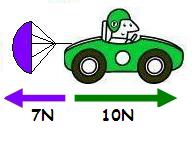
What is the net force?
3 N
3 N, right
17 N, right
3 N, left
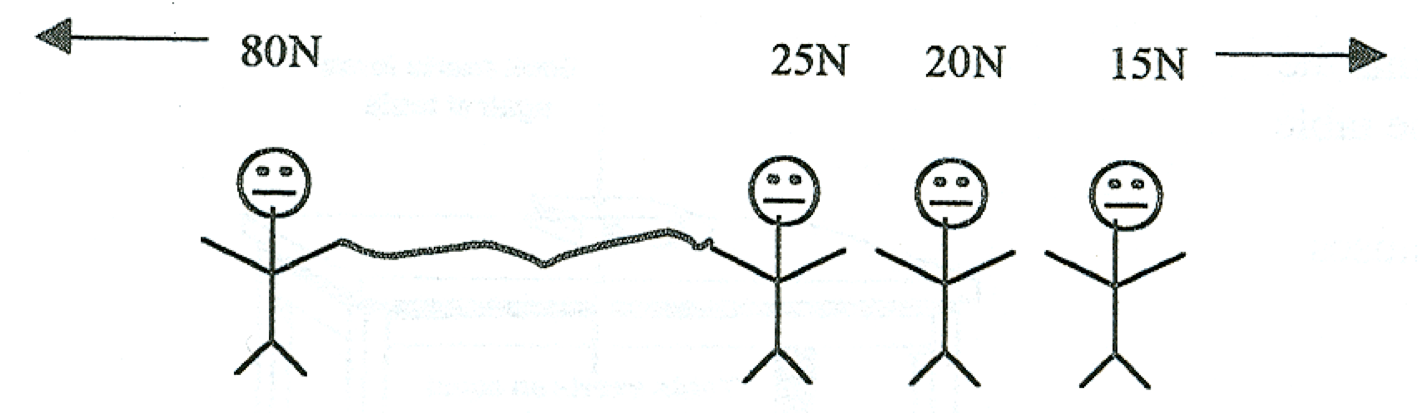

What is the unit to MEASURE force?
Kilogram
Meter
Pounds
Newton

A ____________ is a push or a pull on an object.
friction
force
magnet
gravity


Forces that have a net force of zero Newtons
Balanced force
Unbalanced force


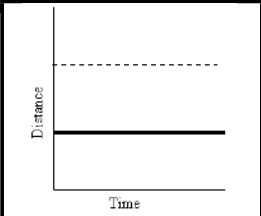
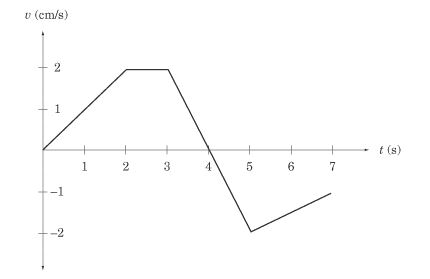
What is happening between 2 and 3 seconds?
The object is not moving.
The object is not accelerating.
The object is slowing down.
The object is speeding up.

What is happening between 3 seconds and 4 seconds?
The object is moving in a negative direction.
The object is returning to its starting position.
The object is slowing to a stop.
The object is changing direction.
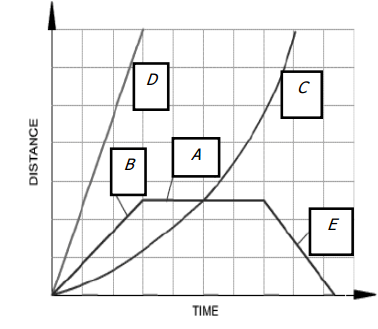
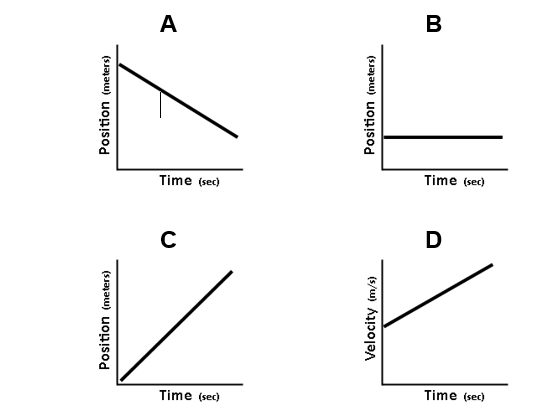
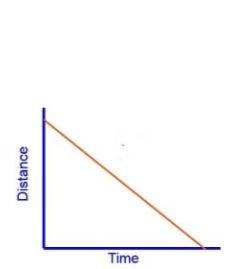
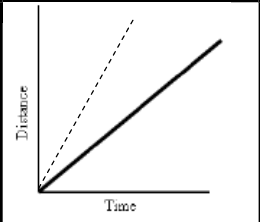
What is this line of this graph showing?
moving away from starting point at a constant speed
moving back towards the starting point at a constant speed
acceleration (getting faster)
deceleration (getting slower)

