wayground logo

Free Printable Worksheets

Font size

S
M
L
XL
Worksheets

CFA 6 DNA and Genetics Review

Total questions: 35

Worksheet time: 52mins

Name
Class
Date
1.

How many alleles do you inherit from EACH parent for a specific trait?

a)

1

b)

2

2.

A tool used to predict the probability of offspring inheriting certain traits is called a ...

a)

karyotype

b)

Punnett Square

3.

The study of heredity is called ....

a)

biology

b)

genetics

c)

chemistry

4.

The physical expression of a trait is called the ...

a)

genotype

b)

phenotype

5.

Segments of DNA that code for traits are called ....

a)

genes

b)

proteins

c)

alleles

6.

Genotype: TT

a)

homozygous dominant

b)

homozygous recessive

c)

heterozygous dominant

7.

Genotype: Aa

a)

homozygous dominant

b)

homozygous recessive

c)

heterozygous dominant

8.

Cross 2 heterozygous tall pea plants. Tall (T) is dominant to short (t). What fraction of the offspring do you predict will be tall?

a)

1/4

b)

2/4

c)

3/4

d)

4/4

9.

In the problem shown, what must the genotype of the missing parent be?

a)

BB

b)

Bb

c)

bb

10.

The different forms or versions of a gene are called ...

a)

alleles

b)

gametes

11.

Genotype: rr

a)

homozygous dominant

b)

homozygous recessive

c)

heterozygous dominant

12.
Which of the following units are repeatedly joined together to form a strand of DNA?
a)
amino acids
b)
nucleotides
c)
fatty acids
d)
polysaccharides
13.
The enzyme that unwinds the DNA to prepare for replication
a)
helicase
b)
replicase
c)
polymerase
d)
synthase
14.
The enzyme that unwinds the DNA to prepare for replication
a)
helicase
b)
replicase
c)
polymerase
d)
synthase
15.
order of replication
a)
3, 4, 2, 1
b)
3, 1, 4, 2
c)
2, 1, 4, 3
d)
3, 4, 1, 2
16.
A process in which DNA has the unique ability to make an exact copy of itself.
a)
Replication
b)
Translation
c)
Transcription
17.
Which enzyme is responsible for adding nucleotides?
a)
Topoisomerase
b)
DNA Polymerase
c)
Ligase
d)
Primase
18.
The process of DNA replication is called semi conservative because it results in
a)
none of these
b)
Two DNA molecules.  One original molecule and one with two new strands
c)
two exact copies with new strands
d)
two identical molecules, each with 1 original strand and one new.
19.
Nitrogenous bases are joined by which type of bond?
a)
polar bonds
b)
ionic bonds
c)
covalent bonds
d)
hydrogen bonds
20.
Guanine bonds with ______________.
a)
Adenine
b)
Guanine
c)
Cytosine
d)
Thymine
21.
Which organelle is DNA usually found in?
a)
cell membrane
b)
vacuole
c)
chloroplast
d)
nucleus
22.
Which of the following statements is true?
a)
DNA is single-stranded
b)
RNA is single-stranded
c)
DNA contains uracil
d)
RNA contains deoxyribose
23.

Which organelle is the location where protein is made?

a)

Ribosome

b)

Nucleus

c)

Cytoplasm

d)

Nucleotide

24.
Which of the following best describes a DNA molecule?
a)
double helix
b)
contains ribose
c)
made of amino acids
d)
contains Uracil
25.
Which sequence of DNA bases would pair with this partial strand
ATG TGA CAG
a)
ATG TGA CAG
b)
TAC ACT GTC
c)
GTA AGT GAC
d)
CAT TCA CTG
26.

Primary functions of DNA are (mark all that apply)

a)

Transmit information on heredity from one generation to the next

b)

Control cellular respiration

c)

Regulate homeostasis

d)

Provide a blueprint for making proteins
27.
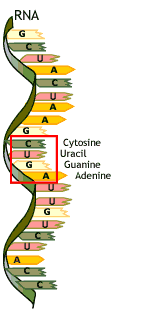
In RNA, Uracil pairs with ______. 
a)
cytosine
b)
adenine
c)
guanine
d)
thymine
28.

CGAUCGAUCAAG

a)

This is a segment of DNA.

b)

This is a segment of RNA.

c)

It is impossible to tell if this is DNA or RNA.

29.

Select the DNA sequence or sequences for Lysine.

a)

TTC

b)

AAC

c)

TTT

d)

TAT

30.

What shape is a red blood cell?

a)

spherical - ish

b)

biconcave disc

c)

egg

d)

rod

31.

Hemoglobin is a _________________ in rbcs that binds oxygen.

a)

protein

b)

lipid

c)

nucleic acid

d)

carbohydrate

32.

What is the function of red blood cells?

a)

transport oxygen to cells

b)

protect blood from invading pathogens

c)

take messages from one part of the body to another

d)

secrete digestive enzymes

33.

What process do plants use to transport their sugars?

a)

Photosynthesis

b)

Translocation

c)

Respiration

d)

Transpiration

34.
What do we call the process of turning DNA into mRNA?
a)
Replication
b)
Transcription
c)
Translation
d)
Cloning
35.
When DNA is transcribed to RNA.... 
a)
A pairs with U
b)
G pairs with U
c)
C pairs with T
d)
A pairs with C