
 Worksheets
Review for 1st Sem Final - Physics First
Total questions: 85
Worksheet time: 43mins
A system undergoes acceleration only when acted on by a(n):
net force (total force >0N)
pair of forces
action reaction forces
internal interaction
The goal of science is to:
understand the world around us
make technological advancements in all areas
understand how and why things happen
all of these
The IV usually goes on the ____ axis unless there is an overriding formula/equation. (select all that apply)
x
y
vertical
horizontal
A well written hypothesis should contain which of the following?
If/then statement
Educated guess to answer the question
Independent Variable
Dependent Variable
On a Google Sheets graph, what you put in column A will become which axis label on your graph by default?
X
Y
Neither
Both
In a Data Analysis paragraph, which of the following should NOT be included?
A summary of the trials
Data from the trials
A Conclusion
all of these
The Experimental Variable is:
the same as the dependent variable or data that is collected.
the same as the controlled variables or constants that must stay the same.
all of these
the same as the independent variable, or what is being tested.
Accuracy is:
how close the measurements are to each other (the grouping).
how close the measurements are to the true value (correctness).
both of these
none of these
Which of these data numbers would not be in the range of precision? 765.1m, 724.3m, 760.6m, 766.2m, 759.9m
765.1
724.3
759.9
766.3
We use the SI system in science class because: (check all that apply)
It is base 10 - easy to convert
The range (very small to very measurements)
It is universal and official
Check all the boxes that are correct:
The mean is the same as average
The mean is all the numbers added/number of numbers added
The range is the high - low number
The mode is the same as the mean and average
Quantitative data should:
have precision
all of these
be as accurate as humanly possible
be measured in SI with the most precise tools
be measured to the decimal of uncertainty - significant figure
A well-written hypothesis should contain which of the following?
written statement
educated guess to answer the question
independent variable
all of these
dependent variable
In a Data Analysis paragraph, which of the following should NOT be included:
What is being tested
A summary of the trials
Data from the trials
A Conclusion
The systematic approach that scientists have for investigating and solving problems is called the:
Problem Solving Model
The Scientific Method
Process of Science
all of these
In an investigation or experiment, there must be:
a testable question
a formulated hypothesis
variables (manipulated, responding, and controlled)
a conclusion
all of these
A manipulated variable is:
the same as the dependent variable or data that is collected.
the same as the controlled variables or constants that must stay the same.
all of these
the same as the experimental variable, independent variable, or what is being tested.
The controlled variables or constants must:
be exactly the same so the only factor being tested is the experimental variable.
be a group or set of objects or specimen that do not get the manipulated variable and are only used for comparison.
be measured and collected as data in order to make a conclusion.
all of these
Precision is:
how close the measurements are to each other (the grouping)
how close the measurements are to the true value (correctness).
both of these
none of these
Bill is testing different brands of light bulbs to determine which one has the longest life. Based on this investigation, what is the independent variable?
Time to burn out
Time to stop
Brands of Lightbulbs
Watts of the lightbulb
Bill is testing different brands of light bulbs to determine which one has the longest life. Based on this investigation, what is the dependent variable?
Brand of Lightbulb
Time to burn out
Watts of the lightbulb
Kind of bulb (fluorescent, LED, etc.)
Bill is testing different brands of light bulbs to determine which one has the longest life. Based on this investigation, what is the most appropriate hypothesis?
If different brands of lightbulbs are tested, the most expensive brand will last the longest.
Lightbulbs with LED will last longer than the others.
I think all the light bulbs will last the same amount of time.
Any of these would be appropriate.
A test that leads to data and a conclusion is known as:
experiment
procedures
observation
Constants/Controlled Variables are:
are the data or observations made during an experiment
are the variables that are being tested
are the variables that do not change
are the control group
The dependent variable:
is the data or observations of an investigation
is the responding variable
is based on the independent variable
all of these
The variable that is set by the experimenter is known as the:
Independent Variable
Manipulated Variable
Experimental Variable
All of these
Before you conduct an experiment or investigation you must:
form a hypothesis
state the conclusion
analyze the data
make charts and graphs
Which equation below is the correct way to calculate %error of data?
Difference in correct and measured value times 100
Correct Value-Measured Value/Correct Value times 100
Measured Value/Correct Value times 100
Add all numbers together/by total amount of numbers times 100
A control group does not get the
Dependent variable
Constants
Controlled variables
Independent variable
Uses data to answer a question including the IV and DV in statement form after the investigation.
Hypothesis
Conclusion
Theory
Data analysis
Which of the following are rules for counting significant figures?
Leading zeros are never significant
Zeros at the end of a number are only significant if there is a decimal somewhere in the number
Zeros between two non-zero numbers are significant
All of the above
Which of these is the correctly written testable question?
What is the effect of texting when driving on reaction time?
If I text while driving then my reaction time will decrease by 10%.
What is the result of texting while driving?
If texting while driving decreases reaction time, then will the data prove it?

What is incorrect about this graph?
The Title is not the DV vs the IV
The Key/Legend is incorrect
The Y axis label is incorrect
X axis label is missing
There is nothing wrong with this graph
Which of the following is the correctly written hypothesis?
If caffeine is used as a stimulus, then the reaction times will decrease.
If reaction times decrease, then caffeine was the stimulus.
All of these are correctly written hypothesis.
If reaction times are recorded, then caffeine may increase or decrease reaction times.
Which has zero acceleration? An object:
At rest
Moving at constant velocity
That has balanced forces acting on it
All of the above
When the net force on an object is zero, what is the acceleration of that object?
less than zero
zero
greater than zero
all of these
Your car is coasting (no gas or brake) on level ground at 60km/hr and you apply the brakes until the car slows to 40km/hr. If you suddenly release the brakes and no other forces are acting, the car would:
regain its higher initial speed
continue moving at 40km/hr
both of these
none of these
An object following a straight line path at constant speed:
has a net force acting on it in the direction of the motion
has zero acceleration
has no force acting on it
all of these
If an object's mass is decreasing while a constant force is applied to the object, its acceleration would:
decrease
increase
remain the same
none of these
An object is propelled along a straight-line path in space by a force. If the object sweeps up extra particles and its mass becomes twice as much, its acceleration:
quadruples
doubles
stays the same
halves
________ are needed to cause a change in motion?
Unbalanced Forces
Balanced Forces
both of these
none of these
Is a force needed to change the speed of a moving object?
No
Yes
Is a force needed to keep an object moving at a steady speed?
No
Yes
Is a force needed to change the direction of a moving object?
Yes
No
Is a FORCE necessary to keep a thrown football moving HORIZONTALLY and/or upward through the air once it has left the quarterback's hand?
YES - it is gravity
NO - a force is not needed to keep an object moving with constant velocity
No way to tell
Yes - it is friction
A newton is
kg*m/s/s
kg/m/s/s
kg/m/s
kg
kg*m*s
The force is 50N and the mass is 5 kg, what is the acceleration?
10 m/s/s
2 m/s/s
25 m/s/s
250 m/s/s/s
A newton is *
a derived unit
all of these (not just 2 of them)
the SI unit for force
2 of the above (not all of the above)
What is the net force associated with constant motion? (N=newton) *
0N
>0N
What is the net force associated with acceleration? (N = newtons) *
0N
>0N
>0 newton Fnet = ________ forces and has ________ motion. *
balanced, accelerated
unbalanced, no
balanced, constant
unbalanced, accelerated
unbalanced, constant
Which has more inertia a 5000kg truck at rest or a 1000kg car moving at 60mph? *
truck at rest
moving car
Jane walks 6 blocks south and 10 blocks north, what is her displacement?
2 East
1 East
4 North
5 West
The displacement and distance traveled will be the same number when:
the object travels in a straight-line path
the object backtracks
the object's motion is in a circle
the object moves randomly
Δ is Greek symbol called ______, which means "change in"
Alpha
Displacement
Beta
Delta
What is the displacement if the Xi = 20 km and the Xf = -10 km?
-10 km
-30 km
10 km
30 km
If the dog runs south 5 miles then west 2 miles, what is the change in position or displacement of the dog? (Use Pythagorean Theorem)
5.39 miles SW
29 miles SW
3 miles SW
7 miles SW
In order to know the exact location of a position, the origin (0 position) must be known.
True
False
Velocity is: (select all that apply)
Speed with a direction
Vector
Scalar
Calculated with V=D/T
The slope of an XT graph
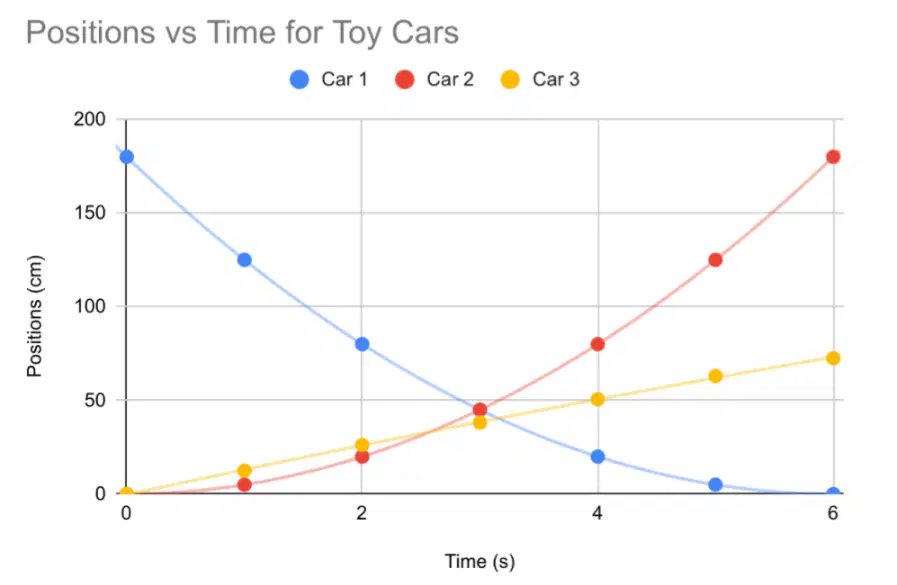
Which car(s) are accelerating? Check all that apply.
1
2
3

Which car(s) are moving with constant velocity? Check all that apply.
1
2
3
__________ is a vector and can be the same amount as the ________ which is a scalar, but it can never be larger.
Distance, Displacement
Displacement, Distance
The total units (absolute value) traveled by an object as it changes position is called: ______________.
distance
displacement
change in position
none of these
If an object is moving with _______ velocity, the instantaneous velocity and average velocity are always the same quantity and direction at any given time.
increasing
decreasing
constant
________ is also called change in position.
Position
Velocity
Distance
Displacement
Velocity is a ________ because it has a magnitude and a ________.
Scalar, direction
Scalar, amount
Vector, direction
Vector, amount
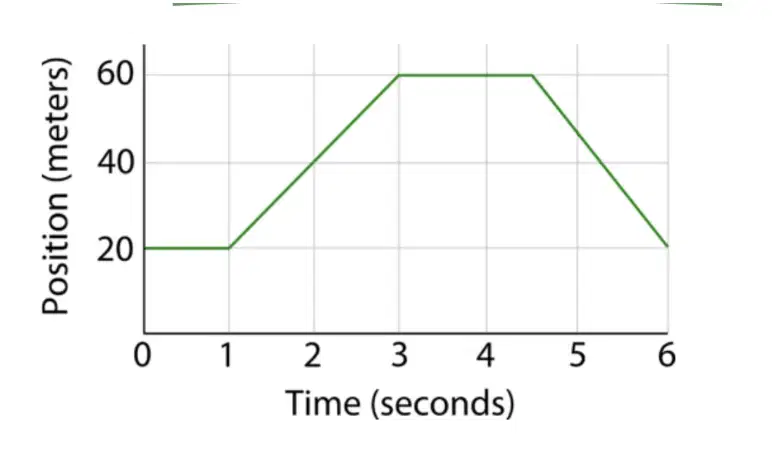
What is the average velocity in the time interval 3 to 4 seconds?
40 m/s
0 m/s
20 m/s
60 m/s

What is happening from 4.5 to 6 seconds?
The object is decreasing speed
The object is not moving
The object is increasing speed in a negative direction
The object is moving with constant velocity in a negative direction

In the following graph, what is the object's instantaneous velocity at 2 seconds?
10 m/s
12 m/s
5 m/s
20 m/s

Which best describes the motion depicted in the following position time graph?
The object is increasing its speed in a positive direction starting from 0.
The object is increasing its speed and position in a positive direction starting from 0.
The object is not moving but time is continuing from 0 seconds.
The object is moving at a steady speed in a positive direction.
If an object is accelerating, all of the following may occur EXCEPT:
A change in speed
A change in direction
It remains motionless
A change in speed and direction
The boy decreases his speed from 4 m/s to a stop in 8 seconds. What is his acceleration?
0.5 m/s²
-0.5 m/s²
1 m/s²
-1 m/s²
You can calculate acceleration in which ways? (select all that apply)
Δ V/T
slope of a VT graph
T/D
D/T
A=F/M
What is the rate of acceleration if the car increases from 40 mph to 60 mph in 2.0 seconds?
10 mph
-10 mph
10 mph/s
40 mph/s

How is this object moving?
Constant velocity
Changing directions
Constant acceleration
Constant Acceleration is:
A steady change in velocity (speed or direction)
Steady motion
Uniform velocity
An object moving at a steady 50 mph around a corner has:
constant speed
acceleration
change in direction
all of these
What is the primary purpose of a control group in an experiment?
To test the hypothesis
To collect data
To serve as a standard for comparison
To manipulate the independent variable
Which of the following best describes a dependent variable?
A variable that remains constant
A variable that is measured or observed
A variable that is changed by the experimenter
A variable that is not used in the experiment
In a scientific experiment, what is the role of a hypothesis?
To provide a detailed analysis of the data
To offer a possible explanation that can be tested
To summarize the results of the experiment
To list the materials needed for the experiment
What happens to an object in motion if no external force is applied?
It will accelerate
It will continue moving at a constant velocity
It will stop immediately
It will change direction
Which of the following is NOT a characteristic of a well-designed experiment?
Having a control group
Randomly assigning subjects to groups
Using a large sample size
Changing multiple variables at once
What is the role of a control group in an experiment?
To introduce new variables
To serve as a baseline for comparison
To ensure the experiment is biased
To manipulate the independent variable
Which of the following best describes a hypothesis?
A random guess
A proven fact
A testable prediction
An untestable opinion
When graphing data, what is typically placed on the y-axis?
Control variable
All of these
Dependent variable
Independent variable

