
 Worksheets
Anatomy of the Ear
Total questions: 140
Worksheet time: 2hrs 22mins
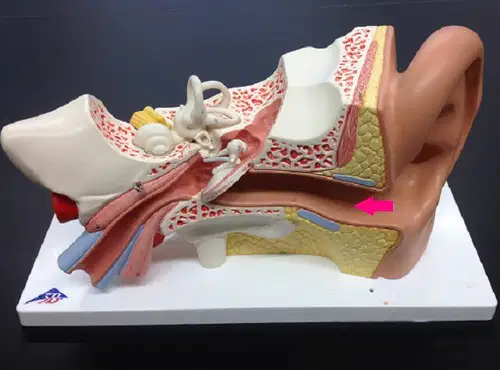
This part of the ear is a tube leading to the eardrum.
It channels sound waves toward the eardrum and protects the ear with wax and hairs. (ear canal)
external auditory meatus (canal)
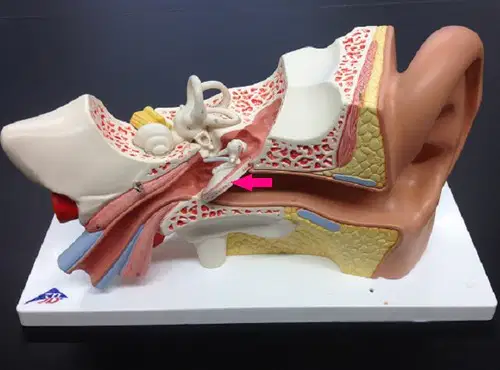
The thin membrane at the end of the ear canal.
Vibrates when sound waves hit it, converting sound energy into mechanical vibrations.
Tympanic membrane (Eardrum)
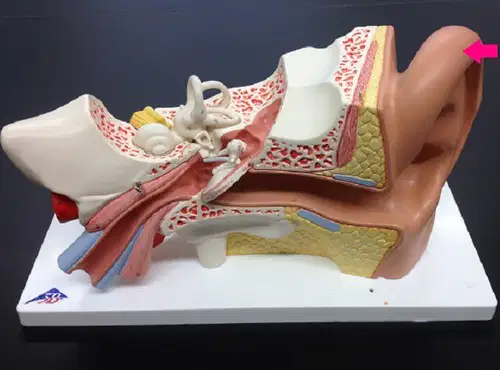
The visible part of the ear.
Collects and directs sound waves into the ear canal.

What part of the inner ear helps you keep your balance?
Vestibule
the Ossicles (MISO)
Pinna
Semicircular canals

What is the function of the middle ear?
amplify sound
convert acoustic energy into mechanical energy
direct sound toward inner ear
all of the above

What part contains the ceruminous glands (which secrete cerumen/ear wax)?
4
7
8
9

What is the function of the vestibular complex?
Contains sensory receptors for equilibrium. Sends nerve impulses that brain interprets as body position or movement.
Contains receptors that send impulses that the brain interprets as sounds.
Surrounds the Eustachian tube and swells due to upper respiratory infection.
Amplify and transmit vibrations of the tympanum inward to the inner ear.
The membrane that marks the boundary between the middle and inner ears, this receives vibrations from the ear bones:
oval window
meatus
auditory ossicles
tympanic membrane
The spiral part of the inner ear's labyrinth responsible for sensing and transducing sound waves:
hair cells
ossicle
cochlea
tympanic membrane

Name this bone that forms a portion of the ear canal
Frontal
Parietal
Temporal
Zygomatic
Where is the Eardrum located?
The Outer ear
The Inner Ear
The Middle Ear

What is this?
Anvil
Hammer
Stirrup
Ear Canal
Ear drum
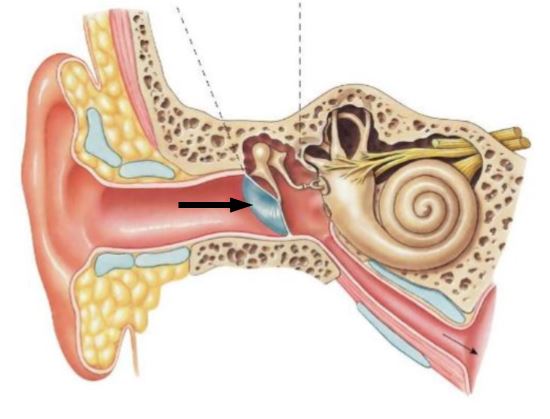
What is this?
Ear Drum
Ear Canal
Pinna
Hammer
Cochlea

What is this?
Ear Drum
Ear Canal
Pinna
Cochlea
Hearing Nerve
The malleus, incus, and stapes are collectively called the
maculae
vestibulocochlear nerves
semicircular canals
auditory ossicles
The ear only controls the sense of hearing.
True
False

What part is #1?
Pinna
Ear Canal
Ear Drum
Oval Window
What part is #2?
Pinna
External Auditory (Ear) Canal
Ear Drum
Oval Window
What part is #3?
Pinna
Ear Canal
Tympanic membrane (Ear Drum)
Oval Window
What part is #5?
Semicircular Canals
Eustachian Tube
Cochlea
Oval Window
What part is #6?
Semicircular Canals
Eustachian Tube
Cochlea
Oval Window
What part is #7?
Semicircular Canals
Eustachian Tube
Cochlea
Oval Window
What parts are #8?
Semicircular Canals
Vestibulocochlear Nerves
Ear Bones
Ossicles
What part is #9?
Semicircular Canals
Eustachian Tube
Cochlea
Oval Window
What part is #10?
Incus/Anvil
Malleus/Hammer
Cochlea/Snail Shell
Stapes/Stirrup
What part is #12?
Incus/Anvil
Malleus/Hammer
Cochlea/Snail Shell
Stapes/Stirrup
What part is #13?
Incus/Anvil
Malleus/Hammer
Cochlea/Snail Shell
Stapes/Stirrup
What part is #15?
Outer Ear
Middle Ear
Inner Ear
Sub Ear
What part is #16?
Outer Ear
Middle Ear
Inner Ear
Sub Ear
What part is #17?
Outer Ear
Middle Ear
Inner Ear
Sub Ear
the sense organ involved in receiving sound waves
ear
ear canal
eardrum
membrane
a tube-like structure connecting the external ear to the eardrum.
ear
ear canal
eardrum
membrane
the membrane separating the outer ear from the inner ear.
ear
ear canal
eardrum
membrane
a layer of tissue that serves as a covering, connection, or lining.
ear
ear canal
eardrum
membrane
tiny hairs that line the cochlea and help turn vibration into nerve impulses.
cilia
cochlea
oval window
stirrup
a spiral tube that makes up the part of the inner ear responsible for hearing.
cilia
cochlea
oval window
stirrup
an opening between the middle ear and the inner ear.
cilia
cochlea
oval window
stirrup
the third in a series of three small bones in the middle ear.
cilia
cochlea
oval window
stirrup
the first in a series of three small bones in the middle ear.
cilia
anvil
hammer
stirrup
the second in a series of three small bones in the middle ear.
cilia
anvil
hammer
stirrup


Which is not true of static equilibrium?
it helps us detect which direction we are relative to gravity
otoliths float in a gel around the hair cells
the receptors for static equilibrium are in the vestibule
receptors in the semicircular canal respond to rotary movements of the head


What type of receptors are found in the ear?
mechanoreceptors
photoreceptors
chemoreceptors
Which of these is necessary for equilibrium?
outer ear
middle ear
inner ear
all of these
What does dynamic equilibrium detect?
position of the head
acceleration of the heat
sound
Where is the Organ of Corti found?
the middle ear
the vestibule
the semicircular canals
the cochlea
What is the function of the Organ of Corti?
to detect sound
to detect position
to detect acceleration
to equalize pressure
What is the purpose of the middle ear?
to amplify sounds
to dampen sounds
to detect motion
balance
What detects high pitched sounds?
short fibers close to the oval window
short fibers deep in the cochlea
long fibers close to the oval window
long fibers deep in the cochlea
What detects low pitched sounds?
short fibers close to the oval window
short fibers deep in the cochlea
long fibers close to the oval window
long fibers deep in the cochlea

What is number 1?
Pinna
External Auditory Canal
Ear Canal
Ossicle
What is number 3?
Temporal Membrae
Tympanic Membrane
Temporal Bone
Pinna
What is number 4?
Incus
Eustachian Tube
Temporal Bone
Malleus
What is the LEFTMOST bone in number 5?
Stapes (Stirrup)
Malleus (Hammer)
Incus (Anvil)
Cochlea
What is the RIGHTMOST bone in number 5?
Stapes (Stirrup)
Malleus (Hammer)
Incus (Anvil)
Cochlea
What is number 6?
Stapes (Stirrup)
Malleus (Hammer)
Incus (Anvil)
Cochlea
What is right above number 7? (It is directly after the stapes.)
Pinna
Malleus (Hammer)
Oval Window
Cochlea
What is considered the "Middle Ear Cavity"?
Eustachian Tube
Oval Window
Round Window
Tympanic Cavity
What nerve carries the electrical signal from the cochlea to the brain?
Auditory Nerve
Tympanic Nerve
Auditory Canal
Eustachian Tube
What is number 2?
Pinna
External Auditory Canal
Ear Canal
Ossicle
What is the MIDDLE bone in number 5?
Stapes (Stirrup)
Malleus (Hammer)
Incus (Anvil)
Cochlea
What converts the mechanical movement of the hairs into electrical impulses that are sent to the brain?
Auditory nerve
Cochlea
Stapes
Semicircular Canals
What is the part of the ear that is visible along the side of the head called?
Inner ear
Middle ear
Outer ear
Eardrum
What carries sound to your ear?
Light waves
Sound waves
Water waves
Air waves
What is the process of how we tell where sound is coming from called?
Localization
Vibration
Intensity
Echo
What is a thin piece of tissue in your ear that vibrates when sound reaches it?
Inner ear
Middle ear
Outer ear
Eardrum
What is the air-filled central cavity of the ear, behind the eardrum called?
Inner ear
Middle ear
Outer ear
Eardrum
What is the innermost part of the ear which includes the cochlea and helps with balance?
Inner ear
Middle ear
Outer ear
Eardrum
What is the measurable strength or sharpness of a sound called?
Vibration
Intensity
Localization
Echo
What does it mean to move or cause to move continuously and rapidly back and forth?
Localize
Intensify
Vibrate
Echo
How many main parts is the ear divided into?
Two
Three
Four
Five
What does the outer ear consist of?
Eardrum and ear canal
Pinna and ear canal
Cochlea and auditory nerve
Eustachian tube and semicircular canals
What is the function of the pinna in the outer ear?
It helps in balancing the body.
It transmits sound waves to the brain.
It captures sound waves and funnels them into the ear canal.
It vibrates to produce sound.
What does the middle ear contain?
Cochlea and auditory nerves
Eardrum and a chain of three tiny bones
Eustachian tube and oval window
Semicircular canals and vestibule
What are the names of the three tiny bones in the middle ear?
Malleus, incus, and stapes
Radius, ulna, and humerus
Tibia, fibula, and femur
Maxilla, mandible, and hyoid
What is the function of the eustachian tube in the middle ear?
It transmits sound to the inner ear
It helps equalize pressure
It processes sound waves
It protects the ear from foreign objects
Why is pressure equalization important for hearing?
It allows the ear to detect different pitches
It prevents the buildup of earwax
It ensures that the eardrum can vibrate properly
It enhances the ability to determine the direction of sounds
What is the function of the malleus in the middle ear?
It transmits vibrations to the inner ear.
It connects the eardrum to the incus.
It amplifies the vibrations.
It detects sound waves.
How does the stapes contribute to hearing?
It attaches to the eardrum.
It amplifies sound waves.
It transmits the vibrations to the inner ear.
It connects the malleus to the incus.
What is the cochlea responsible for in the inner ear?
It helps with balance.
It is responsible for converting vibrations into electrical impulses.
It is a fluid-filled chamber.
It amplifies sound waves.
What do the semicircular canals in the inner ear help with?
Hearing high-pitched sounds.
Converting sound waves into vibrations.
Helping with balance.
Protecting the inner ear from infections.
How might the inner ear affect your ability to stand or walk?
By amplifying sound waves.
By converting vibrations into electrical impulses.
By helping with balance.
By protecting against ear infections.
Where are the signals detected by the hair cells in the cochlea sent?
To the heart
To the lungs
To the brain via the auditory nerve
To the stomach
What can damage to the hair cells in the cochlea lead to?
Improved vision
Hearing loss
Increased sensitivity to touch
Enhanced taste
What is the first step in the process of hearing according to the text?
The inner ear converts sound waves into signals.
The brain processes the signals from the inner ear.
The outer ear picks up sound waves.
The sound waves are amplified in the middle ear.
What does the inner ear do with the sound waves?
It amplifies the sound waves further.
It picks up the sound waves from the environment.
It converts the sound waves into signals the brain can understand.
It sends the sound waves back to the outer ear.
Where do electrical impulses from the cochlea travel along to reach the auditory cortex in the brain's temporal lobe?
The visual nerve
The olfactory nerve
The auditory nerve
The gustatory nerve
What is the role of the brain in response to the signals it receives from the auditory nerve?
The brain ignores these signals.
The brain processes, interprets, and responds to these signals.
The brain only processes and stores these signals.
The brain amplifies these signals to make them louder.
Why might it be important for the brain to filter out background noise?
To increase the volume of the noise
To help focus on specific sounds
To memorize the background noise
To mix all sounds together
What can damage the hair cells in the cochlea?
Exposure to soft noises
Exposure to loud noises
Using ear protection
Limiting exposure to sounds
How can you help preserve your hearing?
By increasing exposure to loud sounds
By not using any ear protection
Using ear protection and limiting exposure to loud sounds
Taking certain medications without considering their side effects
Why is it important to be aware of the side effects of certain medications?
Because they can improve hearing
Because they can affect taste
Because they can affect vision
Because they can affect hearing
What happens to your ears when you sleep?
They stop hearing completely.
They continue to hear, but the brain ignores incoming sounds.
They only respond to loud noises.
They switch off like turning off a radio.
What are the smallest bones in your body?
The bones in your fingers.
The bones in your toes.
The bones in your ears.
The bones in your nose.
What should you avoid doing to prevent damaging your eardrum?
Listening to music
Inserting objects (Q-tips, bobby pins) into your ear
Wearing hats
Going swimming

What is number 1 ?
Eustachain/auditory/pharyngotympanic tube
cochlea
Tympanic membrane
Auricle

What is number 2 ?
Vestibule
Semicircular canals
pinna
Tympanic membrane (ear drum)

What is number 3 ?
cochlea
Vestibule
external auditory meatus and canal
Semicircular canals

What is number 4 ?
Cochlea
Auricle (pinna)
Malleus
incus

What is number 5 ?
Cochlea
Semicircular canals
auricle (pinna)
Stapes

What is number 6 ?
Cochlea
Tympanic membrane
vestibulocochlear nerve (cranial nerve VIII/eight )
Auricle

What is number 7 ?
Semicircular canals
Oval window
Stapes
Vestibule

What is number 8 ?
Semicircular canals
Incus
Malleus
External auditory meatus and canal

What is number 9 ?
Stapes
Vestibule
Incus
Oval window

What is number 10 ?
Cochlea
Malleus
vestibulocochlear nerve ( cranial nerve VIII/eight)
stapes

What is number 11 ?
Oval window
Stapes
Incus
Tympanic membrane (ear drum)

What is number 12 ?
vestibulocochlear nerve (cranial nerve VIII/eight)
Cochlea
Malleus
Stapes

What are the ossicles of the ear ? (1,2,3 in order )
Malleus,incus,stapes (MISO)
Incus,vestibule,oval window

What does the eustachian/auditory/pharygnotympanic tube do ?
helps with balance and equilibrium
filters out ear wax
Equalizes pressure between the middle and outer ear
What part of the inner ear helps you keep your balance ?
Vestibule
the Ossicles (MISO)
Pinna
Semicircular canals

