
 Worksheets
Skeletal Muscle and The Nervous System Intro
Total questions: 145
Worksheet time: 4hrs 41mins
T tubules are ________.
Infoldings of the sarcolemma
The plasma membrane of a muscle cell
The cytoplasm of the muscle cell
A modified tubular network that stores calcium in muscle cells
The three steps of contraction of a skeletal muscle are the neuromuscular junction, excitation-contraction coupling, and ________.
Terminal cisternae
Transverse tubules
Actin and myosin
Cross bridge cycling
What rod-like structure contains actin and myosin arranged in a regular pattern that creates dark and light bands.
Myofilament
Myofibril
Sarcolemma
Sarcoplasm
Myoglobin
What myofilament is also known as the thick filament?
Actin
Troponin
Myosin
Tropomyosin
What is the cytoplasm of a muscle cell called?
Synaptic cleft
Endomysium
I bands
Sarcoplasm
Epimysium
Which neuroglia cells forms the myelin sheath for neurons in the brain?
Dendrites
Microglia
Astrocytes
Axons
Oligodendrocytes
Axons that are large in diameter and considered group A in classification are _____.
Areas that also consist of myelinated nerve fibers.
Long distance signal that travels away from the cell body.
Short lived stimuli that decays with distance
What is a graded potential?
Area that consists of myelinated nerve fibers.
Long distance signal that travels away from the cell body.
Short lived stimulus that decays with distance.
The final trigger for smooth muscle contraction is _____?
The rise of intracellular calcium ions.
The rise of extracellular calcium ions.
The rise of intracellular sodium ions.
The rise of extracellular sodium ions.
None of the above.
Where is the origin of the trapezius?
The costal cartilage of rib 1.
The radial tuberosity of the radius
On the base of the occipital bone.
Lateral condyle of the tibia
What muscle is the prime mover for arm flexion at the shoulder?
Pectoralis major
Latissimus dorsi
Rectus femoris
Deltoid
An elaborate network of membranes in skeletal muscles cells that functions in calcium storage is the _____?
mitochondria
intermediate filament network
sarcoplasmic reticulum
T-tubules
Which of the following processes produces the most ATP?
Anaerobic glycolysis
Anaerobic respiration
Aerobic respiration
Lactic acid formation
A muscle that acts to stabilize the movements of other muscles at joints is classified as which of the following?
Antagonist
Prime mover
Synergist
Stabilizer
None of the above
What type of muscle fascicle arrangement is seen when fascicles are arranged in a circle, as in found in body sphincters and around the eyes and mouth?
circular
longitudinal
pennate
parallel
fusiform
Nodes of Ranvier speed up the velocity of conduction along the axon.
True
False
The autonomic division of the nervous system innervates skeletal muscles.
True
False
Which of the following neurotransmitters acts as a hormone in the blood?
Epinephrine
GABA
Endorphins
Serotonin
Dopamine
Which of the following are not associated with the thin filaments?
Actin
Myosin binding site
Troponin
Tropomyosin
Myosin
During depolarization, the sarcolemma is most permeable to ________.
potassium ions
calcium ions
bicarbonate ions
A muscle that immobilizes a bone, or a muscle's origin so that the prime mover has a stable base in which to act is called a ________.
Synergist
Prime Mover
Agonist
The ________ is(are) the most important muscle(s) for inspiratory breathing.
internal intercostals
diaphragm
scalenes
rectus abdominis
The nervous system has three overlapping functions. Which of the following represents a logical sequence of these three functions from start to finish?
Sensory input, motor output, integration
Motor output, integration, sensory input
Sensory input, integration, motor output
Integration, sensory input, motor output
Which type of potential does not decay with distance?
Graded potential
Action potential
Which of the following synapse types is the most rapid?
Chemical synapse
Electrical synapse
How many cell processes project off a bipolar neuron?
Two cell processes
One cell process
Three or more cell processes
All the above
"A functional junction or point of close contact between two neurons or between a neuron and an effector cell," best describes which of the following terms?
Astrocyte
Blood-brain barrier
Node of Ranvier
Synapse
Junctional folds
Which one of the following is an autoimmune disorder characterized by the destruction of myelin sheaths in the central nervous system (CNS)?
Coma
Multiple sclerosis
Huntington’s disease
Sensorineural deafness
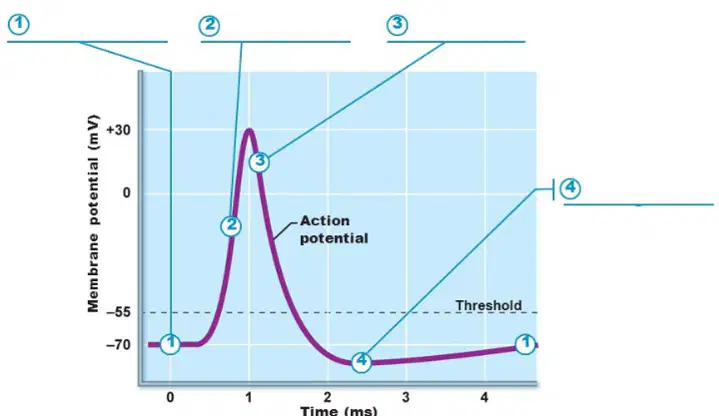
Using the image, which part of the action potential is caused by the the opening voltage-gated sodium (Na+) channels, which allows the neuron membrane to depolarize itself?
1
2
3
4
Is the rectus femoris muscle located on the anterior or posterior side of the thigh?
Anterior
Posterior

What are thick filaments known as?
Cross Bridges
Myosin
Light Band
Actin
Scientific name for muscle fiber bundle.
Epimysium
Fascicle
Myofibril
Myofilament
Tough connective tissue sheath that surrounds the entire muscle.
Endomysium
Epimysium
Fascicle
Perimysium
Connective tissue sheath that surrounds muscle fibers.
Endomysium
Epimysium
Fascicle
Perimysium
Disappears when the muscle is contracted.
I band
A band
H-zone
M-line

Which label indicates the sarcomere?
H
I
J
K
Click all that apply. Which of these make up a motor unit?
Motor neuron
Muscle fiber
Muscle
Nerve
Which muscle characteristic allows the muscle to return to resting length after contraction?
Contractility
Excitability
Extensibility
Tension
What is the name of the location where the neuron and muscle fiber meet?
Sarcoplasm
Sacolemma
Neuromuscular junction
Axon terminal
What is the name of the neurotransmitter that is released from the neuron to the sarcolemma?
Acetylcholine
Acetone
ATP
Calcium
Which of these occurs first during a muscle contraction?
The nerve signal reaches the neuromuscular junction
Ach is released and opens Na ion channels
The sarcomere shortens
The myosin binds to the actin
Which of these occurs last during a muscle contraction?
The nerve signal reaches the neuromuscular junction
Ach is released and opens Na ion channels
The sarcomere shortens
The myosin binds to the actin
Binding sites on actin form cross-bridges with molecules of:
Troponin
ATP
Tropomyosin
Myosin
In order for an active site on actin to be exposed for the cross-bridging binding, the presence of _______ is required
Potassium
Sodium
Calcium
Water
The connective tissue layer that surrounds the fascicle is the:
Perimysium
Epimysium
Endomysium
Sarcomysium
What are the three types of muscles?
voluntary, smooth, cardiac
cardiac, skeletal, nervous
cardiac, smooth, skeletal
smooth, cardiac, stomach
Which of the following muscle types are voluntary?
Skeletal
Cardiac
Smooth muscle
___are regulatory proteins that cover the myosin binding site on the actin.
troponin-tropomyosin
sarcomere
sarcolemma
sarcoplasmic reticulum
Calcium binds to ___of the troponin-tropomyosin complex.
troponin
tropomyosin
actin
myosin
___gets shorter during contraction.
actin
myosin
troponin-tropomyosin
none of these



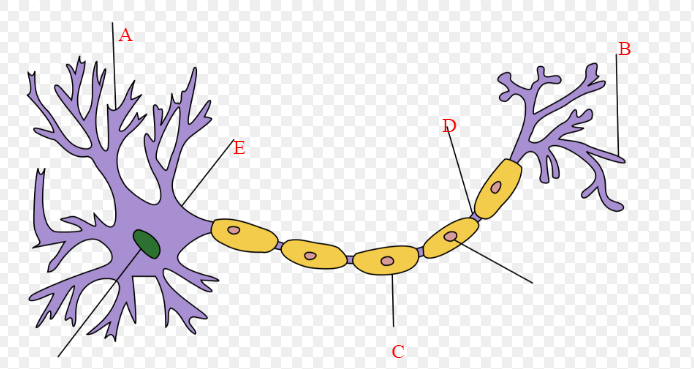
B
Dendrite
Axon
Axon Terminal
Cell Body


When a membrane potential reaches +30mV, ________ channels open, ________ occurs, and ________ channels close.
When is the potassium channel open?
during rest only
during repolarization only
during depolarization only
all the time
Action potentials run along the ______ from ______ to ________.
axon, dendrites, axon terminals
axon, axon terminals, dendrites
dendrites, axon, axon terminals
axon terminals, axon, dendrites
As the neuron fires, there's a reversal in _____ as the axon undergoes ________.
direction, depolarization
charge, depolarization
direction, repolarization
charge, repolarization

Myelin would be which color of structure?
the red one
the blue one
the green one
the purple one
ATP is required to run
Na/K pumps
leak channels
gated channels
myelin sheaths

What muscle is the arrow pointing to?
Pectoralis (Pecs)
Biceps
Triceps
Lats

What muscle is the arrow pointing to?
Biceps
Triceps
Lats
Quads


Identify the structure. It binds to thin filamentous actin, and uses ATP hydrolysis to generate force and "walk" along the thin filament.
actin
myosin head
tropomyosin
troponin
cross bridge
In what part of our muscle structure does the sliding filament theory (muscle contraction) occur in?
fascicles
muscle fibers
sarcomeres
epimysium
How does calcium initiate muscle contraction?
Calcium attaches to actin, allowing cross bridges to form
Calcium causes myosin to attach to the actin protein
Calcium causes ATP to move to myosin heads
Calcium turns the electrical signal into a chemical signal

Cellular Respiration's goal is to
make water
make ATP
make glucose
make oxygen
Anaerobic cellular respiration is termed
glycolysis
Krebs cycle
ETC- electron transport pump
Pyruvate to Acetyl CoA
Insufficient O2 leads to _____ resulting in the need to continue deeply breathing post exercise
Oxygen debt and EPOC
Oxygen debt and muscle fatigue
Muscle fatigue and EPOC
When a muscle lack sufficient ATP due to extended O2 deficiency results in
muscle fatigue
O2 debt
EPOC
How many classifications of levers are there?
3
2
5
4
What part of the human body acts as the fulcrum in all lever systems?
(a)
In which position will the fulcrum be in relation to the effort and load in a first class lever system?
On the left
In the middle
On the right

What lever type is this?
1st class lever
2nd class lever
3rd class lever
Not a lever

What type of lever is this?
1st class lever
2nd class lever
3rd class lever
Not a lever

What is the function of the nervous system?
to control and coordinate body functions and systems.
to protect the body from harm.
to identify pain and begin healing.
to break down food.
The basic unit of structure and function in the nervous system is a nerve cell. Nerve cells are also called-
Osteocytes
Dendrites
Neurons
Spinal Cords


Where in the body are Integrating Neurons found?
Muscles
Periphery
Sensory systems
Central Nervous System
Your body detects that you stomach has been stretched after eating a large meal. What type of signal is this?
Visual
Motor
Taste
Sensory
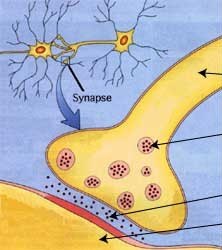
The location of neurotransmitters
axon terminals
dendrites
Schwann cells
cell body
Type of synapse which increases the chance of the next neuron firing
Inhibitory
Excitatory
Neurotransmitters
Neuron
Type of synapse which decreases the chance of the next neuron firing
Inhibitory
Excitatory
Neurotransmitters
Neuron

By what process do vesicles containing neurotransmitter leave the axon terminal?
Exocytosis
Endocytosis
Diffusion
Through gated channels
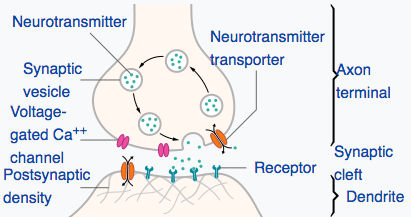
What is the response in the postsynaptic cell once the acetylcholine has bound to it?
In opens the Na+ gated channels and Na+ rush in
It opens the Ca2+ gated channels and Ca2+ rush in
It closes the K+ channels creating a resting potential
It releases its own neurotransmitter into the synaptic cleft
Neurons that carry information from the sensory receptors to the CNS:
Sensory, afferent
Sensory, efferent
Moror, afferent
Motor, efferent
Rare in adults, these neurons are only found in sense organs like the eye and nose:
unipolar
bipolar
multipolar

This type of neuron is usually found in your sensory receptors.
Unipolar
Bipolar
Multipolar

Motor neurons are also called ____________ neurons and they are usually __________.
efferent, bipolar
efferent, multipolar
afferent, unipolar
afferent, multipolar

Sensory neurons are also called ____________ neurons and they are usually __________.
efferent, unipolar
afferent, multipolar
efferent, bipolar
afferent, unipolar

Interneurons are also called ____________ neurons and they are usually __________.
association, unipolar
association, bipolar
association, multipolar
Which neuroglial cell is not found in the CNS?
microglia
schwann cells
oligodendrocytes
ependymal cells
Astrocytes
Which of the neuroglial cells is important in protecting the CNS from infection?
astrocytes
microglia
ependymal cells
oligodendrocytes
Schwann cells
Neuron with one axon and many dendrites is
Multipolar
Bipolar
Unipolar
CNS axons can regenerate
true
false
Which controls cardiac muscle, smooth muscle and glands?
Somatic nervous system
autonomic nervous system
Which is under voluntary control?
Somatic nervous system
autonomic nervous system
Which group controls the skeletal muscles?
Somatic nervous system
autonomic nervous system
The sympathetic and parasympathetic divisions are two arms of the ________.
central nervous system
voluntary nervous system
autonomic nervous system
somatic nervous system
peripheral nerous system
What cells form the myelin sheaths around nerve fibers in the PNS?
satellite cells
ependymal cells
Schwann cells
microglial cells
Which ciliated neuroglial cell circulates cerebrospinal fluid?
oligodendrocytes
Schwann cells
microglia
ependymal cells
astrocytes

