Worksheets
Unit 5 (Genetic Inheritance)
Total questions: 150
Worksheet time: 3hrs 41mins

A red flowered plant (RR) is crossed with a white flowered plant (WW). The gene for petal color in these plants expresses incomplete dominance. What percentage of the offspring will have red (RR) flowers?
0%
25%
50%
100%
The hair form gene shows incomplete dominance. Straight hair (SS) is dominant, curly hair (CC) is recessive, and wavy hair (SC) is heterozygous. Mr. and Mrs. Anderson both have wavy hair (SC). What percentage of their children will also have wavy hair (SC)?
25%
50%
75%
100%

Codominance occurs in calico cats, which allows for the Black and Tan colors to show. What percentage of the offspring will be calico (black and tan spotted)?
25
50
75
100
Some flowers are controlled by codominance. Red flowers (RR), blue flowers (BB) and Speckled flowers (RB).
Cross a red flower with a speckled flower. What is the phenotypic ratio?
2 red, 2 speckled
2 red, 2 blue
2 blue, 2 speckled
When one allele is not dominant over another, resulting in a blended phenotype for heterozygous offspring is considered....
Incomplete Dominance
Codominance

The chart shown indicates a method of representing traits in pea plants. Some offspring of a cross in pea plants were tall and green. According to the chart, these plants could be represented by
TTYY
Ttyy
ttYy
TtYy


In order for a female to have a sex-linked disorder, the following must be true.
both parents must be normal
The father must have the disorder and the mother must be a carrier
The father must have the disorder and the mother must be normal.
The father must be a carrier and mom must be a carrier

Base your answer to the following question on the pedigree chart below, which shows a history of ear lobe shape, and on your knowledge of biology. The genotype of individual 2 could be
EE, only
Ee, only
ee, only
EE or Ee

Base your answer to the following question on the pedigree chart below, which shows a history of ear lobe shape, and on your knowledge of biology. The genotype of individual 1 could be
EE, only
Ee, only
ee
EE or Ee

Base your answer to the following question on the information and diagram below and on your knowledge of biology. Yellow male offspring are represented by
1
2
3
4


What happens when a baby inherits just a Y chromosome (no X chromosome).
The baby will be a normal, healthy baby boy. The X is not necessary for survival.
The baby will be a normal, healthy baby girl. You must have both an X and a Y to be male.
The baby will be a super masculine male with none of the feminine characteristics carried on the X chromosome.
The X chromosome is necessary for life because it carries genes that code for non-sex characteristics so the embryo will die.
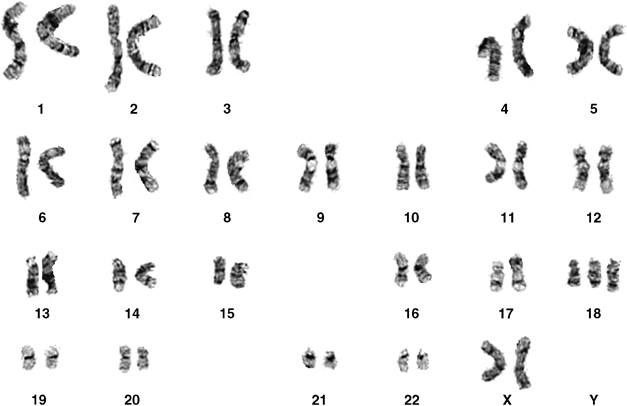
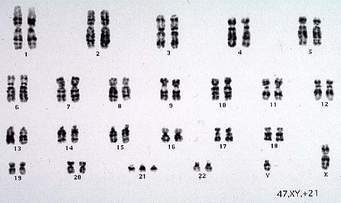
Based on the Karyotype shown, at which chromosome can we identify a genetic disorder?
Chromosome 5
sex chromosomes
Chromosome 21
There are no chromosomal disorders
Which of the following is why gametes sometimes lack a complete chromosome?
Chromosome pairs 1-22 are referred to as
sex chromosomes
sister chromatids
a karyotype
autosomes


Which letter(s) in the diagram correspond to cells that are haploid?
A only
B only
C only
A and B
C and B
When does independent assortment occur?
In mitosis
In metaphase I
In metaphase II
In metaphase I and II
Which of the following are true of meiosis? Select all that apply!
It results in four cells
It results in two cells
The daughter cells are genetically identical
The daughter cells are genetically unique
The daughter cells are haploid

How many chromosomes are normally found in human body cells?
46
23
26
44
What type of reaction is this?
C6H12O6 + 6O2 → 6CO2 + 6H2O + 32 ATP
endergonic
exergonic
The reaction shown below is performed by baker's yeast (S. cerevisiae). Which of the following is true about this reaction?
C6H12O6 --> 2C2H5OH + 2 CO2 + 2ATP
Glucose --> Ethanol
This process requires O₂, which acts as the final electron acceptor in the formation of ethanol and CO₂.
Yeast cells do not produce carbon dioxide during this reaction, as CO₂ is not a byproduct of fermentation.
Human muscle cells also perform this reaction to produce ethanol and CO₂ during exercise.
This process occurs anaerobically, allowing yeast to regenerate NAD⁺ so glycolysis can continue in the absence of oxygen.
Mendel crossed yellow-seeded and green-seeded pea plants and then allowed the offspring to self-pollinate to produce an F2 generation. The results were as follows: 6,022 yellow and 2,001 green (8,023 total). Which of the following statements correctly describes the relationship of the allele for green seeds to the allele for yellow seeds?
The two alleles exhibit incomplete dominance.
The two alleles are codominant.
The green allele is recessive to the yellow allele.
The green allele is dominant to the yellow allele.
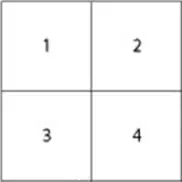
Use the following description and the Punnett square to answer. In a plant where allele D produces dark leaves and dd produces light leaves, a true-breeding dark-leaved plant crossed with a light-leaved plant yields F1 plants that self-pollinate, producing an F2 shown in a Punnett square with boxes labeled 1, 2, 3, and 4. Which of the boxes marked 1-4 correspond to plants that will be true-breeding?
1 and 4 only
2 and 3 only
1 only
1, 2, 3, and 4
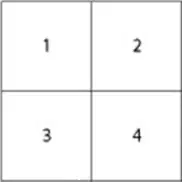
Use the following description and the Punnett square to answer. In a plant where gene locus D controls leaf color, D produces dark green leaves and dd produces light green leaves. A true-breeding dark-leaved plant crossed with a light-leaved plant yields F1 plants that self-pollinate, producing an F2 shown in a Punnett square with boxes labeled 1, 2, 3, and 4 for the genotypes. Which of the boxes marked 1-4 correspond to plants with a heterozygous genotype?
2 and 3
1
1, 2, and 3
2, 3, and 4
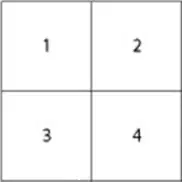
Use the following description and the Punnett square to answer. In a particular plant, leaf color is controlled by gene locus D. Plants with at least one allele D have dark green leaves, and plants with the homozygous recessive dd genotype have light green leaves. A true-breeding, dark-leaved plant is crossed with a light-leaved one, and the F1 offspring is allowed to self-pollinate. The predicted outcome of the F2 is diagrammed in a Punnett square in which the four boxes are labeled 1, 2, 3, and 4 to represent the genotypes produced. Which of the boxes marked 1-4 correspond to plants with dark leaves?
2 and 3
1, 2, and 3
1 only
4 only
Mendel continued some of his experiments into the F2 or F3 generation in order to:
distinguish which alleles were segregating
obtain a larger number of offspring on which to base statistics
observe whether or not the dominant trait would reappear
observe whether or not a recessive trait would reappear
What was the most significant conclusion that Gregor Mendel drew from his experiments with pea plants?
Traits are inherited in discrete units and are not the result of "blending."
Recessive genes occur more frequently in the F1 generation than do dominant ones.
Genes are composed of DNA.
There is considerable genetic variation in garden peas.
In fruit flies, grey body color is dominant over black body color, and long wings are dominant over short wings (G = grey body color allele, g = black body color allele; L = long wing allele, l = short wing allele). You perform a cross with two parental flies, each of which has a grey body color and long wings. You obtain the following results when you analyze the phenotypes of the offspring: 18 with grey bodies and long wings, 6 with black bodies and long wings, 6 with grey bodies and short wings, and 2 with black bodies and short wings. Based on this information, what are parental genotypes?
GgLl X GgLl
GgLl X ggll
GGLL X ggll
GgLl X GGLL
Tay-Sachs disease is a fatal genetic disorder caused by a mutation in an autosomal gene coding for a lysosomal enzyme. A couple, neither of whom suffer from the disorder, have three children; one child was diagnosed with Tay-Sachs at birth, while the other two have normal phenotypes. Determine the genotypes of the parents and indicate the pattern of inheritance displayed by the disorder (T = dominant allele, t = recessive allele).
Parents: TT × Tt; Pattern: autosomal dominant
Parents: TT × TT; Pattern: autosomal dominant
Parents: Tt × Tt; Pattern: autosomal recessive
Parents: Tt × tt; Pattern: autosomal recessive
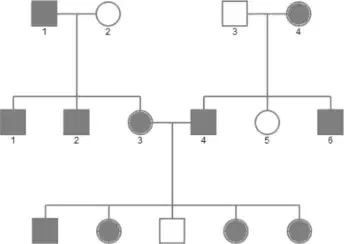
In the bobcat pedigree where long claws are dominant (B) and short claws are recessive (b), what is the genotype of individual II-5?
BB
Bb
bb
Unable to determine from the pedigree
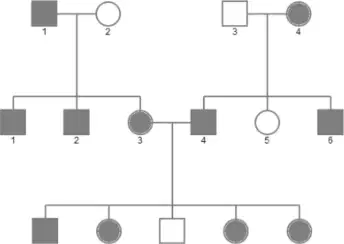
In the bobcat pedigree where long claws are dominant (B) and short claws are recessive (b), what is the genotype of individual II-3?
BB
Bb
bb
Unable to determine from the pedigree
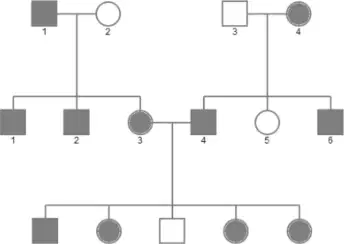
In the bobcat pedigree where long claws are dominant (B) and short claws are recessive (b), what is the genotype of individual I-4?
BB
Bb
bb
Unable to determine from the pedigree

In the bobcat pedigree where long claws are dominant (B) and short claws are recessive (b), which of the following represents an individual male bobcat with short claws?
I-4
II-5
III-1
III-3
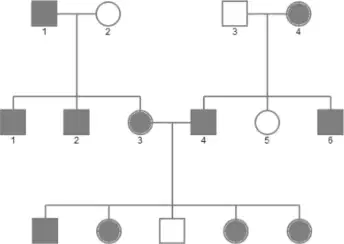
A pedigree for a bobcat population indicates the occurrence of long claws, a trait controlled by a single autosomal gene with two alleles (B = dominant allele, produces long claws; b = recessive allele, produces short claws). Which of the following represents an individual female bobcat with long claws in the pedigree?
I-4
II-5
III-1
III-3

Your class obtains three corn cobs and counts the number of purple and yellow kernels on each cob as summarized:
If corn kernel color is controlled by a single gene with two alleles (R = dominant purple, r = recessive yellow), which parental cross could have produced these cobs as offspring?
RR × RR
Rr × Rr
rr × rr
Rr × rr
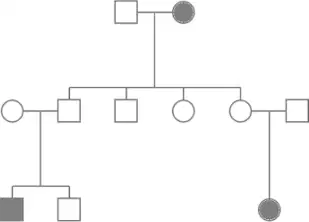
The pedigree shows the inheritance of a human biochemical disorder called alkaptonuria in which affected individuals accumulate a dark-colored substance (alkapton) in urine and certain tissues. Shaded symbols indicate affected individuals. Based on the pedigree, what is the most likely inheritance pattern for alkaptonuria?
Autosomal dominant
X-linked dominant
Autosomal recessive
X-linked recessive
Down syndrome results from an extra copy of which chromosome?
Chromosome 2
Chromosome 21
X chromosome
Chromosome 13
The failure of chromosomes to separate properly during cell division is called what?
Nondisjunction
Crossing over
Synapsis
Inversion
The SRY gene is best described by which of the following?
A gene region present on the Y chromosome that triggers the formation of testes and a penis during embryonic development
A gene required for general development in both sexes, and individuals lacking the gene do not survive past early childhood
An autosomal gene that is required for the expression of genes on the X chromosome
A gene present on the X chromosome that triggers formation of the ovaries and a clitoris during embryonic development
A human male will inherit which of the following from his mother?
All of his X chromosome genes
None of his Y chromosome genes
Half of his autosomal alleles
All of the above
Hemophilia A is an X-linked recessive trait. A woman is a carrier for hemophilia A, and her husband is a hemophiliac. What is the chance that the daughter they plan to have will be a carrier?
0%
25%
50%
75%
100%
Hemophilia A is an X-linked recessive trait. A woman is a carrier for hemophilia A, and her husband is a hemophiliac. What is the chance that the son they plan to have will be a hemophiliac?
0%
25%
50%
75%
100%
Hemophilia A is an X-linked recessive trait. A woman is a carrier for hemophilia A, and her husband is a hemophiliac. Assume N is the dominant allele and n is the recessive allele. What are the genotypes of the mother and the father, respectively?
XN Xn and XnY
XN and XNY
XnXn and XNY
XN Xn and XNY
Use the following information: A woman who has type A blood has a daughter who is type O and a son who is type B. Which of the following is a possible genotype/phenotype for the father of the two children?
IA IB, type AB
IB i, type B
IB IB, type B
ii, type O
Use the following information: A woman who has type A blood has a daughter who is type O and a son who is type B. Which of the following is the only possible genotype for the mother?
IB i
ii
IA IA
IA i
Use the following information: A woman who has type A blood has a daughter who is type O and a son who is type B. Which of the following is the only possible genotype for the son?
IB i
ii
IB IB
IA IB
A human egg cell containing 22 autosomes but no sex chromosomes (O) is fertilized by a human sperm cell containing 22 autosomes and an X chromosome. The resulting zygote will
have Klinefelter syndrome (XXY).
have Down syndrome.
have Turner syndrome (XO).
have 46 chromosomes.
Use the following information: In pea plants, the yellow seed color allele (Y) is dominant over the green seed color allele (y). You have a pea plant of unknown genotype that produces yellow seeds and perform a test cross to determine the genotype of this plant. Which set of results from the test cross would indicate that the pea plant with unknown genotype is heterozygous (Yy)?
808 offspring with yellow seeds, 0 offspring with green seeds
406 offspring with yellow seeds, 402 with green seeds
Either outcome above indicates that the unknown pea plant is heterozygous.
Use the following information: Huntington's disease is caused by a dominant allele (H). Jane is heterozygous for the Huntington's allele. Jane wants to have a child with Jack. Jack is homozygous recessive for the gene in question. What are the chances they will have a child with Huntington's disease?
0%
75%
25%
100%
50%
Use the following information: Huntington's disease is caused by a dominant allele (H). Jane is heterozygous for the Huntington's allele. What is Jane's phenotype?
She has Huntington's disease.
HH
She does not have Huntington's disease.
Hh
Use the following information: Huntington's disease is caused by a dominant allele (H). Jane is heterozygous for the Huntington's allele. What is Jane's genotype?
She has Huntington's disease.
HH
She does not have Huntington's disease.
Hh
Eye color, skin color, and height in humans are controlled by multiple genes. These traits demonstrate which of the following?
monohybrid ratios
polygenic inheritance
nondisjunction
polyploidy
Use the following information: As a genetic counselor, you meet with Sam and Dianne, who have both tested positive as carriers for the recessive allele (p) that causes phenylketonuria (PKU). What is the chance that their first child will not be affected by PKU?
1/4 (25%)
3/4 (75%)
1/2 (50%)
no chance
4/4 (100%)
Use the following information: As a genetic counselor, you meet with Sam and Dianne, who have both tested positive as carriers for the recessive allele (p) that causes phenylketonuria (PKU). What is the chance that their first child will have PKU?
1/4 (25%)
3/4 (75%)
1/2 (50%)
no chance
4/4 (100%)
Use the following information: As a genetic counselor, you meet with Sam and Dianne, who have both tested positive as carriers for the recessive allele (p) that causes phenylketonuria (PKU). What are the genotypes of the parents who have come into your office?
Sam is PP, and Dianne is pp.
Sam and Dianne are both Pp.
Sam and Dianne are both PP.
Sam is Pp, and Dianne is pp.
Eye color, skin color, and height in humans are controlled by multiple genes. These traits demonstrate which of the following?
polygenic inheritance
polyploidy
nondisjunction
monohybrid ratios
A species of daylily can have either yellow or red flowers. If we cross a homozygous yellow flower plant with a homozygous red flower plant, all of the offspring have red flowers. Based on that result, which of the following is true?
The yellow allele is dominant
The red and yellow alleles exhibit incomplete dominance
The red allele is dominant
Down syndrome results from an extra copy of which chromosome?
chromosome 2
chromosome 13
chromosome 21
X chromosome
Which of the following statements is correct in describing the terms monohybrid cross and dihybrid cross?
A dihybrid cross involves organisms that are heterozygous for two characters that are being studied, and a monohybrid cross involves organisms that are heterozygous for only one character being studied.
A monohybrid cross results in a 9:3:3:1 ratio, whereas a dihybrid cross gives a 3:1 ratio.
A monohybrid cross is performed for one generation, whereas a dihybrid cross is performed for two generations.
A monohybrid cross involves a single parent, whereas a dihybrid cross involves two parents
What was the most significant conclusion that Gregor Mendel drew from his experiments with pea plants?
Genes are composed of DNA.
Recessive genes occur more frequently in the F1 generation than do dominant ones.
Traits are inherited in discrete units and are not the result of "blending."
There is considerable genetic variation in garden peas.
Which of the following inheritance patterns describes the ability of a single allele to have multiple phenotypic effects?
multiple alleles
pleiotropy
incomplete dominance
epistasis
Which of the following phenotypes is an example of polygenic inheritance?
pink flowers in snapdragons
the ABO blood group in humans
skin pigmentation in humans
white and purple flower color in peas
Which of the following statements correctly describes how Mendel accounted for the observation that traits had disappeared in the F1 generation and then reappeared in the F2 generation?
The mechanism controlling the appearance of traits was different between the F1 and the F2 plants.
Traits can be dominant or recessive, and the recessive traits were "hidden" by the dominant ones in the F1.
New mutations were frequently generated in the F2 progeny, causing traits that had been lost in the F1 to reappear in the F2.
Members of the F1 generation had only one allele for each trait, but members of the F2 had two alleles for each trait.
When Mendel set up a Parental (P) cross between true breeding purple and white flowered plants to generate the F1 and then allowed the F1 to self-pollinate to generate the F2 he saw a dominant to recessive ratio of 3:1. What phenotypic ratio would be expected if he crossed the F1 with the original purple parent?
9:3:3:1
1:1
3:1
4:0
Why did all of the F1 offspring of Mendel's purple and white flowered pea cross always look like one of the two parental varieties?
One allele was dominant.
Each allele affected phenotypic expression.
No genes interacted to produce a new unique phenotype.
The traits blended together during fertilization.
Albinism is a recessive trait where an individual does not produce the pigment melanin. A man and woman both produce melanin, but both have one parent with albinism. What is the probability that their first child will have albinism?
0
1
1/2
1/4
Albinism is a recessive trait where an individual does not produce the pigment melanin. A man and woman who both produce melanin have one child out of three who has albinism. What are the genotypes of the man and woman?
One parent must be heterozygous; the other parent can be homozygous dominant, homozygous recessive, or heterozygous.
One parent must be homozygous for the recessive allele; the other parent can be homozygous dominant, homozygous recessive, or heterozygous.
Both parents must be heterozygous.
One parent must be homozygous dominant; the other parent must be heterozygous.
In a particular plant, green (G) seed color is dominant to blue (g). If two plants with green seeds were crossed and resulted in 302 green and 98 blue seed plants, what was the most probable genotype of each parent?
Gg × Gg
GG × Gg
G × G
gg × Gg
Pea plants produce either purple or white flowers with purple showing complete dominance. A gardener was given plants with purple flowers. Which of the following types of crosses would best allow her to determine the genotype of her plant in one generation?
Self-pollination
A dihybrid cross
A monohybrid cross
A testcross
In pea plants, the tall phenotype is dominant to the dwarf phenotype. If a heterozygous pea plant is crossed with a homozygous tall pea plant, what is the probability that the offspring will be dwarf in size?
0.25
1
0.5
0
Ten plants of the same genotype are planted in a large flower garden. Later that year, some of the ten plants have blue flowers and others have pink flowers. This can be best explained by which of the following statements?
the alleles are codominant
multiple alleles are involved in color determining flower color
the allele for blue hydrangea is completely dominant over the allele for pink hydrangea
environmental factors such as soil pH affect the phenotype
Radish flowers may be red, purple, or white. A cross between a red-flowered plant and a white-flowered plant yields all-purple offspring. The flower color trait in radishes is an example of which of the following inheritance patterns?
sex linkage
incomplete dominance
codominance
a multiple allelic system
Marfan syndrome in humans is caused by an abnormality of the connective tissue protein fibrillin. Patients are usually very tall and thin, with long spindly fingers, curvature of the spine, sometimes weakened arterial walls, and sometimes eye problems, such as lens dislocation. Which of the following would you conclude about Marfan syndrome from this information?
It is pleiotropic.
It is dominant.
It is recessive.
It is epistatic.
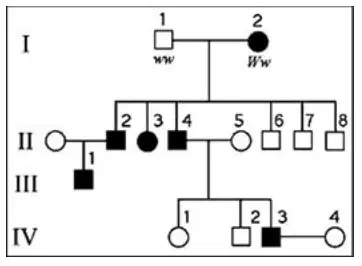
The following question refers to the figure of a family's pedigree chart, some of whose members exhibit the dominant trait, W. Affected individuals are indicated by a dark square or circle.
What is the genotype of individual II-5?
WW or Ww
Ww
WW
ww
The following question refers to the figure of a family's pedigree chart, some of whose members exhibit the dominant trait, W. Affected individuals are indicated by a dark square or circle.
What is the likelihood that a future child of IV-3 and IV-4 will have the trait?
50%
0%
75%
100%
The following question refers to the figure of a family's pedigree chart, some of whose members exhibit the dominant trait, W. Affected individuals are indicated by a dark square or circle.
What is the genotype of individual II-5?
WW or Ww
Ww
WW
ww
The following question refers to the figure of a family's pedigree chart, some of whose members exhibit the dominant trait, W. Affected individuals are indicated by a dark square or circle.
What is the probability that individual III-1 is Ww?
25%
75%
50%
100%
Which of the following statements about the law of independent assortment is correct?
It describes the inheritance of different alleles relative to one another.
It is the reason that dominant alleles are visible in the organism's phenotype.
It is the consequence of having two copies of each chromosome in somatic cells and one copy in gametes.
It describes the inheritance of different genes relative to one another.
Which of the following statements about the law of segregation is correct?
It explains how codominant alleles each affect the phenotype in separate ways.
It describes situations where either genotype or environment affect phenotype, but not both.
It describes the inheritance of different chromosomes relative to one another.
It describes the inheritance of different alleles relative to one another.
Male sex determination in mammals is in large part due to the SRY gene found on the Y chromosome. Which of the following scenarios will result in a person with an XX karyotype developing a male phenotype?
nondisjunction of the X chromosome during meiosis
translocation of SRY to an X chromosome during gamete formation
the loss of the SRY gene from an autosome during gamete formation
the presence of an extra autosomal chromosome after fertilization
Duchenne muscular dystrophy is a serious condition caused by a recessive allele of a gene on the human X chromosome. The patients' muscles weaken over time because they have a lack or decreased levels of dystrophin, a muscle protein. Which of the following correctly predicts the probability of muscular dystrophy in female children?
One-half of the daughters of an affected man and a carrier woman would have this condition.
One-fourth of the daughters of an affected man would have this condition.
One-half of the daughters of an unaffected man and a carrier woman would have this condition.
Females can never have this condition.
Which of the following individuals will inherit an X-linked allele from a male parent who carries the allele (XhY)?
all of his daughters
all of his children
half of his daughters
all of his sons
Which of the following statements correctly describes the chromosome theory of inheritance as it was understood in the early 20th century?
Individuals inherit particular chromosomes attached to genes.
Natural selection acts on certain chromosome combinations rather than on genes.
Mendelian genes are at specific loci on the chromosome and, in turn, segregate during meiosis.
No more than a single pair of chromosomes can be found in a healthy normal cell.
Males are more often affected by X-linked traits than are females because ________.
X chromosomes in males generally have more mutations than X chromosomes in females
males are hemizygous (a diploid organism that has only one copy of a particular gene due to having only one X and one Y chromosome) genes on the X chromosomes
imprinting is more likely to occur on X chromosomes inherited from the mother than on Y chromosomes inherited from the father
X inactivation occurring in male effectively shuts down expression of any X chromosome genes
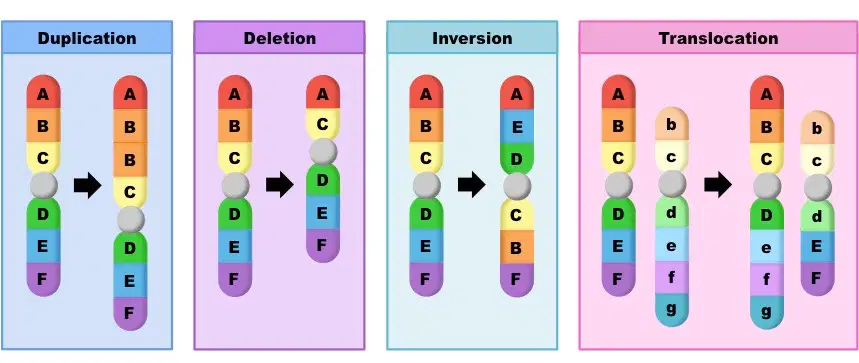
The chromosomal alteration that results from a chromosome fragment joined to a non-homologous chromosome is called a ________.
duplication
inversion
deletion
translocation

A couple has a child with Down syndrome. Which of the following is the most probable cause of the child's condition?
One member of the couple underwent nondisjunction in somatic cell production.
One member of the couple underwent nondisjunction during meiosis.
The woman's genome has a chromosomal duplication.
The man's family has a predisposition for Down syndrome.
A patient has 47 chromosomes, including three X chromosomes. Which of the following statements describes her expected phenotype?
an apparent male who is sterile
a sterile female
healthy female of slightly above-average height
a female with masculine characteristics such as facial hair
Which of the following is an example of monosomy in humans?
Down syndrome
Klinefelter syndrome
Turner syndrome
trisomy X
Red-green color blindness is an X-linked recessive trait in humans. Two people with normal color vision have a son with colorblindness. Given this information, the genotypes of the parents are ________.
XnXn and XnY
XNXN and XnY
XNXN and XNY
XNXn and XNY
Cinnabar eye color is an X-linked, recessive characteristic in fruit flies. If a female having cinnabar eyes is crossed with a male having wild-type, red eyes, what percent of the F1 males will have cinnabar eyes?
50%
100%
0%
25%
Widow's peak is dominant to no widow's peak. Determine the genotype and phenotype ratios for a homozygous dominant female and a homozygous recessive male.
4:4 Ww, 4:4 widow's peak
2:4 Ww, 2:4 WW
4:4 Widow's peak
2:4 ww, 2:4 WW
2:4 No widow's peak 2:4 Widow's peak
2:4 Ww, 2:4 ww
2:4 Widow's peak 2:4 no widow's peak
Brown eyes are dominant to blue eyes. Determine the genotype and phenotype ratios for a homozygous dominant female and a homozygous dominant male.
1:4 BB 2:4 Bb 1:4 bb
3:4 Brown eyes 1:4 blue eyes
2:4 BB 2:4 Bb
4:4 Brown eyes
4:4 BB
4:4 Brown eyes
3:4 BB 1:4 Bb
4:4 Brown eyes
Cleft chin is dominant to no cleft chin. Determine the genotype and phenotype ratios for a heterozygous female and a heterozygous male.
1:4 CC 2:4 Cc 1:4 cc
3:4 cleft chin 1:4 no cleft chin
2:4 Cc 2:4 cc
2:4 cleft chin 2:4 no cleft chin
2:4 Cc 2:4 cc
2:4 cleft chin 2:4 no cleft chin
2:4 CC 2:4 Cc
4:4 cleft chin
In a complete dominance cross between a white, terminal (recessive) and red, axial (dominant) flower, what is the probability of a red, axial offspring?
1/16
3/16
9/16
16/16
In a dihybrid cross of complete dominance, what is the phenotypic ratio?
1:2:1
3:1
9:3:3:1
12:4
In a monohybrid cross of incomplete dominance, what is the phenotypic ratio?
1:2:1
3:1
9:3:3:1
12:4
In a monohybrid cross of complete dominance, what is the phenotypic ratio?
1:2:1
3:1
9:3:3:1
12:4
In a dihybrid cross of complete dominance, what is the phenotypic ratio?
1:2:1
3:1
9:3:3:1
12:4
Identify which of the following descriptions about dominance are correct
Incomplete dominance involves the homozygous dominant and heterozygous looking the same
Incomplete dominance involves the heterozygous offspring resulting in an intermediate between the two dominant traits
Codominance involves the heterozygous offspring resulting in an intermediate between the two dominant traits
Codominance involves the homozygous dominant and heterozygous looking the same
This process involves homologous chromatids exchanging genetic material to increase genetic diversity.
crossing over
random fertilization
independent assortment
gene flow

Which of the following best describes the inheritance pattern of the shown pedigree?
Autosomal Dominant
Sex-Linked Dominant
Autosomal Recessive
Sex-Linked Recessive
Describe the process of nondisjunction.
Homologous chromosomes exchange genetic information
The alignment of the chromosomes on the metaphase plate
Homologous chromosomes or sister chromatids remain attached during anaphase
The process of sperm and egg fusing to create a zygote
Describe why a male is more likely to be affected by a sex-linked trait?
Males have only 1 Y chromosome
Females have only 1 Y chromosome
Males have only 1 X chromosome
Females have only 1 X chromosomes
What is an example of a codominant trait in the human body?
Hair color
Skin Color
Blood Type
Color Blindess
Can a human male be a carrier of red-green color blindness?
Yes, males can be carriers of red-green color blindness, as color blindness is autosomal dominant
No, males cannot be the carriers of red-green color blindness, as color blindness is X-linked
No, males cannot be the carriers of red-green color blindness, as color blindness is Y-linked
Yes, males can be carriers of red-green color blindness, as color blindness is autosomal recessive
This type if chromosome mutation happens when a part of the chromosome breaks off and that segment flips around backwards and reattaches itself.
Duplication
Deletion
Inversion
Translocation

Part of a chromosome is repeated
Gene Mutation
Point Mutation
Deletion Mutation
Duplication Mutation

Part of a chromosome is reversed.
Inversion Mutation
Deletion Mutation
Translocation
Point Mutation

Part of one chromosome is transported and attached
to a non-homologous chromosome
Inversion Mutation
Translocation Mutation
Duplication Mutation
Point Mutation
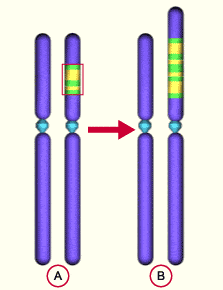
This type of chromosomal mutation produces an extra copy of all or part of the chromosome:
multiplication
replication
duplication
inversion
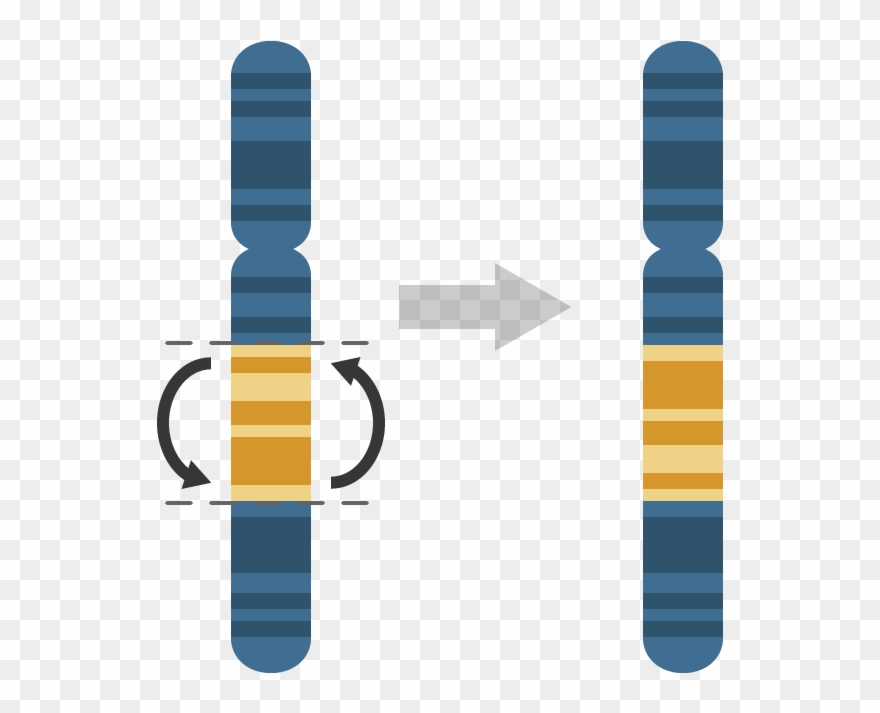
If part of the chromosome is turned around in the opposite direction this is called:
inversion
translocation
deletion
duplication
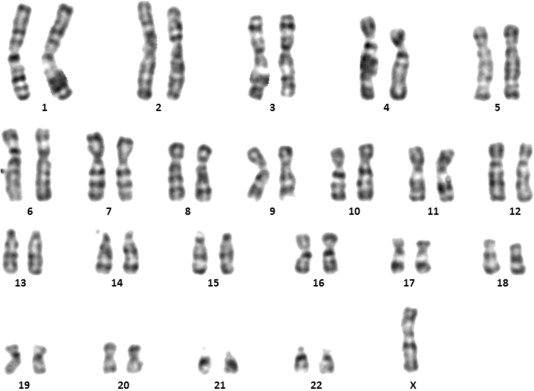
This is called Turners syndrome, can you notice the mutation in the chromosomes?
Both chromosomes 1 are bent
There are too many chromosomes
There are too many of chromosome 3
There is no Y chromosome
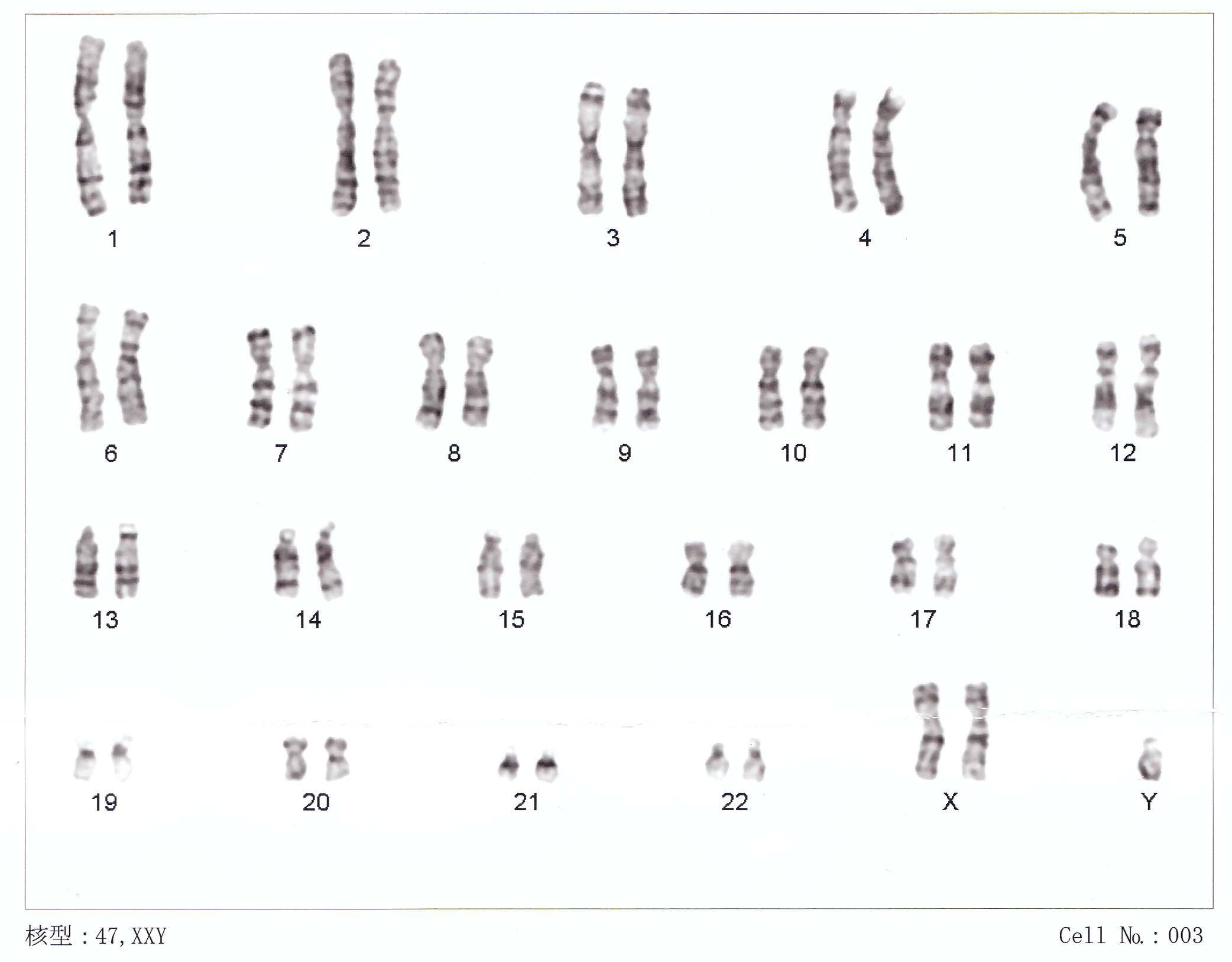
These are the chromosomes of someone with Kleinfelters syndrome. What is different about their chromosomes?
There is only one Y chromosome
One of the 5th chromosomes is too curved
There is an extra X chromosome
There are too few chromosomes

Notice the abnormal 23rd chromosome. This individual has an extra X chromosome. What type of mutation is this?
Translocation
Nondisjunction
Dublication
Inversion
Deletion
There are two alleles for the single gene which controls the shape of a species of radish: long and round (spherical). If we cross a homozygous long radish with a homozygous round radish, all of the baby radishes are oval. Based on that result, which of the following is true?
The long allele is dominant.
The round allele is dominant.
The oval allele is dominant.
The long and round alleles exhibit incomplete dominance.
Use the following information: In pea plants, the yellow seed color allele (Y) is dominant over the green seed color allele (y). You have a pea plant of unknown genotype that produces yellow seeds. You want to perform a test cross to determine the genotype of this plant. In the scenario above, you are test-crossing your plant of unknown genotype to a plant that has what genotype and phenotype?
yy, yellow seeds
YY, green seeds
Yy, yellow seeds
yy, green seeds
Which of the following does NOT support the concept of common ancestry for all organisms?
DNA/RNA (genetic code) are shared by all living systems
Ribosomes are found in all forms of life
Glycolysis takes place in all organisms
All organisms undergo sexual reproduction
Describe the process of nondisjunction.
Homologous chromosomes exchange genetic information
The alignment of the chromosomes on the metaphase plate
Homologous chromosomes or sister chromatids remain attached during anaphase
The process of sperm and egg fusing to create a zygote
What is codominance?
Both alleles are partially expressed
Both alleles are recessive
Both alleles are equally strong and visible
Neither allele is expressed
What is incomplete dominance?
One allele is expressed over the other in a heterozygote
When both alleles are expressed in a heterozygote
A blend of the parental traits; neither is dominant
When your parents can't agree on what's for dinner
What is a gene loci
Heterozygous carrier of a recessive disease
Having two copies of the same dominant allele
Specific positions of genes on a chromosome
Having two copies of the same recessive allele

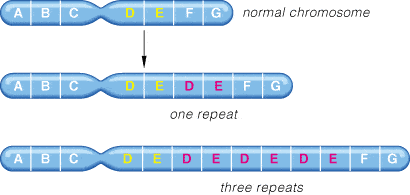
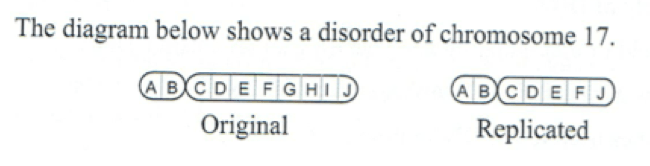
This is an example of
chromosomal duplication
Chromosomal insertion
DNA duplication
Genetic nucleotide duplication
a point mutation or substitution of UAU to UAA results in the translation from
Tyrosine to STOP
Tyrosine to Cysteine
Serine to STOP
STOP to Tyrosine
Serine to STOP
If Crossing over is a tool for generating variation in the population, then what is the purpose of the S phase in the cell cycle
S phase is the phase in which mutations mostly occur in the DNA of the cell
S phase is the phase during which DNA is getting condensed to form a chromosome
S phase is the phase during which DNA is replicated in the cell
S phase is the phase during which the proteins needed for mitosis are prepared

An individual has three number 21 chromosomes. Which is most likely the cause?
disjunction
crossing over
gene mutation
nondisjunction
Which sex chromosomes would indicate a human male that did NOT go through nondisjunction?
XX
X
XY
XXY

Which of the following would be considered a Gamete cell?
Egg Cell
Sperm Cell
Both of these

Chromosome mutation involving loss of a piece of chromosome.
Deletion
Inversion
Translocation
Removal
Chromosome mutation involving the repeat of a piece of chromosome.
Deletion
Inversion
Translocation
Duplication