
 Worksheets
Semester 1 Practice Test Part 1
Total questions: 50
Worksheet time: 25mins
The largest of the ocean basins, which currently covers more than half of the ocean surface, is the ________.
Arctic Ocean
Atlantic Ocean
Indian Ocean
Pacific Ocean
Southern Ocean
The four principal ocean basins (plus an additional ocean) on Earth are the ________.
Atlantic, Arctic, Mediterranean, Southern, and Pacific Oceans
Atlantic, Pacific, Indian, Southern, and Arctic Oceans
Atlantic, Antarctic, Southern, Mediterranean, and Pacific Oceans
Antarctic, Caspian, Southern, Indian, and Pacific Oceans
Antarctic, Arctic, Indian, Pacific, and Southern Oceans
Which of the following is TRUE concerning the deepest part of the ocean?
The bottom of this trench has never been reached by a submersible.
The deepest part of the ocean is located in a trench off the coast of California.
The depth of this trench exceeds the height of Mount Everest.
The depth of this trench is estimated at 15,000 meters.
This trench is called the Philippine Trench.
The separation of the Earth into layers while it was molten was the result of the ________.
decrease in temperature downward toward the core
differing densities of the elements that make up the Earth
gravitational force created by the rotating Earth
initial collection of materials and their position in Earth
presence of water at Earth's surface
OCEANIC crust is primarily ________.
basalt
carbonate sedimentary rocks
clay minerals
granite
siltstone
Which of the following statements regarding continental and oceanic crust is TRUE?
Continental crust and oceanic crust have equivalent densities.
Continental crust is thicker and denser than oceanic crust.
Continental crust is thinner and denser than oceanic crust.
Continental crust is thicker and less dense than oceanic crust.
Continental crust is thinner and less dense than oceanic crust.
Earth's primordial (early) atmosphere most likely included ________.
ammonia, oxygen, carbon dioxide, and water vapor
carbon dioxide, water vapor, hydrogen
hydrogen, helium, and oxygen
nitrogen, ozone, and sulfur dioxide
Earth is about ________.
6,000 years old
4.6 billion years old
4.6 million years old
40 billion years old
400,000 years old
Current scientific knowledge indicates that the most likely origin of most of Earth's oceans was due to ________.
other planets that had water before the earth
release of liquid water from the core as iron and nickel melted
water vapor released from volcanic outgassing and comets from outer space
water-bearing minerals found in meteorites
Which of the following statements about the Pacific Ocean is TRUE?
The Pacific Ocean is about three times larger than the next largest ocean.
The Pacific Ocean covers more than two-thirds of the ocean surface area on Earth.
The Pacific Ocean is the second largest geographic feature on the planet.
All of the continents could fit into the space occupied by the Pacific Ocean.
Which ocean covers more than half of the ocean surface area on Earth?
The Pacific Ocean
The Atlantic Ocean
The Indian Ocean
The Southern Ocean
The Antarctic Ocean
Which ocean is the deepest ocean in the world?
The Pacific Ocean
The Atlantic Ocean
The Indian Ocean
The Southern Ocean
The Arctic Ocean
Which ocean is similar in size and average depth to the Indian Ocean?
The Pacific Ocean
The Atlantic Ocean
The Indian Ocean
The Southern Ocean
The Arctic Ocean
Which ocean is mostly, but not entirely, in the southern hemisphere?
The Pacific Ocean
The Atlantic Ocean
The Indian Ocean
The Southern Ocean
The Arctic Ocean
Which ocean is the shallowest ocean in the world?
The Pacific Ocean
The Atlantic Ocean
The Indian Ocean
The Southern Ocean
The Arctic Ocean
Based on definition, it is more appropriate to consider which ocean as a sea?
The Pacific Ocean
The Atlantic Ocean
The Indian Ocean
The Southern Ocean
The Arctic Ocean
Which ocean is actually a part of three other oceans?
The Pacific Ocean
The Atlantic Ocean
The Indian Ocean
The Southern Ocean
The Arctic Ocean
Seas are different from oceans because seas are typically ________ (choose TWO)
Shallower than oceans
Enclosed by land
Deeper than oceans
All connected to one another
Wider than oceans
Which of the following is Earth's rigid layer that includes the crust plus the topmost portion of the mantle?
Asthenosphere
Inner core
Lithosphere
Mesosphere
Outer core
Which of the following is Earth's plastic layer, which flows when a gradual force is applied to it?
Asthenosphere
Inner core
Lithosphere
Mesosphere
Outer core
Which of the following is Earth's LIQUID iron-nickel layer?
Asthenosphere
Inner core
Lithosphere
Mesosphere
Outer core
Which of the following is Earth's SOLID iron-nickel layer?
Asthenosphere
Inner core
Lithosphere
Mesosphere
Outer core
What is the density of a plastic ball that has a volume of 6 cm3 and a mass of 12 g?
2 g/cm3
.5 g/cm3
72 g/cm3
4mL
To calculate density you would use the following equation
D = M/V
M = D X V
V = M/D
D = V/M
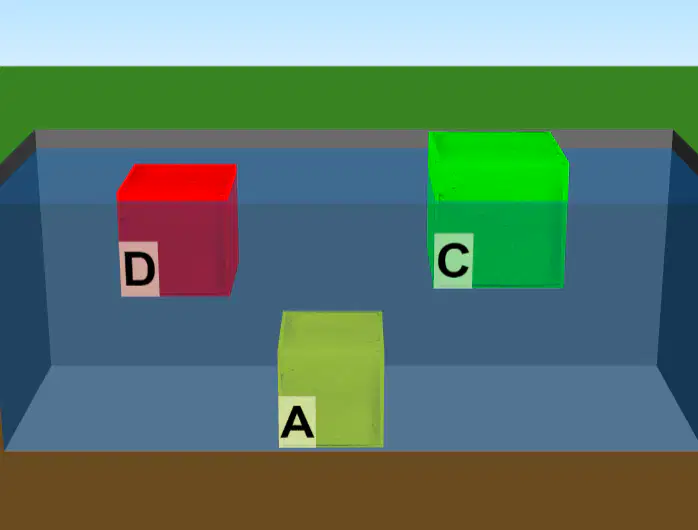
Which block has the lowest density?
A
C
D
There's no way to know
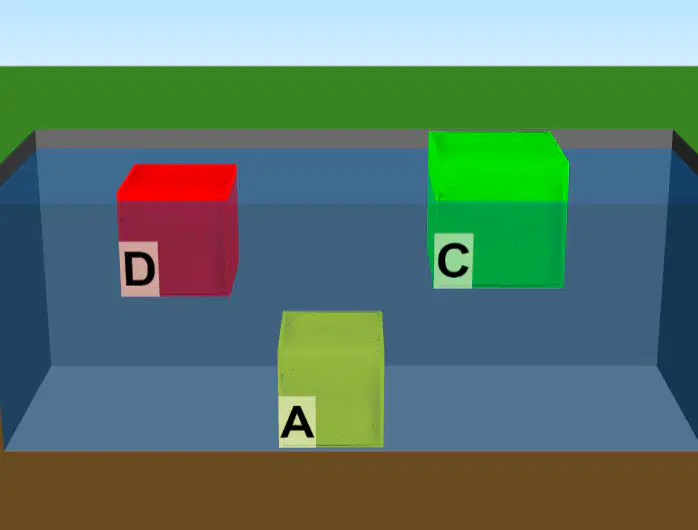
Which block has the highest density?
A
C
D
There's no way to know
A plastic cube has sides of 3 cm and mass of 3 grams, will it float or sink in water? (The formula for the volume of a cube is L x W x H)
Float in water
Sink in water
Which of Earth's layers has the lowest density?
Crust
Mantle
Core
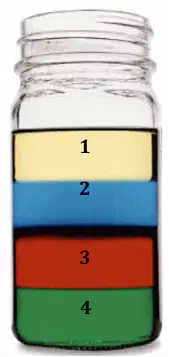
Put the liquids in order from most dense to least dense?
4, 3, 2, 1
1, 2, 3, 4
4, 2, 3, 1
3, 4, 1, 2
A solid metal cube has a mass of 2 grams and volume of 3 cm3. A liquid has a mass of 4 grams and volume of 8 ml. Will the metal cube sink or float in the liquid?
Sink
Float
What is the technical term for the measurement and charting of ocean depth?
bathymetry
topographical profiling
pinging
precision recording
Before the 1900's, depth soundings were performed by what method?
sound signal from the ship that pings off of the bottom of the ocean
measurement the speed of sound in water
lowering weighted lines off the side of a boat
satellite measurement
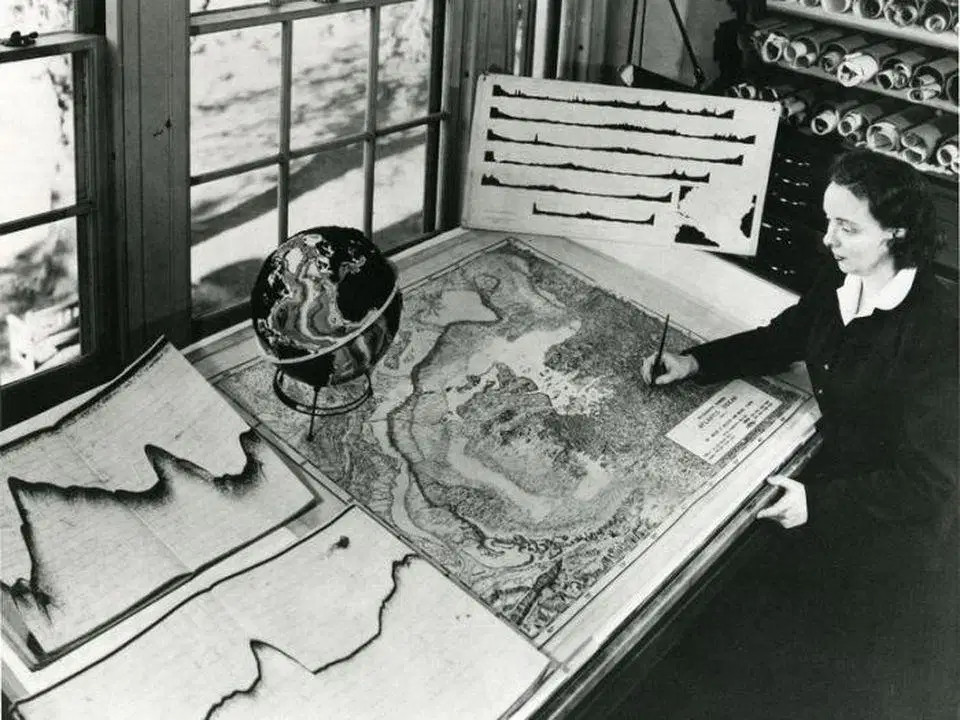
What did Marie Tharp accomplish?
She went on many research cruises to discover the shape of the seafloor
She created the idea of Plate Tectonics
She created the first detailed maps of the whole ocean floor
She used satellite data to better understand the seafloor
Modern oceanographers measure the depth of the ocean by ___________.
very accurately measuring the amount of dissolved material in seawater
diving to the sea floor and recording the pressure
observing the amount of marine life present
sending sound through the water and measuring the time required for it to return to the ship
looking over the edge of the boat and estimating the depth of the ocean floor
The formula to determine water depth from sonar measurements is
Depth = (1500 m/s) / (Return Time)
Depth = (1500 m/s * Return Time)
Depth = 2 * (1500 m/s * Return Time)
Depth = (1500 m/s * Return Time) * 1/2
If a sonar ping takes 1 second to return, and the speed of sound in seawater is 1500 m/s, what is the depth of the water?
750 m
1500 m
3000 m
6000m
There is not enough information to determine the depth.
If the water depth is 6000 meters, what should be the return time for a sonar ping?
2 seconds
3 seconds
4 seconds
6 seconds
8 seconds
On average, about how often does Earth's magnetic field reverse itself?
5000 years
10,000 years
50,000 years
100,000 years
500,000 years
Which structure runs down the center of a mid-ocean ridge?
rift valley
pillow basalt
oceanic trench
volcanic arc
Which is associated with a volcanic island arc?
spreading center
subduction zone
A spreading center, where new crust is created, is also called a(n)
mid-ocean ridge
subduction zone
ocean trench
transform boundary
Which is most associated with a mid-ocean ridge?
spreading center
subduction zone
Which is associated with seafloor plates moving apart?
spreading center
subduction zone
Which is associated with a deep sea trench?
spreading center
subduction zone
Of the following statements about ocean crust, which TWO are true?
Ocean crust is created at deep sea trenches.
Ocean crust is destroyed at transform faults.
Ocean crust is destroyed at deep sea trenches.
Ocean crust is created at the mid-ocean ridge.
Ocean crust is destroyed at the mid-ocean ridge.
What do ALL plate boundaries have in common? Select only one answer.
They are all associated with an abundance of volcanic activity.
They occur only on the ocean floor.
They occur entirely within the middle of continents.
They are all associated with zones of earthquakes.
They are all located along the edges of continents.
Tectonic plates move about as fast as ________.
a child crawls
a river flows
a snail crawls
a car
your fingernails grow
Which is a sloping area forming a trench along a downward moving plate?
subduction zone
Pangaea
island arc
continental shelf
rift valley
Which of the following statements is TRUE of the lithosphere?
The lithosphere is composed only of outer mantle material.
The lithosphere is composed only of igneous rock.
The lithosphere is composed only of metamorphic rock.
The lithosphere is composed of the crust and the uppermost portion of the mantle.
The lithosphere is composed of the inner portion of the mantle and the outer core.
Tectonic plates are pieces of the ________ that float on the more fluid ________ below.
crust; lithosphere
asthenosphere; lithosphere
lithosphere; asthenosphere
mantle; crust
lithosphere; mesosphere

