
 Worksheets
Chemistry Fall Final 2025
Total questions: 47
Worksheet time: 47mins
Name
Class
Date
1.
Electronegativity ______ as atomic radius decreases.
a)
Increases
b)
Decreases
c)
Stays the same
d)
Becomes irrelivent
2.
Choose all that apply. Which of the following is not a physical property?
a)
Density
b)
Reactivity
c)
Flammability
d)
Hardness
3.
Which would more likely be the most reactive element?
a)
Li
b)
Be
c)
B
d)
C
4.
What is the name for the compound PCl5?
a)
Phosphorous Tetrachlorate
b)
Phosphorous tetrachloride
c)
Phosphorous pentachloride
d)
Potassium heptachloride
5.
Which of the following has 7 valence electrons?
a)
Li
b)
N
c)
Ga
d)
Br
6.
Who discovered that atoms have electrons?
a)
Dalton
b)
Democritus
c)
Thompson
d)
Rutherford
7.
Which of the following has the greatest electronegativity?
a)
Cs
b)
Ne
c)
P
d)
Cl
8.
What element would have an ionic charge of 2+?
a)
Li
b)
Be
c)
O
d)
F
9.
All of these are true about electronegativity except...
a)
It increases left to right across periods
b)
It describes the distance between electrons
c)
It decreases down groups
d)
It describes the tendency of an atom to attract electrons
10.
The phase of matter with the highest energy is
a)
Gas
b)
Plasma
c)
Solid
d)
Liquid
11.
Which of the following is not an intensive property of matter?
a)
Luster
b)
Color
c)
Density
d)
Length
12.
Which is the least polar compound?
a)
NO
b)
PO3
c)
O2
d)
AsF
13.
No two different elements have the same number of...
a)
Electrons
b)
Protons
c)
Nuetrons
d)
Isotopes
14.
Which is the smallest particle?
a)
Protons
b)
Neutrons
c)
Electrons
d)
Atoms
15.
Atomic mass is the number of
a)
Average protons
b)
Protons plus average neutrons
c)
Average electrons plus average protons
d)
Average electrons plus average neutrons
16.
Valence electrons are not...
a)
The outermost electrons
b)
The electrons that bond in a reaction
c)
Negatively charged
d)
Larger than protons
17.
Which element below has the largest atomic radius?
a)
Sodium
b)
Magnesium
c)
Aluminum
d)
Silicon
18.
What is the electron configuration for Cl?
a)
1s2,2s2,3s2,4s2,5s2,6s2,7s2,1p3
b)
1s2,2s2,2p6,3s2,3p5
c)
1s2,2s2,3s2,1p6,2p5
d)
[Ne],1s2,2s2,2p3
19.
According to the wave model of the atom, the most energized electrons...
a)
Are closest to the center of the atom
b)
Are the furthest from the center of the atom
c)
Are unlikely to bond with other atoms
d)
Have a location that can be accurately determined
20.
Oxygen would _____ to bond with beryllium.
a)
Lose 2 electrons
b)
Share 1 electron
c)
Share 2 electrons
d)
Gain 2 electrons
21.
Group 2 elements would form what type of ions in ionic bonding?
a)
2+ cations
b)
2- cations
c)
2+ anions
d)
2- anions
22.
The Pauli exclusion principle states that...
a)
Every orbital in a sublevel is singly filled before any is double filled.
b)
Electrons occupy orbitals in order from lowest to highest.
c)
No more than 2 electrons can occupy the same orbital and they must have opposite spins.
d)
Electrons behave like a wave and also like a particle.
23.
What is the name for N2O5?
a)
Nitrogen oxide
b)
Dinitrogen pentoxide
c)
Nitrogen tetroxide
d)
Dinitrogen heptoxide
24.
What is the name for HF(aq)
a)
Monohydrogen fluoride
b)
Hydrofluoride
c)
Hydrogen fluoride
d)
Hydrofluoric acid
25.
What is the name for CaF(g)
a)
Calcium Difluoride
b)
Monocalcium Difluoride
c)
Calciumfluoric acid
d)
Calcium Fluoride
26.
A single d orbital would hold up to how many electrons?
a)
2
b)
6
c)
10
d)
14
27.
Which would have the smallest particles?
a)
Suspension
b)
Colloids
c)
Solutions
d)
Solutes
28.
[Kr] 5s2,4d5 is the noble gas notation for what element?
a)
N
b)
Rb
c)
Zn
d)
Tc
29.
Ionic bonding may occur between
a)
Anions and metals
b)
Cations and metals
c)
Metals and metals
d)
Non-metals and non-metals
30.
Phase change is an example of
a)
Physical change
b)
Chemical change
c)
Intensive property
d)
Extensive property
31.
Which is an example of a homogenous mixture?
a)
Sand at the beach
b)
Water in a bottle
c)
A sample of water from the Rio Grande
d)
Trail mix
32.
Electrons will fill in lower energy sublevels before filling higher energy ones. This is according to which of the following?
a)
Pauli exclusion principle
b)
Aufbau principle
c)
Heisenberg principle
d)
Hund's rule
33.
The gold foil experiment determined that...
a)
Atoms have electrons
b)
electrons are massive compared to protons and neutrons
c)
Atoms are mostly empty space
d)
The nucleus is massive compared to the whole atom
34.
An aluminum isotope consists of 13 protons, 13 electrons, and 14 neutrons. Its mass number must be...
a)
13
b)
14
c)
27
d)
40
35.
Chromium III oxide has what chemical formula
a)
Cr3O
b)
CrO
c)
CrO3
d)
Cr2O3
36.
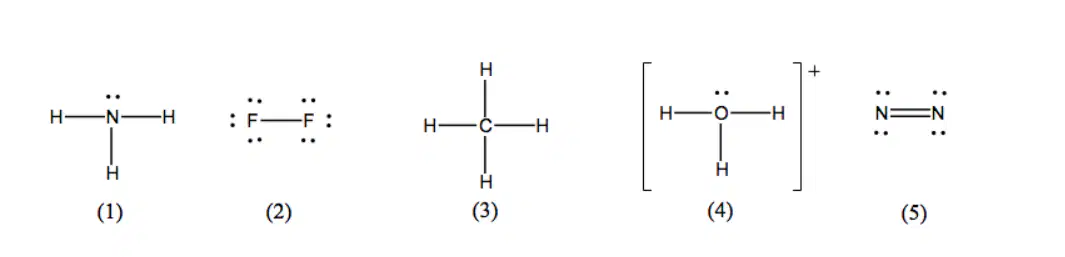
Which Lewis structure is drawn incorrect?
a)
1
b)
2
c)
3
d)
4
e)
5
37.
The change of states of matter from solid straight to gas is...
a)
Sublimation
b)
Deposition
c)
Evaporation
d)
Condensation
38.
How many lithium atoms are in lithium selenide
a)
1
b)
2
c)
3
d)
4
39.
A mixture that is uniform in composition is said to be...
a)
Heterogenous
b)
Homogenous
c)
Chemically bonded
d)
A compound
40.
A molecule with the designation AX2E would be which of the following?
a)
Trigonal planar with 3 bonding groups
b)
Linear with 2 bonding groups and 1 non bonding group
c)
Bent or v-shaped with 2 bonding groups and 1 non bonding group
d)
Tetrahedral with 2 bonding groups and 2 non-bonding groups.
41.
Which of the following is a physical change?
a)
Combustion
b)
Melting
c)
Decaying
d)
Rust
42.
What is the correct chemical formula for the product of Barium and iodine?
a)
BaI
b)
Ba2I
c)
BaI2
d)
IBa
43.
True or False. Noble gasses are colorless gasses that are extremely unreactive.
a)
True
b)
False
44.
Under ordinary conditions, the particles of a gas are_____.
a)
Closely packed
b)
Very far from one another
c)
Held in fixed positions
d)
Are unevenly distributed
45.
How many Fe(III) atoms must bond with sulfur to make Iron III sulfide?
a)
2
b)
3
c)
6
d)
1
46.
Explain what electronegativity and atomic radius are and how they are related.
4 lines
47.
How can the periodic table tell you the number of protons, electrons, valence electrons, and properties. Be as specific as possible.
4 lines
100 %

