
 Worksheets
Atomic Structure Test Honors
Total questions: 64
Worksheet time: 44mins
Atoms of elements in the same group of the periodic table share the same
number of energy levels
number of valence electrons
atomic numbers
atomic masses
The atomic mass number of magnesium is 24. Therefore its nucleus must contain
12 protons and 12 neutrons
6 protons and 6 electrons
12 neutrons and no protons
12 protons and no electrons
A neutral atom may contain 8 protons, A. 9 neutrons and 10 electrons B. 8 neutrons and 10 electrons C. 9 neutrons and 8 electrons D. 10 neutrons and 9 electrons
9 neutrons and 10 electrons
8 neutrons and 10 electrons
9 neutrons and 8 electrons
10 neutrons and 9 electrons
An element with 5 protons, 6 neutrons, and 8 electrons has an atomic number of A. 5 B. 6 C. 8 D. 11
5
6
8
11
An element with 5 protons, 6 neutrons, and 8 electrons has a mass number of A.
5
6
8
11
The farther an electron is from the nucleus, the more (a) it has.
charge
energy
mass
pull
The majority of the mass of the atom is located in the (a) and the majority of the volume of the atom is located in the (b) .
Nucleus, electron cloud
Nucleus, nucleus
Electron cloud, nucleus
Electron cloud, electron cloud
Atoms of the same element that have different numbers of neutrons are called
molecules
ions
protons
isotopes
The total number of electrons in the outer shell of a sodium atom is
A. 1
B. 2
C. 8
D. 18
Which particles determine the atomic number of an element?
Protons only
Neutrons only
Neutrons and protons
Protons and electrons
The total number of neutrons in the nucleus of any atom is equal to the
mass number of the atom
atomic number of the atom
atomic number minus the mass number
mass number minus the atomic number
The maximum number of electrons that can occupy the 2nd shell of an atom of magnesium is
1
2
8
18
What is the correct electron arrangement for sulfur? (Hint: think about electron shells!)
2-8-6
2-8-8
4-6-2
2-8-4
An unstable nucleus results from too many or too few (a)
neutrons
protons
electrons
radons
The nucleus of an atom has all of the following characteristics EXCEPT that it
is positively charged
is very dense
contains nearly all of the atom’s mass
contains nearly all of the atom’s volume
An atom is electrically neutral because
neutrons balance the protons and electrons
nuclear forces stabilize the charges
the numbers of protons and electrons are equal
the numbers of protons and neutrons are equal
The nucleus of isotope A of an element has a larger mass than isotope B of the same element. The number of neutrons in the nucleus of isotope A is (a) the number of neutrons in the nucleus of isotope B.
less than
greater than
the same as
The nucleus of isotope A of an element has a larger mass than isotope B of the same element. The number of protons in the nucleus of isotope A is (a) the number of protons in the nucleus of isotope B.
less than
greater than
the same as

The atoms in Group A are different from the atoms in Group B because only the atoms in Group A have (a)
their outer energy levels filled with electrons
three energy levels of electrons
arrangements typical of metals
arrangements typical of nonmetals
Which of the following is a transition metal?
Calcium
Nickel
Aluminum
Tellurium
Which word(s) below is represented by the word “period” on the Periodic Table?
Group
Family
Energy level
Valence electrons
When looking at the halogens on the periodic table, how does the number of valence electrons change as the energy level is increased?
The total number of valence electrons does not change. It remains at 7.
The total number of valence electrons does not change. It remains at 1.
The total number of valence electrons increases by 1 with each energy level.
The total number of valence electrons decreases by 1 with each energy level.
What is the correct symbol for an isotope of carbon with 6 protons and 6 neutrons?
12C
12C
6C
6C6
Which statement about the arrangement of the periodic table is not true?
Noble gases are in the group farthest to the right
Metals are found on the left side of the periodic table
Rare earth elements are in the first column on the left
Transition metals are in the center of the periodic table
25. Boron, carbon, nitrogen and oxygen are all members of the same (a) .
Family
Period
Group
Valence level
Which of the following elements would be the best conductor of electricity?
Iodine
Silicon
Silver
Argon
Which of the following elements would be the most reactive?
Iodine
Silicon
Silver
Argon
Which of the following elements would be the least reactive?
Iodine
Silicon
Silver
Argon
Complete the chart below. (0.5 pts each, 8 pts total) Isotopic Symbol: 42K, Atomic #: ___, Mass #: ___, Protons: ___, Neutrons: ___, Electrons: ___, Group Name: ___.
Atomic #: 19, Mass #: 42, Protons: 19, Neutrons: 23, Electrons: 19, Group Name: Alkali Metals.
Atomic #: 20, Mass #: 42, Protons: 20, Neutrons: 22, Electrons: 20, Group Name: Alkaline Earth Metals.
Atomic #: 18, Mass #: 42, Protons: 18, Neutrons: 24, Electrons: 18, Group Name: Noble Gases.
Atomic #: 21, Mass #: 42, Protons: 21, Neutrons: 21, Electrons: 21, Group Name: Transition Metals.
Complete the chart below. (0.5 pts each, 8 pts total) Isotopic Symbol: ___, Atomic #: ___, Mass #: ___, Protons: 3, Neutrons: ___, Electrons: 2, Group Name: ___.
Isotopic Symbol: Li, Atomic #: 3, Mass #: 6, Neutrons: 3, Group Name: Alkali Metals.
Isotopic Symbol: Be, Atomic #: 4, Mass #: 9, Neutrons: 5, Group Name: Alkaline Earth Metals.
Isotopic Symbol: B, Atomic #: 5, Mass #: 11, Neutrons: 6, Group Name: Boron Group.
Isotopic Symbol: He, Atomic #: 2, Mass #: 4, Neutrons: 2, Group Name: Noble Gases.
34. Describe one similarity and one difference between the two atoms you drew above. Include why each difference and similarity is expected, based on each element’s location on the periodic table. (4 pts)
Both atoms have the same number of protons; one atom has more neutrons.
Both atoms have the same number of electrons; one atom has a different atomic mass.
Both atoms are in the same group; one atom is in a different period.
Both atoms have similar chemical properties; one atom has a different number of valence electrons.
Match the following scientists with their appropriate accomplishments.
Arranged the elements on the periodic table based on atomic number
Henry Moseley
Solid Sphere Model; elements are atoms with different masses
JJ Thomson
Electron Cloud Model; surrounding the nucleus is an electron cloud made of shells – electrons do not, however, travel in a fixed orbit.
Ernest Rutherford
Nuclear Model; Gold Foil experiment allowed him to discover that the nucleus was the positively charged center of the atom surround by negatively charged electrons
Niels Bohr
Arranged the elements on the periodic table based on atomic mass
Democritus
Classify the following elements as metals, nonmetals, or metalloids. Which of the following is a metal? Ar, H, Al, Na, Te, F
Na
Ar
Te
Al
H
An isotope of Carbon has 7 neutrons. Which of the following is true about this isotope? a. Write this isotope’s notation in Nuclear Form. b. Write this isotope’s notation in Hyphen Form. c. Is this the most common form of the isotope? Explain how you know if it is or isn’t.
a. 13C, Carbon-13, Yes, it is the most common isotope.
b. 13C, Carbon-13, No, it is not the most common isotope.
c. 14C, Carbon-14, Yes, it is the most common isotope.
d. 14C, Carbon-14, No, it is not the most common isotope.
This element is in the same family as Br, but has fewer protons than Mg. It must be _________.
F
Cl
I
At
This element has 6 energy levels and 8 valence electrons. It must be ________.
noble gas, specifically radon (Rn)
alkali metal, specifically cesium (Cs)
halogen, specifically iodine (I)
alkaline earth metal, specifically barium (Ba)
This element is in the alkaline earth metals group and has 3 energy levels. It must be _______.
Magnesium
Calcium
Beryllium
Strontium
This element is in the family with the most reactive nonmetals and has 4 energy levels. It must be __________.
Chlorine
Fluorine
Bromine
Iodine
Which of the following are the three forces that hold the atom together?
Gravitational force, electromagnetic force, and weak nuclear force
Electromagnetic force, strong nuclear force, and weak nuclear force
Gravitational force, strong nuclear force, and electromagnetic force
Strong nuclear force, weak nuclear force, and gravitational force

"Everything is composed of atoms" was first stated by:
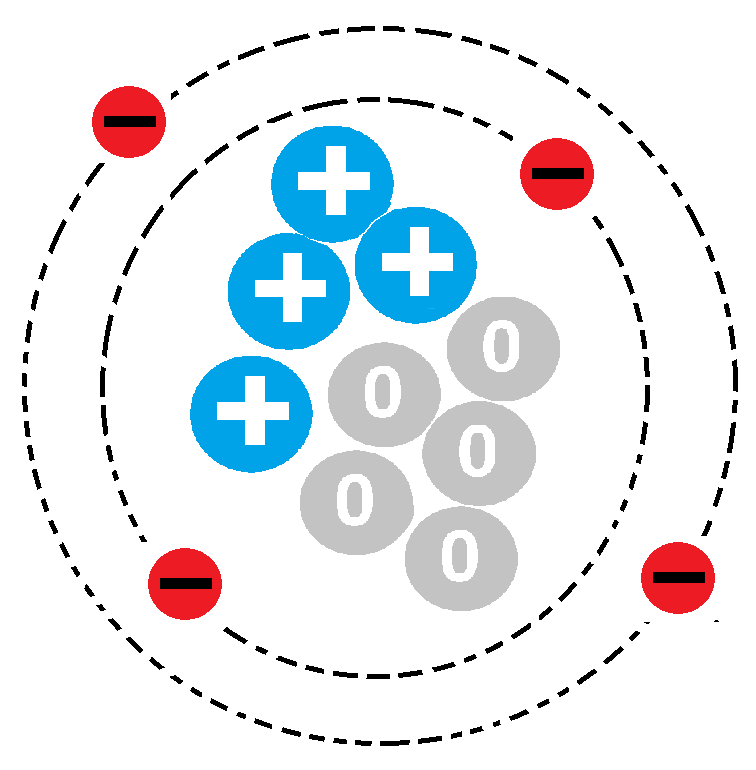

In the symbol 167N what the 7 stand for?
Mass number
Atomic number
Atomic mass
Number of neutrons
Which isotope has 4 neutrons?
Which of the following elements is a noble gas?
Helium
Hydrogen
Oxygen
Carbon
What is the charge of an electron?
Neutral
Negative
Variable
Positive


Sulfur is a...
metal
nonmetal
metalloid
Which of the following is an inert gas?
Hydrogen
Helium
Oxygen
Carbon dioxide
how many rows are on the table
4
5
6
7
how many groups/families are on the table
15
16
17
18
what is the biggest group on the table
metals
nonmetals
metaloids
halogens


noble gases

