
 Worksheets
AP Macroeconomics Mastery Review
Total questions: 101
Worksheet time: 2hrs 37mins

The following diagram shows the production possibility frontier for an economy that produces bread and honey.
If the economy is initially at point W, then the opportunity cost of moving to point X is
6 units of honey.
8 units of honey.
12 units of bread.
23 units of bread.

What is the Opportunity Cost of moving from C to A? (Think in the terms of what do we have to forgo in the process.)
(a)
Which of the following does Economics primarily study?
how scarcity can be eliminated
how firms manipulate prices
how government influences resource allocation decisions
the problem of scarce resources relative to human wants
The equilibrium price of a good occurs if the
quantity of the good demanded equals the quantity of the good supplied
quantity of the good demanded is greater than the quantity of the good supplied.
quantity of the good demanded is less than the quantity of the good supplied.
demand for the good is greater than the supply of the good
price of the good seems reasonable to most buyers
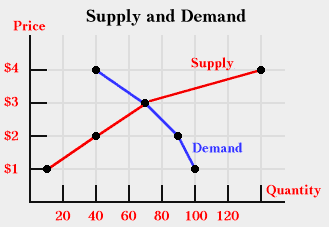
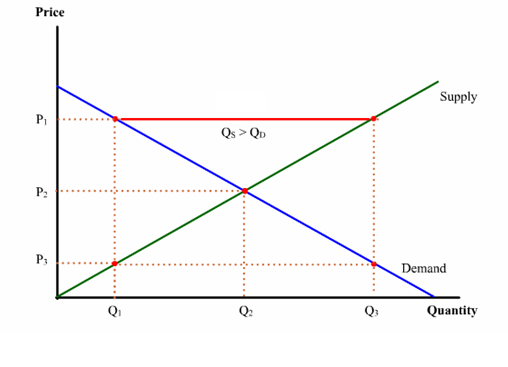
The equilibrium price of a good occurs if the
quantity of the good demanded equals the quantity of the good supplied
quantity of the good demanded is greater than the quantity of the good supplied.
quantity of the good demanded is less than the quantity of the good supplied.
demand for the good is greater than the supply of the good
price of the good seems reasonable to most buyers
What is the purpose of expansionary fiscal policy?
To decrease the money supply and slow down economic growth during a recession
To reduce government spending and decrease aggregate demand during a recession
To increase taxes and reduce consumer spending during an economic downturn
To stimulate economic growth and increase aggregate demand during a recession or economic downturn.
Describe the tools that the government can use to implement fiscal policy.
Raising interest rates
Reducing government debt
Printing more money
Taxation, government spending, and transfer payments
Explain the difference between expansionary and contractionary monetary policy.
Expansionary monetary policy has no effect on the money supply
Contractionary monetary policy increases the money supply
Expansionary monetary policy decreases the money supply
Expansionary monetary policy increases the money supply, while contractionary monetary policy decreases the money supply.
Discuss the relationship between the Phillips curve and the trade-off between inflation and unemployment.
The Phillips curve has no relationship with inflation or unemployment.
The Phillips curve shows the trade-off between GDP and inflation.
The Phillips curve shows the trade-off between inflation and unemployment.
The Phillips curve only applies to the relationship between interest rates and inflation.
Which of the following will shift the aggregate demand curve to the right?
A report that corporate earnings were lower than expected
An increase in interest rates caused by a tightening of monetary policy
Increased imports caused by appreciation of the dollar
Increased spending by businesses on computers
An increase in the government’s budget surplus
To close an inflationary gap in the short run, the government should
decrease spending and increase taxes
buy bonds and lower the discount rate
sell bonds and raise the discount rate
increase spending and decrease taxes
increase spending and increase taxes
an increased household saving rate
Spending on education/training (develop human capital); Infrastructure spending (develop physical capital); Production/Investment incentive programs (supply-side policies)
Government policies to promote long-run economic growth
Government practice of spending more than it takes in from taxes
the relationship between unemployment and inflation
government policies that seek to promote economic growth by affecting short-run and long-run aggregate supply
What type of Unemployment is represented here?
Scenario: The economy is on the decline causing businesses to lay off employees
Cyclical
Seasonal
Structural
Frictional
You have the least amount of control over this since it is based on the ups and downs of the business cycle.
frictional unemployment
seasonal unemployment
cyclical unemployment
structural unemployment
An increase in the price level will most likely cause which of the following?
An increase in the real interest rate
An increase in the demand for money
A decrease in the nominal interest rate
An increase in the supply of money
How is nominal GDP calculated?
Use the current year's prices to calculate the value of the current year's output
Calculate the % change from one year to another
Calculate the amount of taxes citizens pay
Calculate the total amount of goods bought within the year
The relationship between the value of a country's exports and the value of its imports.
Trade Deficit
Trade Surplus
Balance of Trade
Balance of Payments
The variables on the vertical and horizontal axes of the aggregate demand and supply graph are
the price level, real output.
real output, employment.
employment, the inflation rate.
the value of money, the price level.
Which of the following will shift the aggregate demand curve to the right?
A report that corporate earnings were lower than expected
An increase in interest rates caused by a tightening of monetary policy
Increased imports caused by appreciation of the dollar
Increased spending by businesses on computers
An increase in the government’s budget surplus
Taxing and Spending are tools of
Fiscal Policy
Monetary Policy
Taxing & spending to help the economy grow is referred to as
expansionary policy
monetary policy
contractionary policy
budget deficit
Taxing & spending to slow the economy is referred to as
budget surplus
monetary policy
contractionary policy
budget deficit
A shift in long-run economic growth is affected by all of the following EXCEPT -
physical capital
technology
human capital per worker
breaks you take
Which of the following forms of unemployment makes up a nation's "unemployment rate"?
Frictional Unemployment
Seasonal Unemployment
Structural Unemployment
Cyclical Unemployment
The (fill in the blank) is the percentage of bank deposits that the bank must keep in its vault
actual ratio
reserve requirement
spending mutliplier
fifteen percent rule
The amount of money the bank has available to lend
excess reserves
required reserves
actual reserves
navy reserves
deposits are 100,000, RR=10%, no loans have been made, how much money does the bank have available to lend?
80,000
60,000
10,000
90,000
RR=10%, deposits are 50,000. What are the required reserves?
8,000
500
5,000
50,000
Banks create money when -
They make loans
They keep all excess reserves
The money multiplier is less than 1
The loans they make are repaid
The major difference between real and nominal gross domestic product (GDP) is that real GDP
excludes government transfer payments
excludes imports
is adjusted for price-level changes using a price index
measures only the value of final goods and services that are consumed
measures the prices of a market basket of goods purchased by a typical urban consumer
Expansionary fiscal policy includes
Decreasing government spending
Tax increases
Tax decreases
Increasing government spending
Contractionary fiscal policy includes
Decreasing government spending
Tax increases
Tax decreases
Increasing government spending
There is a rise in interest rates for people and businesses to borrow money...
AD shifts right
AD shifts left
AS shifts right
AS shifts left
The government reduces taxes for small businesses...
AD shifts right
AD shifts left
AS shifts right
AS shifts left
Which of the following will shift the aggregate demand curve to the right?
A report that corporate earnings were lower than expected
An increase in interest rates caused by a tightening of monetary policy
Increased imports caused by appreciation of the dollar
Increased spending by businesses on computers
An increase in the government’s budget surplus
Type of unemployment that occurs when people take time to find a job.
Seasonal Unemployment
Structural Unemployment
Frictional Unemployment
Cyclical Unemployment
Someone buys a car in exchange for a large amount of money. They have completed an exchange in which part of the circuclar flow model?
Product Market
Factor Market
Firms
Individuals
In the context of the circular flow model, firms (businesses) sell goods and services in the:
Factor market
Product market
Government sector
International market
when annual government spending and transfer payments are greater than tax revenue.
Budget Deficit
Budget Surplus
National Debt
Global Debt
is the accumulation of all the budget deficits over time.
Budget Deficit
Budget Surplus
National Debt
Global Debt
The nation of Johnsrudia has a marginal propensity to consume (MPC) of 0.9
If there is an autonomous increase in new home construction of $10 billion, what will happen to real gross domestic product (GDP)?
Real GDP will increase by exactly $9 billion
Real GDP will increase by exactly $10 billion
Real GDP will increase by less that $9 billion
Real GDP will not change
Real GDP will increase by more than $10 billion
The multiplier effect shows
How spending is magnified in the economy
How much consumers can spend from their paychecks
How much the government can spend from their budget
How often the economy can survive recessions
Which of the following equations is correct?
MPSMPC=1
Multiplier = MPC1
MPS = MPC
MPC + MPS = 1
If the spending multiplier is 5, the value of the tax multiplier must be
5
4
-4
-5
In the the Nation of Eagleton, a increase in government spending of $20 billion results in an increase in gross domestic product (GDP) of $80 billion. Thus, in Eagleton the MPC is _____ and the value of the multiplier is _______.
0.80; 5
0.75; 4
0.80; 4
0.9; 10
Does increasing the money supply cause inflation or deflation?
Inflation
Deflation
An increase in government spending will affect the demand for money and nominal interest rates in which of the following ways?
MD : Increase
NIR : Increase
MD : Increase
NIR : Decrease
MD : Increase
NIR : Indeterminate
MD : Decrease
NIR : Increase
If exports from the United States decreased, what would most likely happen to real gross domestic product and price level?
Real GDP / Price Level
If the Mexican Peso depreciates in relation to the Chinese Yuan, how is Mexico affected?
Mexico has less purchasing power in Chinese currency
Mexico benefits from increased purchasing power
Mexico would have more Chinese investors
They would be invaded by China
If the US $ were to appreciate in relation to the Euro, what effect would this have?
European consumers would have more purchasing power in US
US consumers can buy more European goods and services for fewer $$
US consumers can buy more English goods and services for fewer $$
European tourists to the US will spend more $$
In 2009 the exchange rate of the Singapore dollar changed from 1.49 = 1 US dollar to 1.43 Singapore dollars = 1 US dollar.
How would this affect the import prices and export prices for Singapore?
decrease/decrease
decrease/increase
increase/decrease
increase/increase
An appreciation of a country's currency means that for foreigners this country's goods are
Cheaper
More expensive
What would cause AD to decrease and shift left?
Which of the following equations represents Aggregate Demand
GDP = X + I + C + (Y - Z)
GDP = C + I + G + (X - M)
GDP = C + I + X + (G - T)
GDP = (1/MPS)*G + I + C
Crowding out occurs when investment declines because
a budget deficit causes interest rates to rise.
a budget deficit causes interest rates to fall.
a budget surplus causes interest rates to rise.
a budget surplus causes interest rates to fall.
(M x V = P x Y)
quantity theory of money
the idea that changes in the money supply
relationship between the unemployment rate and the inflation rate
velocity of money
Net Exports
Considers ALL international transactions
Exports – Imports
Inflow > Outflow
Includes only goods and service
Inflow < Outflow
A decrease in price level in the U.S. relative it its trading partners will cause the U.S. dollar to __________ on the foreign exchange market, and Americans will __________ the purchase of foreign made goods.

Based on the Required Reserves that Reserve Ratio must be
5%
10%
20%
19%
none of the above

The reserve ratio here is....
10%
20%
5%
27%
25%
People who are helped by inflation. Pick 2.
Borrowers
Lenders
A business where the price of the product increases faster than the price of resources
Savers
What is the relationship between money supply and nominal GDP?
Nominal GDP is inversely related to the money supply
Nominal GDP is unaffected by the money supply
Nominal GDP tends to rise with the money supply
Nominal GDP tends to fall with the money supply

Which of the following would likely cause the supply curve of gasoline to shift right?
Political instability in OPEC nations
Increased taxes on oil corporations
New oil deposits found in the Gulf of Mexico
The Federal Reserve raises interest rates
Which of the following is considered the most liquid asset?
Real estate
Stocks
Bonds
Currency (cash)
when annual government spending and transfer payments are greater than tax revenue.
Budget Deficit
Budget Surplus
National Debt
Global Debt
Which of the following will cause the short-run Phillips curve to shift to the right (up)? (CHOOSE 2)
a positive supply shock
a positive demand shock
an increase in inflation expectations
an increase in oil prices
a decrease in government spending
Laws that reduce unemployment and increase GDP (Close a Recessionary Gap).
Increase Government Spending.
Decrease Taxes (Increasing disposable income).
Combinations of the Two.
Expansionary Fiscal Policy
Contractionary Fiscal Policy
Deficit Spending
Inflation Policy
Laws that reduce inflation, decrease GDP (Close an Inflationary Gap).
Decrease Government Spending.
Increase Taxes (Decreasing disposable income).
Combinations of the Two.
Expansionary Fiscal Policy
Contractionary Fiscal Policy
Deficit Spending
Inflation Policy
During a recession, the Fed should use...
an expansionary policy
a contractionary policy
During an expansion, the Fed should use...
an expansionary policy
a contractionary policy
the action by the FED to adjust the size of the money supply, and to adjust interest rates in order to keep prices down and employment high.
fiscal policy
monetary policy
What is the main difference between the short-run and the long-run in economics?
In the short-run, potential production is considered, while in the long-run, current production is the focus.
In the short-run, some variables are fixed, while in the long-run, everything is variable.
In the short-run, the economy is self-correcting, while in the long-run, demand and supply forces adjust to full employment.
In the short-run, the economy is stable, while in the long-run, it is volatile.
What is the formula for calculating the multiplier?
1 / (MPC - 1)
1 / (1 + MPC)
1 / (MPC + 1)
1 / (1 - MPC)
What is the balanced budget multiplier when equal changes in government spending and taxation lead to an equal change in income?
0.5
2
1.5
1
What is the term for the gap between where GDP currently is and where GDP would be at full employment assuming that the economy is currently underperforming?
Recessionary gap
Equilibrium gap
Inflationary gap
Stimulus gap
Assume there is an initial change in spending of $60,000. What is the potential total change in spending/income? MPC = 0.80
$75,000
$400,000
$300,000
$60,000
Generally speaking, inflation is beneficial to ________ and harmful to _________.
sole proprietors; partnerships
lenders; borrowers
government; individuals
borrowers; lenders
If the federal government decreases its expenditures on goods and services by $10 billion and decreases taxes on personal incomes by $10 billion, which of the following will occur in the short-run?
The federal budget deficit will increase by $10 billion.
The federal budget deficit will decrease by $10 billion.
Aggregate income will remain the same.
Aggregate income will increase by up to $10 billion.
Aggregate income will decrease by up to $10 billion.
the degree of wealth and material comfort available to a person or community
Exchange Rate
Gross Domestic Product
Standard of Living
Literacy Rate
Phillips Curve
an increase in the demand for loanable funds
a decrease in the demand for loanable funds
an increase in the supply of loanable funds
a decrease in supply of loanable funds
no change in the supply of loanable funds
According to the quantity theory of money, if the money supply is $20 billion, real output is $50 billion, and the price level if 0.6, what is the velocity of money?
1.25
3
1.5
3.5

The shift in the graph would cause
a US trade deficit.
an increase in American tariffs.
speculators demanding more pesos.
an appreciation of the dollar.
inflation in the US.

A bank's reserves over and above its required reserves.
bank run
excess reserves
monetary base
bank reserves
The difference between imports and exports for a country is called the:
the balance of trade
the balance of payments
trade surplus
payment surplus
When the value of exports is greater than the value of imports, then it is known as _____________.
Trade Surplus
Trade Deficit
Trade Equilibrium
BOP Deficit

