
 Worksheets
физика 1-50
Total questions: 57
Worksheet time: 29mins
What type of motion do the written formulas below refer to?
decelerated
uniform
uniformly accelerated at v₀≠0
uniformly decelerated at vt=0
uniformly accelerated at v₀=0
Specify the dimension of the angular velocity unit in the SI system?
rad
m/s
m/s²
rad/s
rad/s²
In what case can the body be taken as a material point? If:
The mass of the body can be neglected
The size and shape of the body can be neglected in this problem
the momentum of the body is negligibly small
the deformation of the body can be neglected
Neglect the interaction
Mechanical movement is
A motion in which the speed remains constant
All points of the body describe identical trajectories
A change in the relative position of a body in space over time
A motion in which all points of the body move in a circle, the centers of which lie on the same line
A motion in which the speed increases
The line described by the moving point in space is called
Movement
Angular movement
Radius - vector
Trajectory
Vector
The vector connecting the initial and final position of the point at its movement is called:
Radius - vector
Displacement of a point
Traveling path
Trajectory
Speed
The path traversed by the body in uniform movement is determined by the formula:
S=vt
S=V0t-at^2/2
S=V0t+at^2/2
S[V(t)dt
s=gt^2/2
Uniform speed is determined by the formula
v=v0-at
_ _
V=dr/dt
V=S/t
v=vo+at
_
V=dS/dt
The body moves around the circle at a constant modular speed. How will the centripetal acceleration of the body change if the velocity is doubled if the radius of the circle remains unchanged?
will decrease by 2 times
will not change
will decrease by 4 times
will increase by 2 times
will increase by 4 times
The value of tangential acceleration can be determined by the formula:
_..._.........
a =dv/dt
a=v2/R
a=dv/dt
a=/kjfukukgnfgh
a=const
The value of the normal acceleration can be determined by the formula
_..._.........
a =dv/dt
a=v2/R
a=dv/dt
a=/kjfukukgnfgh
a=ER
The linear velocity of the material point at curvilinear motion is doubled. Radius of curvature halved. How has аn changed?
increased by 4 times
decreased by 4 times
increased by 8 times
no change
increased by 2 times
The full acceleration of a point is determined by the formula
a=dv/dt
a=v2/R
a=ER
a=W2R
a=/(du/dt)2+(v2/R)2
The rotation angle of the rotating body is changed by law u=3t^2-2t+5 . How does the body spin?
dw/dt<0
dw/dt>0
dw/dt=0
du/dt=const
w=const
Specify the formula corresponding to the definition of angular speed
E=dw/dt
a=w2R
w=du/dt
E=a/R
w=v/R
Specify the speed dimension:
T
LT-2
L
LT-1
L-1T
Specify the acceleration unit in SI:
m/s
m/s²
kg∙m/s
kg∙m/s²
m-¹∙s-¹
The rotation angle of the disc changes according to the law . Find the linear velocity of the A point of the disc after 0.25 s after the start of the motion if its distance from the rotation axis R=0.5m.
5 m/s
2 m/s
0, 5 m/s
0, 25 m/s
1 m/s
At what speed will the body move 5 s after the beginning of the free fall? Take g=10 m/s²
125 м/с
250 м/с
10 м/с
50 м/с
5 м/с
What is the path of the body in free fall for 5s?
250 m
50 m
10 m
100 m
125 m
The train is moving at a speed of 36 km/h. If you turn on the current, the train, moving equidistant, stops after 20 s. Find the acceleration of the train
а = -0, 5 m/s²
а = -2 m/s²
а = 4 m/s²
а = 1 m/s²
а = -3 m/s²
The dependence of the path traversed by the body S from time t is given by equations where A= 2 m/s, B=3 m/s2, C=4 m/s3. Find the distance the body traveled two after the beginning of the movement.
S = 10 m
S = 24 m
S = 25 m
S = 30 m
S = 40 m

Which of the marked lines is the graph of the path of equal accelerated motion?
1
2
3
4
3.2
What is the equation for uniform movement? (r-vector of movement)
dr/dt=f(t)
dr/dt=0
dr/dt=const
dr/dt≠const
dS/dt=0

Which of the selected points on the speed chart corresponds to the movement with the least acceleration?
1
3
4
2
5

At which of the indicated values of tangential a(t) and a(n) normal acceleration the body will make an uneven linear movement?
a(t)=0 ; a(n)=0
at≠p ; an≠0
at=0 ; an≠0
at≠0 ; an=0
at=const ; an=const
The equation for the movement of a point is given by the expression: x=(t2 +2)m . Determine the average speed in the interval of time (0-1) s.
3 m/s
1 m/s
1, 5 m/s
2m/s
2, 5 m/s
The equation of motion of a point is given by an expression x=t3/3 . Determine the acceleration at time t=5 s.
5, 4 m/s²
5 m/s²
10 m/s²
3 m/s²
0.
Specify the value of the angle between the vectors of the angular and linear velocities of any point of the solid rotating around the fixed axis.
0
180o
70o
90o
может быть любой
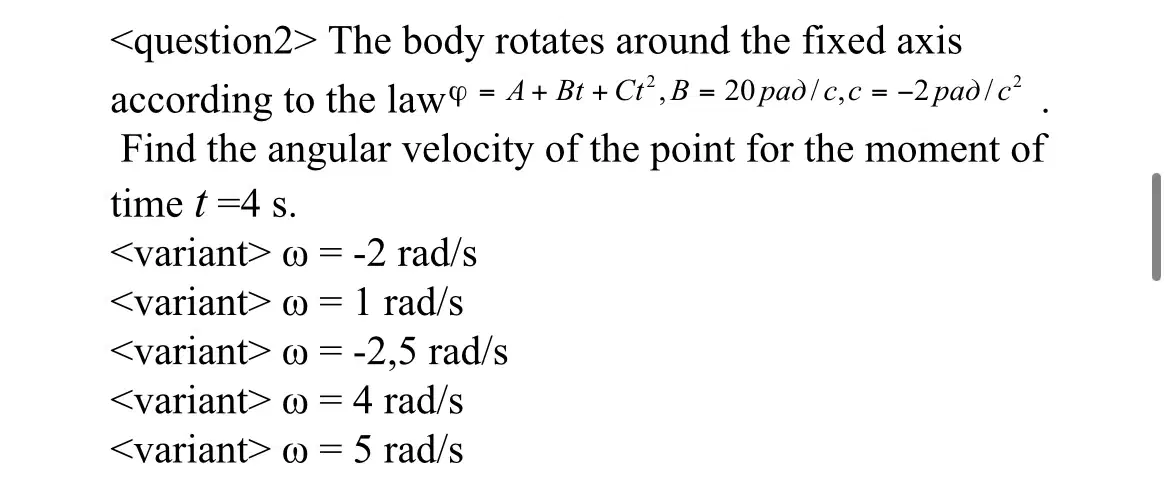
.
ω = -2 rad/s
ω = 1 rad/s
.ω = -2,5 rad/s
,ω = 4 rad/s
.ω = 5 rad/s
The wheel, rotating equinally, reached the angular speed ω = 20 rad/s after N = 10 turns the beginning of rotation. Find the wheel’s angular acceleration
ε = -3 m/s²
ε = 4 m/s²
ε = 5 m/s²
ε = 1 m/s²
ε = 3,2 m/s²
Find the angular velocity of the minute hand on the clock.
3 m/s
4 m/s
5 m/s
2 m/s
1,74∙10⁻³ m/s
What movement a point makes if its equation of motion is given in parametric form and has the form x=a., y=Bt3 . a and B-constant numbers.
rectilinear uniformly accelerated
rectilinear accelerated
rectilinear, uniform
curvilinear
rectilinear
The kinematic equation of the motion of the material point along a line has the form x=A+Bt+Ct3 where A=4м,B=2м/c,C=-0,5м/с2 . For the moment of time t = 2 s determine the instant speed
2∙10³ m/s
-4 m/s
4∙10³ m/s
4 m/s
4,5 m/s
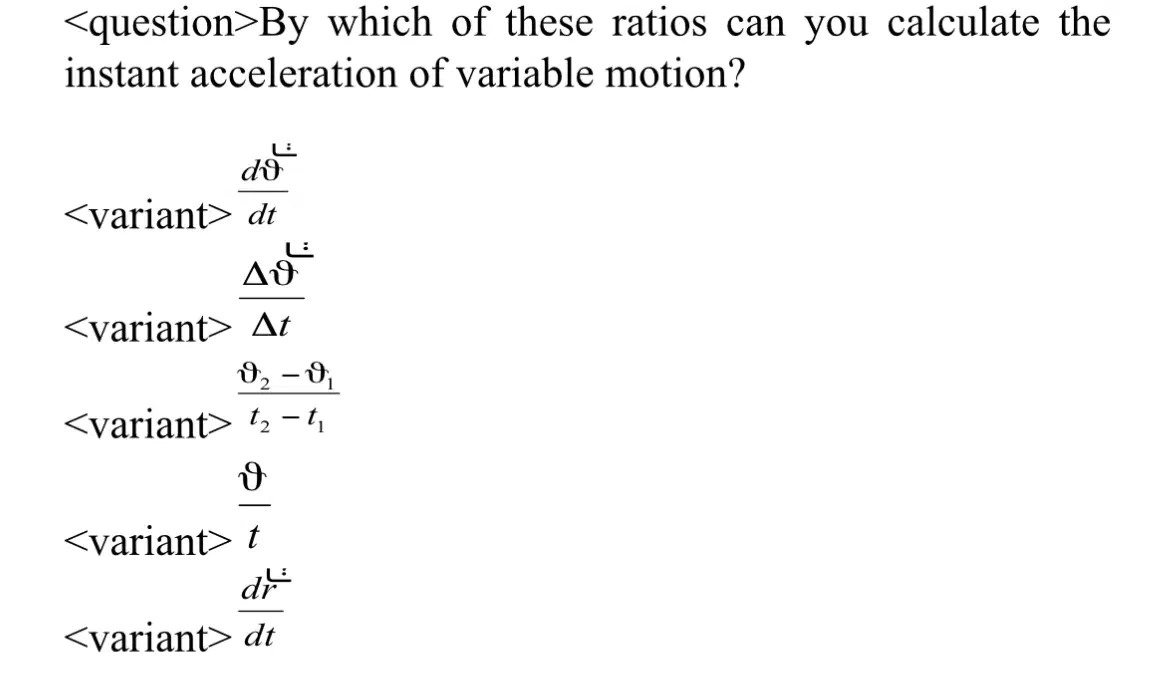
By which of these ratios can you calculate the instant acceleration of variable motion?
1
2
3
4
5

.
2,5 м/с
3 м/с
4 м/с
8 м/с
2*102m/s
What is the nature of rotation of the solid around the fixed axis if the angle between the angular velocity vector and the angular acceleration vector is zero?
.uniform
slowed
uniformly accelerated
uniformly slowed
.accelerated
The body is thrown horizontally. How will the horizontal component of the speed change in the process of movement? (air resistance neglected)
Remains unchanged
Decreases
Increases
Extreme value passes
Changed
Which of the above kinematic values is the same for all points of a absolutely solid body rotating around a fixed axis?
linear movement
angular velocity
angular acceleration
linear speed
linear acceleration
At what speed does the body move 4 seconds after the beginning of the fall? For free fall acceleration g=10 m/s2
160 m/s
2,5 m/s
80 m/s
120 m/s
40 m/s
Initial free-fall body speed is zero, free-fall acceleration g=10 m/s2. How far would the body go in six seconds?
60 m
360 m
0,6 m
120 m
180 m
Swimmer swims along the river. The speed of the river flow is 0.5 m/s, the speed of the swimmer relative to the river is 1.5 m/c. What is its speed relative to the bank?
1 m/s
2 m/s
1,5 m/s
0.5 m/s
2,5 m/s
Body thrown vertically upwards, fell after 5 seconds. To what height was it thrown?
49 m
122,5 m
112 m
30,6 m
70 m
Two cars move according to equations: x₁=t2+2t; x₂=7t+6. When and at what distance do they meet?
x= 4m, t= 4s
x= 148m, t= 16s
x= 1m, t= 1s
x= 24m, t= 8s
x=48m, t= 6s
What is the nature of the movement of the material point if the sum of the forces applied to it is zero?
Accelerated
Slow motion
Uniform
Uniformly accelerated
Uniformly slow

Which of these expressions determines the average acceleration?
1
2
3
4
5
The movement of the material point is given by equation x=2t2+6 . With what acceleration does the point move ?
2 m/s2
8 m/s2
-2 m/s2
4 m/s2
0
Specify the equation corresponding to the equal accelerated motion of the body.
x=3t
x=2t2+4
x=3t3+8
x=2t+4
x=3t+2
How fast does the body move in 8 seconds after the beginning of the fall ?
80 m/s
40 m/s
160 m/s
120 m/s
2,5 m/s
What is the formula used to determine the path the body has travelled in a straight and uniform movement ?
S=V₀t+at2/2
S= V₀+at
S=V*t
S=gt
S=аt
The oscillation equation has the form: X= А coswt, where . Determine the period of oscillation.
1,5 s
2,5 s
1 s
3 s
2 s
How will the period of oscillation of a mathematical pendulum change if it is moved from the Earth to the Moon? The acceleration of gravity on the Moon is 1.6 m/s^2, and on Earth 9.6 m/s^2.
will decrease by a түбір асты 6 factor.
will not change.
will increase 6 times.
will increase түбір асты 6 by times.
will decrease by 6 times.
Select the formula for the logarithmic damping decrement:
Q = ln(p/d)
lnx = x₀sinwt
(лямбада) l = ln(v T)
lnw = ln(2p/T)
d = ln A(t)/A(t+T)
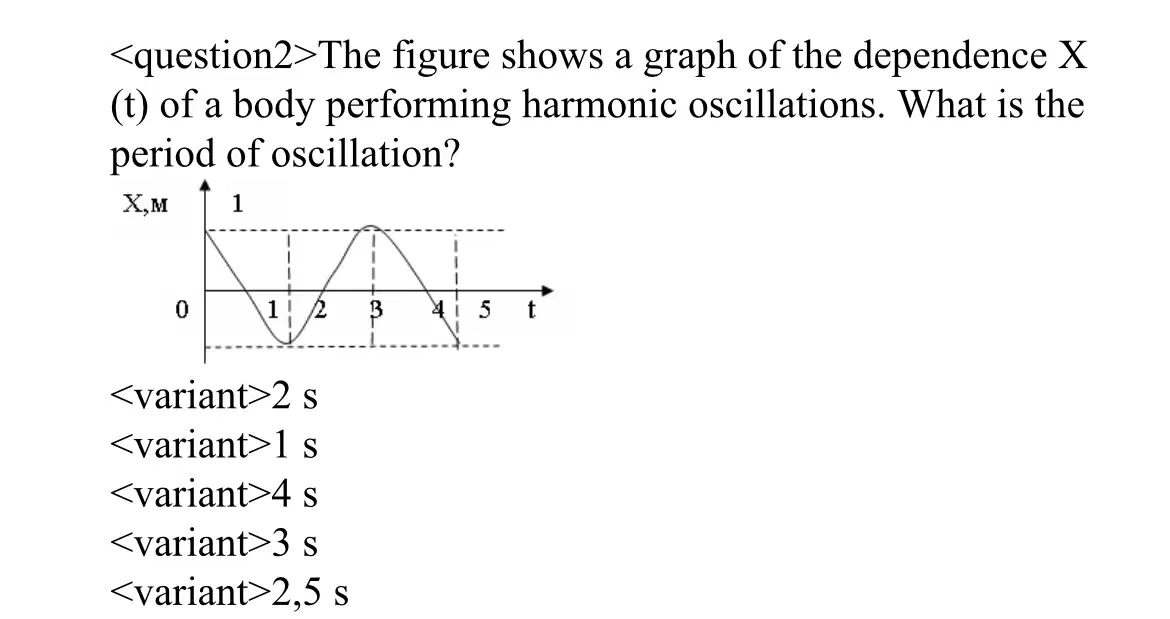
The figure shows a graph of the dependence X (t) of a body performing harmonic oscillations. What is the period of oscillation?
2 s
1 s
3 s
2,5 s
4 s
Two identically directed harmonic oscillations of the same period with amplitudes A₁ = 10 cm and A₂ = 6 cm and initial phases фи(1) and фи(2) add up into one oscillation with amplitude A = 14 cm. Find cos(U01 - U02) of the added oscillations.
1/3
1/4
1/6
1
1/2
Determine the displacement from the equilibrium position of a material point performing harmonic oscillations according to the equation:
х=0,06.cos(Пt/3+П/6), m after 0.5 s from the start.
2 cm
1 cm
0,03 m
0,06 m
түбір асты 3/2 cm
Select ultrasonic vibration frequency
20 Hz
< 20000 Hz
>20000 Hz
25 Hz
2000Hz

