
 Worksheets
Elementary Science: States of Matter
Total questions: 52
Worksheet time: 36mins
What are the three states of matter?
solid, liquid, gas
vapor
plasma
solidus
Which state of matter has a definite shape and volume?
solid
plasma
gas
liquid
In which state of matter do particles have the most energy?
Plasma
Liquid
Gas
Solid
What is the process of changing from a solid to a liquid called?
melting
evaporation
freezing
solidifying
What is the process of changing from a gas to a liquid called?
solidification
evaporation
sublimation
condensation
What is the process of changing from a liquid to a gas called?
Solidification
Condensation
Vaporization or Evaporation
Sublimation
What happens to the particles in a substance when it changes from a solid to a liquid?
Particles gain enough energy to overcome forces holding them in a fixed position.
Particles shrink in size
Particles lose energy
Particles stop moving
What happens to the particles in a substance when it changes from a liquid to a gas?
The particles gain energy to break free and become a gas.
The particles change color and become a gas.
The particles lose energy and become a gas.
The particles decrease in size and become a gas.
What is the term for the point at which a solid turns into a liquid?
freezing point
melting point
solidification point
boiling point
What is the term for the point at which a liquid turns into a gas?
Melting point
Freezing point
Boiling point
Condensation point
If I add heat to a solid, how will the motion of the particles be affected?
They will move slower
They will stop moving
They will move faster
They will move to a different container
Which process could cause a material to change state from gas to liquid?
Adding heat
Adding energy
Removing particles
Removing energy
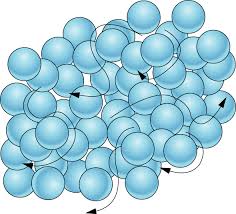
Which of the following statements is true regarding the particle structure of liquids? Particles of a liquid are:
very close together, so the liquid cannot easily change its shape.
fast-moving, so they fill the volume of their container.
relatively close together, so they cannot be easily compressed.
very far apart, so they have plenty of room to move around.
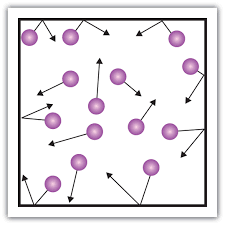
A gas typically consists of:
low energy particles that experience high attractive forces between them.
low energy particles that experience no attractive forces between them.
high energy particles that experience high attractive forces between them.
high energy particles that experience little attractive force between them
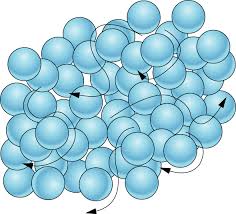
Which is not true about the liquid state of matter?
The liquid state has a definite volume and a definite shape.
The liquid state takes on the shape of its container.
The liquid state has a definite volume and an indefinite shape.
The particles in a liquid can easily move past each other.
Carbon dioxide, nitrogen, oxygen, and hydrogen are this state of matter at room temperature.
Solid
Liquid
Gas
Plasma
This state of matter has a firm, unchanging physical structure.
Solid
Liquid
Gas
Plasma
This state of matter expands to fill its container.
Solid
Liquid
Gas
Plasma
This state of matter has a constant volume, but fits the space of the container holding it.
Solid
Liquid
Gas
Plasma


Tell what state of matter is the object.
soy sauce
solid
liquid
gas

Tell what state of matter is the object.
door
solid
liquid
gas

Tell what state of matter is the object.
LPG
solid
liquid
gas

Tell what state of matter is the object.
mango
solid
liquid
gas

Tell what state of matter is the object.
tree
solid
liquid
gas

Tell what state of matter is the object.
balloons
solid
liquid
gas

Tell what state of matter is the object.
wind
solid
liquid
gas

Tell what state of matter is the object.
orange juice
solid
liquid
gas

Tell what state of matter is the object.
bag
solid
liquid
gas

Tell what state of matter is the object.
milk
solid
liquid
gas
Cutting, crushing, melting, and boiling are all examples of what?
physical changes
chemical changes
messes
Law of Conservation of Particles
Which of the following is a Chemical Property?
solubility
flammability
viscosity
melting point
Properties that can only be observed or measured by changing the chemical identity composition of a substance is a
Physical Property
Combustible Property
Chemical Property
Changeable Property

The reactivity of a substance is an example of a
physical property
chemical property

The texture of a substance is an example of a
physical property
chemical property

When a substance tarnishes/rust is an example of a
physical property
chemical property

The color of a substance is an example of a
physical property
chemical property
When matter reacts with fire it is called
toxicity
flammability
oxidation
The ability for energy, such as electricity and heat, to move through an object is known as
conductivity
solubility
mass
volume
Anything that has mass and takes up space
(everything is made of this) is known as
mass
matter
volume
reflectivity

The total amount of matter in an object is known as its
volume
solubility
magnetism
mass

When the physical property of a substance is observed its composition remains the same.
True
False

How a substance reacts to a magnet (attract or repel) is called
solubility
malleability
state of matter
magnetism

The ability of substance to dissolve into another substance is called
magnetism
malleability
solubility
appearance
The way something looks, feels, smells, and tastes are physical properties.
True
False
Is the ability of glass to break a chemical or physical property?
Which of the following is true?
A physical property can only be seen.
A physical property describes how matter can change when exposed to air.
A physical property is something that can be observed about the substance by itself.
A physical property can only be observed when two types of matter interact.

