
NEW
Font size
 Worksheets
2025 Unit 2 - Trace evidence
Total questions: 60
Worksheet time: 1hrs 2mins

Based on the glass fracture provided, which glass impact was created first?

Using the pencil analogy, which layer of the hair shaft corresponds to the paint on the surface?
Using the pencil analogy, which layer of the hair shaft corresponds to the lead?
Using the pencil analogy, which layer of the hair shaft corresponds to the wood?

The spinous cuticle scale pattern in the photograph indicates that the sample originated from
A human
An animal
The hair follicle is dormant and hairs are easily lost / fall out naturally during which stage of the hair life cycle?

Based on the skin cells attached to the follicle, what can you infer about the sample?
The hair fell out naturally
The hair was forcibly removed
The suspect can be traced based on the color pigments present
The passing of evidence, such as fiber, from a victim to a suspect or vice versa is called
polymer
trace evidence
secondary transfer
primary transfer
Fibers are an excellent source of trace evidence because:
they are easily transferred from victim to suspect
they are often overlooked or not seen by a suspect
they can be easily collected and stored without degradation
all of the answers are correct

What type of medulla pattern is shown in the photo?
absent
continuous
uniserial ladder
fragmented
In most animals the medulla is much ___________ than humans
continuous
thinner
dense
thicker

This flattened cuticle scale type, which consist of overlapping narrow scales, are found in human hairs:
Coronal Pattern
Spinous Pattern
Imbricate Pattern
Which of the following answers contains all natural fibers?
cotton, nylon, wool
cotton, polyester, mohair
wool, cotton, silk
coir, spandex, polyester
Which of the following is a synthetic fiber?
coir
silk
cashmere
polyester
In a burn test, these fibers will often melt.
Natural fibers come from:
only animals
only plants
plants or animals
a factory where they are made
The term "Catagen" refers to:
The final stage of hair growth
The outer layer of the hair shaft
The transitional phase where hair growth slows and recedes from the blood supply
A synthetic fiber
the follicle / root
the hair shaft
the tip
the medulla
This is the growing phase, and longest phase of hair growth...
What are the three layers of hair?
Medulla, keratin, cortex
Cuticle, medulla, keratin
Keratin, cuticle, cortex
Medulla, cortex, and cuticle
This feature of hair might be absent in some humans.
cuticle
medulla
cortex

The hair in the picture most likely orginates from
a human
an animal

The following medulla pattern is best classified as
absent
This type of evidence is found in small but measurable amounts.
Physical evidence
Testimonial evidence
Rare evidence
Trace evidence

What kind of medulla is seen in this hair shaft?
Interrupted

The medulla pattern seen in the photograph indicates that this hair most likely originated from
A human
A cat
A dog
A deer

The medulla pattern seen in the photograph indicates that this hair most likely originated from
A human
A cat
A dog
A deer
What is the significance of density in glass comparison and identification?
Density is irrelevant in glass comparison and identification.
Density is only used to determine the color of glass.
Density is used to determine the temperature resistance of glass.
Density is used to determine the composition and type of glass.
Which of the following represents different types of glass?
Tempered, Laminated, and Soda-lime
Transparent, Translucent, and Opaque
Red, Blue, Green, and Yellow
Smooth, Rough, Shiny, and Dull
Which type of glass is most commonly used in home windows and glass soda bottles?
Tempered glass
Soda-lime glass
Borosilicate glass
Laminated glass
Which type of glass is most commonly used for baking because it can withstand high temepratures?
Tempered glass
Soda-lime glass
Borosilicate glass
Laminated glass
This type of glass is made of a double layer of glass held together by a middle layer of polyvinyl butyral (plastic); it is used in car windshields
borosilicate glass
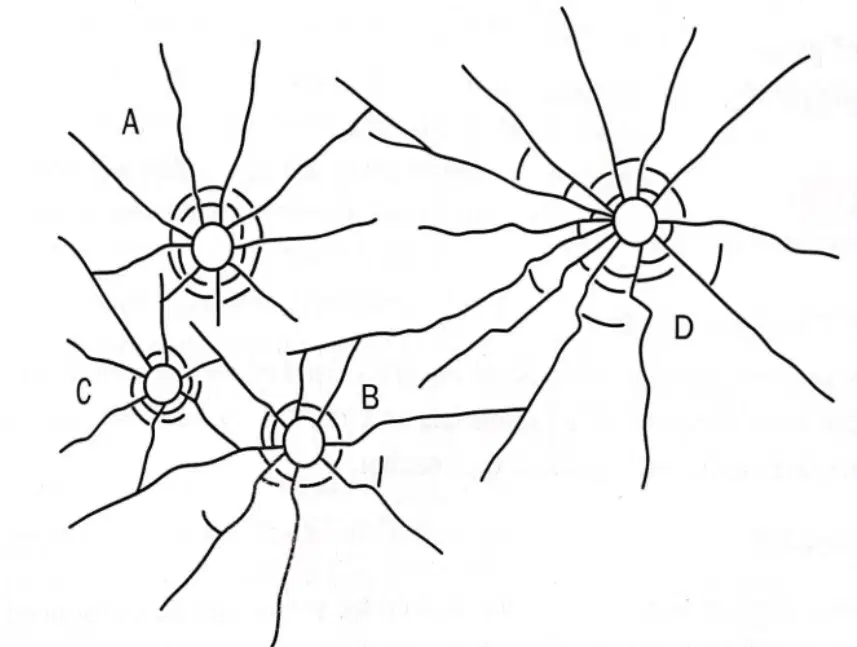
Based on the fracture pattern, which impact occurred first?
A
B
C
D
Automobile paint is often used to solve crime scenes because of it's variability. Investigators compare the _______ of paint to determine if a transfer occured
primer
layers
pigment
refractive index
Besides density, forensic analysts may compare the ________ of glass to determine its composition
primer
layers
pigment
refractive index
The most common plant fiber is:
Hemp
Cotton
Mohair
Wool
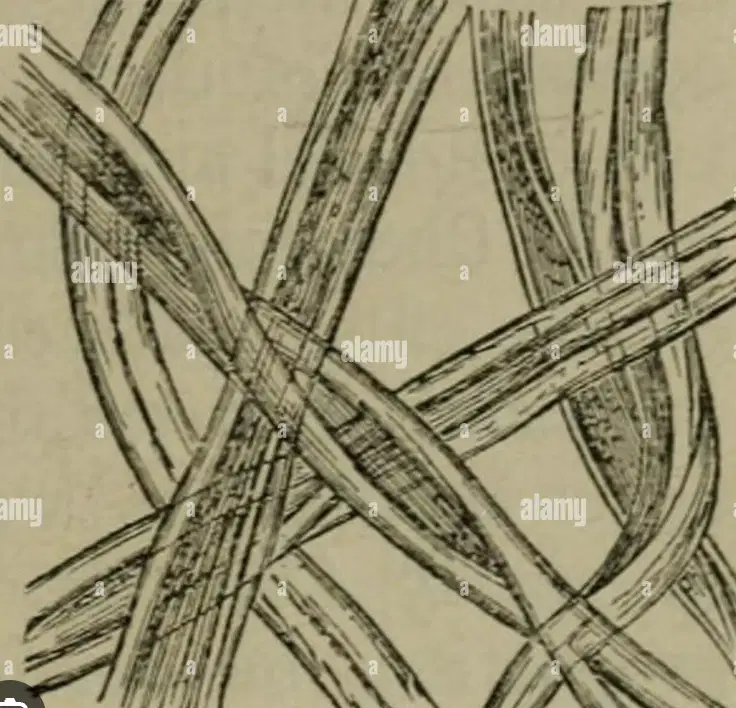
A unique characteristic to cotton is:
under a microscope it looks twisted
it has very regular diameters
it has a medulla like animal hair
it is known for being stretchy
Microscopic examination of hair can best determine
the age of the person it originated from
the gender of the person it originated from
whether or not the hair is from a human or animal
the DNA of the person it orignated from
A forensic scientist performed a density gradient experiment on a piece of glass. The glass floated in water, but sank in isopropyl alcohol. What does this tell investigators?
The density of the glass is less than water but more than isopropyl alcohol
The density of the glass is more than water but less than isopropyl alcohol
The density of the glass is more than both water and isopropyl alcohol
The density of the glass cannot be estimated
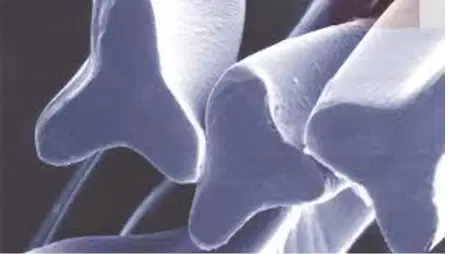
The picture shows the cross section of nylon fibers. How do investigators know that this is a synthetic fiber from the picture?
The cross section of a synthetic fiber depends on the nozzle used in the machine as the plastic is pushed through it
The cross section of a synthetic fiber always has 3 points
The cross section of a synthetic fiber is twisted
What type is paint is most commonly analyzed in forensic cases?
House paint
Automobile paint
Acrylic paint
Watercolor
Automobile paint is often used to solve crime scenes because of it's variability. How many layers of paint will an automotive paint chip have?
2
4
10
20
In trial, what kind of evidence is a hair shaft considered?
direct
class
testimonial
individual
Which of the following statements is not true about fiber evidence?
To determine what it is, you can burn it
Looking under a microscope you can tell if its natural or synthetic
Fibers may originate from plants
Fibers are considered individual evidence
Laminated glass forms which of the following when it is impacted by an external force?
Smooth and concentric cracks
Radial and concentric cracks
Refractive and analytic cracks
Rough and ridged cracks
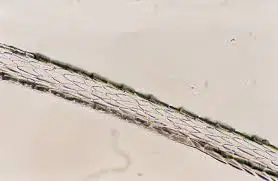
The hair sample most likely originated from
An animal, due to its spinous cuticle scales
An animal, due to its imbricate cuticle scales
A human, due to its spinous cuticle scales
An human, due to its imbricate cuticle scales
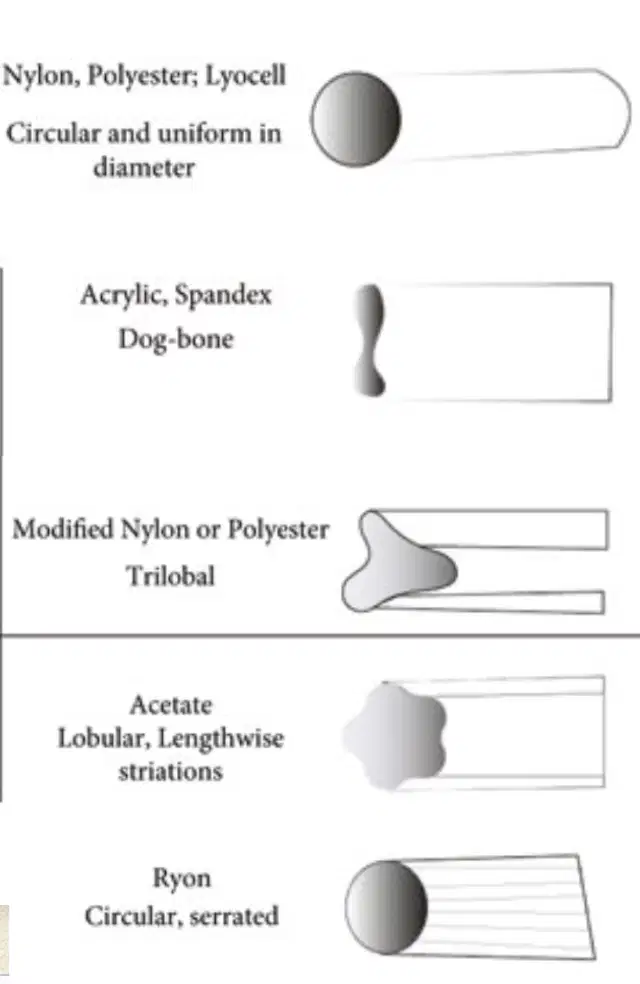
Why do synthetic fibers have uniquely shaped cross sections?
The monomers that make them up also have unique cross sections
They wrap around each other to form intricate patterns
The polymers that make them up take the shape of the element they are composed of
They take the shape of the nozzle they are forced out of during manufacture

Based on the hair samples provided, which statement is correct?
both samples are human hair
the right sample is human hair, the left: sample is animal hair
right sample is animal hair, the left sample is human hair
both samples are animal hair
Which hair phase is the longest?
anagen
catagen
telogen
When looking at paint chips under the microscope - what should you be comparing?
the number of layers, the color sequence, and the thickness of layers
the texture and the trace element concentration
the thickness and pigment composition
which gasses are released during pyrolysis GC and which infrared wavelengths are absorbed during spectroscopy
What is the common medullary index for animal hair?
0
more than .55
less than .3
less than .55
Which of the following lists only synthetic fibers?
wool, cotton, cashmere
polyester, mohair, silk
nylon, jute, coir
rayon, acrylic, nylon
If your microscopes total magnification is 200x, what objective lens are you using?
What is the total magnification of a microscope if you are using an objective lens that is 4x?
100x
If the laboratory can piece broken glass from a window or headlight together (known as a jigsaw match), then the evidence has ___________ characteristics.
identification
comparative
class
individual
What are the steps involved in glass comparison and identification?
Visual examination only
Comparison with other materials
Visual examination, measurement of physical properties, chemical analysis, and comparison with reference samples.
Measurement of chemical properties
What is the difference between radial and concentric fractures in glass?
Radial fractures and concentric fractures are the same thing.
Radial fractures form straight lines, while concentric fractures form circles around the point of impact.
Radial fractures radiate outward, while concentric fractures form circles around the point of impact.
Radial fractures form circles around the point of impact, while concentric fractures radiate outward.
Glass and paint evidence are most commonly found at
Burglary and vehicular crime scenes
Arson investigations
Homicides
Drug raids
Flotation is a method used by scientists to determine the _______ of small pieces of glass.
Mass

