
 Worksheets
Muscle Physiology Quiz
Total questions: 52
Worksheet time: 26mins
What is the primary focus of the sliding filament theory?
The interaction between actin and myosin filaments
The process of muscle relaxation
The role of calcium in muscle contraction
The function of connective tissue
Which of the following is a potential factor in delayed onset muscle soreness (DOMS)?
An influx of enzymes into the fatigued area.
Muscle fiber recruitment
Connective tissue damage
Increased blood flow
What is one of the roles of muscles in integrated body movements?
To produce isolated muscle actions
To stabilise joints
To increase bone density
To store energy
What is a function of connective tissue in the body?
To transmit nerve impulses
To support and bind other tissues
To produce red blood cells
To regulate body temperature
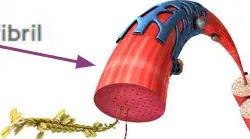
What is the function of the sarcoplasmic reticulum in muscle fibers?
Stores calcium ions
Produces energy
Transports oxygen
Synthesizes proteins
Which structure surrounds the muscle fiber?
Endomysium
Epimysium
Perimysium
Myofibril
What are the two main proteins involved in muscle contraction?
Actin and Myosin
Collagen and Elastin
Keratin and Myoglobin
Hemoglobin and Fibrin
Which layer surrounds the entire muscle?
Epimysium
Endomysium
Perimysium
Sarcoplasmic reticulum
What role do mitochondria play in muscle function?
Energy is released using oxygen (aerobic ATP production occurs here).
They store calcium ions.
They produce lactic acid.
They synthesize proteins.
Which of the myofilaments are thick?
Myosin
Actin
Tropomyosin
Troponin
What structure of the muscle extends to form tendons?
Fascia (epimysium, perimysium, endomysium)
Sarcomere
Myofibril
Myofilament
What are the smallest contractile units of a muscle called (where actin and myosin are found)?
Sarcomeres
Myofibrils
Fascicles
Fibers
How are these contractile units arranged in the myofibril?
In chains along the length of the myofibril.
In parallel layers.
In a spiral pattern.
In random clusters.
What does the sliding filament theory explain?
The process of muscle relaxation
The mechanism of muscle contraction
The function of motor neurons
The role of calcium in the body
What is the 'all or none' law in muscle contraction?
A muscle fiber contracts partially
A muscle fiber contracts completely or not at all
A muscle fiber contracts only under high tension
A muscle fiber contracts only when fatigued
What does the size principle of motor unit recruitment state?
Smaller motor units are recruited first
Larger motor units are recruited first
All motor units are recruited simultaneously
Motor units are recruited randomly
What occurs during the Cocking phase of the sliding filament theory?
ATP primes the myosin head.
Calcium ions are released from the sarcoplasmic reticulum.
Myosin binds to actin.
ATP becomes ADP, releasing energy.
During which phase are calcium ions released from the sarcoplasmic reticulum?
Cocking phase
Binding phase
Power stroke
Re-setting
What happens during the Power stroke phase?
ATP primes the myosin head.
Myosin binds to actin.
ATP becomes ADP, energy is released to make the myosin heads nod and rotate.
ATP binds to myosin heads, releasing them from the actin binding site.
In the Re-setting phase, what binds to the myosin heads?
Calcium ions
Troponin
ATP
ADP
In the rowing a boat analogy for muscle contraction, what do the myosin heads represent?
The boat
The water
The oars
The rowers
What do the actin filaments represent in the rowing a boat analogy?
The boat
The water
The oars
The rowers
In the analogy, what does the action of the boat moving forward represent?
Muscle relaxing
Muscle contracting
Muscle stretching
Muscle tearing
What does the 'all or none' law state about motor units?
Motor units contract partially.
Motor units contract maximally or not at all.
Motor units contract only when fatigued.
Motor units contract randomly.
According to the size principle, how are motor units recruited?
From largest to smallest.
Randomly, regardless of size.
From smallest to largest depending on the force required.
All at once, regardless of size.
Which of the exercises below involves the highest proportion of total motor units
Clean & Jerk
Seated Row
Lat Pull Down
Isolated Supplementary Lifts
Which of the below exercises involves the least motor units?
Maximal Sprints
Bench Press
Isolated Supplementary Lifts
Deadlift
What are the three types of skeletal muscle fibres?
Type 1, Type 2a, Type 2b
Type A, Type B, Type C
Type X, Type Y, Type Z
Type I, Type II, Type III
How do Type 1 muscle fibres differ in characteristic?
Rich in mitochondria, aerobic supply, slow to fatigue
Low in mitochondria, anaerobic activity, quick to fatigue
High force production, poor blood supply, anaerobic
Rich in mitochondria, anaerobic supply, quick to fatigue
How do Type 2a muscle fibres adapt to strength training?
Higher force production, quick to fatigue
Lower force production, slow to fatigue
Rich in mitochondria, aerobic supply
Poor blood supply, aerobic activity
Which of the following is an anterior muscle of the human body?
Biceps brachii
Trapezius
Latissimus dorsi
Gluteus maximus
Which of the following is a posterior muscle of the human body?
Pectoralis major
Rectus abdominis
Trapezius
Quadriceps
What is the role of an agonist muscle in a movement?
It opposes the movement.
It stabilizes the joint.
It is the primary muscle responsible for the movement.
It assists the primary muscle.
Which muscle action is responsible for opposing the movement of the agonist?
Agonist
Antagonist
Synergist
Fixator
What is the function of a synergist muscle?
It opposes the movement.
It stabilizes the joint.
It assists the primary muscle in performing the movement.
It is the primary muscle responsible for the movement.
Which muscle action helps stabilize the joint during movement?
Agonist
Antagonist
Synergist
Fixator
Which muscle role assists the agonist in performing an action?
Synergist
Antagonist
Fixator
Protagonist
What is DOMS?
Delayed onset muscle soreness
Direct onset muscle soreness
Dynamic onset muscle soreness
Diminished onset muscle soreness
What are the symptoms of DOMS?
Muscle pain and stiffness
Joint swelling
Headache and nausea
Fever and chills
What exercises are likely to cause DOMS?
Eccentric exercises
Static stretching
Light walking
Breathing exercises
When is DOMS likely to occur?
24 to 72 hours after exercise
Immediately after exercise
One week after exercise
During exercise
Are there any prevention or recovery strategies for DOMS that may be useful?
Proper warm-up and cool-down
Skipping meals
Avoiding hydration
Increasing workout intensity
Which of the following is a recovery strategy for DOMS?
Cooling down and stretching
Cold treatment
Gradual exercise progression
Gradual introduction of unfamiliar exercises
What is the primary function of ligaments?
Connect muscle to bone
Connect bone to bone
Connect muscle to muscle
Connect skin to muscle
What are ligaments mainly formed by?
Keratin and elastin
Collagen and elastin
Myosin and actin
Keratin and collagen
What role does collagen play in ligaments?
Increases elasticity and stretch
Increases toughness and strength
Decreases flexibility
Provides color
What characteristic of elastin is important for ligaments?
Increases toughness
Increases elasticity and stretch
Decreases flexibility
Provides rigidity
What is a notable feature of ligaments regarding blood supply?
Rich blood supply
Poor blood supply
No blood supply
Variable blood supply
What is the primary function of tendons?
Connect muscle to bone
Connect bone to bone
Connect muscle to muscle
Connect skin to muscle
From where do tendons emerge and where do they insert?
Emerge from bone, insert onto muscle
Emerge from muscle's connective tissue, insert onto bone
Emerge from skin, insert onto muscle
Emerge from bone, insert onto skin
What is a characteristic of the blood supply to tendons?
Rich blood supply
Moderate blood supply
Poor blood supply
No blood supply
What are tendons mainly formed from?
Elastin with some collagen
Collagen with some elastin
Keratin with some elastin
Myosin with some collagen

