
 Worksheets
Great Big AP Exam Review Quiz
Total questions: 147
Worksheet time: 4hrs 33mins
If you walk 5 meters south, 5 meters west, 5 meters north, and then 5 meters east, what is your displacement?
0 m
20 m
15 m
10 m
5 m
.
In the process of delivering mail, a postal worker walks 161 m, due east from his truck. He then turns around and walks 194 m, due west from his truck. What is the worker's displacement relative to his truck?
33 m, due west
33 m, due east
194 m, due west
252 m, due east
A blue car travels 1000 m north and then 1000 m south. The entire trip takes 200 seconds. What is the car's average velocity for the trip?
10 m/s
5 m/s north
5 m/s south
0 m/s
A box slides 30 m at a constant velocity of 20 m/s. How long did the trip take?
600 s
50 s
10 s
1.5 s
You drive 4 km at 36 km/h and then 4 km at 60 km/h. What is your average speed for the whole 8 km trip?
12 km/h
48 km/h
45 km/h
80 km/h
An object's velocity is its (a) divided by (b) .
An object's speed is its (a) divided by (b) .
What are the SI units for velocity in kinematics?
m/min
mi/hr
d/t
m/s
Speed is a __________ quantity and velocity is a __________ quantity.
(a)
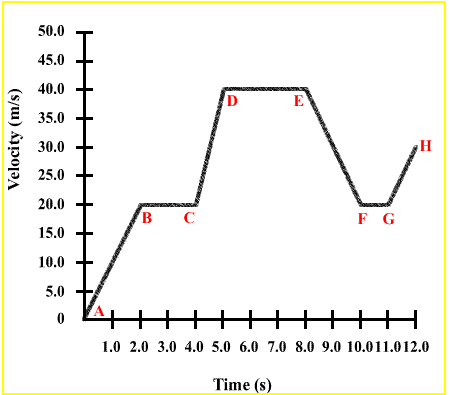
Which section of this v-t graph shows constant velocity?
AB
BC
EF
GH
In which of the following graphs below are both runners moving at the same speed?


Which X vs. T graph corresponds to this V vs. T graph?


If the dots represents 1-second intervals, which of these is the best mathematical model to represent motion map C?
x = (1 m/s)t + 5 m
x = (-1 m/s)t + 5 m
x = (1 m/s)t - 5m
x = (-1 m/s)t + 0m

At what time does this object have a negative velocity?
3 seconds
7 seconds
11 seconds
never
What is the average velocity of the object from 4-12 seconds?
0. 38 m/s
-0.38 m/s
0.63 m/s
-0.63 m/s


In each of the following cases, determine which car has the greatest acceleration magnitude.
starts from 0 m/s to 20 m/s in 4 seconds.
speed up from 20m/s to 40m/s in 3 seconds
slow down from 50m/s to stop in 2 seconds
starts from 0 m/s to 20m/s in 5 seconds
Organize these options into the right categories of motion
Positive velocity, negative acceleration
Positive velocity, positive acceleration
Negative velocity, negative acceleration
Negative velocity, positive acceleration
Positive velocity, zero acceleration
Organize these options into the right categories of motion
Speeding up in the negative direction
Speeding up in the positive direction
Slowing down in the negative direction
Slowing down in the positive direction
Constant speed in the positive direction
Constant speed in the negative direction
A car starts from rest and accelerates uniformly over a time of 5.21 seconds for a distance of 110 m. Determine the acceleration of the car. Choose the appropriate equation.
v = at + vi
Δx=21at2+vit
vf2=2aΔx+vi2
xf=vt+xi
A car is traveling to the right with a speed of 29 m/s when the rider slams on the accelerator to pass another car. The car passes in 110 m with constant acceleration and reaches a speed of 34 m/s. We want to find the acceleration of the car as it sped up. What equation should you choose?
v = at + vi
Δx=21at2+vit
vf2=2aΔx+vi2
xf=vt+xi

What direction should the acceleration vectors point during the positive part of the motion?
in the positive direction
in the negative direction
first positive, then negative directions
first negative, then positive directions

Describe the signs of velocity and acceleration of an object given by this Position-time graph.
velocity = negative, accel = negative
velocity = positive, accel = negative
velocity = negative, accel = positive
velocity = positive, accel = positive


What is the velocity of the object at 5 seconds?
0 m/s
5 m/s
1 m/s
2 m/s

What is the rate of acceleration of the object between 6 and 10 seconds?
0.5 m/s
0 m/s2
-0.5 m/s2
0.5 m/s2

Find the displacement between 3-5 seconds.
2 meters
4 meters
0 meters
1 meter

The unit we use to measure acceleration is ___. Select all that apply.
m/s
m
m/s/s
m/s2
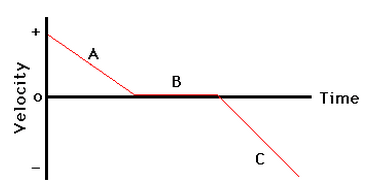
Describe the motion in segment A
Slowing down; Positive direction
Slowing down; Negative direction
Speeding up; Negative direction
Constant velocity; Negative direction
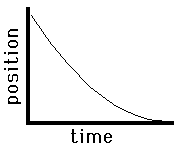
Describe the motion
speeding up; Negative direction
slowing down; Negative direction
slowing down; Positive direction
speeding up; Positive direction

In this velocity vs time graph of an object, in what segment is the object speeding up?
All of them
EF
AB, CD, and GH
BC, DE, and FG
What is happening at C?
What is happening in this graph from point B to C?
The object is speeding up.
The object is slowing down.
In which of the following graphs below are both runners moving at the same speed?
Which section of this v-t graph shows a decreasing velocity?
AB
BC
EF
GH
Which section of this v-t graph shows a decreasing velocity?
AB
BC
EF
GH
A resultant vector is
equal to the sum of one vector.
equal to the sum of two or more vectors.
equal to the difference of one vector.
If two vectors to be added are at right angles, you will need to
just add them together.
use the Pythagorean theorem.
use the Law of Cosines.
subtract the smaller for the larger.

What are the vector components?
(2, 2)
(3, 3)
(3, 2)
(2, 3)

What are the vector components?
(-2, -2)
(-3, -3)
(-3, -2)
(-2, -3)

What vector gives the sum of these two vectors?


At what point is vy= 0 m/s?
A
B
C
D
None of these points
At what point is vx= 0 m/s?
A
B
C
D
None of these points
Which vector pair (arrow pair) correctly represents the acceleration and velocity at point P?


Who do you agree with?
Anita: “A projectile’s vx changes because of gravity, and its vy remains constant.”
Barry: “Both vx and vy are constant.”
Chris: “A projectile has no acceleration in the vertical dimension but it does accelerate horizontally.”
Dave: “A projectile has vertical acceleration and a constant horizontal velocity”

Suppose Lemming A runs off the edge of the cliff at 2 m/s and Lemming B runs off the edge at 1 m/s. Which will hit the ground first?
A
B
Both at the same time
A ball is thrown into the air at some angle, with initial velocities vx (horizontal) and vy (vertical). At the very top of the ball’s path:
What is its velocity in the horizontal direction?
vx
Greater than vx
Zero

A package is dropped from an airplane, where will the package hit the ground?
A
B
C
If a ball thrown straight up into the air takes 4 seconds to reach the top (peak), how long will it take to travel from the peak back to the original position?
0s
1s
3s
4s
If two projectiles are launched at two different heights, 2m and 10m, which one will reach the ground first?
2m
10m
they both will hit the ground at the same time
Once a projectile is launched, what is the only force that affects its motion?
mass
friction
inertia
gravity

The magnitude of the horizontal acceleration of a projectile is (a) m/s2.

If you throw a baseball straight up, its acceleration at the highest point is (a) m/s2.
The fact that an apple and a watermelon, dropped simultaneously from the same height, would hit the ground at the same time indicates that
you don't like apples or watermelons.
greater masses have greater acceleration.
lesser masses have greater acceleration.
acceleration is independent of mass.

A projectile is fired with initial velocity vo at an angle θ0 with the horizontal and follows the trajectory shown above. Which of the following pairs of graphs best represents the vertical components of the velocity and acceleration, v and a, respectively, of the projectile as functions of time t?


A volleyball is served at a speed of 8.0 m/s at an angle 35° above the horizontal. What is the speed of the ball when received by the opponent at the same height?
4.0 m/s
8.0 m/s
9.8 m/s
16.0 m/s

A ball is thrown and follows the parabolic path shown above. Air friction is negligible. Point Q is the highest point on the path. Points P and R are the same height above the ground. How do the speeds of the ball at the three points compare?
vP < vQ < vR
vR < vQ < vP
vQ < vR < vP
vQ < vR = vP
vP = vQ < vR
Sort the following statements by whether true or false about vectors.
Mass is a vector quantity.
The orientation of a vector shows the direction.
The length of the vector represents magnitude.
The vector sum is the resultant.
The length of the vector represents the direction.
Vectors are always at angles under 90 degrees.
A horizontally-launched projectile arcs out and hits the ground below. The vertical displacement and the horizontal displacement are the only variables measured. What is the best equation (written in general form) to use to find the time the projectile was in the air?
Δx =21aΔt2+viΔt
v=ΔtΔx
vf2=2aΔx+vi2
a=ΔtΔv

What is the walker's speed from the observer's perspective?
10 mph
40 mph
50 mph
30 mph
A passenger at the rear of a train traveling at 15 m/s relative to the ground throws a baseball with a speed of 15 m/s in the direction opposite the motion of the train. What is the velocity of the baseball relative to the ground as it leaves the thrower’s hand? In other words: how fast does a person on the ground see the ball move?
30 m/s
15 m/s
0 m/s
20 m/s
When you're in a car, what is your frame of reference?
the car
the road
the Earth
there is none
A ball dropped by a boy walking at a speed of 1 m/s viewed by the boy. What direction is the ball moving relative to the boy?
West
South
Up and down
Stationary
A person standing on a platform viewed from a train traveling north. What is the direction the person is traveling relative to the train?
North
West
East
South
Kinetic Friction acts in a direction __________ to the direction of the object’s motion.
A box is a rest on a ramp. What forces are acting on the box? Select all that apply.
Air Resistance
Gravitational
Normal Force
Friction
Tension
A skydiver is falling through the air at constant speed. What forces are acting on the skydiver? Select all that apply.
Gravitational
Normal Force
Applied Force
Air Resistance
Tension
A 10 kg object is gliding to the left at a steady speed of 8 m/s on a frictionless ice rink. Which of the following free-body diagrams accurately depicts the forces acting on this object, in accordance with Newton's 1st Law?
A diagram showing a net force to the left
A diagram showing a net force to the right
A diagram showing no net force
A diagram showing forces pointing downward and upward but no horizontal forces

The amount of net force required to keep a 5-kg object moving rightward with a constant velocity of 2 m/s is ____.
0 N
0.4 N
2 N
2.5 N
5 N

Ava, James, and Evelyn are having a blast in their physics class, exploring Newton's laws. They've got a cool setup with a toy car of known mass tied to one end of a string, looped over a frictionless pulley, with the other end tied to a hanging mass. The toy car, initially at rest, starts rolling without slipping when released. The wheels of the toy car have negligible inertia. They have all the common laboratory equipment to measure the components of the system.
Feeling adventurous, they decide to double the hanging mass and replace the original toy car with a new one that's twice as heavy. What do you think will happen to the tension in the string and the acceleration of the toy car when both masses are doubled?
The tension and the acceleration will double.
The tension will double, but the acceleration will stay the same.
The tension will stay the same, but the acceleration will double.
The tension and the acceleration will stay the same.
A block is pulled along a surface of negligible friction by a spring scale that exerts a force F on the block. The mass of the block is 4kg, and the spring scale reads 10N. Which of the following free-body diagrams can be used to show the magnitude and direction of all the forces exerted on the block as it is pulled along the surface?


Elijah, Hannah, and Michael are having a friendly competition in an elevator. They are standing on a scale, and they notice that the scale reads 40 newtons greater than their normal combined weight. Which type of movement of the elevator could cause this greater-than-normal reading?
The elevator is accelerating upward
The elevator is accelerating downward
The elevator is moving upward at a constant speed
The elevator is moving downward at a constant speed

Aiden, Aria, and Noah are studying physics. They are discussing a scenario where there is no friction. In such a case, they wonder what the acceleration would be equal to. What do you think?
mg
sin(θ)mg
g
sin(θ)g

James, Abigail, and Anika observe a physics demonstration involving two different cases of a block being pulled by a string. They notice that the blocks accelerate in both cases. However, in Case 2 the block reaches the edge of the table in less time even though the force exerted on the string in this case is the same as the weight of the hanging object in Case 1. How can this be?
This can't be. In both cases 98 N of force are exerted on the string so both blocks should have the same acceleration and reach the edge of the table at the same time.
This is because the tension in the string in Case 1 is less than in Case 2.
This is because Newton's 3rd law states that block M exerts an equal but opposite force on the table as the table does on the block.

By collecting the appropriate data, the students can determine the relationship between the acceleration of the cart and the net force exerted on the cart. Which of the following graphs should the students produce to show the correct relationship?


Michael is helping his friend Elijah move a 46-newton box up an inclined ramp that makes an angle of 25° with the horizontal. What is the magnitude of the component of the box's weight perpendicular to the incline?
19N
21N
42N
26N

Elijah is helping Rohan move a heavy box of weight W along a flat surface at a constant speed v. Elijah is pulling the box with a force F, which he is applying at an angle of θ with the ground. What is the magnitude of the normal force that the surface is exerting on the box?
W - F cosθ
W + Fsinθ
W-Fsinθ
W + Fcosθ
W
Evelyn, Benjamin, and Nora are having a blast at the skate park when they decide to take a break and study some physics. They come across a problem where an object with mass m is placed on a ramp at the skate park, which is at an angle θ above the horizontal ground. They are trying to calculate the component of gravity that is parallel to the ramp. Which formula should they use?
Fg∥ = mg sinθ
Fg∥ = mg cosθ
Fg∥ = μg Fg⊥
Fg∥ = mgtanθ

Aiden is helping Michael move a heavy box of weight W along a flat surface at a constant speed v. Aiden is pulling the box with a force F, which he is applying at an angle Θ with the ground. The force exerted on the box by the ground (also known as the normal force) has a magnitude of_____.
greater than W
greater than 0 but less than W
equal to W
0

Given the net forces on and the masses of the blocks shown above, which two blocks have the same acceleration? Select two answers
Block A
Block B
Block C
Block D

An object slides across a horizontal surface such that it slows down due to the force of friction that is exerted on the object. The object and the direction of its displacement are shown in the figure. Which of the following free-body diagrams could represent the forces that are exerted on the object?
Responses


Identical spheres are dropped from a height of 100 m above the surfaces of both Planet X and Planet Y. The position of the spheres as a function of time is recorded as the spheres fall. These data are shown in the graphs above. Which planet exerts a greater gravitational force on the sphere, and what evidence supports this conclusion?
Planet X, because the object’s final speed is greater.
Planet X, because the object’s time of fall is greater.
Planet Y, because the area under the curve is smaller.
Planet Y, because the magnitude of the slope of the curve increases at a faster rate.
Which of the following is example of Newton’s Third Law:
You jump on a trampoline. it springs you back into the air.
A swimmer pushes against a pool wall to begin swimming a lap.
A rocket’s thrust pushes it out of Earth’s atmosphere
All of these
If you push a skateboard with a force of 8 N and your mass is 80 kg, what is the force that the skateboard exerts on you?
75 N
8 N
7N
10 N
A bus hits a bug, and the bug splatters on the windshield. Which force is greater?
The force on the bus by the bug
The force on the bug by the bus
The forces are the same magnitude.
There is not enough info to figure this out.
Which of the following statements is correct about static friction?
Static friction does not depend on the surface roughness.
Static friction always has the same magnitude for a given object on a given surface no matter what external forces are applied.
Static friction is always parallel to the object-surface interface.
The magnitude of the static friction force depends solely on which horizontal external forces are acting on the object.
You need to move a 105-kg sofa to a different location in the room. It takes a force of 102 N to start it moving. What is the coefficient of static friction between the sofa and the carpet?
1
0.099
0.8
What does the coefficient of friction describe?
How heavy two objects rubbing together are
How fast two objects are rubbing together
How rough or smooth two surfaces are rubbing together
How much inertia two objects rubbing together have
I am pushing a refrigerator really hard to the right. It is not yet moving. Select the true statement.
Since it is not moving, there is no friction on the refrigerator.
There is static friction going to the left the same size that I am pushing
There is static friction going to the left harder than I am pushing
There is kinetic friction going to the left the same size that I am pushing
I push a refrigerator really really hard to the right. It starts to slide. What is true during the slide?
There is no friction since I pushed hard enough to make it slide.
There is kinetic friction opposing motion, pointing to the left.
There is kinetic friction going to the right.
There is static friction opposing motion, pointing to the left.

Two conclusions can be drawn from this graph. Select both.
The blue trial (Col 3) has a larger coefficient of friction than orange.
The orange trial (Col 2) has a larger coefficient of friction than the blue.
Normal force is directly related to friction force.
Normal force is inversely related to friction force.

If a 2N force were applied to the object represented in this graph, the net force would be
0 Newtons
1.5 Newtons
2 Newtons
3 Newtons
If a 2N force were applied to the object represented in this graph, the object would
remain stationary
move with constant velocity
accelerate

When the person pushes on the wall, and the wall pushes back, why does the person move and not the wall?
The wall has more mass
The person is pushing harder than the wall
The wall is pushing harder than the person
The skateboard is pushing on the person
A bus hits a bug and the bug splatters on the windshield, which acceleration is greater?
The Bus
The Bug
They're the same
Gravity acting on the bus
A bus hits a bug and the bug splatters on the windshield, which acceleration is greater?
The Bus
The Bug
They're the same
Gravity acting on the bus


A 10kg car travels at a constant speed of 20.0 m/s around a horizontal circular track. Which diagram correctly represent the direction of the car's velocity (v) and the direction of the net force acting on the car at a particular moment?


a car going around a level curve - identify the force(s) making up the net force. Select all that apply:
static friction
tension
normal force
gravitational force
a roller coaster car at the the top of a hill - identify the force(s) making up the net force. Select all that apply:
static friction
tension
normal force
gravitational force
a car going around a banked curve in icy conditions - identify the force(s) making up the net force:
static friction
tension
the horizontal component of the normal force
gravitational force

A curved groove is place on the top of a level table as shown in the diagram. A ball is pushed in the groove at P so that it leaves at Q. Which picture shows how the ball will move when it leaves the groove at Q?


What happens to the centripetal force exerted on an object if you half the velocity?
it doubles
it halves
it decreases by a factor of 4
it quadruples
As the radius of a spinning object decreases, acceleration
increases
decreases
stays the same
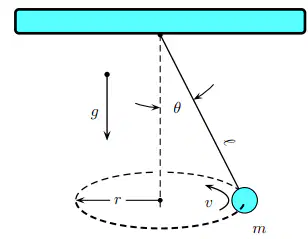
What do the 2nd Law equations look like for a ball swung in a horizontal circle from a ceiling? Assume θ is the angle shown.
Centripetal Direction: (a)
Tangential Direction: (b)
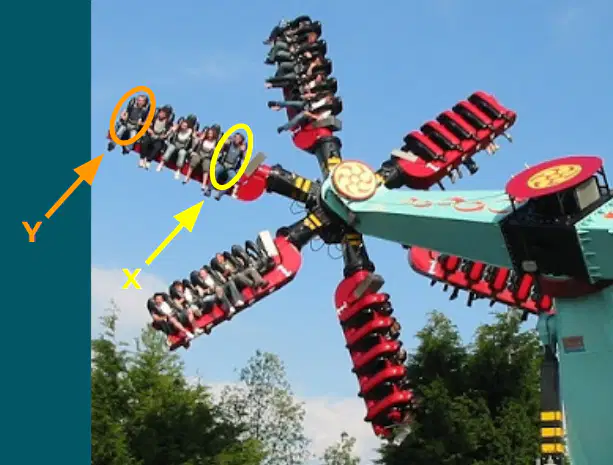
Two riders sit at positions X and Y. Do they have different periods of rotation and why / why not?
No, because they have the same tangential velocity.
No, because they take the same amount of time to complete 1 loop.
Yes, because they have different tangential velocities.
Yes, because they have different masses probably.
Organize these positions on a vertical circle into the right categories.
the bottom of the circle
on the sides of the circle
the top of the circle
NEVER!
For a conical pendulum (i.e. Flying Pig), sort the concepts about forces along x and y-components.
Fnet=rmv2
FT sinθ=rmv2
Fnet=0
FT cosθ=mg
What happens to Gravitational force if I double both of the masses and double their distance?
stays the same
half as big
4x bigger
2x bigger
Which graph represents what happens to Fg between two objects if the distance between them increases?


The picture shows two identical satellites, A and B, in circular orbits around the Earth. Upon which satellite does the Earth exert a stronger gravitational force?
Satellite A
Satellite B
Equal on both
Cannot be determined
If the Earth's mass suddenly tripled but the radius remained the same, what would happen to your weight?
It would also triple
It would be reduced by 1/3
it would be reduced by 1/9
It would remain the same
A moon of Jupiter has nearly circular orbit of radius R and an orbit period of T. Which of the following expressions give the mass of Jupiter? HINT: Start with the centripetal Newton's 2nd Law and derive m.
T24π2R
(GT2)2πR3
(GT2)4πR2
(GT2)4π2R3

You are looking at a top view of a planet orbiting the Sun in a clockwise direction. Which of the following would describe the velocity, acceleration, and force acting on the planet due to the Sun's pull at point P?


The acceleration due to gravity (g) can be calculated for any location using which equation? Assume m1 is the mass of the planet.
Gm1m2
Gm1m2/r2
√(Gm1/r)
Gm1/r2
Organize these concepts based on whether they apply to the following terms. (2 concepts per term)
also called gravitational field strength
only depends on planet's mass and distance squared
always constant
Universal Gravitational Constant
depends on the mass of both objects
quadruples when both masses are doubled
depends on just distance not r squared
describes the minimum speed required to maintain the orbital motion

What are the units of Potential Energy? Select all that apply.
N*m, Newtons*meters
kg, kilogram
J, Joules
m/s, meters/second


A 1000N force pulls a car for 300m to the left. What is the work done by the truck?
-300,000 J
-150,000 J
0 J
150,000 J

Which force(s) does/do negative work on the gold block? Select all that apply.
Fa
Fg
Ff
Fn

A block slides down a ramp at constant speed of 6 m/s. Which force does a negative value of work?
Fn
Fg
Ff
Fa
A block slides down a ramp at constant speed of 6 m/s. Which force does no work?
Fn
Fg
Ff
Fa

