
 Worksheets
Oceanography Final Review
Total questions: 81
Worksheet time: 41mins
The largest of the ocean basins, which currently covers more than half of the ocean surface, is the ________.
Arctic Ocean
Atlantic Ocean
Indian Ocean
Pacific Ocean
Southern Ocean
Which ocean is the smallest and shallowest?
Atlantic
Arctic
Indian
Pacific
Southern
The first humans from Western Hemisphere known to have developed the art of navigation were the ________.
Polynesians
Greeks
Vikings
Phoenicians
New Zealanders
The method of determining latitude in the Northern hemisphere by measuring the angle between an observer’s line of site to the North Star and line of site to the northern horizon was developed by ________.
Pytheas
Eratosthenes
Herodotus
Seneca
Ptolemy
Most of the explorations by northern and western Europeans during the Middle (Dark) Ages were undertaken by _____________.
Italy
Portugal
Vikings of Scandinavia
France
Spain
The European “Age of Discovery” began with (a) .
Which of the explorers was not known in the Ages of the Discovery in Europe?
John Cabot
Christopher Columbus
Vasco de Gama
Leif Eriksson
Ferdinand Magellan
The Library of Alexandria was founded by Alexander the Great, where is it located?
Egypt
Turkey
Syria
Libya
Greece
The first recorded circumnavigation of Africa was made by the (a) .
Which of the following Vikings is credited with discovering Greenland?
Erik Thorvaldson
Bjarni Herjolfsson
Leif Eriksson
Thor Heyerdahl
Who is credited with being the first European to see the Pacific Ocean?
Ferdinand Magellan
Juan Sebastian del Cano
Vasco Nunez de Balboa
James Cook
Vasco da Gama
Who is killed in the Philippines during his last sea voyage after a skirmish with local people?
Prince Henry the Navigator
Ferdinand Magellan
James Cook
Vasco de Gama
The study of the structure of the sea floor and how the sea floor has changed through time is an example of (a) oceanography.
A tentative, testable statement about the general nature of a phenomenon is called a(n) (a) .
The Sun and the rest of the solar system formed about 5 billion years ago from a huge cloud of dust and gas called a (a) .
What is the main rock type of continental crust?
Granite
Diorite
Basalt
Quartzite
Andesite
Which layer of the Earth behaves in a plastic manner?
Crust
Lithosphere
Asthenosphere
Inner core
Outer core
Which of the following was true about the Protoearth?
Protoearth’s size was smaller than today’s Earth
Protoearth had one large ocean
Protoearth had early primitive life forms
Protoearth’s interior was homogenous
Based on physical properties, Earth consists of (a) layers.
Isostatic adjustments are the result of the buoyancy of Earth’s lithosphere as it floats on the (a) - below which is denser and plastic like.
Which of the following is Earth’s rigid layer that includes the crust plus the topmost portion of the mantle?
Asthenosphere
Inner core
Lithosphere
Mesosphere
Outer core
Most of Earth’s water was derived from (a) .
Earth’s primordial atmosphere most likely includes (a) .
Earth’s atmosphere became oxygen-rich about (a) years ago.
The great oxidation event resulted in the massive die-off of which of the following?
Anaerobic bacteria
Blue-green algae
Dinosaurs
Land plants
The land area that supplies water to a river system is called.
Water table
Watershed
Catchment basin
The lake zone that suffers from a lack of light and has limited photosynthesis:
Littoral
Profundal
Benthic
Limnetic
Eutrophic lakes are characterized by ________.
Low nutrients, low oxygen
High nutrients, low oxygen
High nutrients, high oxygen
Low nutrients, high oxygen
Which zone contains the most life in a lake or pond?
Limnetic zone in the open lakes as far as light reaches
Profundal zone in the deep and dark
Littoral zone around the shoreline
Benthic zone in the sediment
Which of the following organisms would you NOT expect to find in a depositional area of a lotic habitat?
Small fish
Dragon flies
Snails
Algae-attached to rocks
During the summer months thermal stratification has warmer waters on the surface layer and cooler water on the bottom. What is the name of the area that separates them?
Epilimnion
Thermocline
Hypolimnion
Which of the following zones of an aquifer has the highest elevation?
Irrigation zone
Artesian zone
Contributing zone
Recharge zone
Which of the following is not a lotic environment?
Buffalo Bayou
Trinity River
Caddo Lake
Sessoms Creek
(a) rooted plants, near the shore.
The river is said to be a gaining stream. This means ________.
It has a lot of tributaries.
It feeds directly from headwaters
The water table is shallower than the riverbed
The water table is deeper than the riverbed
Aquatic ecosystems that have a thin layer of water covering soil that is wet most of the time is called (a) .
(a) a curve in a stream; flow is fastest on the outside of a curve, causing erosion.
In a freshwater ecosystem, a lotic system has (a) .
The larger the watershed the more homogenous it will be.
True
False
Which zone contains the most life in a lake or pond?
(a)
Plants living in lotic water have/are:
long thin, flexible stems and strong roots
Taller for more support allowing them to rise above to reach the sun
Tiny, free floating species of algae
Waxy coatings and porous stems to absorb minerals right from the water
An oligotrophic lake would:
Be cold and oxygen-rich
Contain algal blooms
Contain summer stratification
Be shallow with large biomass
Riparian zone is _______________.
Area with a pond
Area adjacent to terrestrial habitats
Center of a river with large rocks
Unpredictable flow; dry for most parts of the year
Intermittent
Episodic
What is water that fills the cracks and spaces in underground soil and rock layers called?
Groundwater
Precipitation
Water table
Snow
In ponds and lakes, cooler water temperature means
More dissolved oxygen
Less dissolved oxygen
Fluctuating dissolved oxygen levels
How many kingdoms are there?
4
6
5
7
Which pair of planktonic subdivisions correctly describes a crab larva?
Zooplankton and picoplankton
Zooplankton and meroplankton
Phytoplankton and macroplankton
Phytoplankton and bacterioplankton
The Sargasso seaweed floats adrift in the middle of the Atlantic Ocean. This photosynthetic organism averages more than 50 cm in size. Which pair of planktonic subdivisions correctly describes the Sargasso?
Zooplankton and picoplankton
Zooplankton and meroplankton
Phytoplankton and macroplankton
Phytoplankton and microplankton
Picoplankton and holoplankton
Which of the following groupings includes most adult fish, marine mammals, marine reptiles, and some marine invertebrates?
Protista
Plantae
Nekton
Plankton
Benthos
Large planktonic organisms in the photic zone often protect themselves from being seen from either above or below through (a) .
Which of the following is not a benthos organism?
mussels
annelid worm
barnacles
bluefin tuna
Plankton that measure between 2-20 cms are classified, based on size, as which of the following?
macroplankton
picoplankton
zooplankton
viroplankton
Some planktonic marine organisms, especially those that live in warm water, have unusual appendages to increase their _______.
Surface area
Hunting skills
Overall size
Body mass
Sinking rate
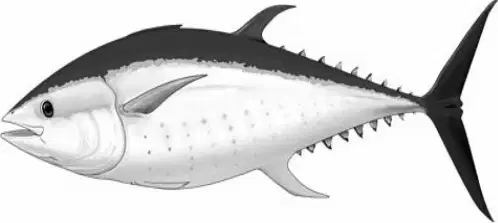
The body shape illustrated in the diagram allows the fish to cope with which of the following properties of water?
Salinity
Viscosity
Temperature
Pressure
Dissolved gases
Every living thing is known by two (a) names.
The (a) zone consists of deep trenches along the margins of continents.
Krill move in the ocean as (a) .
Which of the following is the highest taxonomic classification of an organism?
Kingdom
Class
Phylum
Order
Which of the following is NOT considered a basic category of organisms in an ecosystem?
Consumers
Producers
Decomposers
Autotrophs
The efficiency of trophic transfers in ecosystems is on average around:
75%
10%
5%
30%
50%
Which of the following is NOT a color of macroscopic algae or seaweeds?
Black
Brown
Green
Red
Diatom tests are composed of opaline (a) .
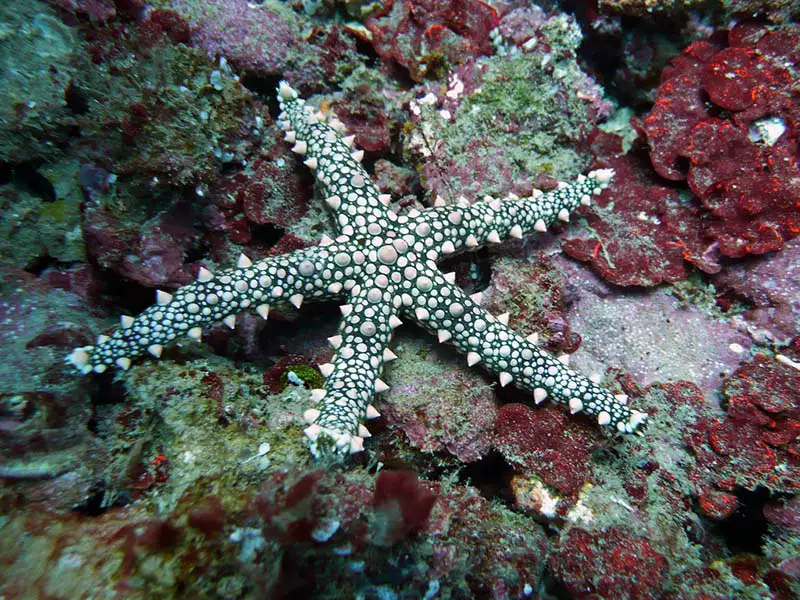
With respect to their marine environment, these organisms can be referred to as (a) .
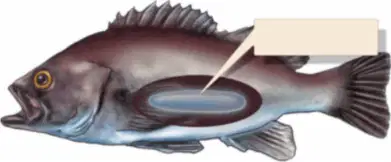
The internal organ illustrated in the diagram allows the fish to adapt to changes (a) .
Plankton that measure between 2-20cm are classified, based on size, as which of the following?
Macropkankton
Picoplankton
Zooplankton
Viroplankton
Octopuses, crabs, and sea urchins are classified as which of the following?
Benthosnektos
Infauna
Planktofauna
Epifauna
Nektobenthos
Cold water is ____ and has a ____ than warm water.
more dense; high viscosity
less dense; lower viscosity
more dense; lower viscosity
less dense; higher viscosity
The largest size that a population can sustain based on the number of resources is
limiting resources
interspecific competition
standing stock
carrying capacity
Dead organic matter in solid form is referred to as
Detritus
Parasite
Decomposer
Biomass
A Secchi Disk is used to measure water ___________.
Acidy
Density
Salinity
Temperature
Transparency
In primary production _________.
Carbon dioxide is released into the water
Oxygen is utilized by plants
Oxygen utilized by animals is less than the oxygen consumed by autotrophs
Proteins are made by animals
There is a net gain in organic carbon by organisms
The process by which energy is derived from solar radiation that is used by certain organisms to form organic matter is called _______.
Photosynthesis
Chemosynthesis
Upwelling
Visible light
Biomass
The depth at which the cellular respiration rate equals the photosynthetic rate is referred to as the _______ for photosynthesis.
Carbonate depth
Epipelagic depth
Euphotic zone
Compensation depth
Productive zone
Which of the following is NOT a component that energy from the Sun affects?
Ocean winds
Ocean wave height
Ocean stratification
Primary productivity
Important marine autotrophs that have silica incorporated into their cell walls are _______.
Coccolithophorids
Cyanobacteria
Diatoms
Dinoflagellates
Radiolarians
The relative productivity in the world’s oceans from most productive to least productive is ______.
Polar waters, temperate waters, tropical waters
Polar waters, tropical waters, temperate waters
Temperate waters, polar waters, tropical waters
Temperate waters, tropical waters, polar waters
Tropical waters, temperate waters, polar waters
Which ecosystem has the greatest average primary productivity?
Algae beds and coral reefs
Estuaries
Upwelling zone
Continental shelf
The term bycatch or incidental catch refers to _________.
Krill and other shellfish
Non-target species that are caught along with commercial species
Species caught as part of traditional fisheries
Species harvested for industrial purposes
Species raised in aquaculture settings
In polar oceans, productivity peaks during the ______ and is limited by sunlight during the rest of the year.
Spring
Winter
Fall
Summer

