
 Worksheets
Topic 1 Atoms and the Periodic Table
Total questions: 56
Worksheet time: 1hrs 24mins
An atom has 18 protons and 8 valence electrons. Which statement would best identify this element? Use the periodic table to assist you in answering the questions in this section.
The element is highly reactive with eight electrons in its outer shell.
The element has an atomic mass of 18.
The element is “happy” or stable because its outer energy level is filled.
The element is a metal.
Which atom is shiny, has the properties of both metals and nonmetals, and has three valence electrons? Use the periodic table to assist you in answering the questions in this section.
boron (B)
germanium (Ge)
antimony (Sb)
tin (Sn)
Of the four atoms shown at the right, which TWO are in the same group? Use the periodic table to assist you in answering the questions in this section.
1 & 2
1 & 4
1 & 3
2 & 3
Think about the pH scale. The numbers listed below are the pH of each substance. Which of the following are considered bases? Read the question and check ALL answer choices that are correct.
soft drink - 2.9
pure water - 7.0
eggs - 7.8
ammonia - 11.6
baking soda solution - 8.5
Look at the table above. Which of the following best describes the pH of milk?
A. slightly basic
B. strongly basic
C. slightly acidic
D. strongly acidic
Which subatomic particles have no electrical charge and may not always be the same in number as the protons?
electrons
neutrons
atoms
nucleus
What is the octet rule? Respond to the item below with complete sentences.
What is the smallest unit of an element that retains the properties of that element?
ion
compound
atom
molecule
Which subatomic particle is found in the nucleus and has a positive charge?
photon
proton
neutron
electron
What determines the chemical identity of an atom?
atomic mass
number of protons
number of electrons
number of neutrons
Which of the following elements is a noble gas?
helium (He)
hydrogen (H)
oxygen (O)
carbon (C)
What is the charge of an electron?
positive
negative
variable
neutral
Which of the following best describes a covalent bond?
A bond formed by the sharing of protons
A bond formed by the sharing of electrons
A bond formed by the transfer of electrons
A bond formed by the attraction between ions
Which of the following best describes the electron configuration of a noble gas?
All orbitals have one electron
All orbitals are half-filled
All orbitals are empty
All orbitals are filled
What is the primary factor that determines the reactivity of an element?
Number of protons
Number of valence electrons
Number of neutrons
Atomic mass
Which of the following statements is true about isotopes?
They have the same number of protons but different numbers of neutrons
They have different numbers of protons and neutrons
They have the same number of neutrons but different numbers of electrons
They have different numbers of electrons and protons
What is the pH range of an acidic solution?
7
0 to 7
7 to 14
14 to 21
Which of the following is a characteristic of a base?
It tastes sour
It has a pH less than 7
It turns red litmus paper blue
It reacts with metals to produce hydrogen gas
Which element is known as the 'king of the elements' due to its ability to form a wide variety of compounds?
Oxygen (O)
Carbon (C)
Nitrogen (N)
Hydrogen (H)
What is the atomic number of an element indicative of?
The atomic mass of the element
The number of protons in the nucleus
The number of electrons in the outer shell
The number of neutrons in the nucleus
Which group in the periodic table contains the alkali metals?
Group 1
Group 2
Group 17
Group 18
What is the common property of elements in the same group of the periodic table?
They have the same atomic number
They have the same number of neutrons
They have similar chemical properties
They have the same atomic mass
Which of the following elements is a halogen?
Calcium (Ca)
Sodium (Na)
Neon (Ne)
Fluorine (F)
What is the primary characteristic of a noble gas?
High density
Complete valence electron shell
Low boiling points
Highly reactive
Which of the following best describes an ionic bond?
A bond formed by the sharing of electrons
A bond formed by the transfer of electrons
A bond formed by the attraction between neutrons
A bond formed by the sharing of protons
Which of the following elements is most likely to form a cation?
Argon (Ar)
Chlorine (Cl)
Oxygen (O)
Sodium (Na)


What is the atomic number of this atom shown in the Bohr model?
11
12
13
can't be determined
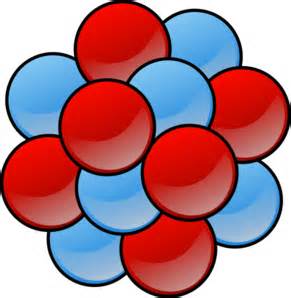
This diagram is showing the nucleus of an atom. If the red circles represent the protons, then which element is being modeled here?
Oxygen
Carbon
Nitrogen
Boron

Which is an electron?
A
B
C
electrons are not labeled in the diagram

The vertical (up and down) columns in the Periodic Table are called ___.
groups
towers
periods
atomic numbers

What group and period is sodium (Na) located?
period 1 and group 3
period 3 and group 1
period 2 and group 3
period 3 and group 2

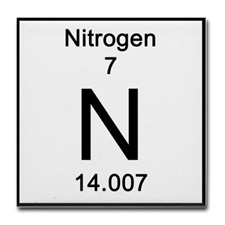
A model of Nitrogen is shown, in this model, what do the blue spheres represent?
electrons
neutrons
photons
protons
Everything in the periodic table is arranged by
the alphabet
their properties
their subatomic particles
their discovery date

Which subatomic particle has a negative charge?
proton
neutron
electron
atom
Which of the following is an element?
salt
oxygen
vinegar
water

An atom of a certain element has 11 electrons, and a mass number of 23. This element is very reactive in room temperature. How many neutrons are in this atom?
11
12
33
23

This is a chemical formula for glucose, a type of sugar. What statement is true about glucose?
Glucose is an element, because it can be separated into smaller components
Glucose is an element, because it is made up of more than one kind of atom
Glucose is a compound, because it is made up of more than one element
Glucose is a compound, because it is made of protons, neutron and electrons

Which elements in the periodic table have similar properties?
a metal and a noble gas
a metal and a non metal
two elements in the same group
two elements in the same period


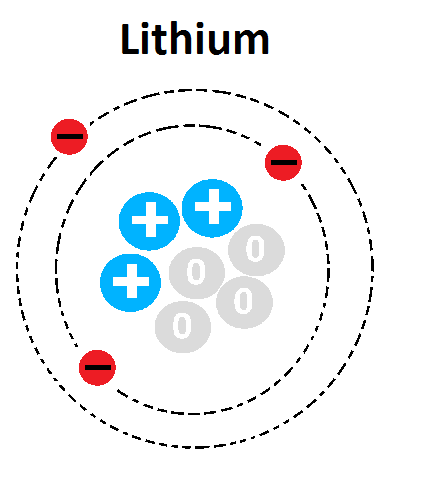
What is the atomic number of this atom?
1
3
4
7
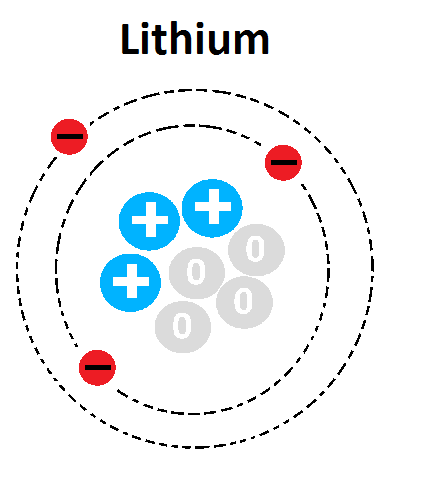
What is the mass number of this atom?
1
3
4
7

A typical atom of beryllium has an atomic number of 4. How many protons does this element have?
4
5
9
13
Group 18 of the periodic table contains nonreactive elements like helium, neon, and argon. The element in this group are called:
Alkali Metals
Transition Metals
Halogens
Noble Gases
Everything in the universe (except energy) is made of (a) .

What does the number 6 as shown in this periodic table box of Carbon represent?
The number of protons in an atom of C
The average atomic mass of C
The group number of C
The period number of C

