
 Worksheets
Alg.2 Midterm Review
Total questions: 75
Worksheet time: 1hrs 15mins
Select all: Natural Numbers
4.5
5
-2
0
7,652
Select all: Integers
4.2
4
-4.2
4/3
-2
Which of the following is NOT an irrational number?
16
5.58703...
96
π
Which of the following is NOT a natural number?
12
3,000
5
0
Pi is an example of which type of number?
Irrational number
Natural number
Unnatural number
Fraction
Classify the following number: 1.01276894...
Rational
Irrational
What type of number is 3.5 ?
Integer
Rational Number
Irrational Number
Natural Number
Solve the following: -8 + (15 - 3) ÷ 4
Simplify: 8 + 5 ∙ 4 + (7 - 3)
Simplify: 91 + 27 ÷ (72 ÷ 24)
Solve the following: -2 x (3 + 8 ÷ 4)2
Solve for x: 2x + 5 = 12
Solve for x: 4x + 1 = 7x - 5
Solve for x: 6(2x + 1) = 18
Solve for x: 2(3x + 4) + 2 = 4 + 3x
Solve for x: 7 - 2(10x + 1) = 25

If f(x) = 2x + 1, find f(1).
f(1) = 1
f(1) = 4
f(1) = 0
f(1) = 3
Let w(x) = 3x - 7. If w(x) = 14, find x.
7
35
2.33333
-49

Select THREE TRUE statements
The y-intercept is at (0, -4).
There are three zeros at x = -1, x = 2, x = 4.
The function has one local maximum and an absolute maximum.
The domain is [-1, 4].
The function has four local maximum points.

What is the RANGE of the function?
(−∞, ∞)
(−∞, 0]
[0, ∞)
[−∞, ∞]

Where is the function increasing and decreasing?
Decreasing: (0, ∞)
Increasing: (−∞,0)
Decreasing: (0, −∞)
Increasing: (0, ∞)
Decreasing: (−∞,0)
Increasing: (0, ∞)
Decreasing: (−∞, ∞)
Increasing: none

What are the increasing, decreasing and constant intervals of the function?
Increasing: (-4, ∞)
Decreasing: (-4, 2)
Constant: (2, 2)
increasing: (2, ∞)
Decreasing: (-4, 2)
Constant: (-∞, -4)
Increasing: (2, -4)
Decreasing: (-4, ∞)
Constant: (-∞, -4)
Increasing: (2, -4)
Decreasing: (-2, ∞)
Constant: (-6, -4)
What is the slope-intercept form of a line?
Ax+By=C
y=mx+b
y−y1=m(x−x1)
y=Ax+By
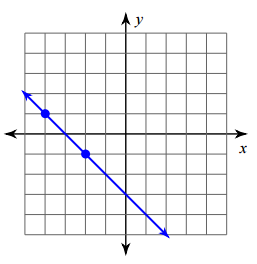
Write the equation of this line
y = 2x + 2
y = -2x - 3
y = -x - 3
y = x -3
What is standard form of a line?
y = mx + b
Ax + By = C
y - y1 = m(x - x1)
y = Ax + By
7x + 2y = 9
Name the x- and y-intercepts for the equation: 5x - 3y = 15
Write this equation in Standard Form: 13 - 6x - y = 0
-6x - y = -13
13 - 6x = y
6x + y = 13
y = -6x + 13
Write x + 5y = 10 in slope-intercept form.
y=−5x + 2
y = −51x + 5
y = 5x + 2
y = −51x + 2
Write -2x - 3y = 12 in slope-intercept form.
y = −32x − 4
y = 32x − 4
y = −32x + 4
y = 32x + 4
y = 3/2x + 3
y = 2/3 - 3
y = 2/3x - 3
y = 2/3x + 3
In slope-intercept form, write the equation of the line passing through the points (-3, 4) and (-4, 2).
y = -2x + 10
y = -2x - 10
y = 2x - 10
y = 2x + 10
Write the equation of the line passes through the point (2,1) and has a slope = 4.
y = 3x - 2
y = 4x - 7
y = 4x + 7
y = 3x + 3
y = -2/3x + 2 and y = 3/2x + 9. These lines are...
Parallel
Perpendicular
Neither
Are the given lines parallel, perpendicular, or neither?
y=21x+2 and y=21x−4
Parallel
Perpendicular
Neither


Solve the system of equations
Infinite solutions
(2, -2)
(1, 0)
(3, -4)
Solve:
y = -1x - 5
4x - 8y = 4
(-3, -2)
(5, -7)
(3, 9)
(-5, 4)
Solve:
y = 8x + 1
y = 6x + 3
(1, 9)
(4, 14)
(0, 1)
(2, 4)

Solve:
3x + 7y = 23
-3x - 7y = -17
No solution
ARN
(-3, 3)
(3, 3)
Let's multiply the top equation by -2. What would be our new equation?
2x + 3y = 12
4x - 7y = - 54
4x - 6y = -24
-4x - 6y = 12
-4x - 6y = 24
-4x - 6y = -24
Solve by elimination:
-2x + 6y = 16
-4x - 3y = 2
(2, 2)
(-2, 2)
(2, 1)
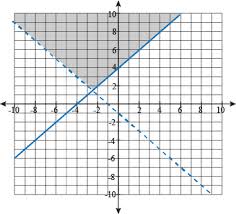

Which of the following is NOT a solution to this system of inequalities?
(0, -1)
(0, 3)
(4, 0)
(6, -2)

y < 2
y < 2
y < 2
y < -2

Which system of linear inequalities is represented by the graph?
y ≤ 2x - 1
y > -2x + 3
y > 2x - 1
y ≤ -2x + 3
y < 2x - 1
y ≥ -2x + 3
y ≤ 2x - 1
y > 2x + 3

Solve the system.
(5, -6, 3)
(2, 3, -1)
(-4, 2, 5)
No Solution

Solve the system of equations to find the value of z.
4
-4
2
-2
Given the equation for this parabola: y=−(x−4)2−3, does this parabola have a maximum or minimum value?
Maximum
Minimum
Given the equation for this parabola: y=−(x−4)2−3,
what are the coordinates of the vertex?
(4, 3)
(4, -3)
(0, -3)
What is the y-intercept of this quadratic equation? y=2(x−2)2−2
(0, 6)
(6, 0)
(2, -2)
(-2, 2)
What is the axis symmetry of this quadratic equation?
y=2(x−2)2−2
x = 2
x = -2
y = 2
y = -2
What is the axis of symmetry? f(x)=x2−8x+15.
x = -4
x = 4
y = 4
y = -4
What is the y-intercept? f(x)=−x2−4x+12.
(12, 0)
(0, 12)
(-2, 16)
(2, 0)


What is the axis of symmetry? f(x) = x2 - 8x + 15.
What is the vertex? f(x) = -x2 - 4x + 12.
y = 2(x + 3)2 + 4
y = (x + 3)2 - 4
y = (x - 3)2 + 4
Maximum or Minimum? y=2(x−3)2+6
Max = -3
Min = 3
Min = 6
Max = 6
What is the x-intercepts of the parabola? y = -3(x + 5)(x - 9)
(-5, 0) and (9, 0)
(5, 0) and (-9, 0)
(5, 0) and (9, 0)
(-3, 0) and (5, 0)and (-9, 0)

What is the quadratic function for the graph in intercept form?
y = (x - 2)(x - 6)
y = - (x - 2)(x - 6)
y = (x + 2)(x + 6)
y = (x + 4)(x - 4)
Determine the vertex of j(x) = (x - 8)(x + 3)
(-8, 3)
(8, -3)
(2.5, -30.25)
(5, -24)
Convert to Vertex Form: f(x) = x2 + 8x + 14
f(x) = (x - 4)2 + 2
f(x) = (x - 4)2 - 2
f(x) = (x + 4)2 + 2
f(x) = (x + 4)2 - 2
Convert to standard form: y=(x+5)2−15
y=x2+10
y=x2+10x +10
y=x2+25
y=x2+10x+25
Convert to standard form: y=−2(x−3)2+6
y=−2x2+12x−12
y=−2x2+6x+15
y=−2x2+12x−18
y = −2x2−12
Convert to vertex form: y=x2−12x+30
y=(x−6)2+6
y=(x+6)2−36
y=(x−6)2
y=(x−6)2−6

