wayground logo

Free Printable Worksheets

Font size

S
M
L
XL
Worksheets

Atomic Structure & E Configuration

Total questions: 45

Worksheet time: 1hrs 6mins

Name
Class
Date
1.

All matter is made of _________.

a)
energy 
b)
atoms 
c)
electrons 
d)
compounds 
2.
The positively charged particles of an atom are the ________.
a)
electrons
b)
protons
c)
neutrons
d)
protons & neutrons
3.
What does the nucleus of an atom contain?
a)
Electrons and neutrons
b)
Protons and neutrons
c)
Neutrinos and positrons
d)
DNA and RN
4.

The subatomic particles that make up an atom.

a)

solid, liquid, gas

b)

electrons, protons, nucleus

c)

energy, protons, nucleus

d)

electrons, protons, neutrons

5.

__________ are negatively charged particles that are in the orbitals around the nucleus.

a)

protons

b)

nucleus

c)

neutrons

d)

electrons

6.

A neutron has _________ charge or is ________.

a)

negative ... neutral

b)

positive .... neutral

c)

no .... negative

d)

no ... neutral

7.
Which is an electron?
a)
A
b)
B
c)
C
8.

Where is nearly all the mass of an atom located?

a)

electron cloud

b)

nucleus

c)

proton

d)

empty space

9.
How many protons does this atom have?
a)
2.5
b)
6
c)
5
d)
10.811
10.
In order for me to find the number of neutrons, I must round the atomic mass and then do what?
a)
atomic number-atomic mass
b)
atomic number x atomic mass
c)
atomic mass + atomic number
d)
atomic mass - atomic number
11.

How many neutrons are in Magnesium?

a)

36

b)

12

c)

24

d)

6

12.

How many electrons are in Sulfur?

a)

32

b)

16

c)

48

d)

8

13.

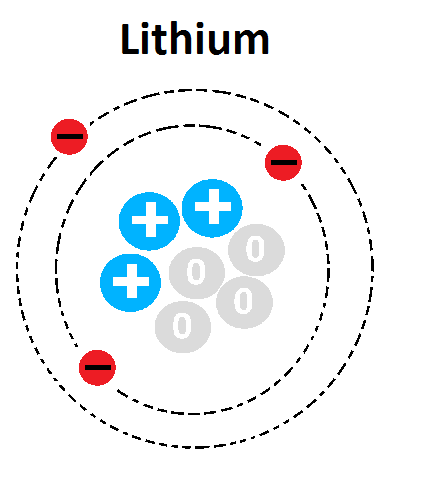
Which would you do to change this Lithium to a new element?

a)

Add a neutron

b)

Add an electron

c)

Add a proton

d)

Add a proton and neutron\

14.
4.35% of all X atoms have a mass of 39.946 amu. 83.79% have a mass of 41.941 amu, 9.50% have a mass of 42.941 amu, and 2.36% have a mass of 43.939 amu. What is the average atomic mass of atom X?
a)

41.996 amu

b)

42.194 amu

c)

10.432 amu

d)

40.048 amu

15.
Which sub-atomic particles were determined to have charges? 
a)
Protons & Electrons 
b)
Electrons & Neutrons
c)
Protons & Neutrons
16.

An atom has 25 protons and 30 neutrons. How many electrons are needed to make the atom neutral?

a)

0

b)

25

c)

30

d)

35

17.

How many neutrons does Chlorine have?

a)

18

b)

17

c)

35

d)

52

18.

How do isotopes of the same element differ?

a)

Different number of protons

b)

Different number of electrons

c)

Different number of neutrons

d)

Different atomic numbers

19.

If Carbon-14 has 6 protons, how many neutrons does it have?

a)

6

b)

7

c)

8

d)

14

20.

What is the mass number of an isotope with 20 protons and 22 neutrons?

a)

20

b)

22

c)

40

d)

42

21.

If two isotopes have the same mass number but different atomic numbers, what can you infer about them?

a)

They are isotopes of the same element.

b)

They have the same number of neutrons.

c)

They are not isotopes but different elements.

d)

They have the same number of protons.

22.
What atom matches this electron configuration?
1s2s2p3s2
a)
Neon
b)
Magnesium
c)
Aluminum
d)
Potassium
23.
Which is the electron configuration for an oxygen atom?
a)
1s22s22p63s23p64s2
b)
1s22s22p4
c)
1s22s22p6
d)
1s22s22p63s23p6
24.
What atom matches this electron configuration?
[Xe] 6s2 4f14 5d9
a)
Mercury
b)
Gold
c)
Platinum
d)
Thallium
25.
How many electrons can the first energy level hold?
a)
1
b)
2
c)
8
d)
0
26.
Which element is pictured?
a)
neon
b)
fluorine
c)
magnesium
d)
argon
27.
The electron configuration of an atom is 1s22s22p6.  The number of electrons in the atom is 
a)
3
b)
6
c)
8
d)
10
28.
What do you start electron configuration with?
a)
1s2
b)
1d10
c)
1f14
d)
1p6
29.

What are valence electrons?

a)

The innermost electrons

b)

The outermost electrons

30.

What is the octet rule?

a)

Elements can only have 8 electrons in its outermost shell

b)

The elements must form an octopus like structure

31.
There are 4 different types of subshells (orbitals) s,p,d,f.
a)
true
b)
false
32.
What is the name of this element?
a)
Helium
b)
Hydrogen
c)
Argon
d)
Silver
33.
What is the mass number of this atom?
a)
1
b)
3
c)
4
d)
7
34.
What is the atomic number of this atom?
a)
2
b)
4
c)
6
d)
none of the above
35.

What element has the following electron configuration?

1s22s22p63s23p64s23d104p65s1

a)

Rubidium (Rb)

b)

Halfnium (Hf)

c)

Aluminum (Al)

d)

Potassium (K)

36.
How many electrons can the first energy level hold?
a)
1
b)
2
c)
8
d)
0
37.
What is incorrect about this orbital diagram?
a)
Both arrows in the 2p box should be pointing up
b)
There is nothing incorrect with this diagram
c)
In the 2p box there should only be 1 electron in the first 2p box and one in the 2nd 2p box
d)
All the arrows should be pointing up.
38.

What is a positive ion called?

a)

anion

b)

cation

c)

isotope

d)

covalent

39.

What is a negative ion called?

a)

anion

b)

cation

c)

covalent

d)

isotope

40.

If an atom loses electrons, the charge will be positive.

a)

true

b)

false

41.
What is the charge of an atom that has lost one electron?
a)
-1
b)
-2
c)
+1
d)
+2
42.

An atom with 2 protons, 3 neutrons, and 4 electrons has a charge of ____.

a)

+2

b)

-2

c)

+3

d)

0

43.

If an element has 3 valence electrons, what charge will likely form on its ion ?

a)

+3

b)

+5

c)

-3

d)

-5

44.
What is an ion?
a)
A Charged Atom
b)
A Large Atom
c)
A Small Atom
d)
A Cute Atom
45.
Why are ions formed?
a)
To make our lives difficult
b)
Because atoms want 8 valence electrons
c)
Because atoms have the same number of protons and electrons
d)
Because atoms gained neutrons