
 Worksheets
Physical Science Fall 24 Study Guide
Total questions: 165
Worksheet time: 4hrs 35mins
What is the mass number
Number of protons + Numbers of Neutrons,
Number of Neutrons + Number of electrons
Number of Protons
Number of Neutrons


Subatomic particles that have a negative charge
electrons
protons
quarks
neutrons
An atom has 25 protons and 30 neutrons. How many electrons are needed to make the atom neutral?
0
25
30
35

What is the atomic number?
35
18
17
52

How many neutrons does Chlorine have?
18
17
35
52

What is the atomic mass of Arsenic?
33
107
75


What family is silicon (Si) a part of?
Metal
Nonmetal
Metalloid
Halogens
How many electrons does Barium (Ba) have?
13
2
71
56
Why are halogens so reactive?
They want to get rid of their only valance electron
They only need one more electron
They are non reactive, they have a full shell
They are awesome.
How many valence electrons does a carbon atom have?
8
4
2
6
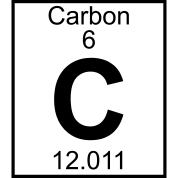
Ionic bonds happen because of the ____ of valence electrons.
sharing
transfer
explosion
turbo
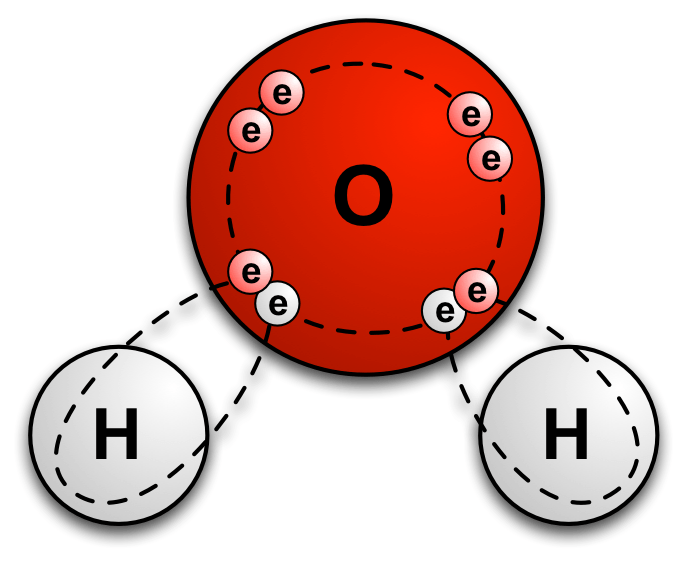
Which element is not a metal?
Sr
Ni
Al
B

The vertical columns on the periodic table are called:
periods
elements
groups
matter
The horizontal rows on the periodic table are called:
periods
elements
groups
matter

What group does Lithium (Li) belong to?
1
2
3
4
Which of the following is not true of Metals?
they make up a majority of elements
they are shiny
they are good conductors
they are poor conductors
Which group are the Alkaline Earth Metals in?
1
2
17
18
Which group are the Alkali Metals in?
1
2
17
18
Which group are the Noble Gases in?
1
2
17
18
Atoms of the same element may contain:
the same number of protons but a different number of neutrons.
a different number of protons and a different number of neutrons.
the same number of electrons but a different number of protons.
the same number of neutrons but a different number of protons.
To protect your body from ALL types of radiation would require:
your clothing.
a sheet of notebook paper.
thick concrete walls.
a half-inch sheet of plywood.
The atomic mass number for the radioisotope carbon-13 is:
A) 6
B) 7
C) 12
D) 13
Which one of these can beta particles penetrate
Nothing
skin
Everything
it doesn’t exist
Which type of radiation has the largest mass?
beta
gamma
alpha
electrons
What is happening when my ice cream changes from a solid to a liquid?
freezing
melting
burning
evaporation

the particles break away from one another


How are particles in a solid different from a liquid or a gas?
they are bonded but vibrate in place
they aren't different
they move freely through space
move over and around other particles


This state of matter is found in neon signs, and is the most abundant state of matter in the universe..
solid
liquid
gas
plasma
Thermal energy always moves:
From a high temperature object to a lower temperature object.
From a lower temperature object to a higher temperature object.
From an object with lower kinetic energy to an object with higher kinetic energy.
From an object of higher mass to an object of lower mass.

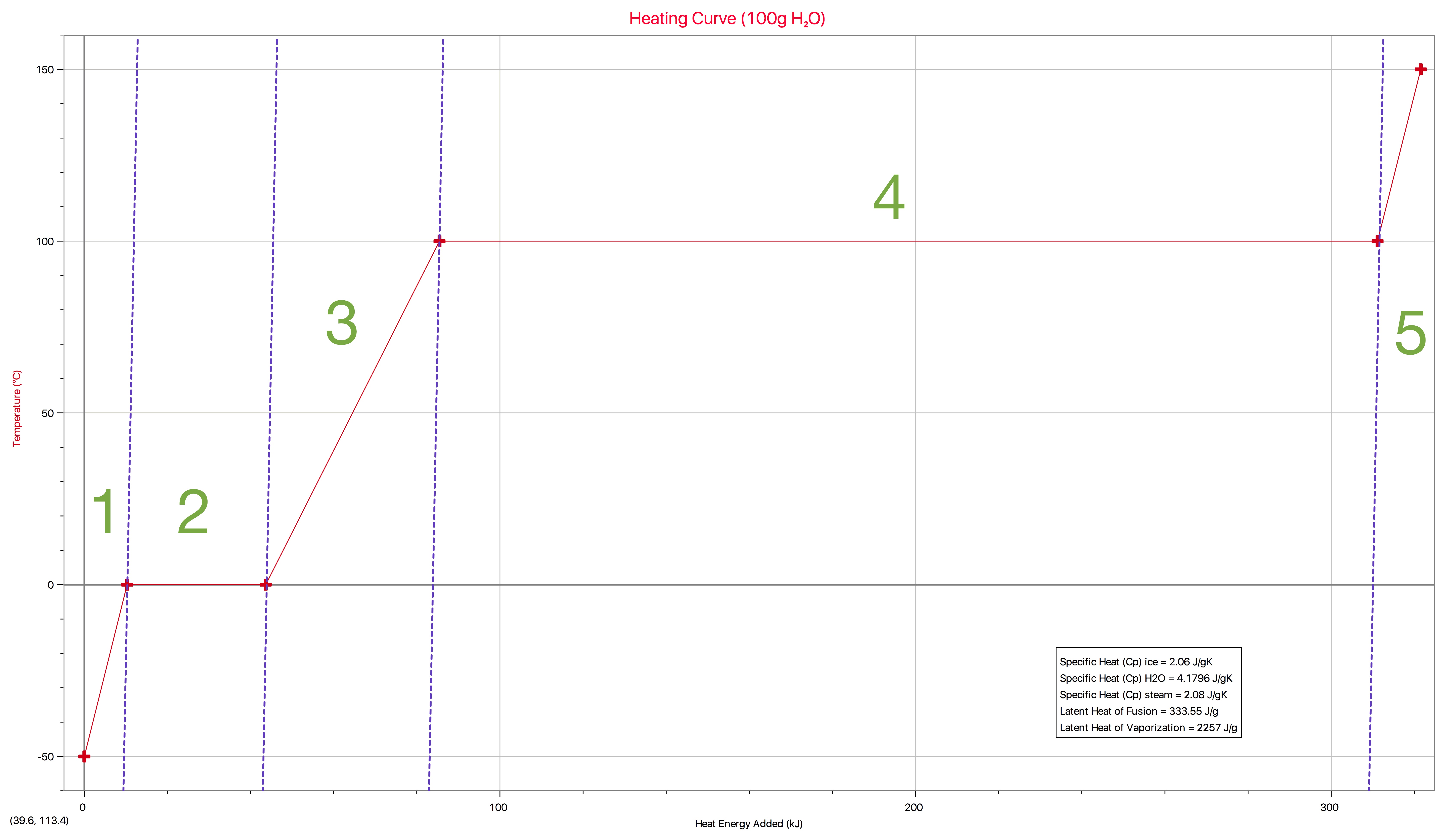
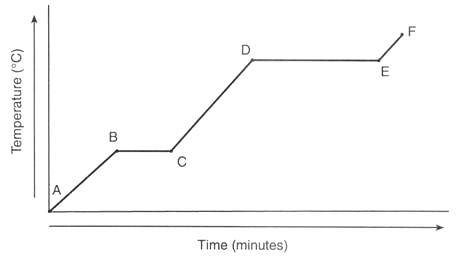
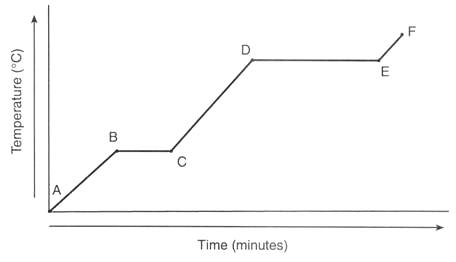
Given the heating curve of a solid being heated at a constant rate, what is the boiling point of this substance?
20°C
50°C
110°C
170°C

The melting point of the sample is
-60 ºC
-100 ºC
60 ºC
100 ºC

Given the heating curve of water, what is happening to potential and kinetic energy during segment CD?
the potential energy and kinetic energy both increase
the potential energy increases while the kinetic energy decreases
the potential energy is constant while the kinetic energy increases
the potential energy increases while the kinetic energy is constant
When an atom loses an electron, it becomes a
positive ion
negative ion
neutral ion
neutral atom
An atom that gains or loses an electron becomes
an isotope
a new element
an ion
a molecule
Valence electrons are
neutral (no charge)
found in the outer most energy level of the atom
equal to the number of protons
The charge for oxygen is:
1-
2-
1+
2+
The correct formula for beryllium fluoride is:
BeF
BF2
Be2F
BeF2
The correct name for CaCl2 is:
calcium chlorine
calcium chloride
calcium dichloride
calcium (II) chloride
The correct formula for copper (II) nitride is:
CuN
CuN2
Cu3N2
Cu2N3
LiBr is called
lithium bromine
lithium (I) bromine
lithium bromide
lithuim (I) bromide
Name the following ionic compound: BeCl2
beryllium chlorine
beryllium II chloride
beryllium chloride
beryllium dichloride
Name the following ionic compound: Cs2S
cesium sulfide
cesium sulfate
cesium II sulfate
cesium II sulfide
When naming ionic compounds with transition metals you need to include roman numerals to show the _____ of the metal..
atomic number
mass number
charge
ionization energy
When naming a compound, what must the last part be?
the element with "ide" at the end
the element with the ending "ite"
the name of the element
the element with "ide" at the end, unless its a polyatomic ion
The number that tells you if an ion has lost or gained electrons
atomic number
oxidation number
mass number
electron number
If I gain electrons I become
Positive because I've added to my atom
negative because I've added electrons
same because i'm balanced
equal because now I have electrons
Name the following compound: Zn3N2
zinc nitride
trizinc dinitride
zinc (III) nitride
zinc (II) nitide
zinc nitrogen
What is the name of the following compound: NaCl
sodium chloride
sodium (I) chloride
sodium chlorine
sodium (I) chlorine
Cr3+ O2-
Al3+ O2-
Solute
Salt
Suspension
Solvent

What is this?
Element
Compound
Homogeneous Mixture
Heterogeneous Mixture

Just one substance; the simplest form
Element
Compound
Homogeneous Mixture
Heterogeneous Mixture
When there is 2 or more elements combined together
Element
Compound
Homogeneous Mixture
Heterogeneous Mixture
Which of these is an element?
Salt (NaCl)
Water (H20)
Oxygen (O)
Coffee
Which of these is a compound?
Aluminium (Al)
Carbon Dioxide (CO2)
Nitrogen (N)
Sand
Which of these is a mixture?
Laundry Detergent
Salt (NaCl)
Oxygen (O)
Fluorine (Fl)
Air is:
An element
A compound
A mixture
None of these
Which of the following is classified as a pure substance?
Lemonade
Fruit punch
ketchup
Helium
Matter is anything that takes up ___________________ and has _____________________________.
time, space
volume, no mass
space, mass
space, no mass
Homogeneous mixtures are ______________________ distributed out on a microscopic level.
evenly
differently
chemically
unevenly
This mixture includes substances that are not evenly spread out.
Homogeneous
compounds
Lemonade
Heterogeneous

Kool-Aid
Heterogeneous mixture
Homogeneous mixture
element
compound

Water
element
compound
heterogeneous mixture
homogeneous mixture

Coffee
element
compound
homogeneous mixture
heterogeneous mixture
Which of the following is the strongest acid?
1
5
3
8
Which of the following is the strongest base?
4
14
7
15
Which of the following is a characteristic of a base?
bitter
sour
corrosive
releases hydrogen ions in water
Which of the following is a characteristic of an acid?
bitter
slippery
sour
releases hydroxide ions in water
What does a base release when placed in water?
hydroxide ions (OH-)
hydrogen ions (H+)
ions
molecules
What does an acid release when placed in water?
hydroxide ions (OH-)
hydrogen ions (H+)
ions
nothing
A substance with a pH of 8 is...
a weak base
a weak acid
a strong base
a strong acid
An acid can be corrosive.
True
False
A substance with a pH of 7 is which of the following?
acid
base
neutral

What law is best described
1st
2nd
3rd
law of motion

What law is best described
A magician pulls a tablecloth out from under dishes and glasses on a table without disturbing them.
Newton's 1st Law
Newton's 2nd Law
Newton's 3rd Law

What law is best described
A person not paying attention while skateboarding hits a rock. The skateboard stops...they don't.
The Law of Inertia (1st law)
The Law of Acceleration (2nd law)
The Law of Conservation of Momentum
Action Reaction Law (3rd law)

Mac and Tosh are arguing in the cafeteria. Mac says that if he flings the jello with a greater speed it will have a greater inertia. Tosh argues that inertia does NOT depend upon speed, but rather upon mass. Who is correct?
Mac
Tosh
Neither
Both
What is needed to calculate work?
time and distance
speed and distance
force and direction
acceleration and velocity
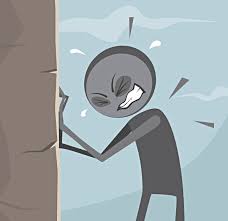
Is this an example of work?
Yes
No
What is the unit of measurement for work?
meters
newtons
m/s
Joules

Is this an example of work?
Yes
No!
You have to push with 15 N of force to move it 10 meters. How much work do you do?
15 Joules
150 Joules
1.5 Joules
.67 Joules
500 J of work is done by a person who uses a force of 50N to move a box, how far does it go?
10 m
0.1 m
25,000 m
10 J
Newtons are the unit for _____________.
Work
Distance
Acceleration
Force
A push or a pull
Work
Force
Acceleration
Speed
For work to be done on an object, the direction and force have to be going the same direction.
True
False
What is effort (input) force?
the force one exerts on a machine
the force which an effort force must overcome in order to do work on an object via a simple machine.
the force the machine exerts on a object
the output work times the input distance
How can simple machines make work easier?
by decreasing the force needed to complete the task
by increasing the friction between the machine and the object
by adding more work on the object than originally applied
by removing the force of gravity on the object
Simple machines can make work easier by reducing the input force needed to move an object. However, there is a trade off for decreased input. What is the trade off?
The distance the object is moved is increased.
The distance the object is moved is decreased.
The amount of work is increased.
The amount of work is decreased.

A doorknob is an example of a _______.
wheel and axle
inclined plane
pulley
wedge

The fixed point around which a lever rotates is know as the
wheel.
fulcrum.
input force.
output force.

A simple machine that splits an object apart is a _______.
inclined plane
fulcrum
wedge
lever

A ramp is an example of a(n) _______.
inclined plane
fulcrum
force
lever

A seesaw is what simple machine?
lever
inclined plane
pulley
gear
How many grams are left after 1 half life?

