
 Worksheets
WHAP Midterm Review
Total questions: 74
Worksheet time: 40mins
The Code of Hammurabi was a major contribution to the development of civilization because it
treated citizens and slaves equally
ended all physical punishment
recorded existing laws for all to see
rejected the principle of filial piety
Who wrote the Prince, which examines how a ruler can gain and keep power in spite of his enemies?
Francesco Petrarch
Niccolò Machiavelli
Desiderius Erasmus
Martin Luther
Judaism, Islam, and Christianity share a belief in
the central authority of the Pope
a prohibition of the consumption of pork
reincarnation and the Four Noble Truths
monotheism and ethical conduct
An immediate result of the fall of the Roman Empire was
a renewed interest in education and the arts
a period of disorder and weak central government
an increase in trade and manufacturing
the growth of cities and dominance by the middle class
The Bantu migration is most closely associated with the spread of
bureaucratic governments
agricultural skills
the diamond trade
the principles of Sharia law
What was a major contribution of the Byzantine Empire?
adoption of democratic ideas from Russia
spread of humanism and secularism across Europe
reunification of eastern and western Christendom
preservation of Greek and Roman culture
A major reason the Renaissance began in the Italian city-states was their
military success against the Seljuk Turks
access to goods from the Americas
participation of trade routes on the Mediterranean Sea
dependence on the teachings of the Catholic Church
All of the following religions were included in the religious syncretism in Eastern Africa except
Islam
Buddhism
Christianity
Animism
Which action is most closely associated with the early Mesopotamian civilizations?
building floating gardens to grow corn
establishing representative democracies
developing a writing system using cuneiform
constructing Hindu temples
Which of the following statement is true of Mongol rule?
Local officials were always allowed to rule throughout the Mongol Empire.
The Mongols demanded that those who were conquered convert to Islam.
The Mongols used various methods to rule the different people they conquered and usually did not force their own culture on to the people
Civil service examinations were used to select government officials in all conquered areas
Inca and Aztec societies were similar in that both
developed from Maya civilization
acquired empires by means of military conquest
independently developed iron technology
depended entirely on oral record keeping
Ibn Battuta and Marco Polo were similar in that both
ruled over vast empires that included diverse peoples
produced written records of their extensive travels
converted thousands of people to Christianity
fought to free their people from Mongol rule
Which of the following correspond to the role or roles that the Church played in medieval society? I. Excommunication II. Common place for worship, protection, and socializing III. Origins of most education IV. A place of training for most nobles
A. I & II only
B. II, III, & IV
C. I, II, & IV
D. I, II, III
Which leader started the Protestant Reformation by speaking out against papal abuses and the sale of indulgences in the Ninety-five Theses?
A. John Calvin
B. John Wycliffe
C. Henry VIII
D. Martin Luther
Which of the following changes best justifies the claim that the late 1400s mark the beginning of a new period in world history?
A. The rise of the Aztec and Inca Empires
B. The economic recovery in Afro-Eurasia after the Black Death
C. The incorporation of the Americas into a broader global network of exchange
D. The emergence of new religious movements in various parts of the world
Which dynasty ruled northern India during its Golden Age from AD 320 to 535?
A. Chauhan
B. Gupta
C. Maurya
D. Mughal
Which is one way ancient Shiite Muslims differed from Sunni Muslims?
A. Only Shiites worshiped according to the Five Pillars of Islam.
B. Only Sunnis worshiped according to the Five Pillars of Islam.
C. Sunnis accepted only descendants of Mohammed as the true rulers of Islam.
D. Shiites accepted only descendants of Mohammed as the true rulers of Islam.
This philosophical belief became popular during the Renaissance and resulted in the focus of individual achievement.
A. conformity
B. humanism
C. mysticism
D. obedience
The Koran, jihad, and the 5 Pillars are most closely associated with the practice of
A. Islam
B. Judaism
C. Shinto
D. Buddhism
In ancient Egypt’s Middle Kingdom, how were pharaohs typically selected?
A. By priests
B. By lottery
C. By popular vote
D. By dynastic ties
What was one direct result of the Crusades?
A. Trade increased between Europe and the Middle East.
B. Islamic kingdoms expanded into Europe.
C. Arabs and Christians divided the city of Jerusalem between them.
D. Alexander the Great became a powerful leader in Eurasia
Important long-term contributions of Ancient Greek and Roman civilizations are primarily found in the area of
The Council of Trent (1545–63) was convened in order to
Formally approve the doctrine of Transubstantiation
Restore the unity of the Orthodox and Roman Catholic traditions
Respond to the Protestant Reformation
Declare the doctrine of papal infallibility
According to this passage, which Mongol practice contributed greatly to their success?
nomadic lifestyle
superior horsemanship
psychological warfare
religious conversion
After the fall of Rome, the eastern portion of the Roman Empire became known as the
Byzantine Empire
Ottoman Empire
Holy Roman Empire
Persian Empire
Which of the following was the most immediate effect of the Portuguese establishment of a school for navigation in the 1400s?
The development of overland trade between Asia and Europe.
The establishment of regular trade contacts between Europe and the Americas.
The decline of Venetian control of the trade in Asian luxury goods.
The establishment of direct overseas trade links between India and Europe.
What were the reasons that Christianity spread throughout the Roman Empire?
It embraced all people: men and women, rich and poor.
Rome's excellent roads encouraged the exchange of ideas.
Jesus promised eternal life.
All of the above are true.
Which of the following has the events listed in the correct order from earliest to latest?
Protestant Reformation, Black Death, Renaissance
Protestant Reformation, Renaissance, Black Death
Black Death, Renaissance, Protestant Reformation
Black Death, Protestant Reformation, Renaissance
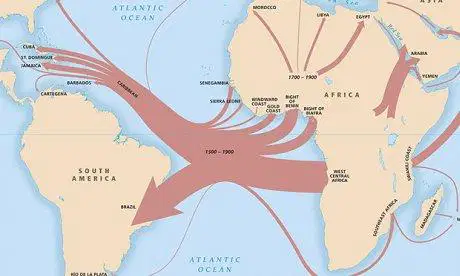
The map above illustrates which of the following?
The most frequent destination for African emigrants of the twentieth century
Predominant areas of origin and destination of African slaves in the fifteenth through nineteenth centuries
Proportional flows of African agricultural commodities during the nineteenth century
Winds and water currents that affected trans-Atlantic and trans-Saharan trade
Mansa Musa’s journey to Mecca in the 1300’s is evidence that
the Crusades had a great influence on western Africa
most African leaders were educated in the Middle East
European culture was superior to the cultures of western Africa
Islam had a major influence on the Mali Empire
Which time period saw the rise of Islam early spread of Islam?
Period 1 (Pre-history – 600 B.C.E.)
Period 2 (600 B.C.E – 600 C.E.)
Period 3 (600 C.E. – 1450 C.E.)
Period 4 (1450 C.E. - 1750 C.E.)
Which of the following are NOT characteristics of either the Qin or Zhou dynasties?
Feudalism as a government
Building of defensive walls
Development of a democratic form of government
Autocracy as a government
Alexander the Great’s conquests of Greece, Asia Minor, Egypt, and Persia led to the
spread of Hellenistic culture
adoption of a feudal system
establishment of representative democracy
spread of Islamic culture throughout Europe
Which of the following elements is contained in BOTH the Athens direct democracy and Roman republic forms of government?
Representatives are chosen to vote on all laws.
All full citizens were expected to actively participate in the government.
Each city-state would send representatives to the Senate.
All citizens are expected to vote on each and every law.
Which event in European history was most directly influenced by these individuals? - Johannes Gutenberg - King Henry VIII - John Calvin
Renaissance
Glorious Revolution
Protestant Reformation
trans-Atlantic slave trade
Feudalism and manorialism played an important role in western European society during the
medieval period
Pax Romana
Enlightenment
Age of Exploration
The Eightfold Path, the Four Noble Truths, and the concept of nirvana are associated with the religion of
Islam
Jainism
Shinto
Buddhism
Which of the following is an accurate comparison of the Inca and Roman Empire?
Both empires required all inhabitants to practice only the state religion
Both empires enslaved all conquered populations.
Both empires relied on an extensive network of maritime trade.
Both empires were able to integrate provinces through extensive roadways.
Marco Polo described which of the following at Kublai Khan’s court at Beijing that he had not encountered in Europe?
The use of spies in foreign nations
The interest of the Khan in the international sea trade and European shipbuilding techniques
The use of paper money and coal and the practice of frequent bathing
The austerity of the design of the Khan’s place.
After the expansion of Islam into Africa, an organized Christian presence remained in:
Egypt & Ethiopia
Morocco
Mauritania and Tunisia
The area along the Silk Road
The Mayans are different from the Aztecs and Inca societies in that they
did not worship the sun god.
were largely comprised of city-states.
practiced human sacrifice
had an advanced 2 calendar system
Which of the following languages came into existence after 1000 CE as the direct result of expanding global trade patterns?
Arabic
Latin
Sanskrit
Swahili
The term “samurai” describes men in feudal Japan who were most like the men in feudal Europe known as
Lords of the manor
Catholic bishops
Serfs
Knights
All of the following were significant technological advancements of the Chinese during the Tang and Song dynasty’s except:
Gunpowder
Movable type
The astrolabe
The compass
Which of the following innovations was most important in increasing trade in the Sahara Desert?
The camel saddle
Gun powder
Moveable type printing press
Magnetic compass
From the Muslim viewpoint, Christianity and Judaism were
earlier, less perfect versions of Islam
equal to Islam
not worthy of consideration
Useful only politically
Which is not true of the Aztecs
They were an extremely warlike people
They believed that their sun god required human blood
They were located in Mesoamerica
They worked diplomatically to establish loyalty among conquered peoples
The Indus Valley civilization
Developed planned cities with plumbing
is best studied through its written records
was isolated from other river valley civilizations because of surrounding mountains
declined after the arrival of Aryan invaders
Which world religion would be least likely to have a missionary outreach?
Islam
Christianity
Buddhism
Hinduism
The Hanseatic League was
A commercial confederation of merchant guilds that dominated trade along the coast of northern Europe.
A military alliance of European kingdoms against the Ottoman Empire.
A religious coalition that sought to spread Christianity in Asia.
An artistic movement that influenced the Renaissance in Italy.
Though not officially interested in foreign trade, what example below indicates the involvement of the Chinese government in internal trade?
The Great Wall of China
The opening of the civil service examinations’
The construction of the Grand Canal
The regaining of the Silk Roads during the Late Song Dynasty
The Rosetta Stone allowed modern historians to translate what ancient language?
Cuneiform
Latin
Greek
Hieroglyphics
Which of the following is the least likely reason early civilizations developed along rivers?
Provided drinking water
Rivers could be used for fishing as well as transport using boats
Served as barriers to stop invading armies
Overflowed each spring, re-fertilizing the lowland areas
A Phoenician contribution that people still benefit from today was
The introduction of Indo-Aryan languages to Europe
The invention of the Phonetic sail
The introduction of Iron weapons
The invention of the Phonetic alphabet
Which time period saw the rise of the Mongols?
Period 1 (Pre-history – 600 B.C.E.)
Period 2 (600 B.C.E – 600 C.E.)
Period 3 (600 C.E. – 1450 C.E.)
Period 4 (1450 C.E. - 1750 C.E.)
Which two religions believe that life is an endless cycle?
Hinduism and Christianity
Buddhism and Christianity
Hinduism and Buddhism
Confucianism and Islam
In the period 1500 to 1750, the population of the Portuguese colony of Brazil grew rapidly and became predominantly African. Which of the following best explains these demographic changes?
The adoption of the indigenous food crops by African migrants
Portuguese loss of colonial holdings in the Indian Ocean
The rapid natural increase of Brazil’s early slave population
The increase in global demand for cash crops such as sugar
Which order is correct chronologically for these West African Kingdoms?
Mali – Songhai – Ghana
Songhai – Ghana – Mali
Ghana – Mali – Songhai
Bantu – Mali – Ghana
Before 500 C.E. Judaism and Hinduism were similar in that both
Had written scriptures and an ethical code to live by
Spread widely around the Mediterranean
Promoted teachings about reincarnation
Advocated a monastic life and a rejection of the world
From the time of the Roman republic to the Pax Romana
Rome became increasingly democratic
Roman civilization became increasingly weaker
The territory of Rome continued to expand
Roman citizenship became increasingly rare
Which Prince of Moscow led the Russians to freedom from the Mongols controlling their country?
Ivan III
Vladimir
Peter the Great
Rus II
The chief purpose of the code of conduct that Confucius formulated was to
Improve society and government
Prepare for the afterlife
Enable the Zhou ruler to retain power
Encourage Chinese expansion
Which official measure made King Henry VIII the head of the Church of England?
Edict of Worms
The Great Schism
Act of Supremacy
Council of Trent
Put these time periods in chronological order from oldest to most recent.
Ancient World – Classical Age – Middle Ages – Renaissance
Classical Age – Ancient World – Middle Ages – Renaissance
Renaissance – Ancient World – Classical Age – Middle Ages
Ancient World – Middle Ages – Classical Age – Renaissance
The great gift of Champa to Song China was
Nutritious lentils
Tea
Quick-ripening rice
Poisonous projectiles
Which time period saw large empires such as Rome, Han, Persia, Mauryan?
Period 1 (Pre-history – 600 B.C.E.)
Period 2 (600 B.C.E – 600 C.E.)
Period 3 (600 C.E. – 1450 C.E.)
Period 4 (1450 C.E. - 1750 C.E.)
Which of the following was one of Luther’s main beliefs?
Men and women are naturally sinful.
Christian needed to be baptized again as adults.
Good works were required for salvation
All people with faith were equal.
Which of the following was a doctrine agreed upon at the Council of Trent?
Christians needed only faith for salvation
The Church’s interpretation of the Bible is final.
Priest cannot pardon sinners for committing sins
The Bible is the only authority for guiding Christian life.
Which is the correct chronological appearance of civilizations in Mesoamerica?
Olmec, Maya, Aztec
Maya, Olmec, Aztec
Aztec, Olmec, Maya
Olmec, Aztec, Maya
What regions of Asia were most likely to adopt Chinese Confucianism?
The agrarian societies on the east and south of China
The nomadic societies of the north of China
Western Islamic provinces
The agrarian societies of South Asia
Which of the following consequences of the Columbian Exchange most affected Amerindians (Native Americans) in the sixteenth century?
Diseases caused pandemics.
Newly introduced crops replaced indigenous American crops.
The influx of African slaves displaced Amerindians.
European livestock disrupted Amerindian agriculture
Ghana, Mali, and Songhai were all the center of what Trade network?
Indian Ocean Trade
Triangular Trade
Trans-Sahara Trade
Silk Road Trade
The 14th century may be the only century in human history where there was less people living at the end of it than the start of it. This is primarily a result of...
Disease
War
Aliens
Environmental factors
Feudalism is a political and economic system. In the Middle Ages, it worked because it provided something that people needed. What did people need?
Freedom
Rights
Protection
Education

