
 Worksheets
First Semester Biology Practice Questions
Total questions: 60
Worksheet time: 1hrs 28mins
What is competition in an ecological context?
A mutual benefit between two species
A relationship where two or more organisms fight for limited resources
A symbiotic relationship where both organisms benefit
A predator-prey interaction
Which statement best describes parasitism?
Both organisms benefit equally from the relationship
The parasite benefits while the host is harmed
The host benefits while the parasite is harmed
Both organisms are harmed
What is an example of symbiosis?
A lion hunting a zebra
Bull elk fighting over a herd of cows
Two species competing for water
A bee pollinating a flower
What is commensalism in ecological relationships?
A relationship where both organisms are harmed
A relationship where one organism benefits and the other is unaffected
A relationship where one organism is harmed and the other benefits
A relationship where both organisms benefit
How does mutualism benefit the organisms involved?
Only one organism survives while the other perishes
Both organisms are harmed
Both organisms benefit and it helps them survive
It does not affect the organisms involved

This variable in an experiment is the one being deliberately changed by the scientist.
dependent variable
independent variable
data
control group

Should experiments be repeated over and over to see if the results are the same each time?
yes
no

A series of steps used by scientists to solve a problem or answer a question.
scientific method
recipe
data collection
metric system

240 cm = ___________ m
2400
24
2.4
0.24
What is the basic unit of mass in the metric system?
Liter
Meter
Gram
Kilometer
Which statement describes a difference between producers and consumers?
All producers are types of plants, and consumers are types of animals
Producers live on land, but consumers may live on land or in water
Producers get energy only from consuming plant materials, and consumers get energy only from consuming other animals
Producers make their own food, and consumers eat other organisms to get food

What is the ULTIMATE source of energy for life on Earth?
Plants
Decomposers
Sun
Earth's Core

A plant that makes it own food is called a(n)
Autotroph
Heterotroph
Consumer
Herbivore

Which of the following is an example of a fossil fuel?
Coal
Solar Energy
Hydroelectric Power
Nuclear Power

The burning of fossil fuels is known as...
Decomposition
Photosynthesis
Combustion
Respiration

In order to be considered organic, a compound must contain...
Hydrogen
Carbon
Nitrogen
Phosphorus

___________ is the process by which dead matter is broken down into simpler substances by detritivores.
Respiration
Decomposition
Combustion
Photosynthesis

In ______________, plants use sunlight and carbon dioxide to make glucose and oxygen
Combustion
Respiration
Decomposition
Photosynthesis

Which type of organisms are responsible for turning nitrogen gas into a form useable by other organisms?
Animals
Plantae
Fungi
Bacteria
Which cycle involves condensation, evaporation, and precipitation?
The water cycle
The carbon cycle
The nitrogen cycle
The motor cycle
Which of the following cycles needs different types of bacteria to make the most common gas in the atmosphere useful to plants?
the water cycle
the carbon cycle
the nitrogen cycle
the hydrogen cycle
Which of the following cycles does photosynthesis produce oxygen and respiration produce carbon dioxide?
the water cycle
the carbon cycle
the nitrogen cycle
the hydrogen cycle
Primary succession occurs in an area that has:
Has Soil
Has No Soil
Has Some Soil
none of these
___ are the first organisms to colonize an area and begin the process of ecological succession.
foundational organisms
introductory organisms
primary organisms
pioneer species
What is the main difference between primary and secondary ecological succession?
Primary begins WITHOUT soil; Secondary begins WITH soil
Primary is the first state and secondary is the second stage
Primary builds plant community; secondary builds animal community.
Primary begins WITH soil; Secondary begins WITHOUT soil
What is an increase of biodiversity over time, after a natural or man made disturbance?
ecological recession
climax recession
ecological succession
climax succession
What is an example of a disturbance that could bring about secondary succession?
Humans cut down many trees in a small region
A volcanic eruption covers a village in lava.

A ______________ is a large molecule.
Micromolecule
Polymer
Amino Acid
Macromolecule
Which of the following elements are found in all macromolecules? (Select all that apply).


Which of the following is not one of the four major classes of macromolecules?
Lipids
Carbon
Protein
Carbohydrates
Nucleic Acid
Which macromolecule is used as our main source of energy?
Lipids/Fats
Nucleic Acids
Proteins
Carbohydrates
Nucleic acids make up which of the two molecules listed below?
FDA
RNA
DNA
FDR
Which macromolecule stores energy?
Carbohydrates
Proteins
Lipids/Fats
Nucleic Acids
The building blocks for organic compounds are called...
Polygons
Polymers
Monograms
Monomers
What is the monomer of proteins?
Amino Acid
Fatty Acid
Nucleotide
Monsaccharide
Enzymes are an example of
Lipids
Carbohydrate
Protein
Nucleic Acid
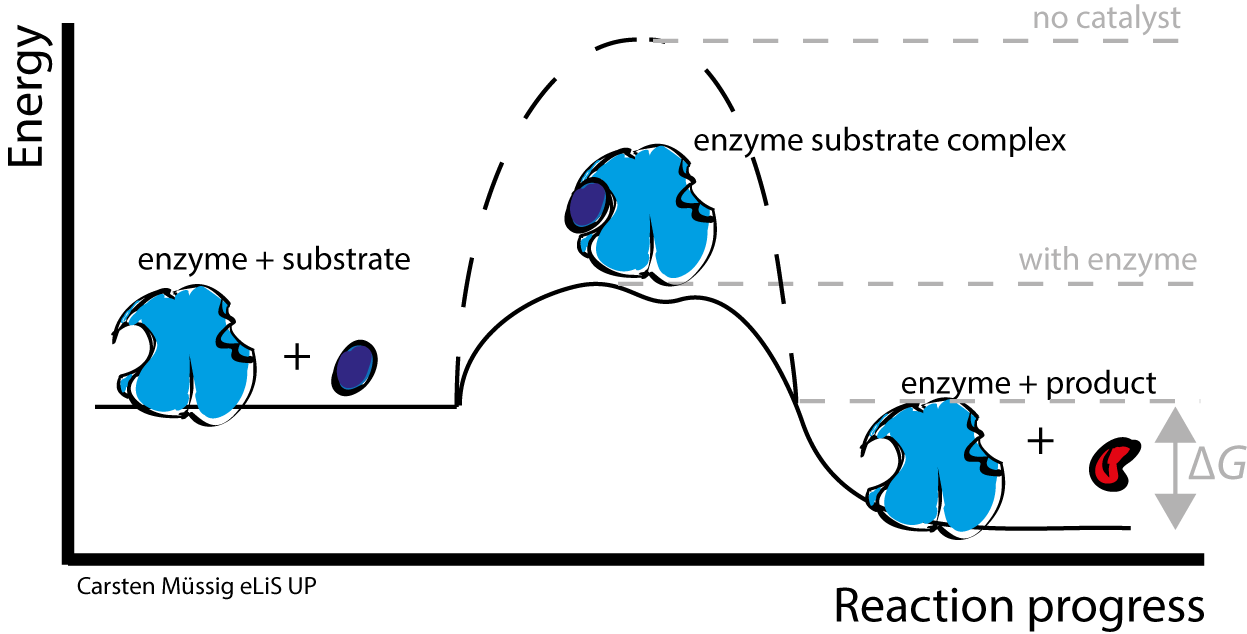
What happens when enzymes are heated to a high temperature?
The enzymes die.
The shape of the enzyme are changed and it denatures
The enzymes' amino acid sequence changes.
The enzymes remain the same
Activation energy
proteins that speed up chemical reactions
Changing substances by breaking and forming bonds (includes hydrolysis and dehydration reactions)
the capacity for doing work
the energy needed to start a chemical reaction
Reactants
the substances changed during a chemical reaction (goes into the process)
the substances made by a chemical reaction (comes out of the process)
substance that speeds up the rate of a chemical reaction
reactant of an enzyme-catalyzed reaction
Products
the substances changed during a chemical reaction (goes into the process)
the substances made by a chemical reaction (comes out of the process)
substance that speeds up the rate of a chemical reaction
reactant of an enzyme-catalyzed reaction

What can be inferred using the graph?
Cells can function equally as well at all pH values.
Cells do not function well at pH values that are too high or too low.
Cells function best at high pH values.
Cells function best at low pH values.
Which of the following two factors affect an enzyme's operation the most?
amount of light and temperature
blood glucose and pH
temperature and pH
amount of light and pressure
How are you feeling about the final?
Oh No!
Ehh
I think I can do it.
Oh easy!

