
 Worksheets
Физика @#₽&
Total questions: 57
Worksheet time: 29mins
Oxygen weighing 0.1 kg occupies a volume of 200 liters at a temperature of 200 K. What pressure does this state of gas correspond to?
Р=0,26 mPa
P=0 Pa
P=2,66 kPa
P=26 kPa
P=390 kPa
What happens to the pressure of a gas when the root mean square speed of its molecules decreases?
pressure increases
pressure decreases
pressure does not change
pressure does not depend on speed
will increase threefold
How will the energy of gas molecules change if the temperature doubles:
will not change
will increase 2 times
will decrease by 2 times
will increase 4 times
will decrease by 4 times
How will the density of an ideal gas change when it is cooled isobarically?
decrease
won't change
there is not enough data to answer the question
can change in any way
will increase
The mass of hydrogen gas in the vessel is 4 g. Approximately how many hydrogen molecules are in the vessel?
10^ 23
4*10^23
2*10^-23
12*10^23
10^-23
How will the root mean square speed of nitrogen molecules change if the temperature of the gas increases 4 times?
will increase 2 times
will decrease by 4 times
will increase 4 times
will decrease by 2 times
will not change
What causes Brownian motion?
collision of particles suspended in a liquid (or gas)
collision of liquid (or gas) molecules with each other
collision of molecules of a liquid (or gas) with particles suspended in it
thermal movement of liquid particles
none of the above reasons
A vessel with a capacity of 0.83 m 3 contains helium. Gas mass 0.16 kg. At what temperature does helium exert a pressure of 60 kPa on the walls of the vessel?
T=300°C
T= 300K
T=150°C
150K
T= 2,4•10~3K
Estimate approximately the mass of 1 m*3 of air at normal atmospheric pressure and temperature 300 K. Select from the values below the closest to the result you obtained.
10 g
100g
1g
1kg
10kg
If a gas is under normal conditions, then its pressure and temperature are equal:
P= 0, T= 273 K
P= 0 Pa, t=0° C
P=10~5 Pa, T= 0 K
P= 100 kPa, T= 273 K
P= 1 atm, temperature could be any
The mean square speed of molecules of a certain gas in the first vessel is 3 times greater than the mean square speed of molecules of the same gas in the second vessel. What is the ratio of gas densities in the first and second vessels if the gas pressure is the same?
3
1
1/3
1/9
9
How many degrees of freedom does a diatomic gas molecule have?
i = 5;
i=3
i=6
i=7
could be any;
When an ideal gas was heated, the mean square speed of thermal motion of molecules increased 4 times. How did the absolute temperature of the gas change?
increased 4 times
increased 8 times
increased 2 times
increased 12 times
increased 16 times
Which of the following formulas is the basic equation of the molecular kinetic theory of an ideal gas?
V=Vn^2+Vy^2
V=N/Na
P=1/3m0n(v)^2кв
pV/N=kT
pv=m/M*RT
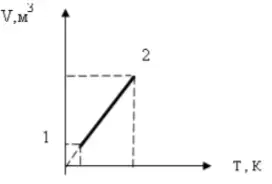
During isobaric heating, an ideal gas is transferred from state 1 to state 2. How did the gas pressure change? The mass of the gas is constant.
decreased.
increased.
has not changed.
you need to know the mass of the gas.
there may be different answers for different gases.
The internal energy of a gas consists of Ek - the total kinetic energy of the molecules and Ep - the potential energy of their interaction. At what ratio between Ek and Ep can the state of a gas be described by the Mendeleev-Claiperon equation?
Ek =0, Ep#0
Ек#0, Ep =0
Еk = Ep
Ek> 0 and Ep >0
Ek=0 and EpП<0
<question>Determine the number of degrees of freedom of oxygen molecules (O2).
3
6
5
9
1
What formula is used to determine the average number of collisions of a molecule in 1 s?
N/Na
3/2kT
Z=√2πd^2un
m/m0
m/M
Give the adiabatic equation.
pV =RT
pV=const
pV^y =const
p/V=const
V/T=const
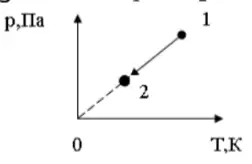
The graph shows the process of cooling a given mass of gas from T1 to T2. How did the gas density change in this process?
halved
decreased
increased
increased twice
has not changed
Indicate the formula for an isochoric process.
P/T=const
PVconst
PV=const
V/T=const
PV/T=const
At a temperature of 27°C, the gas pressure in a closed vessel was 75 kPa. What will its pressure be at temperature t=-13°C2
5 kPa
15 kPa
20 kPa
35 kPa
65 kPa
One mole is the SI unit of measurement…
mass of matter
molar mass of a substance
amount of substance
relative molecular weight
molecule mass
What is the ratio of the root mean square velocities of hydrogen and oxygen molecules at the same temperature? The molar mass of hydrogen is 2x10^-3 kg/mol, oxygen 32x10^-3 kg/mol.
2
4
1
16
32
<question3>What is the average kinetic energy of one water molecule?
1kT
2kT
3kT
6kT
1/2kT
Which formula determines the value of the root-mean- square velocity of translational motion of particles of a monatomic gas?
√2kT/m
√3kT/nm
√3kT
√3kT/m
√2kT/nm
An ideal gas at temperature To had a pressure Po. With a constant mass, the temperature of the gas at a constant volume was increased by 1.5 times. How did the gas pressure change?
P=4/9P0
P=2/3P0
P=P0
P=9/4P0
P=3/2P0
The internal energy of an ideal gas is:
kinetic energy of gas movement together with the vessel
potential energy of interaction of molecules
internal energy
work in a loop
kinetic energy of chaotic movement of gas molecules
Entropy of a closed system performing a reversible Carnot cycle:
decreases
increases
the change can be anything
decreases and increases
does not change
YoThe working fluid of an ideal heat engine received 50 kJ energy from the heater at a temperature of 527°C. Determine the efficiency of the engine and the amount heat transferred to the refrigerator if its temperature is 0°C.
66%, 17 kj
62,5%, 18,75 kj
56%, 22 kj
62,5%, 31,25 kj
61%, 17 kj
A heat engine receives 100 J of heat from the heater per cycle and transfers 60 J to the refrigerator. What is the efficiency of the
machine?
60%
~67%
25%
16%
40%
In which process there is no work done by the gas?
isochoric
isobaric
polytropic
adiabatic
isothermal
Entropy and thermodynamic probability are related by the formula:
∆S=k*In W
S=R*InW
∆S=R*InW
S=k*InW
S=k*ln(∆W)
During what process is the work done by the gas equal to the loss of its internal energy?
isochoric
isobaric
isothermal
adiabatic
such a process is not possible
Is heat transfer from a cold body to a hot body possible?
possible due to further cooling of the cold body
impossible under any circumstances
possible by doing work
it depends on the process
possible only in a heat engine
Diffusion coefficient D of hydrogen under normal conditions, if the mean free path is i=0.16^-6 m equal to:
9.7*10^-4 m^2/s
9.1*10^-5 m^2/s
8*10^-3 m^2/s
9.8*10^-4 m^2/s
300m^2/s
When isobarically heating a certain mass of oxygen O2 on 200K, 25 kJ work is done to increase its volume. The molar mass of
oxygen and the universal gas constant are equal, respectively:
=32*10^-3 кг/ моль, R =8,31Дж/мольК The mass of oxygen is equal to:
0,520 kg
0.491 kg
0.90 kg
8.1 kg
0.481 kg
The gas increased isobarically to three times its volume at pressure 3-10^5 kPa . To increase its volume it was necessary to do work of 12.9 kJ. The initial volume of gas is:
3,14 *10^2 m^3
400м
2,15*10^-2 m^3
2,56*10^2 м^3
0,85м^3
The resistance force F acting from the fluid flow on a ball slowly moving in it is equal to:
F=6πnru
F=ma
F=3πnru
F=m* du/dt
F=-kx
Coefficient of thermal conductivity is numerically equal to…
the amount of heat transferred through a unit area
the amount of heat transferred per unit time
the amount of heat transferred per unit time at a unit value of the temperature gradient
the amount of heat transferred per unit time through a unit area at a unit value of the temperature gradient
unit
The diffusion equation is: (S - arbitrary area)
M=-D*dp/dr*St
M=-D*dp*St
M=p*V
M=-grad*p
The force of internal friction is:
F=-n*dV/dr*S*t
F=n*dV/dr*t
>F=n*dV/dr
F=-n* dV/dr*S
F=n*dV/dr*S
Refrigerator:
produces cold
turns heat into cold
dissipates heat
A refrigeration machine is a type of heat engine
takes heat from the working volume and dissipates it in the surrounding space
The change in internal energy…
does not depend in any way on the type of process and is determined by the initial and final states of the gas
depending on the type of process performed by the gas
depends on changes in the volume occupied by gas
depends on the type of function P= f(V)
depending on the type of heat exchange
An ideal heat engine transfers 30% of the heat received from the heater to the refrigerator. Find the temperature of the refrigerator if the heater temperature is 27°C.
-183K
292K
210K
483K
281K
Indicate a method for determining the ratio of heat capacities at constant pressure to heat capacity at constant volume.
Stokes method.
In Perrin's experiments
In Newton's experiments.
Clément-Desormes method
Fourier method
Indicate the method for determining the viscosity
Clément-Desormes method.
In Perrin's experiments.
In Newton's experiments.
Fourier method
Stokes method.
What processes are used in the Clément-Desormes to determine the ratio of the heat capacities of gases?
Isochoric and isobaric.
Isochoric and isothermal.
Isobaric and adiabatic
Isobaric and isothermal
Isochoric and adiabatic.
Indicate the formulation of the first law of thermodynamics.
The amount of heat transferred to the system is used to perform work against external forces and change the internal energy of the system.
A perpetual motion machine of the second kind is impossible.
Irreversible processes in closed systems occur with increasing entropy.
In a closed Carnot cycle, processes occur at constant entropy.
The process of spontaneous transfer of heat from a cold body to a hot one is impossible.
Indicate the statement of the second law of
thermodynamics.
A perpetual motion machine of the second kind is impossible
In a closed Carnot cycle, processes occur at constant entropy.
When work is done on the system, heat transfer from a cold body to a hot one is possible.
In open systems, entropy can either increase or decrease
A perpetual motion machine of the second kind is impossible.In open systems, entropy can either increase or decrease
Which of the following answers determines the frequency of oscillation of a mathematical pendulum?
2π√l/g
2π√g/l
√l/g
l/2π√l/g
l/√l/g
How much will the phase change during one complete oscillation?
π/2
2π
π
0
4π/3
The equation of harmonic oscillations in differential form has the form:
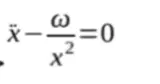
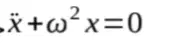
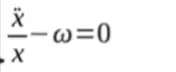
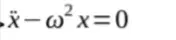
d^2x/dt^2-w^2*x=0
Find the period of oscillation of a mathematical pendulum, length l= 4.9 m and mass m = 13 kg (g = 9.8
m/s^2).
T=3,2 s
T=7,2 s
T=52,4 s
T=4,4 s
T=13,2 s
<question2>Oscillation frequency of the wave source v =0.2 s^-1, wave propagation speed 10 m/s. What is the wavelength?
2 m
0,02 m
50m
30m
It is impossible to determine the wavelength based on the conditions of the problem
In the plane wave equation: Z=Z cos(wt - kx) indicate the wave number.
w
Zo
k
x
t
The energy of an ideal gas molecule is:
potential
kinetic
sum of kinetic and potential
mechanical
internal

