
 Worksheets
Art History: Art 1 Semester 1 REVIEW
Total questions: 89
Worksheet time: 45mins
Name
Class
Date
1.
Art History is the study of art from across the world, and from
a)
prehistoric to present time
b)
ancient to present time
c)
the year 0 to present time
d)
ancient to historic
2.
Art History Covers
a)
the recorded aspects of human history and experience
b)
every single aspect of human history and experience
c)
virtually every aspect of human history and experience
d)
virtually every aspect of history and human existence
3.
Check all that apply.
Art History takes into account all of the following except:
a)
cultural ideas
b)
critique
c)
religion
d)
philosophy
e)
cognition
4.
According to your notes, which of the following terms means existing or being everywhere at the same time?
a)
universal
b)
omnipresent
c)
obsequious
d)
ubiquitous
5.
Art History is important because
a)
it provides a means by which we can understand our human past and relationship to out present
b)
it provides different perspectives and gives us a well rounded way of looking at events, situations and people.
c)
it gives college students something to major in
d)
both A & B
6.
Most of what we know about _______________ comes from the _______________ left behind.
a)
art, history
b)
history, art
c)
history, written stories
d)
art, pictures
7.
Taking inventory of everything you see is done during which step of the Art Critique process?
a)
Description
b)
Analysis
c)
Interpretation
d)
Judgment
8.
Using the Elements of Art and the Principles of Design to help you describe what you see is done during which step of the Art Critique process?
a)
Description
b)
Analysis
c)
Interpretation
d)
Judgment
9.
The ideas, mood, emotion, and stories an artwork communicates falls under which step of the Art Critique process?
a)
Description
b)
Analysis
c)
Interpretation
d)
Judgment
10.
Listing the reasons you feel an artwork is successful or not is done during this step of the Art Critique process:
a)
Description
b)
Analysis
c)
Interpretation
d)
Judgment
11.
The Prehistoric Era lasted from
a)
40,000 to 8,000 BCE/BC
b)
40,000 to 200 AD/CE
c)
30,000 to 200 AD/CE
d)
200 AD/CE to present day
12.
The earliest human inhabitation occurs in
a)
Africa
b)
America
c)
England
d)
New Braunfels
13.
A Megalith is
a)
a stone structure created without mortar or cement.
b)
a prehistoric animal.
c)
drawing or painting on stone.
d)
the elevator lift at DMS.
14.
Examples of stone carvings were
a)
tools
b)
statues
c)
cave walls
d)
All are examples
15.
Jewelry was made from
a)
shells, teeth, bones, human hair, and other natural objects.
b)
shells, teeth, silver, and other natural objects.
c)
shells, teeth, bones, and fish heads.
d)
shells, teeth, bones, gold, silver, and other natural objects.
16.
Cave Art pictographs are
a)
drawings that are carved into stone.
b)
jewelry made of seashells.
c)
Drawing or painting on stone.
d)
Cave men dancing by the fire.
17.
Pigments are made of
a)
natural materials: rocks, plants, blood, and carbon.
b)
natural materials: cotton, silk, limestone, and carbon.
c)
natural materials: rocks, plants, limestone, and clay.
d)
natural materials: blood, limestone, and clay.
18.
A preliterate is
a)
someone who is not educated or sophisticated.
b)
someone who is educated and sophisticated.
c)
someone who can speak many languages.
d)
someone who is part of the Egyptian society.
19.
Egyptian Era was from
a)
3000 BCE/BC to 30 AC/CE.
b)
3000 AC/CE to 30 AC/CE
c)
30,000 BCE/BC to 30 AC/CE
d)
None of the choices
20.
What writing used images in the Egyptian Era?
a)
Hieroglyphics
b)
The English Language
c)
Papyrus
d)
Pharaohs
21.
Paper used in Egyptian Era was
a)
papyrus
b)
dynasties
c)
notebook
d)
polytheistic
22.
Ruler who was also considered a God in the Egyptian Era.
a)
Pharaoh
b)
Papyrus
c)
Polytheistic
d)
architects
23.
What were the 3 major periods of the Dynasties in Ancient Egypt?
a)
Old, Middle, and New Kingdoms
b)
PreDynastic, Libyan , and Greek
c)
Early Dynastic, Greek, and Roman
d)
Egyptian, Greek, and Roman
24.
Egyptians had innovations in
a)
Math (Cubit measurement)
b)
Solar Calendar
c)
Hieroglyphics & Hiratic
d)
All Choices are correct
25.
Egyptians believed in
a)
The Afterlife
b)
Mummifications
c)
Polytheism
d)
All answers are correct
26.
In the pyramid, the King's burial chamber is called
a)
the Grand Gallery
b)
the King's room
c)
the Grand King's chamber
d)
the Giza
27.
The 3 great pyramids in Egypt are called
a)
Giza
b)
Valley of the Kings
c)
the Kings Chambers
d)
Valley of the Gods
28.
The original color of the pyramids when built was
a)
yellow
b)
orange
c)
white
d)
beige
29.

What type of columns does the Lincoln Memorial have?
a)
Corinthian
b)
Ionic
c)
Doric
d)
Colosseum
30.
The Greek & Roman art period occurred during this time:
a)
1,000 BCE/BC to 500 CE/AC
b)
1,000 CE/AC to 500 BCE/BC
c)
500 BCE/BC to 1,000 CE/AC
d)
500 CE/AC to 1,000 BCE/BC
31.
This type of art is made with small tiles to decorate walls, ceilings, and floors.
a)
fresco
b)
contrapposto
c)
landscape painting
d)
mosaics
32.
This type of column is the most ornate and is adorned with leaves.
a)
Corinthian
b)
Ionic
c)
Doric
d)
Contrapposto
33.
Nike shoes were named after this famous sculpture:
a)
Winged Nike - The Roman Goddess of Victory
b)
Winged Victory -The Greek Goddess of Victory
c)
Winged Goddess of Nike - The Goddess of Victory
d)
Winged Swoosh of Greece - The Greek Goddess
34.
Contrapposto is
a)
the statue standing with most of its weight balanced on both legs.
b)
the human figure standing with most of its weight balanced on both legs.
c)
The human figure standing with most of its weight shifted on one leg/foot.
d)
the stutue resting on both legs evenly.
35.

What type of column is the following?
a)
Doric
b)
Ionic
c)
Donic
d)
Corinthian
36.
What was the name used that combined the Greek and Roman Era?
a)
GrecoRoman
b)
RomanGreco
c)
GrecoRomania
d)
GrecoRomanite
37.
What were the 3 types of Roman Architecture?
a)
Arch, Circle, Dome
b)
Arch, Vault, Dome
c)
Dome, Circle, Vault
d)
Vault, Dome, Round
38.
The Pantheon was built to inspire geometric design. What identifies details to support this design?
a)
Occulus
b)
Sphere
c)
Sundial
d)
All of the above
39.
What 3 periods is Ancient Greece divided into?
a)
Archaic, Classical, and Hellenistic
b)
Greek, Roman, and Hellenistic
c)
Archaic, Roman, and Hellenistic
d)
Archaic, Roman, and Greek
40.

What period is this statue from?
a)
Roman Era
b)
Greek Era
c)
Prehistoric Era
d)
Egyptian Era
41.
The Parthenon uses columns to present __________________ that were copied in the Western World in buildings like the White House, Courthouses, and Churches.
a)
symmetry
b)
Mosaics
c)
Frescos
d)
Greek Gods
42.
Roman culture adopted many Greek ideas including
a)
God's & Goddesses of Mythology
b)
Sculptures of Marble and Bronze
c)
Pompeii
d)
All of the above
43.
Greek Pottery was made on a wheel using
a)
Black and Red Clay
b)
Black and Yellow Clay
c)
Black and Brown Clay
d)
Brown and Orange Clay
44.
What material was used to preserve the people of Pompeii in their last moments?
a)
Plaster of Paris
b)
Marble
c)
Foam
d)
Glue
45.
Romans ideology in art was to present
a)
a show of power and impress the public.
b)
and show their love for the people.
c)
mosaics on all the walls and floors of Rome
d)
None of the above.
46.
No one survived the Pompeii eruption of Mt. Vesuvius.
a)
True
b)
False
47.
What did the Greeks first use and design that showed a patron God or Goddess that we still use today?
a)
the coin
b)
the statue
c)
the toilet
d)
All of the above
48.
According to the map, Rome occupied and ruled Armenia.
a)
True
b)
False
49.

These sculptures are examples of
a)
Totem dolls
b)
Sioux dolls
c)
Cherokee dolls
d)
Kachina dolls
50.
About how many different tribes of indigenous people are credited with creating Native American Art?
a)
578
b)
575
c)
573
d)
576
51.
Native American Art is still being made in present times.
a)
True
b)
False
52.
Fashion is one of the traditional art media in Native American Art.
a)
True
b)
False
53.
According to your notes, traditional Native American art was made from
a)
animal hides, mud and pigments
b)
animal hides, clay and natural pigments
c)
animal hides, clay and synthetic pigments
d)
animal hides, mud and natural pigments
54.
Which were the three largest Native American tribes?
a)
Navajo, Cherokee, and Sioux
b)
Sioux, Navajo, and Cheyenne
c)
Cherokee, Cheyenne, and Navajo
d)
Sioux, Cheyenne, and Cherokee
55.
Which of the following is NOT a characteristic of Native American Art?
a)
Many tribes viewed colors as having different meanings
b)
Symbols were often used
c)
Art was made only by men
d)
Art skills were passed down from generation to generation
56.
The Native American Art period lasted from
a)
1,000 BCE/BC to Present
b)
1,000 CE/AD to Present
c)
Present to 1,000 BCE/BC
d)
Present to 1,000 CE/AD
57.
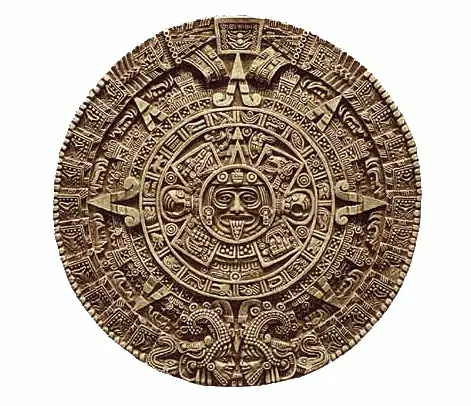
This art work is called a:
a)
Mayan Calendar
b)
Sun Calendar
c)
Mesoamerican Calendar
d)
American Calendar
58.
The Mesoamerican region was located from
a)
North America to Mexico
b)
Mexico to Maya
c)
Costa Rica to Maya
d)
Mexico to Costa Rica
59.
Which of the following is NOT a characteristic of Mayan artworks:
a)
spiritual in nature
b)
depict battles
c)
depict everyday life
d)
use of a modern day alphabet
60.
The Mayan Art Period lasted from
a)
500 CE/AD to 1500 CE/AD
b)
500 BCE/BC to 1500 CE/AD
c)
1500 BCE/BC to 500 BCE/BC
d)
1500 CE/AD to 500 CE/AD
61.
The interior rooms of Mayan pyramids were often painted with ______________ using Mayan Blue.
a)
mosaics
b)
hieroglyphics
c)
kachina dolls
d)
murals
62.
The Mayans used ____________ and __________ to carve materials such as wood, jade and stone.
a)
stone tools and mallets
b)
stucco modeling and stone tools
c)
animal bones and stone tools
d)
mallets and stucco modeling
63.
Many _________________ tribes viewed colors as having meaning.
a)
Mayan
b)
Greek
c)
Native American
d)
Roman
64.
Which was NOT a Dramatic Change that influenced art for Native Americans?
a)
Trail of Tears
b)
Buffalo
c)
Expeditions
d)
Resilience/Suffering
e)
Mayan Calendar
65.
What is art that is created by the traditional people who come from the land?
a)
Indigenous Art
b)
Natural Art
c)
Colorful Art
d)
Traditional Art
66.
What was NOT an effect of the Trail of Tears?
a)
1 tribe was effected and no one else
b)
Traveled over 800 miles on foot
c)
Hunger/Exaustion/Disease
d)
Lasted from 1831-1850
67.
What do Native Americans and Mayans have in common that is still around today?
a)
Hieroglyphics
b)
Performing Arts: Dance & Music
c)
Mandala Calendar
d)
Mayan Blue
68.
Stone slabs to commemorate periods of time and the kings or gods who ruled the city were called _____________.
a)
Stelae/Stela
b)
Mayan Blue
c)
Indigo
d)
Heiroglyphics
69.
Mayan murals were painted using _____________.
a)
Indigo/Mayan Blue
b)
Stelae/Stela
c)
Ceramics
d)
Turquoise
70.
The Medieval Art period lasted from
a)
476 BC/BCE to 1485 BC/BCE
b)
476 CE/AD to 1485 BC/BCE
c)
476 BC/BCE to 1485 CE/AD
d)
476 CE/AD to 1485 CE/AD
71.
What two religions had a major impact on the art created during the Medieval time period?
a)
Christianity and Islam
b)
Catholicism and Islam
c)
Christianity and Catholicism
d)
Christianity and Gothic
72.
Most artists during this art period were monks and priests, or specialized craftsmen.
a)
True
b)
False
73.

The disk of light behind the heads of figures _______________.
a)
are halos
b)
are religious iconography
c)
indicate a holy person
d)
all of the above
74.
This characteristic of Medieval art was made using gold leaf and calligraphy.
a)
Mythological animals
b)
Illuminated Manuscripts
c)
Knotwork
d)
Hierarchy of important people
75.
During Medieval times, everyday people needed images to tell stories because __________________________.
a)
a written language wasn't developed yet
b)
they were illiterate
c)
children were not taught to read
d)
it was against the law to write Biblical stories
76.
Gothic architecture began during this art period
a)
Renaissance
b)
Roman
c)
Greek
d)
Medieval
77.
Medieval art can be divided into these two time periods
a)
Dark and Middle ages
b)
Italian and Northern
c)
Illuminated and Mythological ages
d)
Celtic and Dark ages
78.
We can tell which people in a work of art were more important because they ___________________________.
a)
wore a crown
b)
appeared larger
c)
had a halo
d)
were decorated with gold leaf
79.
We can tell which people in a work of art were holy, saints, angels, or prophets because they _________________.
a)
wore a crown
b)
appeared larger
c)
had a halo
d)
were decorated with gold leaf
80.
What represents strength and is shown fighting a knight many times?
a)
Snails
b)
Flowers
c)
Dogs
d)
Lions
81.
Romanesque is NOT represented by ________.
a)
Low and wide churches
b)
separate areas
c)
low light
d)
integrated space
82.
Gothic is NOT represented by ____________________.
a)
tall pointed arches and ribbed vault ceilings
b)
integrated space and flying buttress
c)
flooded natural light and rose stained glass windows
d)
low and wide churches
83.
Mythological Animals represented were___________________.
a)
horses and lions
b)
unicorns and dragons
c)
serpents and trolls
d)
fairies and nymphs
84.
Christ was represented by ___________________ as a symbol of peace.
a)
the lion
b)
the lamb
c)
the baby
d)
none of these answers
85.
Decorative art was ornate in the Middle Ages represented in ______________________.
a)
Statues and Gargoles
b)
Door Panels
c)
Chalices
d)
All answers are correct
86.

What is this Knotwork called?
a)
The Bayeux Tapestry
b)
The Parade of the Kings
c)
The Illuminated Manuscript
d)
The Alhambra Palace
87.
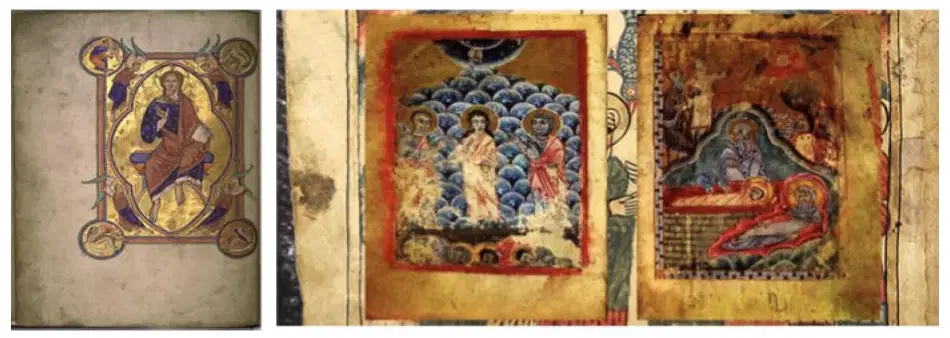
These are called _____________________.
a)
The Bayeux Tapestry
b)
Illuminated Manuscripts
c)
Islamic Tile
d)
Sutton Hoo Helmet
88.

This is called _______________________.
a)
Sutton Hoo Helmet
b)
Illuminated Manuscript
c)
Islamic Tile
d)
None of these answers are correct
89.
Celtic art was used to elaborate _______________________.
a)
knotwork
b)
hierarchy
c)
unicorns and dragons
d)
illuminated manuscripts
100 %

