
NEW
Font size
 Worksheets
Central Dogma- Practice for the Unit Test Test
Total questions: 24
Worksheet time: 12mins
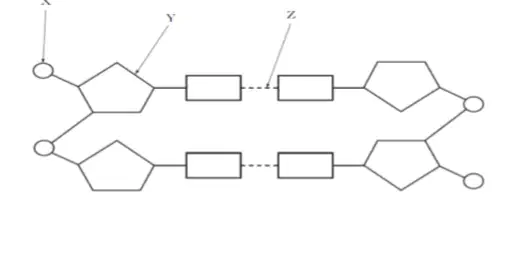
What is Z pointing to?
Hydrogen Bond
Pentose Sugar
Phosphate
What is Y pointing to?
Hydrogen Bonds
Pentose Sugar
Phosphate
Which of the following correctly lists and describes the pyrimidine nitrogenous bases?
A & T, double rings
A & T, single ring
C, T; single ring
C, T; double ring
DNA looks like a “twisted ladder”. If the “rungs” of the ladder are made up of nitrogenous bases, what are the handrails or backbone of the ladder made up of?
Sugars and Salts
Phosphates
Sugars
Sugars and Phosphates
DNA strands run _____ in relation to each other.
antiparallel
parallel
perpendicular
both a and b
A nucleotide in DNA is composed of _____.
a deoxyribose sugar, a phosphate, and a nitrogen base
only a deoxyribose sugar and a nitrogen base
only a deoxyribose sugar and a phosphate
none of the above
Between the two strands of a DNA segment the nitrogen bases are held together by _____.
covalent bonds
hydrogen bonds
ionic bonds
metallic bond
What type of bond is found between the sugar-phosphate backbone?
hydrogen bonds
ionic bonds
phosphodiester bonds
crazy glue
How many hydrogen bonds are between C and G?
one
two
three
Which of the following is the monomer (building block) of DNA?
nucleotide
monosaccharide
amino acid
What is the complementary DNA strand to ATT CGC?
ATT CGC
CCG TAA
CGC ATT
TAA GCG
Why is the deoxyribose categorized as a pentose sugar?
it has 5 nitrogenous bases
it has 4 carbon atoms
it has 5 phosphate groups
it has 5 carbon atoms
Which of the following statements regarding RNA is false?
RNA contains the sugar dextrose.
RNA contains the nitrogenous base uracil.
RNA molecules are single stranded.
RNA molecules can be in the nucleus, cytoplasm, &/or attached to ribosomes.
Before the mRNA leaves the nucleus, it must be processed which includes:
adding a single “G” cap
adding a poly “A” tail
removing the introns (junk DNA)
all of the above
What is the purpose or outcome of transcription? Hint, it occurs in the nucleus.
create the amino acids
join the amino acids via peptide bonds
change “languages”
create mRNA
Where does translation occur in cells?
in the ribosomes
in the nucleus
in the chloroplasts
in mitochondria
Which of the following amino acids only has ONE mRNA codon?
Valine (Val)
Glycine (Gly)
Leucine (Leu)
Methionine (Met)
What is the transcription product of the sequence GCT?
CGT
CGA
CAG
GCU
Using the genetic code shown, what amino acid does the mRNA sequence CUA code for?
Asp
Val
Leu
Met
Let's say that the DNA code was mutated from TCA to TCC, what would be the outcome:
neutral mutation because they code for the same amino acid
the amino acid Arg would replace the amino acid Ser
the amino acid Lys would replace the amino acid Asn
not enough information is given to determine the outcome
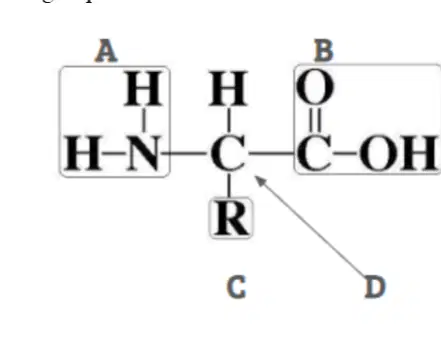
In the diagram at the right, which letter represents the amino group?
A
B
C
D
Which of the following is the monomer of a protein?
monosaccharide
amino acid
carboxyl group
nucleotide
Which level of structure is NOT found in all proteins?
Primary structure
Secondary structure
Tertiary structure
Quaternary structure
Proteins can be easily denatured because most levels of structure rely on these weak bonds:
peptide bonds
ionic bonds
covalent bonds
Hydrogen bonds

