
 Worksheets
Continental Drift
Total questions: 58
Worksheet time: 3590secs
What does the theory of Continental Drift explain?
Ocean currents move continents around the planet
Convection works deep within the asthenosphere
Mid-ocean ridges force tectonic plates to move
Continents were once together and slowly drifted to where they are today
Tectonic plates are made of?
The mantle
Continental and oceanic lithosphere
The outer core
The mesosphere
Where are the youngest rocks on Earth found?
Along mid-ocean ridges
Along transform boundaries
On the edges of the continents
Near ocean trenches
Who was the scientist who proposed the theory of continental drift?
Alfred Powell
Harry Hess
Alfred Wegener
Ernest Rutherford
How far do tectonic plates move each year?
Meters per year
Centimeters per year
Kilometers per year
Feet per year
Where does seafloor spreading take place?
Convergent boundaries
The continentals shelves
Transform boundary
Mid-ocean ridges
What is the driving force behind the movement of the tectonic plates?
Gravity
Convection
Wave motion
Seismic activity
What is the process of convection?
The process of hot material rising and cooler material sinking in circular patterns
The process of hot rock solidifying and forming new crust
The process of explaining what goes up must come down
Strong ocean currents moving tremendous amounts of material
The super continent that existed when all continents were together was named
Gondwana
Laurasia
Eurasia
Pangea
Tectonic plates consist of
continental crust
mesospheric crust
both continental and oceanic crust
oceanic crust
The idea that the continents were once part of a single landmass that broke apart and
moved is
Continental Drift
Tectonic Plates
Transform
The scientist who developed the big idea called "sea-floor spreading"
Alfred Wedgener
Harry Hess
Edward Dutton
Ortelius
Pangaea was an ancient supercontinent made up of...
America, Greenland, and Europe
Antarctica, India, and America
all of Earth’s continents
South Africa, India, Australia, and South America
Why did no one believe Wegener's thoery that the continents were once together?
He could not explain HOW the continents moved
He didn't have evidence
His data was wrong
He didn't use the right technology to gather data
The movement of the tectonic plates is caused by
the rotation of the Earth
convection currents in the Asthenosphere
the gravity of the iron-nickel core
the Moho discontinuity
The fact that similar fossils are found on both sides of the ocean is evidence of
magnetic reversal
global positioning
continental drift
oceanic drift

What process is this?
sea floor spreading
subduction

What process is this?
subduction
sea floor spreading

What landform is this?
trench
mid ocean ridge
formation foundry

What type of landform is this?
trench
mid ocean ridge
giant boundary

_______________ causes hot rocks to rise to the crust.
convection
radioactivity
induction
Why was Wegener's theory rejected?
he really was a crazy little man
he found evidence of matching fossils, land formations and climate evidence
he could not identify the cause behind continental drift
he did not have the support of his fellow scientists
What 3 things did Wegener study to support his ideas? Mark all THREE.
matching fossils
matching land features
matching forces
climate change
A tropical plant fossil is found in Antarctica...this is what type of evidence?
matching fossil
matching land formation
climate change
memorial movement
Glacier grooves are an example of climate change evidence because?
glacial grooves are found in Antarctica today and it is cold
glacial grooves are found in the warm areas today, so it means that continent used to be near the poles
glacial grooves are found in the cold today and it is closer to the poles
glacial grooves are found in the warm areas because there was an ice age and continents were never together
coal is an example of climate change evidence because...
it is found in tropical areas today so it used to be near the equator
it is found in swampy areas today so the area used to be near the poles
it is found in cold areas today so it used to be closer to the equator
coal is not an example of climate change

This picture is an example of which type of evidence?
matching fossil
matching land formation
climate change
memorial movement

This picture is an example of which type of evidence?
matching fossil
matching land formation
climate change
memorial movement

This picture is an example of which type of evidence?
matching fossil
climate change
matching land formation
memorial movement
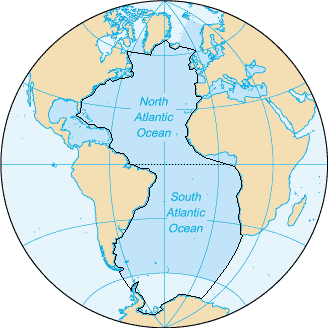
Alfred Wegener thought which 2 continents looked like puzzle pieces that could fit together?
Antarctica and Asia
South America and Africa
South America and Australia
Africa and Pangaea
Study of plates, their movement, and Earth’s features that they affect
Plate boundaries
Plate Tectonics
Major mountains
Oceanic crust near the mid-ocean ridge is younger than oceanic crust farther away from the ridge.
true
false

How is it possible for new crust to be formed without increasing the surface area of the Earth?
Crust is destroyed at the same time it is created
New crust is underwater where it sinks
New crust breaks more easily than old crust
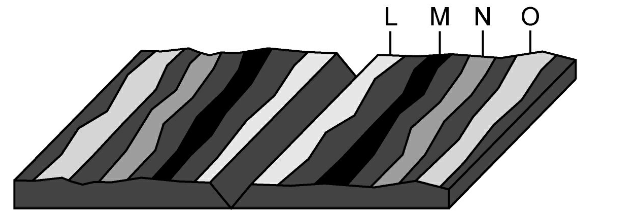
Where does seafloor spreading take place?
Convergent boundaries
The continentals shelves
Transform boundary
Mid-ocean ridges

The OLDEST seafloor is located?
Closest to the mid-ocean ridge
Farthest from the mid-ocean ridge

True or False : Sea-floor Spreading adds new material to the ocean floor?
True
False

What happens when Subduction occurs?
Parts of the crust fall into the mantle
Parts of the crust fall into the core
Parts of the crust fall into space
None of these

What did scientists use to map the oceans floor?
Echo-location
Sonar
Space Shuttles
Animals

What process takes place at the trenches?
divergent boundaries
subduction
new crust is formed
mountain ranges

The oceanic crust is pushed aside on both sides of the
Continent's edge
Deep-ocean trench
Mid-ocean ridge

What is one piece of evidence of seafloor spreading?
age of the rocks
old rock pushes new rock to the side
scientist can use sonar
subduction

At the Mid-Ocean Ridge and active volcanoes you can find:
fault lines
earthquakes
older crust
newest crust
What are three pieces of evidence that support sea floor spreading?
Evidence from molten material that creates mid ocean ridge
Rocks are younger near ridge and older further from ridge
Magnetic polar reversals every 250,00 years
deep oceanic trenches are helping create the mantle
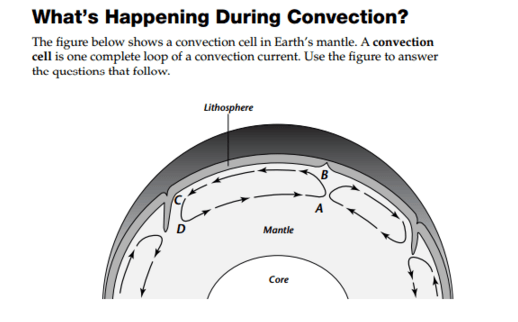
The crust and upper mantle make up Earth's ____.
asthenosphere
lithosphere
core
continents
Seafloor spreading occurs because ____.
new material is being added to the asthenosphere
earthquakes break apart the ocean floor
sediments accumulate at the area of spreading
molten material beneath Earth's crust rises to the surface
This scientist was the first to propose seafloor spreading
William Watts
Harry Hess
Alfred Wegener
Tenzing Norgay
Where does subduction occur?
along the middle of some ocean floors
down the middle of mountain ranges
on continents
at deep ocean trenches
Place the labels onto the image
convection currents that move plates
crust is created
crust is destroyed
This "plastic" layer is responsible for convection currents.
lithosphere
inner core
crust
asthenosphere

What particular event is shown on the picture?
mid-ocean ridge
subduction zone
transform boundary
divergent boundary

