Worksheets
Semester 1 Final Review- Chemistry, Physics and Thermal Energy
Total questions: 81
Worksheet time: 1hrs 11mins

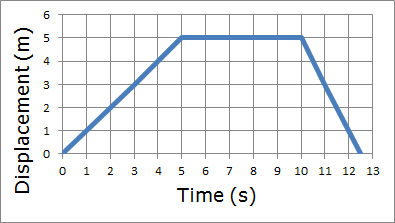
Segment O-A The bus is _________________.
at rest
returning (to original position)
moving forward
Segment A-B The bus is _________________.
at rest
returning (to original position)
moving forward
Segment B-C The bus is _________________.
at rest
returning (to original position)
moving forward
Segment C-D The bus is _________________.
at rest
returning (to original position)
moving forward
Segment D-E The bus is _________________.
at rest
returning (to original position)
moving forward
Segment E-F The bus is _________________.
at rest
returning (to original position)
moving forward

Calculate Albert's average speed for the 100-meter race.
8.33 m/s
5 m/s
7.14 m/s
5.88 m/s



Newton's 1st Law is also called the Law of ...
Friction
Inertia
Unbalanced forces
Newtons
Because of inertia, a moving object will keep ________ unless acted on by an unbalanced force.
at rest
moving
in one spot
inertia


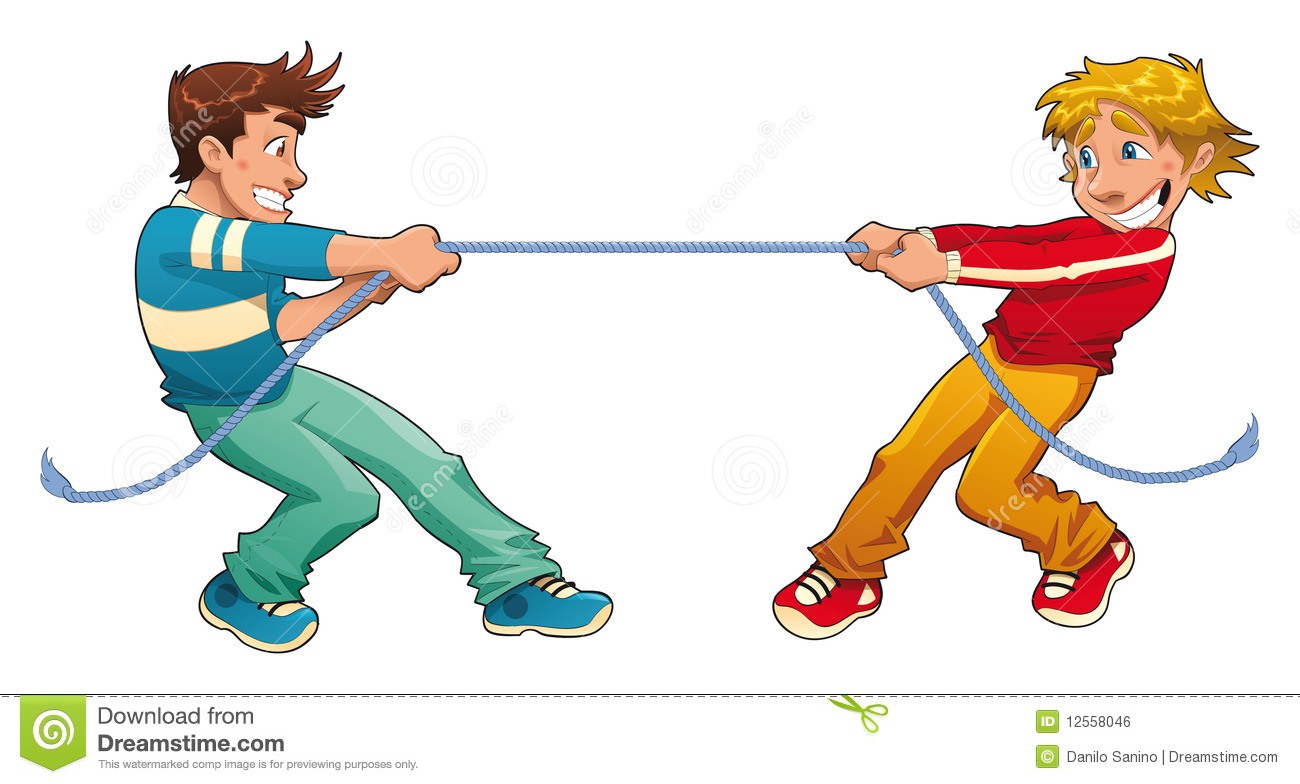
What is the net force acting on this box?
16N to the right
4N to the left
0N
8N to the left
Based on the chemical formula, which statement best describes NI₃?
Based on the chemical formula, there are 3 atoms in one molecule of NI₃.
Based on the chemical formula, there are 6 atoms in one molecule of NI₃.
Based on the chemical formula, NI₃ is composed of atoms of the same elements.
Based on the chemical formula, NI₃ is composed of atoms of different elements.
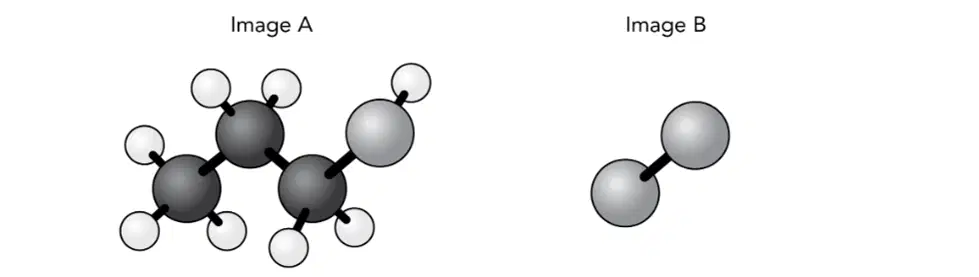
Look at the two images of molecules. Which of the following statements best compares the two images?
Images A and B are both compounds because they have more than one atom.
Image A is a compound because it has different types of atoms, and image B is an element because it has one type of atom.
Image A is an element because it has one type of atom, and image B is a compound because it has different types of atoms.
Images A and B are both elements because they have more than one atom.
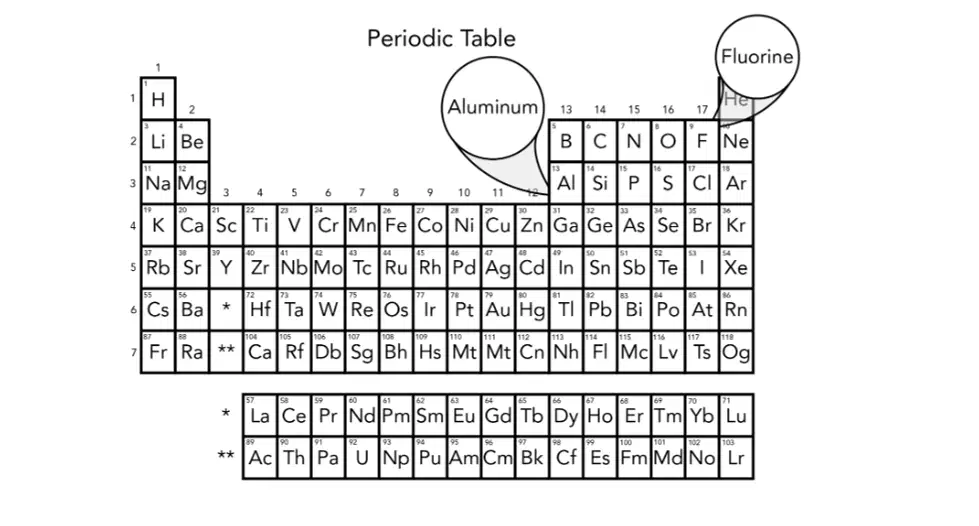
Aluminum fluoride is a compound commonly used in ceramics. The chemical formula for aluminum fluoride is AlF₃. The Periodic Table shows the elements used in the compound.
Aluminum fluoride contains 3 atoms of aluminum and 3 atoms of fluorine.
Aluminum fluoride contains 1 atom of aluminum and 1 atom of fluorine.
Aluminum fluoride contains 1 atom of aluminum and 3 atoms of fluorine.
Aluminum fluoride contains 3 atoms of aluminum and 1 atom of fluorine.
Amanda wants to make a cake. She measures sugar, eggs, oil, flour, and flavorings. She mixes the ingredients together with a whisk. She pours the ingredients into a pan and bakes them. When the cake is baked, she frosts the cake.
Which part of making a cake is a chemical change?
Mixing ingredients with a whisk, because the mixed ingredients form a thick liquid.
Adding eggs because the eggs change shape when they are cracked.
Baking the mixed ingredients because the ingredients change into a different substance.
Putting frosting on the baked cake because frosting changes how the cake looks.
Which of these molecules represent compounds? Select all that apply.
H₂O
H₂
CO
CO₂
S₈
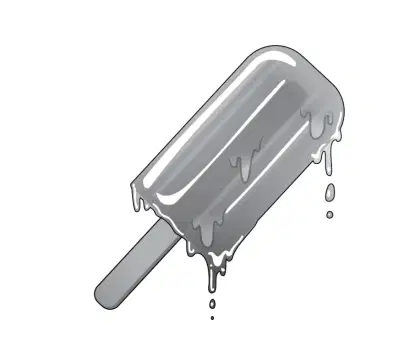
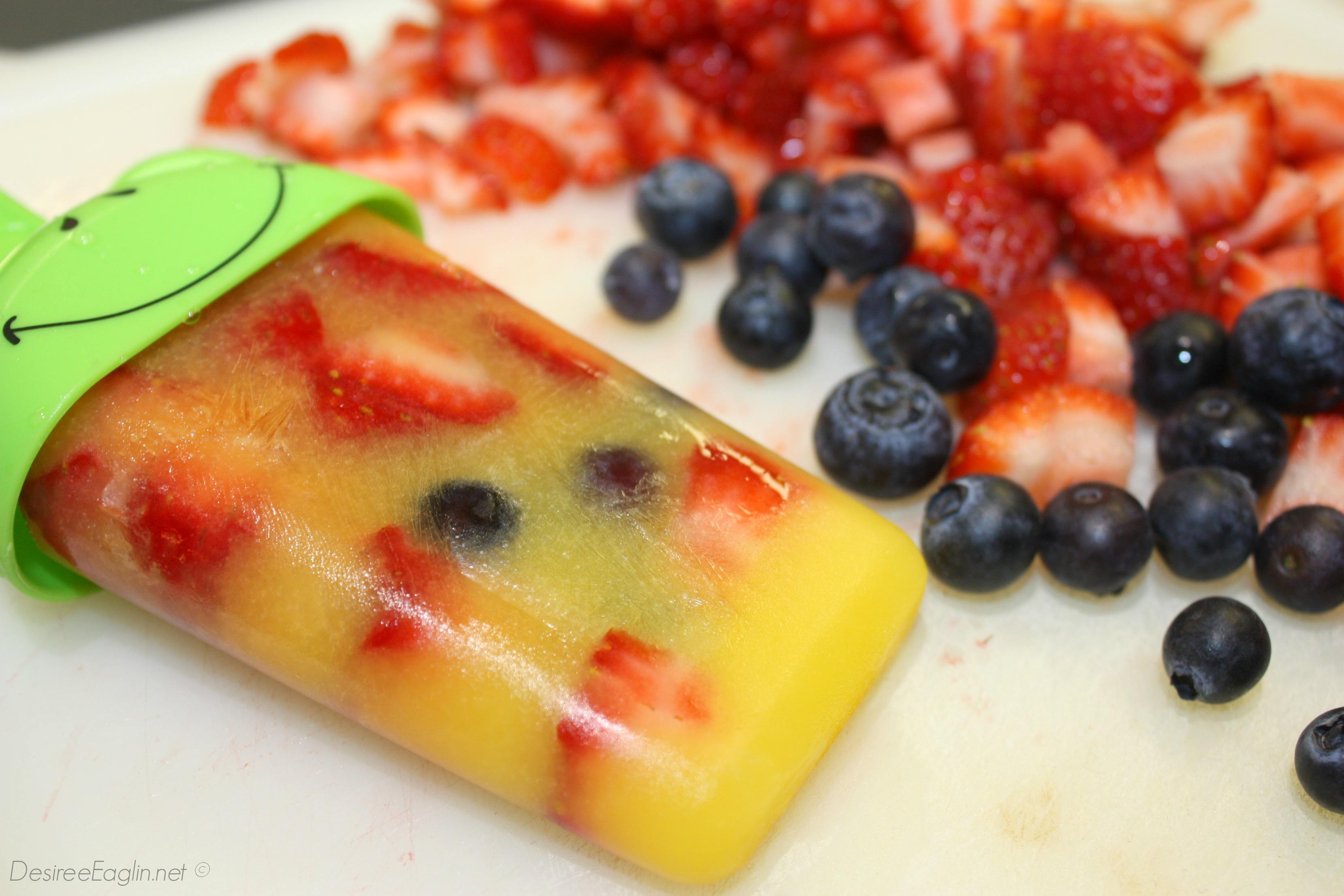
Look at the image of a melting popsicle.
Which of the following best explains what happens when a popsicle melts?
It is a physical change because a new substance was made. .
It is a physical change because it can be easily reversed.
It is a chemical change because the properties of the popsicle changed.
It was a chemical change because it cannot be easily reversed
What is the difference between a chemical change and a physical change?
A substance stays the same In a chemical change, but a new substance is formed in a physical change.
After a physical change, a substance cannot change back, but it is easy to reverse a chemical change.
A physical change includes changing state from solid to liquid, but changing from liquid to gas is a chemical change.
A new substance is formed in a chemical change, but the substance stays the same in a physical change.
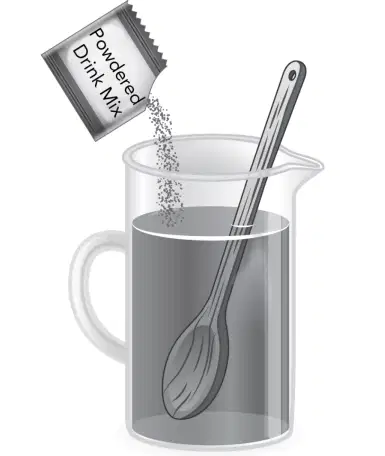
Look at the image showing how to make fruit punch.
When you make a pitcher of fruit punch from a powdered packet of drink mix, the water changes color.
Is this a physical or chemical change?
Physical Change
Chemical Change
Read each of the statements describing a change.
1. Using a magnet to remove iron shavings from a mixture of sand and iron
2. Melting sugar
3. Lighting fireworks and then seeing the colors and hearing the sound pops as they go off
4. Cutting a piece of paper into smaller pieces
5. Burning firewood in a campfire
Which of these examples describe physical changes?
1 and 4
2, 4, and 5
1, 2, and 4
1, 3, 4, and 5
Which statement best describes an element?
pure, made of more than one type of atom
when combined, a chemical reaction forms
pure, made of only one type of atom
can be broken down easily
When two or more different elements chemically combine, a __________________________ is formed.
element
compound
mixture
solution
Helium (He) is an example of an:
Element
Compound
Solution
Mixture
Two or more different elements chemically combine to form compounds.
Agree
Disagree

Is melting butter for popcorn a chemical or physical change?
chemical
physical

When you break a cracker into pieces it is a...
Chemical change
Physical change

solute + solvent =
solution
equation

solvent
solution
solute

solvent
solute
Solutes dissolve quicker in _________ water.
cold
warm
Solutes dissolve quicker if you stir them.
true
false
A solution with high amount of solute
concentrated
saturated
unsaturated
diluted
Weak tea is an example of a _______.
suspension
solvent
concentrated solution
dilute solution
What is a solvent?
the substance that is being dissolved in a solution
the mixing of different substances
the substance that does the dissolving in a solution
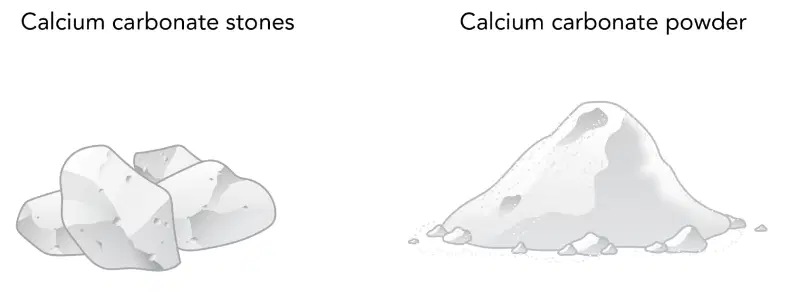
The image shows two different samples of the same compound, calcium carbonate.
There are two beakers full of water. One sample is added to each beaker. Which of the following options correctly compares the rate of dissolution of the samples?
The calcium carbonate stones will dissolve slowly since they have a lower surface area than the calcium carbonate powder.
The calcium carbonate stones and calcium carbonate powder will dissolve at the same rate since they have the same surface area.
The calcium carbonate stones will dissolve quickly since they have a greater surface area than the calcium carbonate powder.

Which solution is most concentrated?
A
B
C
D
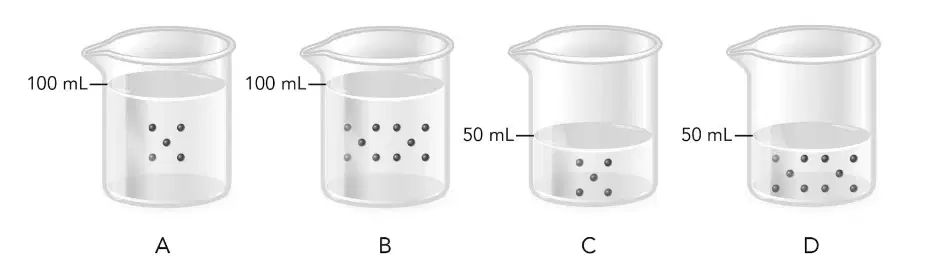
Which solution is most diluted?
A
B
C
D
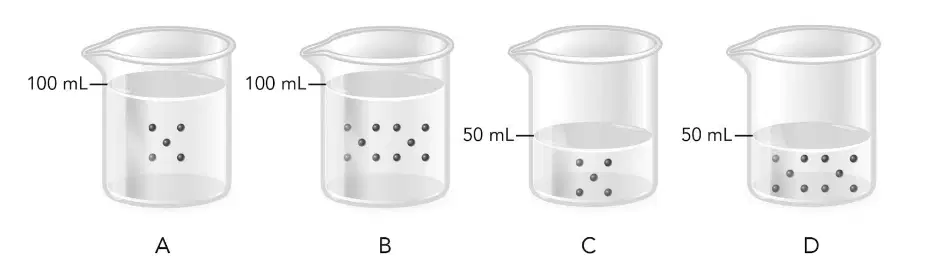
Which two solutions have the same concentration?
A
B
C
D
To increase the _________ of a solution, a person would dissolve more _________ into the _________.
Which words best complete the sentence?
dilution; solvent; solute
dilution; solute; solvent
concentration; solute; solvent
concentration; solvent; solute
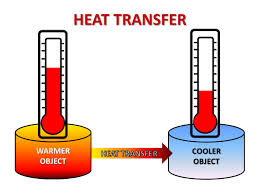
When things get hotter, its molecules are moving faster and have more (a) .
When a thing gets colder, its molecules are moving slower and have (a) kinetic energy.

Abby sets up an investigation using cold water and hot water. He puts three drops of red food dye in each tumbler and waits ten seconds. His results are shown below.
How can he describe the relationship between the temperature of the water and the energy of the water molecules in the system?
The lower the temperature of the water, the greater the amount of energy in the system and the faster the water molecules move.
The higher the temperature of the water, the greater amount of energy in the system and the faster the water molecules move.
The higher the temperature of the water, the lower amount of energy in the system and the slower the water molecules move.
The temperature of the water has no effect on the speed of the molecules, so the amount of energy in the system does not change.
Cold things often have a _________ kinetic energy because_______
lower; particles are moving around less
lower; particles are moving around more
higher; particles are moving around the same
higher; particles do not move

What type of thermal energy transfer is occurring at point A?
Radiation
Convection
Conduction
None of the above

What type of thermal energy transfer is occurring at point B?
Convection
Conduction
Radiation
Kinetic
What type of thermal energy transfer is occurring at point C?
Convection
Conduction
Radiation
Kinetic
Kinetic Energy is the energy of _________
thermal
movement
potential
atoms