
 Worksheets
Anatomy and Physiology Questions
Total questions: 42
Worksheet time: 30mins
What is Anatomy ?
Study of the function of the body
Study of the structure of the body
Study of medical terms for the body
Study of the fossil record
What is Physiology ?
Study of the function of the body
Study of the structure of the body
Study of medical terms for the body
Study of the fossil record
What is the purpose of the anatomical position in the medical field?
To provide a standardized reference point for describing the location of body parts
To prescribe treatments for patients
To serve as a guideline for surgical procedures
To standardize the naming of medical instruments
What does the term "medial" refer to in anatomical direction?
Away from the middle
Towards the side
Towards the middle
Away from the side
What term refers to the back of the human body?
Inferior
Posterior (dorsal)
Distal
Proximal
Which term is used to describe the front of the human body?
Lateral
Medial
Anterior (ventral)
Superior
What does the term "lateral" refer to in anatomical direction?
Towards the middle
Towards the side
Above
Below
What does the term "proximal" refer to in anatomical positioning?
The point that is farthest away from the point of attachment or origin
The nearest point of attachment to a limb or structure
The point that is on the opposite side of the body
The point that is on the surface of the body
What does the term "distal" mean in the context of anatomy?
The point that is closest to the center of the body
The point that is on the surface of the body
The farthest point away from the point of attachment or origin
The point that is on the opposite side of the body
What does the term "superior" refer to in anatomical position?
Below; Away from the head
Above; Toward the head
Toward the front of the body
Toward the back of the body
What does the term "inferior" refer to in anatomical position?
Above; Toward the head
Below; Away from the head
Toward the front of the body
Toward the back of the body
Which example is correct for the use of the term "superior" in anatomy?
Superior = Floor
Superior = Skull
Superior = Hand
Superior = Foot
What does the term "superficial" refer to in anatomical terminology?
Structures closer to the center of the body
Structures closer to the surface of the body
Structures that are internal and not visible
Structures that are more complex in function
What does the term "deep" refer to in anatomical terminology?
Structures that are more complex in function
Structures that are internal and not visible
Structures closer to the surface of the body
Structures away from the surface of the body
What type of muscle tissue is found within vessels and the walls of hollow organs such as the stomach?
cardiac
smooth
skeletal
What type of muscle tissue is attached to bones and produces whole body movements?
cardiac
smooth
skeletal
What type of muscle tissue is striated and is multinucleated?
cardiac
smooth
skeletal
What type of muscle tissue is voluntarily controlled?
cardiac
smooth
skeletal
What type of muscle cells would be located in the small intestine?
Cardiac
Smooth
Skeletal
What types of muscle tissue makes up the heart?
Cardiac
Smooth
Skeletal
What structure connects muscle to bone?
Ligament
Tendon
Fascia

What is the name off label 4?
Sacrolemma
Mitochondrion
Sarcoplasm
Myofibril

What is the name off label 3?
Sacrolemma
Mitochondrion
Myofibril
Sacroplasm

What is the name off label 2?
Sacrolemma
Nucleus
Mitochondrion
Sacroplasm

Fluid part of a muscle cell (fiber)
sarcolemma
sarcoplasma
sarcoplasmic reticulum
sarcomere
actin

The bundle of muscle fibers in Area #5 is called the -
epimysium
fascicle
endomysium
muscle fiber

What is the specialized name for the endoplasmic reticulum in muscle cells?
Smooth reticulum
Sarcoplasmic reticulum
Mitochondrial reticulum
Cardiac reticulum
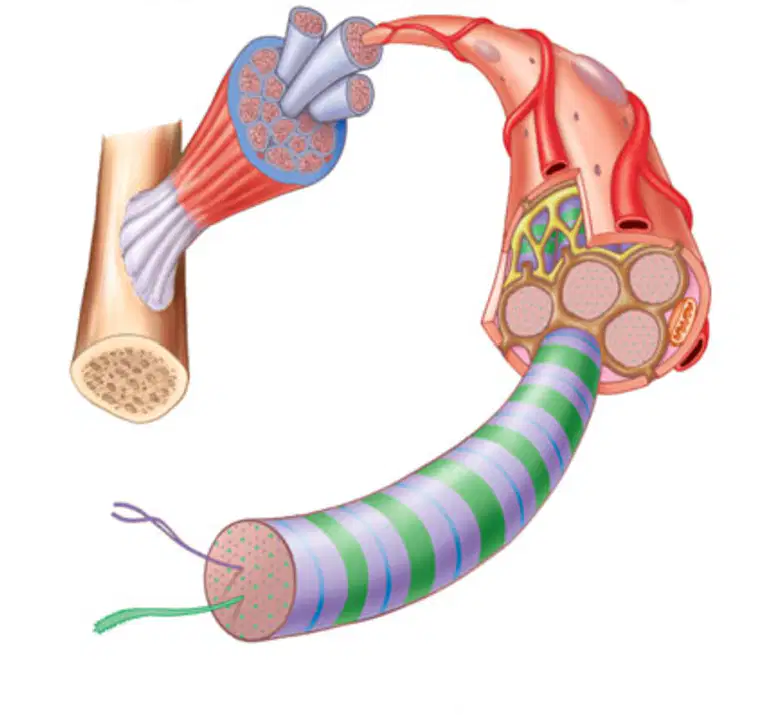

number 7
tendon
myofibril
bonne
blood vessel

Which structure is E?
Muscle fiber
Fascicle
Epimysium
Perimysium
Which structure is D? (connective tissue surrounding bundle)
Muscle fiber
Fascicle
Epimysium
Perimysium
Which structure is B? (outside layer)
Muscle
Epimysium
Muscle fiber
Myofibril

What type of plane is number 2?
Transverse
Coronal
Sagittal

What plane separates the body into a front and back section?
Frontal/Coronal
Sagittal
Transverse

Name the plane that divides the body into a top and bottom section:
(a)
the elbow is _____ to the fingers
distal
superficial
deep
proximal
the nose is ____ to the forehead
posterior
anterior
inferior
distal
the knee is ____ to the thigh
proximal
distal
lateral
ventral
the navel is ______ to the breastbone
medial
posterior
lateral
inferior
the heart is ____ to the arm
lateral
inferior
superior
medial
The bones are _____ to the skin
superficial
anterior
lateral
deep

