
 Worksheets
6th Gr. 1st Semester Test 2024-2025
Total questions: 50
Worksheet time: 25mins
Name
Class
Date
1.
The temperature at which liquid becomes a gas is the _________________ point.
a)
boiling
b)
condensation
c)
freezing
d)
melting
2.
The state of matter of a material depends on its ________________.
a)
density
b)
temperature
c)
volume
d)
weight
3.
A change in the state of matter is caused if enough _____________ is added to or removed from an object.
a)
force
b)
kinetic energy
c)
potential energy
d)
thermal energy
4.
During a hot shower, water vapor fogs up the cooler mirror when the vapor turns to water. This is an example of __________________________.
a)
condensation
b)
deposition
c)
sublimation
d)
vaporization
5.
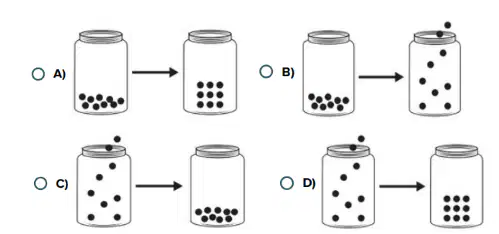
Which model best represents a change that results from adding thermal energy to a substance in a jar?
a)
A
b)
B
c)
C
d)
D
6.
The change in state from a gas to a liquid is called _______________________.
a)
condensation
b)
evaporation
c)
sublimation
d)
vaporization
7.
Charles's law states that if __________________ increases then ______________________ also increases.
a)
kinetic, potential
b)
condensation, vaporization
c)
temperature, volume
d)
liquid, solid
8.
Hurricanes transfer thermal energy by means of _____________________________________ .
a)
conduction and convection
b)
convection and heat of condensation
c)
heat of condensation and radiation
d)
radiation and conduction
9.
The state of matter in which water molecules move the fastest is ______________________ .
a)
gas
b)
ice
c)
liquid
d)
solid
10.
What are three ways heat can move between objects?
a)
absorption, microwaves, condensation
b)
energy, wavelengths, evaporation
c)
insulators, conductors, condensers
d)
radiation, conduction, convection
11.
The flow of thermal energy is known as _______________________________ .
a)
heat
b)
kinetic energy
c)
temperature
d)
wavelength
12.
Moving about or flowing is known as ________________________________ .
a)
circulating
b)
conduction
c)
phase change
d)
vacuum
13.
What is a type of radiation that is absorbed by water?
a)
conduction
b)
convection
c)
microwave
d)
radar
14.
The absence of air is known as a(n) _______________________________ >
a)
insulator
b)
microwave
c)
satellite
d)
vacuum
15.
For heat transfer to occur by _______________________ , objects must be in physical contact.
a)
condensers
b)
conduction
c)
convection
d)
radiation
16.
Something that slows the flow of heat is known as ___________________________________ .
a)
a conductor
b)
an insulator
c)
a microwave
d)
a satellite
17.
A hamburger is cooked by _____________________ where it touches the hot metal grill.
a)
conduction
b)
convection
c)
radiation
18.
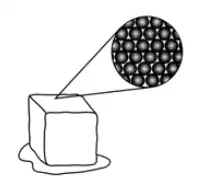
What two states of matter are pictured in the image below?
a)
solid and liquid
b)
gas and solid
c)
liquid and gas
d)
volume and solid
19.
Attractive force between particles decrease as the particles move faster and farther apart.
a)
True
b)
False
20.
The sum of the kinetic energy and potential energy of an object is its _________________ energy.
a)
force
b)
kinetic
c)
potential
d)
thermal
21.
Temperature is a measure of the average ___________ energy of a substance.
a)
kinetic
b)
potential
22.
Particle motion in water is faster than particle motion in ice.
a)
True
b)
False
23.
The molecules in water are farther apart than the molecules in ice. Therefore, the molecules in water have _______________________ than the molecules in ice.
a)
less potential energy
b)
more potential energy
24.
The atomic symbol C represents the chemical element ___________________.
a)
calcium
b)
carbon
c)
copper
25.
On the periodic table, _____________ are horizontal rows of elements.
a)
groups
b)
periods
26.
A compound is formed when two elements combine _____________________.
a)
chemically
b)
physically
27.
In which state of matter there are very weak attractions between particles?
a)
clay
b)
gas
c)
liquid
d)
solid
28.

Ethanol has six hydrogen atoms, two carbon atoms, and one oxygen atom. Which is the correct chemical formula of the model below?
a)
C2H6O
b)
2CH6O
c)
6HCO
d)
C26HO
29.
Protons and neutrons are located in an atom's _____________________ .
a)
isotope
b)
nucleus
c)
orbitals
30.
Electrons are found in the _______________ of an atom.
a)
isotope
b)
nucleus
c)
orbitals
31.
An atom always has exactly the same number of _________________ as protons.
a)
electrons
b)
isotopes
c)
neutrons
32.
Which conditions have to be present for an atom of an element to be considered an isotope?
a)
The number of protons, neutrons, and electrons must be the same.
b)
The number of protons, neutrons, and electrons must all be different.
c)
The number of neutrons must be exactly equal to the number of electrons.
d)
The number of neutrons must be greater than the number of protons.
33.
A process that transforms one set of chemical substances into another is called a(n) ___________________________________.
a)
chemical reaction
b)
compound
c)
ion
34.
What type of bond holds the atoms in a water molecule together?
a)
covalent bond
b)
ionic bond
35.
Identify the organic substances.
a)
H2O
b)
C12H22O11
c)
NaCl
d)
C18H34O2
36.
Sugar is to carbohydrate as __________________________ .
a)
oil is to protein
b)
protein is to carbon
c)
DNA is to nucleic acid
d)
nucleic acid is to energy
37.
_________________ include fats and oils.
a)
Carbohydrates
b)
Lipids
c)
Proteins
d)
Nucleic acids
38.
_________________ include sugars and starches.
a)
Carbohydrates
b)
Lipids
c)
Proteins
d)
Nucleic acids
39.
_________________ function as the main structural material of cells, provide chemical signaling between cells, and help fight infection.
a)
Carbohydrates
b)
Lipids
c)
Proteins
d)
Nucleic acids
40.
This term means relating to or derived from living organisms.
a)
decomposition
b)
inorganic
c)
minerals
d)
organic
41.
A(n) ________________________ is a substance made up of atoms of two or more elements that are chemically combined in specific amounts.
a)
compound
b)
ion
c)
ionic bond
d)
molecule
42.
The number of protons in an atom of an element is known as the ____________________________________ .
a)
atomic number
b)
atomic weight
c)
chemical symbol
d)
group
43.
The energy of motion is called ___________________ energy.
a)
kinetic
b)
potential
44.
Bars of different metals are all heated to 100℃ to determine how their volume and length would be affected. Which statement describes the most likely outcome of this experiment?
a)
All of the volumes change and so do their lengths.
b)
All of the volumes change, but the lengths remain the same.
c)
The volumes and lengths do not change.
d)
All of the volumes change the same amount and the lengths remain constant.
45.
A liquid thermometer works because liquid _______________ when warmed.
a)
condenses
b)
contracts
c)
expands
d)
solidifies
46.
When a substance is heated, the particles gain energy and move apart, increasing the volume. The mass of the substance being heated _______________________ .
a)
decreases
b)
increases
c)
stays the same
d)
varies unpredictably
47.
Most highway bridges are built with expansion joints that can move back and forth. What is the reason for this?
a)
The expansion joint allows the highway to change temperature so that the bridge is not damaged.
b)
The expansion joint allows the highway to become "not as rigid" so that the bridge is not damaged.
c)
The expansion joint allows the highway to expand or contract with temperature changes so that the bridge is not damaged.
d)
The expansion joint will not allow the highway to change temperature so that the bridge is not damaged.
48.
In the following scenario, identify the dependent variable: To test the effects of temperature on diffusion, you could time how long it takes for a drop of food dye to completely mix with water at different temperatures without stirring.
a)
size of the beaker holding the water, volume of water used, and amount of food dye used
b)
temperature of the water
c)
time it takes for diffusion to occur
49.
In the following scenario, identify the independent variable: To test the effects of temperature on diffusion, you could time how long it takes for a drop of food dye to completely mix with water at different temperatures without stirring.
a)
size of the beaker holding the water, volume of water used, and amount of food dye used
b)
temperature of the water
c)
time it takes for diffusion to occur
50.
The increase in volume of a material when particle motion increases is known as _______________________________________________.
a)
thermal expansion
b)
diffusion
c)
kinetic energy
d)
random motion
e)
temperature
100 %

