
 Worksheets
Human Impact
Total questions: 40
Worksheet time: 1hrs 18mins
How does deforestation contribute to climate change?
Deforestation increases the Earth's capacity to absorb carbon dioxide, leading to decreased levels of carbon dioxide in the atmosphere and reducing climate change.
Deforestation has no impact on climate change.
Deforestation leads to an increase in rainfall, which helps mitigate climate change.
Deforestation reduces the Earth's capacity to absorb carbon dioxide, leading to increased levels of carbon dioxide in the atmosphere and contributing to climate change.
What is climate change?
Climate change is the long-term alteration of temperature and typical weather patterns in a place.
Climate change is always caused by human activities such as burning fossil fuels.
Climate change is a short-term fluctuation in temperature and weather patterns.
Climate change only affects certain regions of the world.
What are the main sources of pollution?
Deforestation, volcanic eruptions, and natural disasters.
Household waste, deforestation, and construction activities.
Air conditioning, deforestation, and mining activities.
Industrial activities, vehicle emissions, burning of fossil fuels, agricultural practices, and waste disposal.
How does pollution affect human health?
Pollution has no impact on human health.
Pollution only affects the environment, not human health.
Pollution affects human health by causing respiratory problems, cardiovascular diseases, and other illnesses.
Pollution only affects the health of animals, not humans.
What is biodiversity?
Different species of animals and plants.
The number of individuals in a population.
The study of ecosystems and their interactions.
Variety of life forms
Why is loss of biodiversity a concern?
Loss of biodiversity disrupts ecosystems and threatens their stability.
Loss of biodiversity only affects certain regions.
Loss of biodiversity has no impact on ecosystems.
Loss of biodiversity leads to the extinction of species.
What are the causes of deforestation?
Climate change, urbanization, overpopulation, and natural disasters.
Agricultural expansion, logging, infrastructure development, mining, and wildfires.
Hunting, fishing, tourism, and waste disposal.
Industrialization, pollution, overgrazing, and road construction.
How can individuals reduce their impact on the environment?
By practicing sustainable habits and supporting eco-friendly practices.
By wasting water and energy
By driving gas-guzzling vehicles
By using single-use plastic products
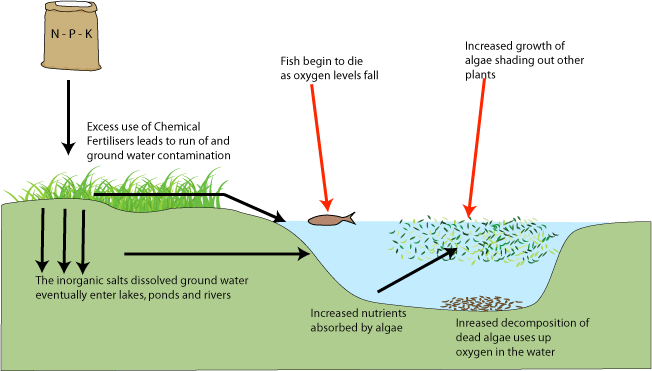
An increase in the amount of nutrients in a lake is known as
calcification
cellular respiration
eutrophication
photosynthesis
Invasive species alter the ecosystem by ___________ in number quickly,this leads to _____ food for the native species.
increasing; less
decline; decreasing
What is an invasive species?
An organism that is new to an environment that has positive effects on the environment.
An organism that is native to an environment that has negative effects on the environment.
An organism that is new to an environment that has negative effects on the environment.
An organism that is native to an environment that has positive effects on the environment.

What is Pollution?
an unhealthy diet
global warming
lands, people and plants
harmful substance introduced to the environment
What is "overfishing"?
Fishing out of season
Catching fish faster than they can replenish
Catching fish from the top of the food chain
Catching more fish than what people eat
What is ecological succession?
The process by which an ecosystem changes over time
The process by which an ecosystem changes rapidly over time
The process by which an ecosystem is destroyed over time
The process by which an ecosystem remains unchanged over time
Which of the following is an example of a biotic factor?
Sunlight
Rocks
Water
Plants
What is the impact of human activities on ecosystems?
Human activities have no impact on ecosystems.
Human activities can lead to habitat destruction, pollution, climate change, and the loss of biodiversity.
Human activities only have a positive impact on ecosystems.
Human activities can lead to the growth and development of ecosystems.
Which of the following is a renewable energy source?
Hydroelectric
Natural gas
Oil
Nuclear power
Some companies have been in trouble for dumping trash in rivers. Which of the following is a direct result of dumping trash into rivers?
air pollution
water pollution
plate tectonic slide
space pollution
Which of these is a disadvantage (bad thing) of fossil fuels?
They are free, we just dig them up
They are a limited supply
They do not take a long time to replenish
They are good for the environment
Which of the following threats to biodiversity is the greatest concern?
invasive species
habitat destruction
overharvesting
pollution

How does biomagnification put a top predator at a disadvantage?
Food is much harder to find the farther up the food chain you go.
Toxins and chemicals accumulate in the bodies of everything that was eaten by the food that you eat.
Toxins and chemicals bind to the tissue of larger animals better than smaller ones.
The loss of energy up the food chain is directly proportional to the amount of toxins taken up by the body.


Which organism in the food web shown would
contain the lowest concentration of chemical pollutants?
producers
primary consumers
secondary consumers
tertiary consumers
Predator at the top of food chain without any natural predators
Carnivore
Herbivore
Apex Predator
Prey

Which of the following correctly shows an energy pyramid?
A
B
C
D
The phenomenon by which toxins concentrate in the organisms at higher trophic levels within an ecosystem is known as...
Biotoxicity
Biomagnification
Eutrophication
Predation


How many trophic levels are represented in the picture of the food web above?
1
2
3
4


