
NEW
Font size
 Worksheets
unit 2 7th grade
Total questions: 58
Worksheet time: 45mins
The cell is considered the basic unit of life. The Cell Theory was developed over time using contributions of several scientists working in different fields. Which of the following is NOT part of the Cell Theory?
All cells contain a nucleus.
The cell is the basic unit of life.
All organisms are composed of cells.
All cells come from preexisting cells.
The cell theory took hundreds of years to develop. The scientists over the years added their discoveries to the theory when they were able to scientifically prove their ideas. What aided in the development of the discoveries over the years?
The organisms were able to grow larger after several decades, which allowed the scientists to see them clearer.
The continued development of the microscope helped the scientists to see smaller organisms and their cellular structures.
The scientists were able to think for themselves as time went on.
The development of eyeglasses that were used helped scientists to look deeper into cell structures.
All living things are composed of cells.
True
False
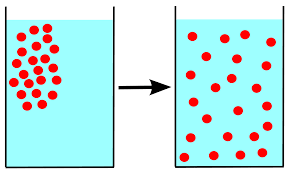
What is DIFFUSION?


What happened to the CELL WALL and the CELL MEMBRANE in these plant cells?
Both the CELL WALL and CELL MEMBRANE shrunk
Only the CELL WALL shrunk, the CELL MEMBRANE stayed the same
The CELL WALL stayed the same, only the CELL MEMBRANE shrunk
Both the CELL WALL and CELL MEMBRANE stayed the same
Diffusion & Facilitated Diffusion are both __________ transport.
Passive
Active
Easy
Free
The general name for movement of substances across cell membranes WITHOUT the need of energy input
passive transport
active transport
What is the movement of particles with the concentration gradient using protein "helpers"?
diffusion
facilitated diffusion
active transport
enzymatic reactions


The arrow is showing the fluid inside the cell that surrounds the cell organelles. What is the arrow pointing to in the cell?
cytoplasm
mitochondria
ribosomes
nucleus
Cellular respiration is...
the process by which cells obtain energy from glucose
process by which organisms absorb energy from the sun
the process by which cells divide
the process by which cells process carbon dioxide
What is the purpose of cellular respiration?
to get rid of carbon dioxide
to take in oxygen
to take in sugar
to break down food to create energy
Which of these is the correct formula for cellular respiration?
oxygen + carbon = energy + glucose
glucose + carbon dioxide = water + oxygen
glucose + oxygen = carbon dioxide + water + energy
carbon dioxide + water + energy = glucose + oxygen
Cellular respiration takes place in the ...
mitochondria
chloroplast
chlorophyll
lungs
How is cellular respiration different from photosynthesis?
Photosynthesis produces ATP, cellular respiration produces sugars
photosynthesis requires oxygen, cellular respiration requires oxygen
photosynthesis produces oxygen, cellular respiration produces carbon dioxide
photosynthesis requires energy from food, cellular respiration requires energy from the sun
Autotrophs capture the sun's energy using...
cellular respiration
mitochondria
chlorophyll
glucose
Both autotrophs & heterotrophs break down glucose to release _____ energy.
CSI
ATP
HCl
H2O
The products of photosynthesis serve as the reactants in cellular respiration to provide chemical energy.
True
False
The products of photosynthesis combine with the reactants in cellular respiration to remove (ATP) chemical energy from cells.
True
False
The products of photosynthesis inhibit the reactants in cellular respiration in the presence of light.
True
False
What is the one main difference between fermentation & cellular respiration?
Fermentation does not occur in animals, while cellular respiration does
fermentation does not require oxygen, cellular respiration does
fermentation does not release energy, cellular respiration does
fermentation does not depend on the sun, cellular respiration does
Photosynthesis releases energy, while respiration stores energy.
True
False
Both photosynthesis & respiration require sunlight.
True
False
Photosynthesis, the process that plants undergo to make glucose, takes place in the...
mitochondria
cell wall
chloroplast
stomata
Cells of organism must replicate for ?
growth
repair of damaged tissue
replacement of dying cells.
All of the above
What does DNA Replication mean?
DNA is made.
DNA makes new cells.
DNA copies itself.
DNA starts the cell cycle.
In what phase do the chromosomes line up in the middle of the cell?
Cytokinesis
Metaphase
Prophase
Telophase
In what phase do the chromosomes get pulled apart into sister chromatid to opposite sides of the cell?
Prophase
Interphase
Metaphase
Anaphase
What part of the cell cycle results in the splitting into two new cells?
Interphase
Mitosis
Metaphase
Cytokinesis
Which part of the Cell Cycle takes the longest?
Interphase
Mitosis
Prophase
Cytokinesis
Which of these lists presents the stages of the cell cycle in the correct order?
interphase, mitosis, cytokinesis
cytokinesis, mitosis, interphase
mitosis, interphase, cytokinesis
interphase, cytokinesis, mitosis


Which part of the cell cycle is divided into prophase, metaphase, anaphase, and telophase?
interphase
mitosis
cytokinesis
Simon looks at an image of a slide and notices that all of the chromosomes are lined up in along the middle of the cell. He is likely looking at a cell that is in
prophase
metaphase
anaphase
telophase
Ramone wants to know: does the distance a person kicks a soccer ball effect how well they will do on their math test. What is the dependent variable?
How far they kick the soccer ball
How well they do on the math test
What happens in metaphase? (choose 1)
DNA splits apart
Cell divides
DNA lines up in middle
New nuclei form
What happens in anaphase? (choose 1)
DNA replicates
Chromatids pull apart to opposite sides
DNA lines up in middle
Cell divides
The end result of mitosis is
4 Identical Cells are produced
4 genetically different cells are produced
2 identical cells are produced
2 genetically different cells are produced
What is the correct order for the phases of mitosis?
Prophase, Anaphase, Telophase, Metaphase
Anaphase, Telophase, Prophase, Metaphase
Telophase, Anaphase, Prophase, Metaphase
Prophase,
Metaphase, Anaphase, Telophase
Timmy fell off his skateboard and scraped his knee. Which cell process is going to be used to heal the wound?
Mitosis
Meiosis
The wound would not heal
Cell diffusion
Which phase does the cell grow and develop?
Prophase
Interphase
Cytokinesis
Metaphase

